The Most Profitable Automotive Services: What Ranks Best
The most profitable automotive services are usually diagnostics, scheduled maintenance, brake work, alignments, AC repair, and battery/electrical jobs, but the best rank depends on labor hours per bay, parts margin, and technician skill. Rank them wrong and you buy slow lifts, low-margin parts, and paid hours your team cannot bill. This guide ranks major service lines by profit mechanics and shows which ones pay only with the right equipment, cycle time, and staffing.
What makes an automotive service profitable?


Profit in a shop comes from gross profit, labor efficiency, overhead control, comeback risk, and bay utilization. A service that looks busy can still lose money if it ties up a lift too long, creates rework, or needs costly tooling that sits idle.
Labor-driven revenue versus parts-driven revenue
Labor usually carries the best margin because it is skill-based and time-based. Parts can contribute healthy gross profit too, but a healthy shop targets around 50% margin on parts overall, while labor typically runs around 65% profit margin in a well-run shop. That is why diagnostics, programming, and inspection-heavy work often beat commodity parts sales on gross profit.
How overhead, comeback risk, and bay time change margin
Overhead includes rent, utilities, insurance, software, training, and technician payroll that cannot be avoided. A job with high comeback risk can erase its own margin through no-charge rechecks and parts return loss. Bay time matters as much as price: a low-ticket service that turns a lift three times a day can out-earn a high-ticket job that holds a bay for two days.
Why diagnostic dependency matters
Services that depend on scan tools, scopes, subscription data, and layered fault-finding tend to keep more value in labor. That is why diagnostics is described as arguably the highest-margin service a shop can offer, and why Shopmonkey says diagnostics are some of the most profitable auto repair services around. The margin depends on accurate testing and clean authorization, not guesswork.
📊 VehicleDatabases frames the automotive industry as about $2.7 trillion. Source: 20 Highly Profitable Automobile Business Ideas in 2026.
Which automotive services make the most money?
The highest-earning lines usually combine labor content, repeatable process, and strong close rates. After looking at shop performance, six services consistently stand out for margin potential, but the order changes by shop format. A general repair shop, tire store, and fleet operation will not win with the same mix.
Diagnostics
Diagnostics can out-earn many repair lines because they are labor-driven, low-parts, and software dependent. A paid diagnostic fee is often better than pure hourly billing because it frames the job around a defined test plan and decision tree. It works best where service advisors can sell a clear fault-isolation process instead of free code reads.
Electrical repairs
Electrical work can be a strong profit center for experienced techs, especially on modern vehicles with sensor faults, wiring faults, network issues, and parasitic draw complaints. The margin improves when the shop has scan tools, wiring diagrams, breakout leads, and disciplined testing. It gets ugly fast when the first answer is parts swapping.
Engine repair and maintenance
Engine work can produce high ticket totals because jobs like timing belts, head gaskets, and ECM-related work are labor-intensive and often bundled. The parts-to-labor mix can be favorable when the job is deep enough to stack adjacent repairs. The downside is comeback exposure, parts availability, and the need for technician skill that prevents repeat teardown.
Suspension and alignment
Suspension and alignment work can run around 40% margin, and it has strong safety appeal when customers notice wandering, tire wear, clunks, or pull. Alignments, wheel balancing, shocks, ball joints, and coil springs fit well in shops with the right lift setup and alignment rack utilization. Pothole and road damage keep demand steady, but only if the shop can inspect and sell the related work.
Brake repairs
Brake work stays in demand because pads, rotors, fluid, and hardware wear out, and it is one of the easiest safety-triggered services to explain. Rotors, pads, brake fluid service, and noise complaints create a natural upsell path into caliper, hose, and maintenance work. It is profitable when inspections convert well and when the shop avoids price-only competition on pads.
Are diagnostics more profitable than brake repairs?
Diagnostics can be more profitable than brake repairs because the value comes from expertise, not parts. Brake work wins on volume in many shops, but diagnostics often delivers stronger gross profit per billed hour when the team can find the fault quickly and charge for the test process. The weaker the parts-to-labor mix, the more diagnostics can dominate.
Diagnostic fee versus hourly billing
A diagnostic fee works best when the shop defines the scope: check engine light, no-start, intermittent stall, electrical draw, or network fault. Hourly billing can work too, but it needs disciplined time tracking and customer approval. The margin disappears if the first hour becomes free training for the customer.
When brake work wins on volume instead
Brake repair can win when the shop has high car count, strong inspection flow, and enough parts purchasing power to keep costs in line. It is also easier to bundle with fluid flushes, tire rotation, alignment, and suspension checks. A common first-timer mistake is pricing brakes like commodity pads only, then missing rotor, hardware, and fluid opportunities.
Services that profit from repeat visits and throughput
Some lines make money by turning bays quickly and bringing the same vehicle back on schedule. Oil changes and quick lube services, tire services, fleet maintenance, and car wash businesses can all work well, but only when throughput is tight and capital is matched to volume. Low ticket does not mean low profit if repeat cycle and utilization are strong.
Oil changes and quick lube services
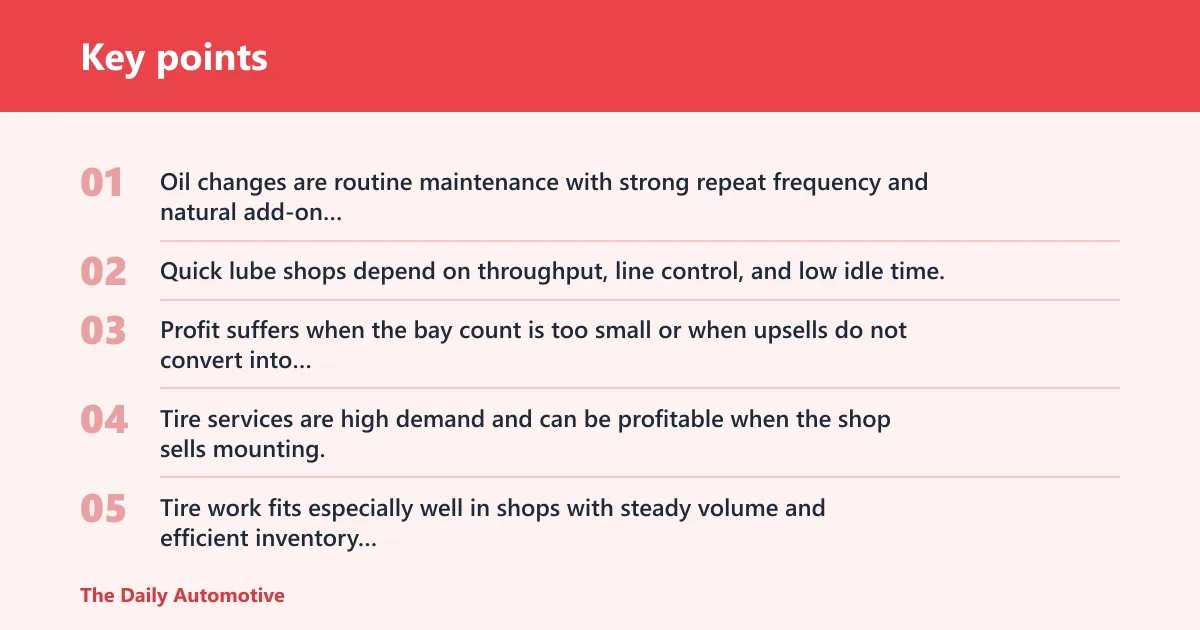
Oil changes are routine maintenance with strong repeat frequency and natural add-on sales, such as cabin filters, wiper blades, battery checks, and fluid inspections. Quick lube shops depend on throughput, line control, and low idle time. Profit suffers when the bay count is too small or when upsells do not convert into meaningful average repair orders.
Tire services
Tire services are high demand and can be profitable when the shop sells mounting, balancing, TPMS repairs, road hazard coverage, and alignment add-ons. Tire work fits especially well in shops with steady volume and efficient inventory control. It gets less attractive when inventory ties up cash or when low-cost price shopping compresses margin.
Fleet maintenance
Fleet maintenance often produces repeat service cycles and B2B demand, which helps stabilize workload. Buyers care about uptime, so they pay for reliability, reporting, and fast turnaround. The model works best when routing, scheduling, and preventive maintenance are organized enough to keep vehicles moving without wasted bay time.
Car wash businesses
Car wash businesses can have low material cost and strong repeat customer potential, but the profit profile depends heavily on capital intensity, location, and wash volume. Fixed-site operations usually need enough traffic to support equipment, water handling, and labor. Mobile wash models cut some overhead, but they still need route density and consistent scheduling.
Where do detailing and interior work fit in the ranking?
Detailing and interior work sit higher than many people expect because labor can be packaged into premium services with strong perceived value. Ceramic coating and paint correction can command high tickets, and upholstery repairs and premium interior packages can improve gross profit if the shop can control time, prep, and rework. Volume matters less than pricing discipline.
Ceramic coating and paint correction
Ceramic coating and paint correction sell on finish quality, labor skill, and presentation. They fit best in shops that can protect the work area, train for surface prep, and book appointments far enough ahead to keep bays full. They are weak fits for general repair shops that cannot control dust, lighting, and turnaround.
Upholstery repairs and premium packages
Upholstery repair and premium packages can lift order value when paired with stains, odor removal, leather repair, or deep interior restoration. These services reward process control and customer trust more than brute speed. They work best where the team can photograph condition, quote clearly, and manage expectations on finish quality.
One-page profitability scorecard for 10 service lines
Use this scorecard as a shop-level screening tool, not a universal ranking. A 5 means more favorable for that factor. Labor hours score higher when they create billable time; parts-to-labor scores higher when labor is the main value driver; diagnostic dependency scores higher when testing expertise matters more; comeback risk scores higher when rework risk is lower; equipment burden scores higher when startup needs are lighter; upsell potential scores higher when related work is easy to attach.
| Service line | Labor hours | Parts-to-labor ratio | Diagnostic dependency | Comeback risk | Equipment burden | Upsell potential |
|---|---|---|---|---|---|---|
| Diagnostics | 5 | 5 | 5 | 3 | 3 | 4 |
| Electrical repairs | 5 | 4 | 5 | 2 | 3 | 4 |
| Engine repair and maintenance | 5 | 3 | 4 | 2 | 2 | 4 |
| Suspension and alignment | 4 | 4 | 3 | 3 | 2 | 4 |
| Brake repairs | 4 | 3 | 2 | 3 | 4 | 4 |
| Tire services | 4 | 3 | 2 | 3 | 3 | 4 |
| Oil changes and quick lube | 2 | 2 | 1 | 4 | 4 | 5 |
| Fleet maintenance | 4 | 3 | 2 | 4 | 3 | 4 |
| Car wash businesses | 2 | 5 | 1 | 3 | 1 | 3 |
| Detailing and interior work | 4 | 4 | 2 | 3 | 3 | 4 |
How to use the table to choose service lines
Use high labor and high diagnostic dependency to find services that can hold margin with skilled techs. Use low equipment burden when the budget is tight. Use high upsell potential when you need average ticket growth. If comeback risk scores low in your shop, that service needs better process before expansion.
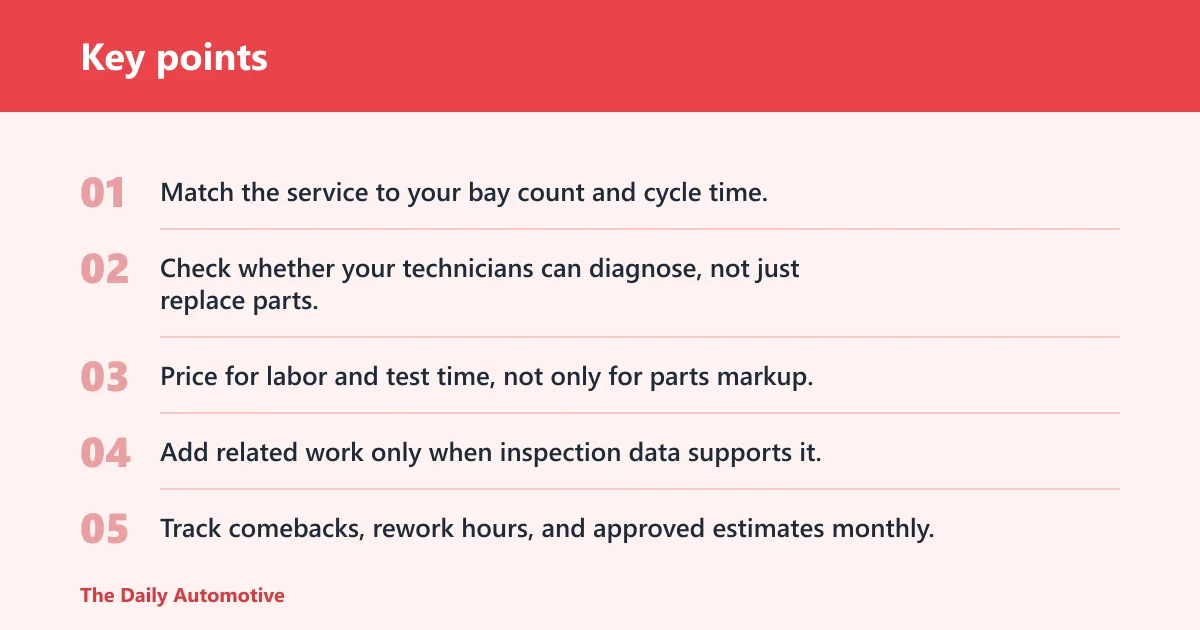
- Match the service to your bay count and cycle time.
- Check whether your technicians can diagnose, not just replace parts.
- Price for labor and test time, not only for parts markup.
- Add related work only when inspection data supports it.
- Track comebacks, rework hours, and approved estimates monthly.
Which services are best for a new shop to offer?
The best starter services are the ones that fit your technicians, equipment, and bay count without creating heavy comeback exposure. General repair shops often start with diagnostics, brakes, tires, maintenance, and light suspension. Tire shops, quick lube shops, fleet operators, and detail shops should stay close to their core model until utilization and close rates are steady.
Best fits by shop type
A quick lube shop fits oil changes, fluid checks, filters, batteries, and light inspections. A tire shop fits mounting, balancing, TPMS, and alignments if it has the equipment. A general repair shop fits diagnostics, brakes, suspension, and electrical work. A fleet shop fits preventive maintenance, inspections, and fast turn jobs. A detail shop fits ceramic coatings, paint correction, and interior restoration.
Services to avoid until the tooling is right
Avoid deep electrical work, complex engine tear-downs, and advanced alignment work if the team lacks the tools and training. These services can be profitable, but only when the shop can verify the fault and complete the repair without repeated rechecks. Specialty or luxury vehicles may command higher prices, yet they also raise tooling, training, and comeback exposure.
How bay count and technician mix affect the choice
Small shops need services that turn bays quickly or create large labor hours with limited parts cost. Larger shops can spread fixed overhead across more car count and use dedicated specialists for diagnostics, alignments, or fleet work. The wrong mix creates dead time: a skilled diagnostician waiting on a lift, or a lube bay blocked by a long repair.
Frequently asked questions
What is the most profitable auto repair?
Diagnostics is often the most profitable auto repair because it is labor-driven, low-parts, and highly dependent on skill and scan-tool use. That said, it only stays profitable when the shop charges for the test process and avoids free fault-finding or unapproved parts replacement.
What car mechanic makes the most money?
The mechanic who usually makes the most money is the one who can diagnose complex problems quickly and consistently, especially electrical and drivability faults. High output matters, but so does accuracy. A tech who can complete hard jobs without repeat comebacks tends to generate more billable hours.
Which automotive services have the highest margins?
Diagnostics, electrical repairs, engine work, suspension and alignment, and well-run maintenance programs often have the strongest margin potential. The best result comes when labor is the main value driver and rework stays low. A service with strong demand but weak approvals can still underperform.
How do labor, parts, and overhead affect auto service profit?
Labor, parts, and overhead decide whether a sale is actually profitable. Labor creates the strongest margin when skill is scarce. Parts matter when markup is healthy. Overhead takes a fixed cut every month, so long cycle times, poor approvals, and rework can erase what looks like good revenue.
Products related to this article
Sponsored / affiliate links. As an Amazon Associate I earn from qualifying purchases. I may earn additional commission from eligible campaigns.