CVT Transmission Review: Is It Worth It?
A CVT can be worth it if you want a low-cost path to smooth, fuel-efficient commuting and can live with stricter fluid service and modest towing limits. Skip it for hard driving, heavy loads, or long-term repair risk. Ignore those limits and you can face higher maintenance bills or a driveline that feels wrong for your use case. This guide explains where a CVT makes sense, where it is a compromise, and when to walk away.
CVT decision matrix


This matrix is for shoppers deciding whether a CVT fits the job. The same transmission can suit a light commuter and fail a hilly, hot, or load-heavy use pattern. Belt-driven CVTs are the main focus here; hybrid eCVTs are handled separately because they are mechanically different.
| Use case | Drivability | Reliability risk | Ownership cost | Fit for a CVT |
|---|---|---|---|---|
| City commuting | Strong. Smooth launch behavior helps stop-and-go traffic. | Low to moderate if fluid service is on schedule. | Often favorable because fuel use can stay down. | Smart buy |
| Highway commuting | Good. Steady-ratio cruising is calm once up to speed. | Low to moderate, with cooling and service history mattering. | Usually favorable on daily fuel use. | Smart buy |
| Hilly terrain | Mixed. More rev flare and engine noise under load. | Moderate to high if heat builds often. | Can rise if fluid service is delayed. | Compromise |
| Towing or light hauling | Poor to fair, depending on vehicle and load. | Higher. Torque load and heat are the concern. | Can climb quickly if the transmission is stressed. | Usually skip |
| Enthusiast driving | Poor for drivers who want shift feel and quick response. | Moderate if driven hard often; heat becomes a factor. | Not the low-stress choice once pace increases. | Skip |
Best-case buyers
Choose a CVT if your driving is mostly commuting, your loads stay light, and you value calm low-speed behavior more than shift feel. This is where the transmission’s smooth ratio change and efficiency potential matter most.
When it is a compromise
It becomes a compromise when your route includes long grades, frequent merges under load, or a lot of heat soak. The transmission may still work well, but the ownership tradeoff gets less attractive, especially if service history is thin.
When to skip it
Skip a belt-driven CVT if you tow often, carry heavy cargo, or want quick throttle response and a more mechanical feel. In those cases, a conventional automatic or another drivetrain type usually fits the job better.
What is a CVT, and how does it work?
A CVT uses pulleys and a belt or chain instead of fixed gears, so it can vary ratio across an infinite range within a set spread. That lets the engine stay near its power peak or at lower revs for efficiency, depending on throttle request.
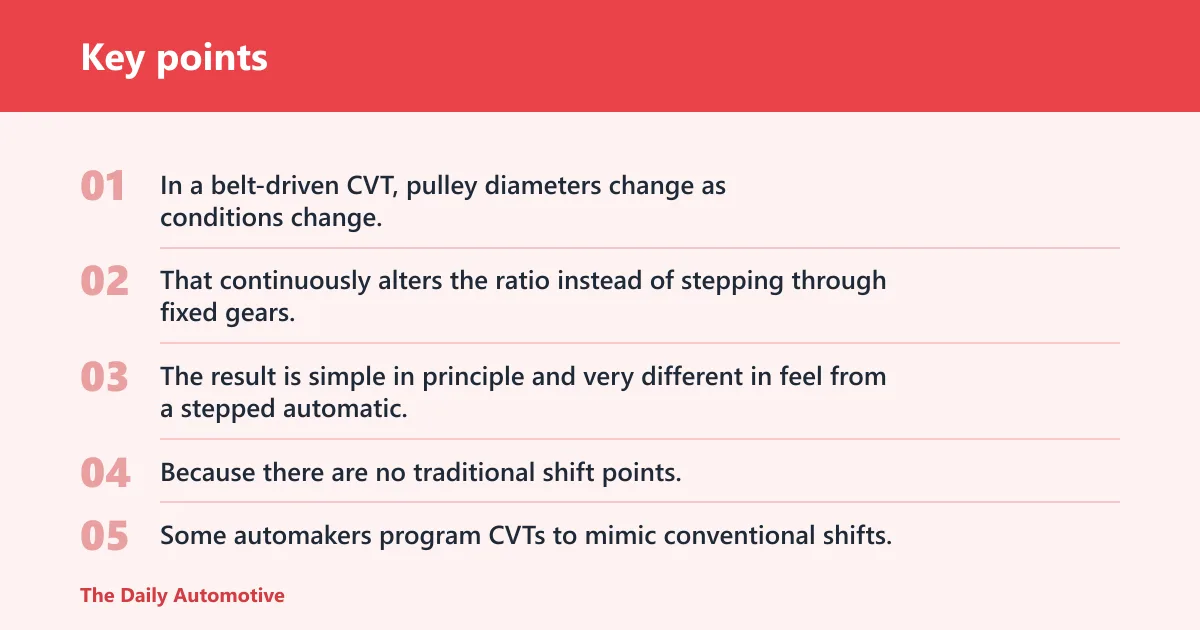
Pulleys, belt or chain, and ratio spread
In a belt-driven CVT, pulley diameters change as conditions change. That continuously alters the ratio instead of stepping through fixed gears. The result is simple in principle and very different in feel from a stepped automatic.
Why the driving feel is different
Because there are no traditional shift points, acceleration can feel smooth and continuous. Some automakers program CVTs to mimic conventional shifts, which can make the car feel more familiar, but that does not change the basic layout.
Where CVTs show up most often
They are commonly found in compact cars, small SUVs, and hybrids. In hybrid systems, some models use an eCVT that replaces pulleys with a pair of electric motors and a planetary gearset, so the hardware and failure patterns are not the same as a belt-driven CVT.
Pros and cons of a CVT
The main draw is smoothness and efficiency potential. The main tradeoff is feel: some drivers dislike the droning sound, the rubber-band effect under throttle, and the way engine speed does not track road speed the way a conventional automatic does.
Pros
- Smooth acceleration with no traditional shift points.
- Can keep the engine in an efficient rev range.
- Often supports good fuel economy in daily use.
- Fewer moving parts than traditional automatic transmissions.
Cons
- Droning noise can be more noticeable under acceleration.
- Rubber-band feel may bother some drivers.
- Driver disconnect is common when the engine holds revs steady.
- Heat and torque load can hurt lifespan in the wrong use case.
Say your weekday drive is 14 miles each way through traffic with no towing and no steep grades. A CVT can make that routine feel calm and efficient. Add a trailer and a long hill on a hot day, and the same transmission takes a much harsher load.
How reliable are CVT transmissions?
Reliability depends heavily on design, heat control, load, and maintenance. Belt-driven CVTs are more sensitive to torque load and overheating than hybrid eCVTs, while eCVTs are generally more reliable because they use a different mechanical layout. Service history matters in both cases.
Belt-driven CVT wear and overheating
Belt-driven CVTs can wear faster when the belt or chain sees repeated high load, high heat, or degraded fluid. Reported problems have included shuddering, hesitation, overheating, whining noises, and premature failure. Those symptoms often point to fluid degradation or stress in the unit.
Why cooling and torque load matter
Heat is one of the biggest threats. A CVT that is asked to manage more torque than it likes, especially in hot weather or on hills, can run hotter and wear faster. That is why cooling design and the vehicle’s duty cycle matter so much.
How eCVTs differ from traditional CVTs
Some hybrids use an eCVT with electric motors and a planetary gearset instead of pulleys and a belt. That makes the system mechanically different from the belt-driven CVT found in many gas cars, and it is generally regarded as the more durable arrangement.
Which brands and designs are safer bets?
Brand reputation should be treated as a filter, not a verdict. Some CVT designs have a better track record than others, and model year plus service history can matter as much as the badge on the grille.
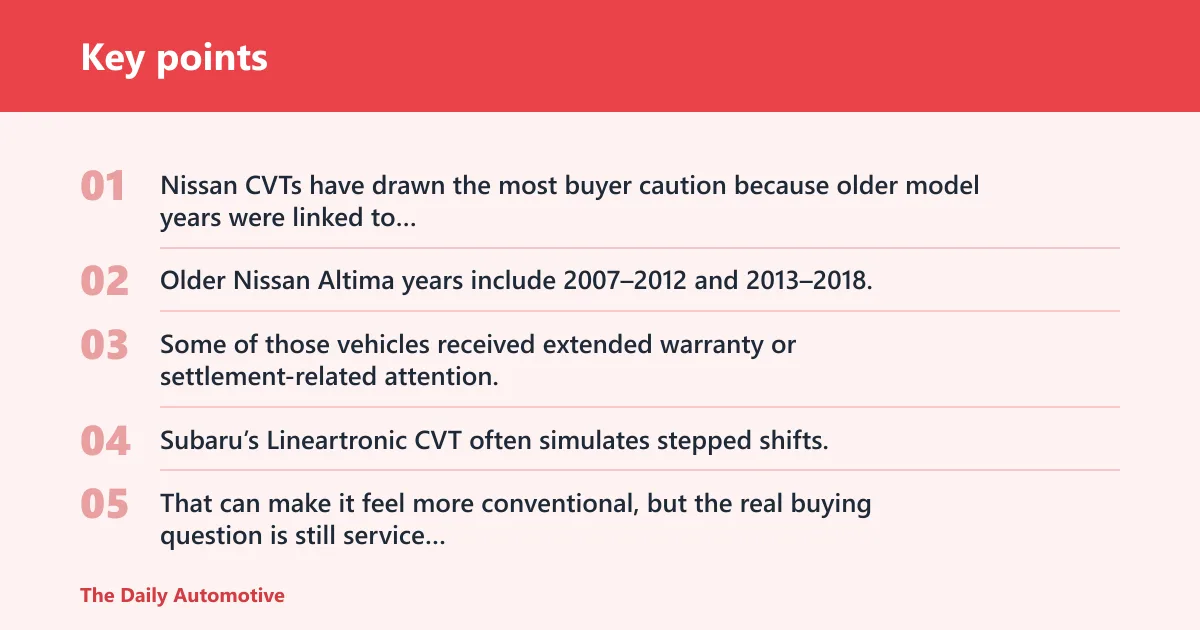
Nissan CVT history and buyer caution
Nissan CVTs have drawn the most buyer caution because older model years were linked to complaints about shuddering, overheating, whining, and premature failure. Older Nissan Altima years include 2007–2012 and 2013–2018, older Sentra years include 2012–2017, and older Rogue years include 2014–2018. Some of those vehicles received extended warranty or settlement-related attention.
Subaru Lineartronic CVT traits
Subaru’s Lineartronic CVT often simulates stepped shifts, and some models offer paddle-shift style control. That can make it feel more conventional, but the real buying question is still service record and how the car was used. Hill driving and repeated load matter here too.
Toyota Direct-Shift CVT and the fixed first gear
Toyota’s Direct-Shift CVT uses a fixed first gear, which helps reduce the rubber-band feel at takeoff. In practice, that design aims to make low-speed response feel more natural while keeping the CVT efficiency benefits once the car is rolling. (Caranddriver)
Why model year and service history matter
A later model year with documented fluid changes is usually a safer used buy than an older example with missing records, even if both wear the same badge. For CVTs, the maintenance file often tells you more than the trim level.
Maintenance and used-car red flags
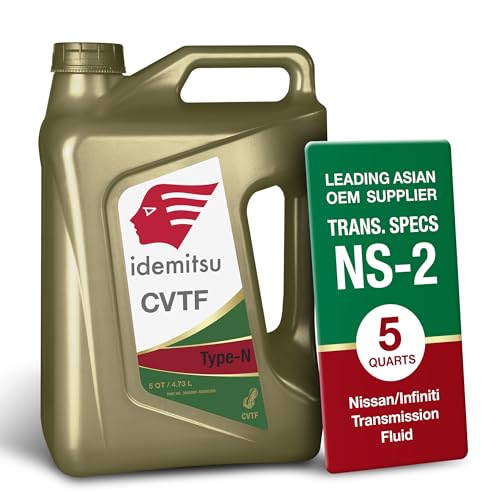
CVT fluid service is a major part of longevity. A common interval often cited is 30,000 to 50,000 miles, and the fluid must match the manufacturer’s specification. Using the wrong fluid can create shift-quality issues, heat control problems, and long-term wear.
Symptoms that deserve a closer inspection
- Shuddering on takeoff or during steady acceleration.
- Whining that rises with speed or throttle input.
- Delayed response when moving from park to drive.
- Overheating warnings or limp-mode behavior.
- Evidence of transmission work without clear paperwork.
Questions to ask before you buy
- When was the CVT fluid last changed?
- Was the correct manufacturer-specified fluid used?
- Has the vehicle towed, hauled, or climbed long grades regularly?
- Has the transmission ever been repaired or replaced?
- Are there any records for software updates, warranty work, or cooling-system service?
Suppose a used compact SUV has about 68,000 miles, no fluid records, and a faint whine under light throttle. That does not prove failure, but it is enough reason to slow down, inspect the paperwork, and budget for risk before you buy.
Who it’s for
A CVT suits a daily commuter who wants smooth operation, good fuel-use potential, and low-stress driving in light to moderate duty. It is a weaker fit for buyers who tow, drive hard, or plan to keep the car through high-mileage years without careful maintenance.
If your life is mostly city lanes and freeway commuting, a well-maintained CVT can make sense. If your use case includes mountains, towing, or a strong preference for shift feel, it is usually better to skip it or limit your search to the more durable designs.
Frequently asked questions
How reliable is a CVT transmission?
Reliability varies by design and use. Belt-driven CVTs can be dependable when cooling is adequate and fluid service stays current, but they are more sensitive to heat and load than many conventional automatics. Hybrid eCVTs are usually the safer reliability bet because they use different hardware.
How good is a CVT transmission for daily driving?
For daily use, a CVT is often very good. It keeps acceleration smooth, helps in stop-and-go traffic, and can support better fuel economy. The tradeoff is feel: some drivers dislike the droning sound and the way engine speed can hold steady under acceleration.
Are CVT transmissions less reliable?
Not across the board. They can be less forgiving than a conventional automatic when heat, load, or maintenance slip. That is why buying the right model and keeping up with fluid changes matters so much. A well-used CVT is not the same as a neglected one.
How reliable is a CVT transmission over 100,000 miles?
Over 100,000 miles, service history becomes the deciding factor. A CVT that has had regular fluid changes at the right interval and has not been overloaded has a better chance of lasting well. A neglected unit, especially in a hot or heavy-duty life, is a much bigger gamble.
Are CVT transmissions good or bad for commuters?
They are often good for commuters, especially if the commute is mostly city or highway cruising with light loads. Smoothness and fuel-use potential work in your favor. They become a weaker choice if the commute includes steep hills, towing, or frequent hard acceleration.
Which brands have the most reliable CVT transmissions?
It is smarter to think in terms of designs and specific model years than brands alone. Hybrid eCVTs are generally the safer type, Toyota’s Direct-Shift CVT addresses takeoff feel with a fixed first gear, and some Nissan CVT years deserve extra caution. Always check records first.
Products related to this article
Sponsored / affiliate links. As an Amazon Associate I earn from qualifying purchases. I may earn additional commission from eligible campaigns.