Manual Transmission Review: Is It Worth It?
A manual transmission is worth choosing only if you value extra control and driver involvement enough to accept slower commuting, fewer trim choices, and shrinking future support; for most daily driving, an automatic is the better choice. Pick the wrong gearbox and you can end up with a car that wears you out in traffic and is harder to sell later. This guide breaks down where manuals still make sense, where they do not, and what you give up in convenience, cost, and long-term ownership.
Manual vs automatic: the real tradeoff
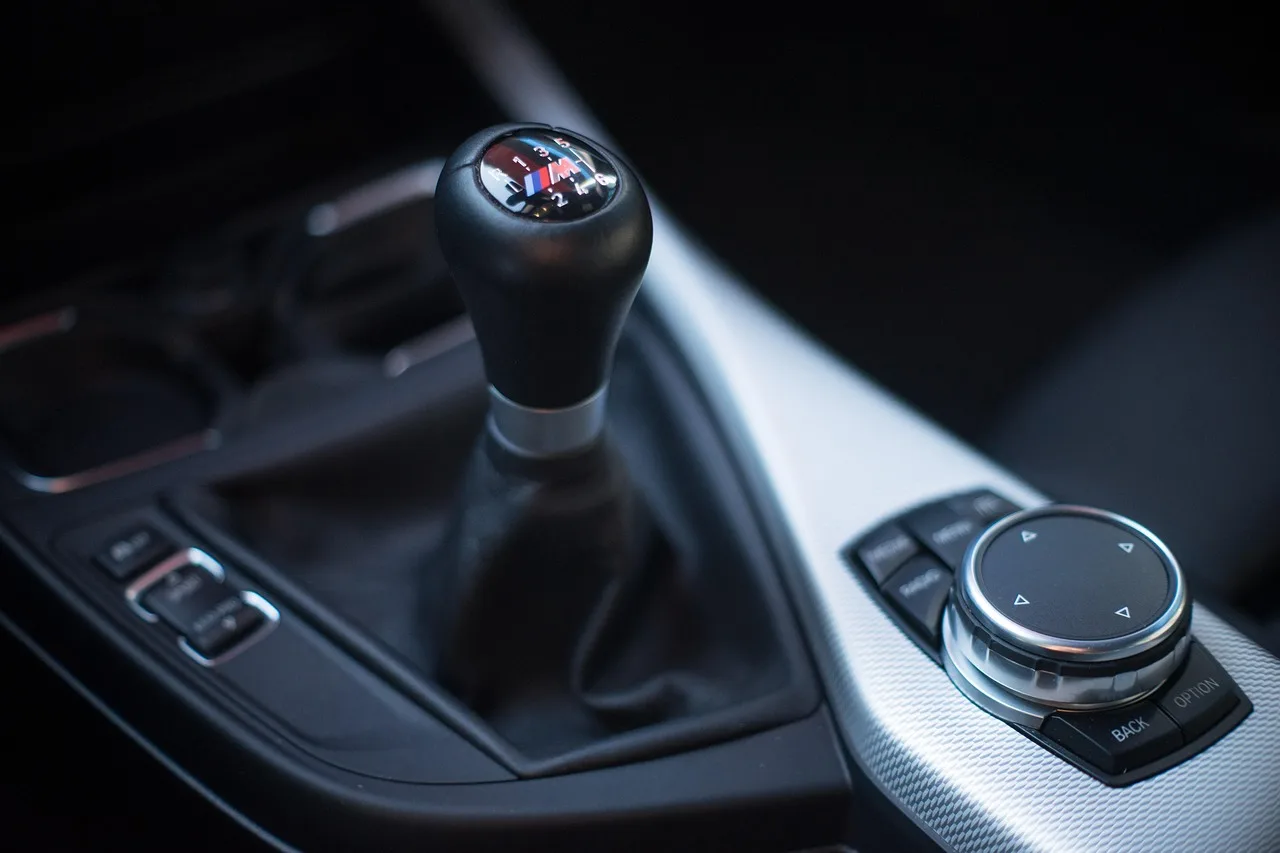
The manual transmission gives you a three-pedal layout and driver-selected gears. That means more involvement, but also more work every time you pull away, crawl in traffic, or downshift. A modern automatic usually shifts faster, often accelerates better, and in recent comparisons often returns better fuel economy too.
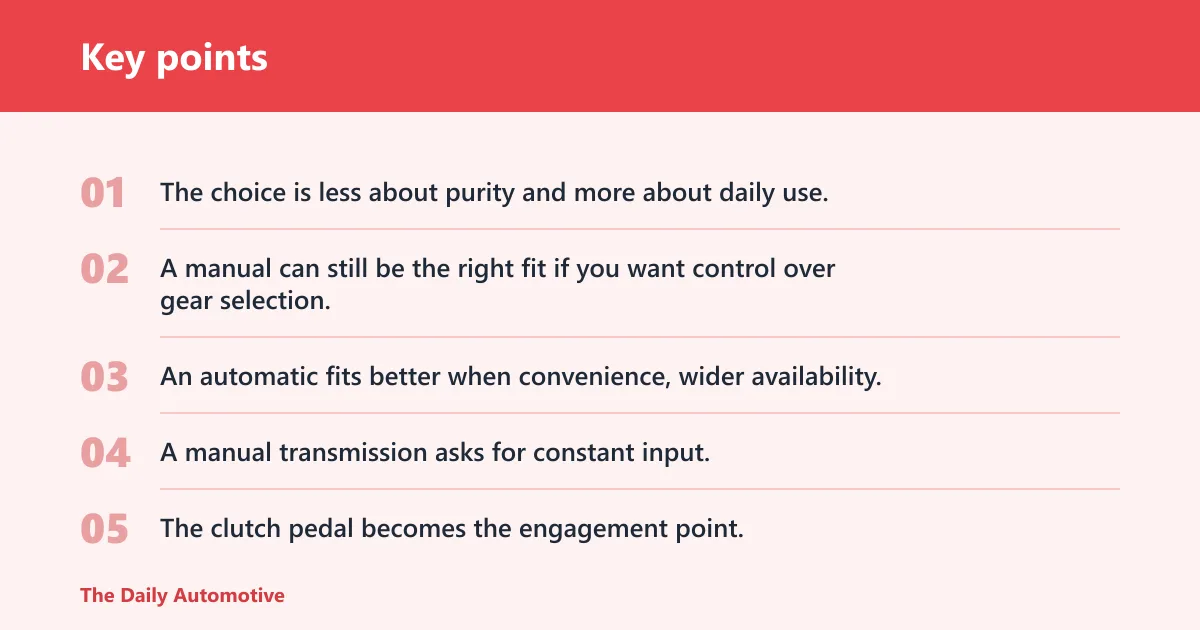
The choice is less about purity and more about daily use. A manual can still be the right fit if you want control over gear selection, plan to drive for enjoyment, and can live with a narrower model list. An automatic fits better when convenience, wider availability, and lower day-to-day effort matter more.
| Criteria | Manual transmission | Automatic transmission |
|---|---|---|
| Shift control | Driver selects each gear | Computer or hydraulics handle shifts |
| Shift speed | Depends on the driver | Faster in modern designs |
| Acceleration | Can be slower in the same model | Often better in the same model |
| Fuel economy | Often lower in the same model | Generally better in recent comparisons |
| Convenience | More effort in traffic and on hills | Less effort in daily driving |
| Market availability | Rare in the 2026 new-car market | Available on far more models |
What each gearbox asks of the driver
A manual transmission asks for constant input. The clutch pedal becomes the engagement point, and the driver decides when the engine and gearbox connect. That makes hill starts, stop-and-go traffic, and parking lot maneuvers more involved than they are in an automatic.
A modern automatic asks less of the driver and does more of the work itself. Many also multiply torque well off the line, which helps with launch feel and everyday drivability. In many current models, that is the better choice for commuting and family use.
How modern automatics changed the comparison
Older automatic transmissions often gave up some efficiency and response. That gap has narrowed. Many modern automatics shift quickly, hold gears well, and can sometimes out-accelerate a manual in the same vehicle because they reduce human delay and manage torque more effectively.
That shift matters because the manual no longer wins by default on performance or running cost. It has to earn its place with feel, control, or a specific model mix that still offers it.
Where manuals still have an advantage
Manuals still matter in niche cases. Some drivers want the control of gear selection on winding roads, the satisfaction of matching revs on downshifts, or the lower purchase cost that sometimes appears in certain trims. A manual can also make a car feel more alert at lower speeds when gearing is chosen well.
That does not make it a blanket better choice. It makes it a specific one.
Is a manual transmission still worth it?
A manual transmission is still worth it when the driving experience is the point and you accept the tradeoffs in convenience, model choice, and future support. It is a narrow ownership choice, not a universal upgrade. If you commute in traffic or want the widest choice of trims, an automatic usually makes more sense.
When engagement matters more than convenience
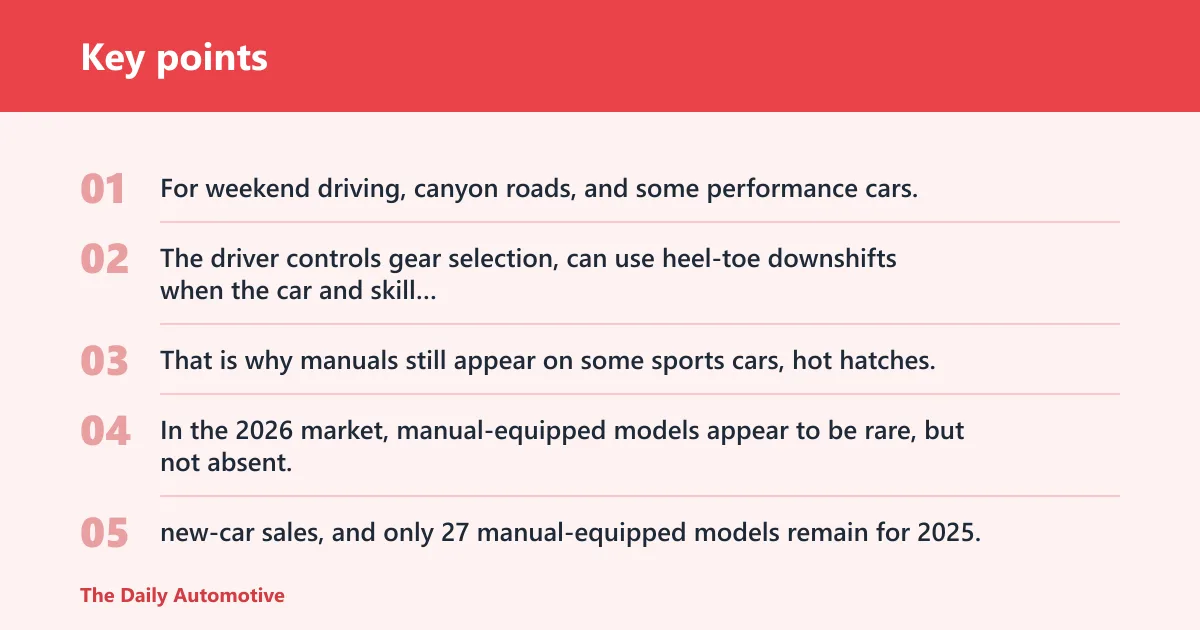
For weekend driving, canyon roads, and some performance cars, a manual can still be rewarding. The driver controls gear selection, can use heel-toe downshifts when the car and skill level allow it, and gets a more direct link between throttle input and road speed.
That is why manuals still appear on some sports cars, hot hatches, and enthusiast-focused trims. In the 2026 market, manual-equipped models appear to be rare, but not absent. Manuals sit below 1% of U.S. new-car sales, and only 27 manual-equipped models remain for 2025, dropping to 24 in 2026 in the cited trend piece.
When a manual adds friction with no payoff
If your driving is mostly commuting, school runs, delivery routes, or heavy stop-and-go traffic, the manual can feel like extra work without a clear return. The clutch pedal demands attention every few seconds in congestion. Over time, that can turn a fun feature into a daily annoyance.
It can also limit what you can buy. Three-pedal configurations remain on base models like the Mazda 3, Mini Cooper, Nissan Versa and Volkswagen Jetta, but many mainstream nameplates have already dropped the manual entirely.
Say your route includes about a 45-minute commute, a few slow merges, and one steep garage ramp. The manual still works, but the repeated clutch use, low-speed shifting, and hill starts will be part of every trip.
How rarity changes the buying equation
Manual scarcity changes the ownership math. Fewer new manuals mean fewer parts stocked on shelves, fewer technicians who work on them every day, and more friction if you need a clutch, linkage, or related hardware later. The market is also narrower, so finding the right trim and color can take longer.
That scarcity also cuts both ways. Enthusiast demand can support resale on the right models, especially in niche trims. But that only helps if you are shopping for a car that people still want in manual form.
Reliability and maintenance costs
A manual transmission is not automatically more reliable. The gearbox itself may have fewer moving parts than some older automatics, but the clutch is a wear item, and driver habits can shorten its life. Modern automatics have also narrowed the reliability gap, so the older “manual equals durable” assumption no longer fits every purchase.
Clutch wear versus transmission durability
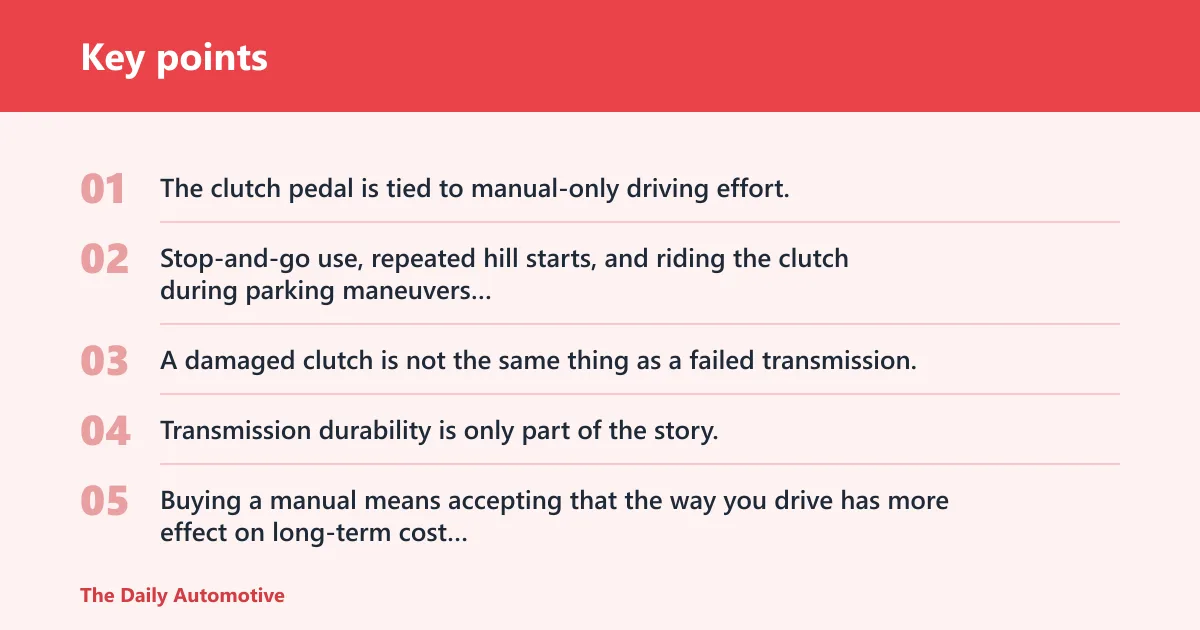
The clutch pedal is tied to manual-only driving effort. Stop-and-go use, repeated hill starts, and riding the clutch during parking maneuvers all add wear. A damaged clutch is not the same thing as a failed transmission, but it is still a real ownership cost.
Transmission durability is only part of the story. Buying a manual means accepting that the way you drive has more effect on long-term cost than it does with many automatics.
| Cost factor | Manual transmission | Automatic transmission |
|---|---|---|
| Likely wear exposure | Clutch replacement risk rises with city use and driver habits | No clutch pedal, but service can be more complex |
| Common failure concern | Clutch, linkage, and driver-induced wear | Valve body, mechatronics, or internal service complexity |
| Service friction | Fewer new manuals may mean fewer familiar techs later | Broader service network and parts support |
| Ownership risk | Depends heavily on use and clutch life | Depends more on design complexity and maintenance history |
Why modern automatics narrowed the reliability gap
Modern automatics are more complex than a simple older torque-converter unit, but they are also more refined and widely supported. That matters because broad market adoption keeps parts and service knowledge more common.
Manuals no longer get a free reliability pass. A well-kept automatic may outlast a manual that has spent years in dense traffic with repeated clutch abuse.
What future service support looks like as manuals disappear
As manuals become less common in new-car lineups, local service support may also become less widespread. Parts catalogs get thinner. Fewer technicians see them daily. And if the car is five or ten years old, the local shop may be more comfortable with the automatic version than the manual one.
That matters most for long-term owners. A manual can still be a good buy, but you should treat future support as part of the purchase decision, not an afterthought.
Fuel economy and performance
The automatic often wins on mpg and acceleration in the same model. That is the current reality in many comparisons. Manuals can still be efficient if the gearing suits the car, but the average new automatic has the edge because it shifts faster and keeps the engine in a better part of the power band.
Why the automatic often wins on mpg and acceleration
Modern automatics can manage shift timing, torque multiplication, and launch behavior more effectively than most drivers can by hand. That helps both off-the-line performance and fuel economy in real-world use. In many recent comparisons, the automatic version returns better mpg than the manual version of the same car.
The gap is not fixed. It varies by vehicle, engine output, and how the gears are spaced.
How gear ratios and final drive can change the result
Gear ratios matter a great deal. A manual with shorter gearing can feel lively around town, while taller ratios can calm highway cruising. Final-drive differences also affect acceleration and drivability, which means two versions of the same model can behave very differently even if the engine is unchanged.
That is why a manual can sometimes offset some of its drawbacks. A well-chosen gear set can make a car feel responsive at low speeds or relaxed on the highway. It still does not guarantee better mpg than the automatic.
Picture a compact car with a 6-speed manual and a taller final drive chosen for highway use. It may feel quieter at 70 mph, but the automatic version can still be quicker in a sprint because it shifts faster and keeps the engine closer to peak torque.
Where rev-matching and iMT fit
Rev-matching systems and iMT setups help smooth downshifts by blipping the throttle for you. They can be defeatable, and they are common on performance manuals. The benefit is simple: cleaner shifts, less driveline jerk, and less effort from the driver.
These systems do not turn a manual into an automatic. They reduce some of the friction, especially for newer drivers or in traffic, but the clutch pedal and driver-selected gears remain part of the equation.
Which gearbox fits your driving?
The right gearbox depends on where you drive, how often you sit in traffic, and whether the car is a daily tool or a weekend machine. Manuals still make sense for some buyers, but the answer changes fast once commuting, snow, towing, or new-driver use enter the picture.
Daily commuting in traffic
An automatic is usually the better fit for commuting. Stop-and-go traffic amplifies the work of a manual, and the clutch pedal becomes a constant task. If your commute includes long signals, ramp queues, or tight parking, the convenience gap matters more than the engagement gap.
For a daily driver, the strongest manual case is usually the trim you want that still happens to offer one. That is a limited scenario, not a broad recommendation.
Weekend fun and spirited driving
A manual can still make excellent sense for weekend use. The driver gets more control over gear choice, can use heel-toe downshift technique if desired, and may value the closer connection to the car more than convenience. This is where the manual still has its clearest advantage.
The key question is whether the car will mostly be driven for enjoyment. If yes, the extra effort is easier to justify.
Winter use, towing, and learning to drive
Winter driving changes the equation. An automatic is easier when roads are slick, traction is inconsistent, and you need smooth, low-effort progress. Manuals can work in snow, but they ask more of the driver at every start and shift. For towing, the automatic’s torque multiplication and easier low-speed control are often the better fit.
Learning to drive stick is a separate question. A manual can still be worth learning if you want the skill and understand the tradeoff, but it is not required for safe or useful driving. For a teen driver or a household that wants the widest range of cars and the least friction, an automatic is the simpler choice.
Manual transmission decision matrix
This decision matrix is the shortest way to read the tradeoffs. It focuses on use case, not nostalgia. Manuals can be the right answer in a few situations, but the wrong answer shows up fast in traffic, during winter use, and when future support matters.
| Use case | Manual advantage | Manual downside | Verdict |
|---|---|---|---|
| Commuting | More driver control | More work in traffic, more clutch use | Usually not worth it |
| Weekend fun | More engagement and downshift control | Less convenient for errands and mixed use | Often worth it for enthusiasts |
| Winter driving | Can give precise gear selection | Harder launches on slick roads | Usually automatic is easier |
| Towing | Some drivers prefer direct control | More effort at low speed, less torque multiplication advantage | Usually automatic is better |
| Learning to drive | Teaches clutch and gear management | Steeper learning curve | Good if learning is the goal, not the commute |
| Long-term ownership | Can hold enthusiast value on rare trims | Fewer parts and fewer familiar techs over time | Depends on model and local support |
Choose manual if… / Choose automatic if…
Choose a manual if you want more involvement, can live with a clutch pedal in traffic, and are shopping a model where the manual trim is a real draw. Choose an automatic if you want easier daily use, stronger broad-market support, and fewer compromises in fuel economy, acceleration, and resale risk.
Choose manual if you want involvement and can accept the tradeoffs
- You want gear selection to be part of the drive.
- You are buying a sports car, hot hatch, or other niche model where the manual trim matters.
- You do not mind slower commuting or extra work in traffic.
- You are comfortable with clutch wear as a normal ownership cost.
Choose automatic if you want easier daily use and broader model choice
- You commute in traffic or drive mostly in the city.
- You want the broadest trim and model selection.
- You care about mpg and acceleration in the same model.
- You want the easier path for long-term service support.
Frequently asked questions
Is a manual transmission more reliable?
Not automatically. A manual can have fewer internal parts in some older designs, but the clutch is a wear item and driver behavior matters a lot. Modern automatics have narrowed the reliability gap, so the better answer depends on the specific vehicle, service history, and how it is driven.
Are manual transmissions cheaper?
Sometimes, but not always. Some manual trims cost less up front, while others are priced for niche demand. The bigger issue is ownership cost: clutch wear, service access, and resale can shift the balance. A manual is cheaper only when the whole package supports that result.
Why manual transmission is better
It is better only for certain buyers. The manual gives direct gear control, a more involved driving feel, and sometimes a lower purchase price in specific trims. But it trades away convenience, often loses on mpg and acceleration, and can be harder to support as manuals disappear from the market.
Do they make manual transmissions anymore?
Yes, but far fewer than before. Manuals remain on a limited set of new cars, mostly sports cars, hot hatches, off-road SUVs, and a few base trims. The new-car market has moved sharply toward automatics, and manuals now account for less than 1% of U.S. sales.
Does a manual transmission hurt fuel economy?
Often, yes. In many current comparisons, the automatic version of the same model gets better mpg because it shifts faster and keeps the engine in a better operating range. The gap is not identical across every car, though. Gear ratios, final drive, and vehicle type can change the result.
Which gearbox is right for me: Automatic or manual?
If you drive in traffic, want easy winter use, or plan to keep the car for practical daily duty, automatic is usually the better choice. If you want a weekend car, value direct control, and are willing to live with a narrower market and more effort, manual can still make sense.
Products related to this article
Sponsored / affiliate links. As an Amazon Associate I earn from qualifying purchases. I may earn additional commission from eligible campaigns.