Mothers VLR Leather Cleaner Review: Is It Worth It?
Mothers VLR Leather Cleaner is a strong pick for mixed-material interiors if you want one cleaner for leather, vinyl, and plastics; choose a dedicated leather-only cleaner when your seats are delicate or heavily finished. Use the wrong product, and you can leave residue, dull the finish, or miss grime in stitched seams. This review covers where VLR fits, where it falls short, and who should buy it.
Pros and cons
Pros
- One-step cleaning and protection for vinyl, leather, and rubber.
- Neutral-pH formula that fits routine interior care.
- OEM-style finish that avoids an oily, over-dressed look.
- Larger 710 ml size than the dedicated leather cleaner.
- Helps protect against drying, fading, and cracking.
Cons
- Not the best match for suede or rough leather.
- Can be the wrong choice if a seat needs a true leather-only cleaner and a separate conditioner.
- May leave a temporary darkening effect on some leather surfaces.
- Mixed-use convenience can hide the need for more focused care on older, dry, or heavily soiled leather.
Who is it for?
Mothers VLR is aimed at DIY owners who want one product for a cabin with leather seats, vinyl trim, and rubber touch points. It is generally a better fit for finished leather and routine upkeep than for delicate, suede-like, or rough leather surfaces that need more specialized care.
Mixed-material interiors
If your cabin has leather seats, vinyl door inserts, and rubber trim, VLR makes sense as a fast maintenance product. It cleans and protects in one step, so you are not switching bottles every time you move from a seat bolster to a dash panel or door pocket edge.
Finished leather seats
Finished leather is the safer target for a product like this. That matters because many car seats are finished leather, while suede and rough leather need different treatment. If your seats are heavily coated, worn, or unusually dry, a dedicated cleaner plus conditioner gives you more control.
Buyers who want one step instead of two
Choose VLR if convenience matters more than maximum tailoring. Skip it if you want the strongest separation between cleaning and conditioning, or if the cabin needs a deeper reset after years of buildup, neglected seams, or uneven wear.
Mothers comparison matrix
| Product | Surface compatibility | Cleaning strength | Conditioning | UV / fade protection | Finish | Best for / not for |
|---|---|---|---|---|---|---|
| Mothers VLR Vinyl-Leather-Rubber Care | Vinyl, leather, and rubber; neutral-pH formula | Good for routine grime and old dirt and stains | Built in, with lanolin oil in the formula | Helps protect against drying, fading, and cracking | OEM-style, not greasy | Best for: mixed-material interiors and quick upkeep. Not for: suede, rough leather, or cabins that need a dedicated two-step leather routine. |
| Mothers Leather Cleaner | Genuine leather; neutral-pH formula; do not use on rough leather or suede | Effective and gentle, but aimed at cleaning rather than conditioning | None by itself; pair with conditioner for maximum protection | Not its main role; protection comes from the follow-up conditioner | Can temporarily darken the surface after application | Best for: leather-only cleaning when you plan to condition afterward. Not for: suede, rough leather, or buyers who want one bottle to do everything. |
| Mothers Leather Conditioner | Use after cleaning on leather surfaces | None; this is not the cleaning step | Moisture-rich conditioner with lanolin oil | Supports the protection goal after cleaning | Typically leaves leather softer rather than slick | Best for: dry leather that needs softness and flexibility restored. Not for: dirty seats that still need a cleaner first. |
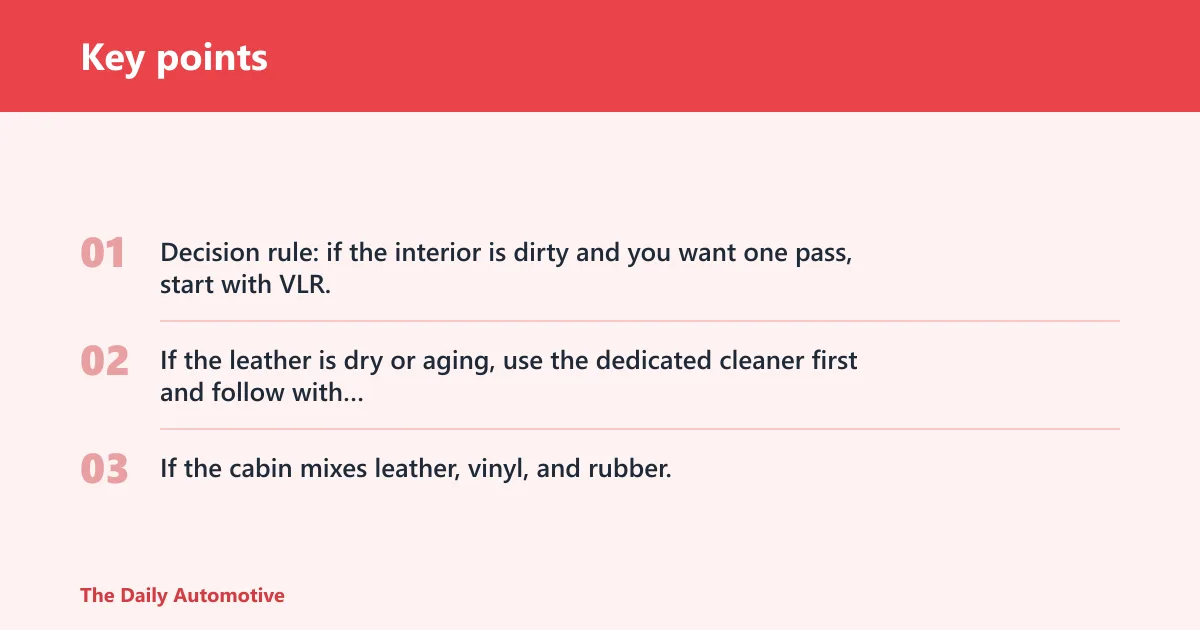
Decision rule: if the interior is dirty and you want one pass, start with VLR. If the leather is dry or aging, use the dedicated cleaner first and follow with conditioner. If the cabin mixes leather, vinyl, and rubber, VLR is the simpler fit unless the leather itself needs special attention.
Does Mothers VLR clean and condition in one step?
Yes. Mothers VLR is positioned to clean and protect in one step, and its neutral-pH formula makes it practical for routine maintenance on finished leather, vinyl, and rubber. That convenience is the product’s main appeal, especially when the interior needs light cleaning rather than a full restoration cycle.
How the neutral-pH formula fits regular maintenance
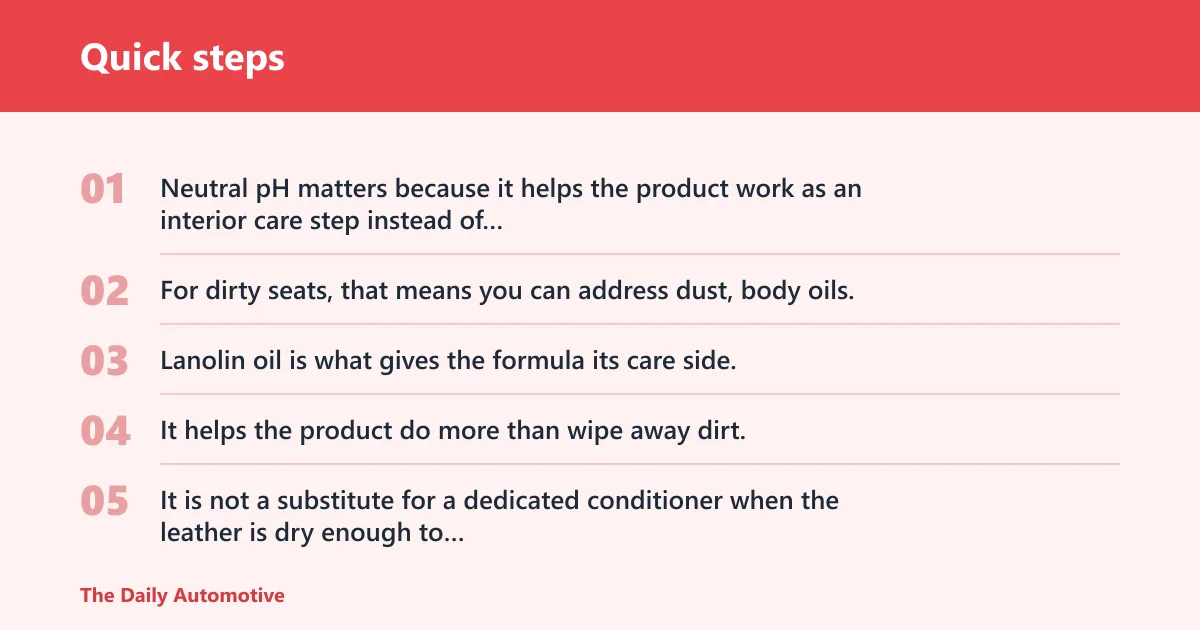
Neutral pH matters because it helps the product work as an interior care step instead of a harsh strip-down cleaner. For dirty seats, that means you can address dust, body oils, and light grime without automatically moving to a separate conditioner immediately after.
What lanolin oil changes in practice
Lanolin oil is what gives the formula its care side. It helps the product do more than wipe away dirt, which is useful for surfaces that need some moisture support while still staying visually tidy. It is not a substitute for a dedicated conditioner when the leather is dry enough to need deeper follow-up care.
Suppose a 10-year-old sedan has beige finished leather on the seats and vinyl trim on the doors. A one-step cleaner like VLR can simplify the job. If the same seats are cracked at the bolsters and feel dry to the touch, a dedicated cleaner and conditioner is the better route.
Where one-step care is enough
One-step care works best on interior surfaces that are not badly neglected. If the goal is weekly or monthly maintenance, VLR is easier to keep using, and that is often the difference between a maintained cabin and one that gets ignored because the process feels too long.
How do you use it on leather?
Use VLR on finished leather only, and start with a hidden-spot check. That is the safest way to catch any odd response such as temporary darkening, uneven gloss, or residue in stitched areas before you treat the whole seat.
Prep and hidden-spot check
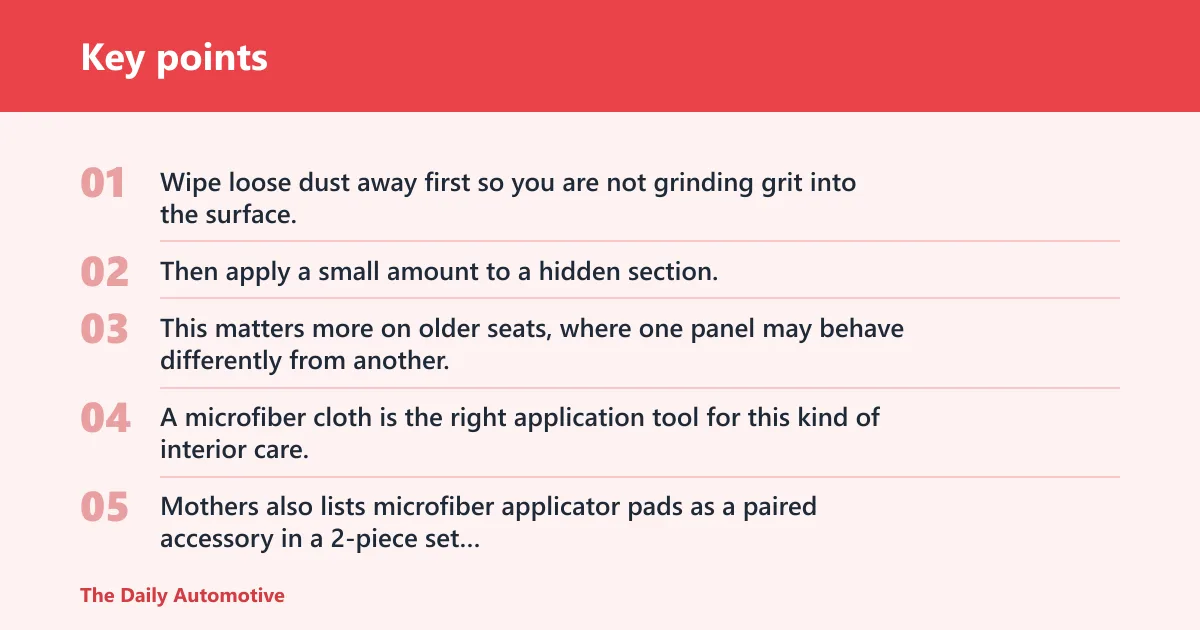
Wipe loose dust away first so you are not grinding grit into the surface. Then apply a small amount to a hidden section, such as the back of a seat base or the lower edge of a bolster, and let it sit long enough to see how the leather reacts. This matters more on older seats, where one panel may behave differently from another.
Apply with microfiber
A microfiber cloth is the right application tool for this kind of interior care. Mothers also lists microfiber applicator pads as a paired accessory in a 2-piece set with 12.5 cm diameter, which can help spread product evenly across larger panels and seat faces.
Work the product into the surface with light pressure. A common first-timer mistake is flooding the leather in one spot, which can lead to blotching in seams and stitching. Thin, even coverage is easier to control and easier to remove cleanly.
Buff dry without residue
After the product has been worked in, use a clean microfiber cloth to wipe residue and dry the surface. That final wipe is what keeps the finish close to OEM-style instead of glossy or slick. If the cloth is loaded with product, switch to a fresh side or a second cloth.
What surfaces should you avoid?
Do not use Mothers VLR on suede or rough leather. Those materials have different textures and absorb product differently, so a general-purpose cleaner can leave uneven appearance, residue, or a patchy feel. If you are unsure, check the manufacturer’s listing for your model and material type.
Suede and rough leather
The dedicated Mothers Leather Cleaner is also not for suede or rough leather. That is an important boundary, because buyers often assume any leather product is safe on every leather-like surface. It is not.
Finish-sensitive interiors
Some interiors need a more controlled approach because older coating layers can react with moisture or leave a temporary darkened look. Mothers Leather Cleaner may darken the surface temporarily after application, so if you are working on a light-colored or aged seat, the hidden-spot check is not optional.
When to stop and switch products
If the surface feels dry after cleaning, or if the seat still looks dull after a careful pass, switch from all-in-one care to the dedicated cleaner and conditioner pair. That two-step path gives you more control over cleaning strength and moisture support.
Does Mothers VLR protect against cracking and fading?
Yes, Mothers VLR is described as helping protect materials from drying, fading, and cracking. That said, protection is not permanent and it is not a substitute for regular care. If the vehicle sits in strong sun or the leather is already dried out, you still need routine maintenance.
Where UV-related care fits
UV protection matters because sunlight is a common reason trim fades and leather dries out over time. The Mothers protectant family also uses UV blocker language in related products, but that does not mean every leather cleaner does the same job in the same way. Read the listing for the exact protection claim.
What protection can and cannot do
Protection helps slow damage. It does not reverse cracking that is already there, and it will not repair worn topcoats. That is why the cleaner choice should match the condition of the seat, not just the material.
Frequently asked questions
Is Mothers VLR Leather Cleaner safe for real leather seats?
Yes, if the seats are finished leather and not suede or rough leather. Mothers VLR is positioned for vinyl, leather, and rubber, and its neutral-pH formula suits routine care. For delicate, heavily worn, or uncertain leather, test a hidden area first before treating the full seat.
Can I use Mothers VLR on vinyl and rubber too?
Yes. Mothers VLR is positioned for vinyl, leather, and rubber, so it makes sense for door trims, dash touch points, and other mixed interior surfaces. That cross-material fit is a major advantage when one cabin has more than one surface type to maintain.
Will Mothers VLR leave a greasy or shiny finish?
It is described as leaving an OEM-style finish, which is the opposite of an overly greasy or high-gloss look. That makes it a practical choice if you want a clean interior appearance without dressing the leather so heavily that it feels slick.
How do you apply Mothers VLR without darkening leather?
Use a hidden-spot check first, then apply a thin layer with a microfiber cloth or microfiber applicator pad. Work it evenly and buff dry with a clean microfiber towel. If the leather darkens temporarily, stop and reassess before treating the rest of the seat.
Should I choose Mothers VLR or a dedicated leather cleaner and conditioner?
Choose VLR for mixed-material interiors and regular upkeep. Choose the dedicated cleaner and conditioner pair when the leather is dry, aging, or needs more precise care. The dedicated route also makes more sense if you want separate control over cleaning strength and moisture restoration.
Products related to this article
Sponsored / affiliate links. As an Amazon Associate I earn from qualifying purchases. I may earn additional commission from eligible campaigns.