My Car Battery Shows 12.3 Volt Is It Normal
Seeing your car battery read 12.3 volts can spark a question in many drivers. Is this number good or bad? For those new to car maintenance, this exact reading can be a bit confusing.
It’s a common point of inquiry, and you might wonder if you need to worry. This guide will make it super simple. We’ll walk you through what 12.3 volts means for your car battery and what to do next.
You’ll feel confident about understanding your car’s power source after reading this.
Understanding Your Car Battery Voltage 12.3 Volt
This section helps you get a clear picture of what a 12.3-volt reading on your car battery actually signifies. Many car owners encounter this voltage reading at some point and wonder about its implications. It’s a common scenario, especially for beginners, because the ideal voltage can fluctuate based on several factors.
We’ll break down the science behind battery voltage in simple terms. Understanding this basic reading is the first step to knowing if your car is ready to start. We’ll look at what this number generally means and when it might suggest a problem.
What Does 12.3 Volts Mean for Your Car Battery
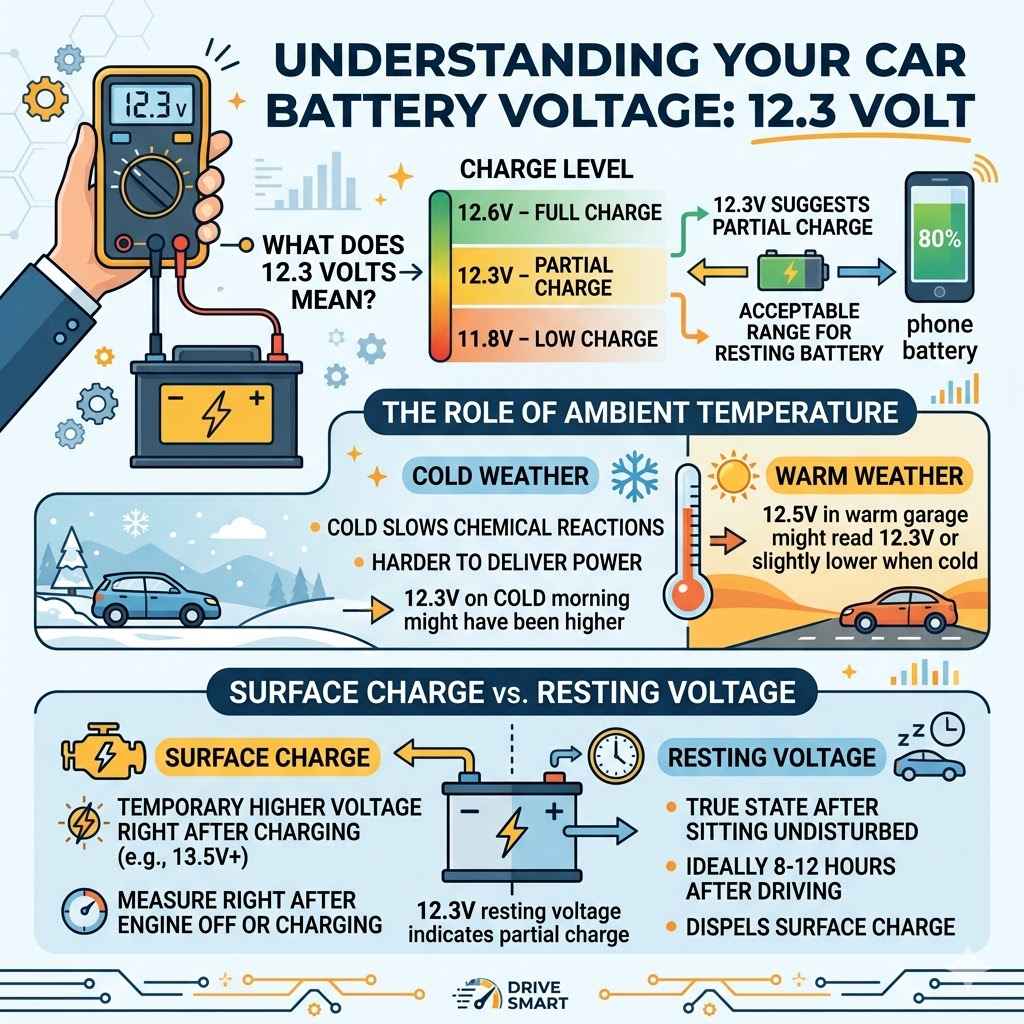
A car battery’s voltage is a key indicator of its charge level. When a car battery is fully charged and not connected to a charging source, it typically reads around 12.6 to 12.7 volts. This is often referred to as a surface charge.
When your car is off and the battery is resting, a reading of 12.3 volts suggests that the battery is not fully charged. However, it doesn’t automatically mean the battery is bad or needs immediate replacement. It simply indicates a state of partial charge.
The exact voltage can vary depending on the battery’s age, temperature, and whether it has recently been used or charged. For instance, if you’ve just turned your car off after a drive, the voltage might be higher due to the alternator charging it. If the car has been sitting for a while, the voltage can naturally drop.
A reading of 12.3 volts, while below the fully charged state, is often still within an acceptable range for a resting battery that isn’t completely depleted.
This voltage level means the battery likely has enough power to start your car under normal conditions. However, it’s not at its optimal potential. Think of it like a phone battery showing 80%; it still works well, but it’s not at 100%.
For a car battery, consistently showing readings around or below 12.3 volts might be a sign that it’s starting to lose its capacity to hold a full charge, especially as it ages.
The Role of Ambient Temperature
The temperature outside your car plays a surprisingly significant role in your car battery’s voltage reading. Cold weather is particularly harsh on batteries. When it’s cold, the chemical reactions inside the battery slow down.
This makes it harder for the battery to deliver its full power. Consequently, a battery that reads 12.3 volts on a cold morning might have been reading higher just hours before in a warmer environment.
Conversely, very hot temperatures can also affect battery performance, though often in different ways, like accelerating degradation. However, for immediate voltage readings, temperature’s primary impact is on the battery’s ability to discharge its stored energy. A battery that might read 12.5 volts in a warm garage could show 12.3 volts or even slightly lower when exposed to freezing temperatures.
This is why it’s important to consider the environmental conditions when interpreting your battery’s voltage. A 12.3-volt reading on a chilly day is much less concerning than the same reading on a hot summer afternoon. Understanding this relationship helps you avoid unnecessary worry and make more accurate assessments of your battery’s health.
Surface Charge vs. Resting Voltage
It’s crucial to distinguish between a surface charge and a resting voltage when checking your car battery. A surface charge is a temporary, higher voltage that appears on the battery’s terminals immediately after it has been charged or discharged. This happens because the chemical process of charging or discharging leaves some electrical potential on the surface of the battery plates.
If you measure your battery’s voltage right after turning off the engine, or immediately after using a charger, you’ll likely see a higher reading, perhaps 13.5 volts or more. This is the surface charge. To get a true resting voltage, you need to let the battery sit undisturbed for several hours, ideally 8 to 12 hours, or at least a few hours after driving.
A resting voltage reading of 12.3 volts, as we discussed, indicates a partial charge. The alternator charges the battery when the engine is running, so if the car has been driven recently, the reading might be higher. However, if the car has been sitting for a while, the surface charge dissipates, and you get the true resting voltage.
So, that 12.3-volt reading is most meaningful when it’s measured after the battery has had time to settle.
What 12.3 Volts Means for Starting Your Car
When your car battery shows 12.3 volts, the most pressing question is: will it still start my car? This section aims to answer that directly and explain the factors involved. For many drivers, the battery is a “black box” – it either works or it doesn’t.
But knowing a little about voltage helps demystify this crucial component. A 12.3-volt reading often causes anxiety for newcomers to car care. We will provide straightforward answers and actionable advice so you can feel confident about your car’s starting ability.
The Minimum Voltage for Starting
The general rule of thumb is that a healthy car battery should be able to provide enough power to start the engine even at a slightly reduced charge. While a fully charged battery is around 12.6 volts, a healthy battery can typically still crank the engine with a resting voltage as low as 12.0 volts. This is because the starter motor requires a significant amount of amperage, not just voltage.
A voltage reading of 12.3 volts suggests that the battery has about 75% of its charge remaining. This is usually more than enough to engage the starter motor and turn the engine over, especially in mild weather conditions. However, it’s on the lower end of what’s considered ideal for reliable starting.
Factors like battery age, the health of the starter motor, and the ambient temperature can all influence whether a 12.3-volt battery will successfully start your car. On a cold day, the engine oil is thicker, making it harder for the starter to turn the engine. This means the battery needs to work harder and deliver more power.
If your battery is only at 12.3 volts, it might struggle in such conditions.
When to Be Concerned About 12.3 Volts
While 12.3 volts is not an immediate cause for panic, it does warrant attention. If you consistently see this reading, or if it drops lower, it could signal that your battery is nearing the end of its lifespan or has an underlying issue. Batteries typically last between 3 to 5 years, and their ability to hold a charge diminishes over time.
You should be more concerned if the 12.3-volt reading is accompanied by other symptoms. These might include slow engine cranking, dim headlights when the engine is off, or electrical issues like flickering dashboard lights. If your car struggles to start or fails to start altogether on a reading of 12.3 volts, it’s a clear sign that the battery needs to be tested or replaced.
Additionally, if you’ve recently jumped your car or it’s been sitting for an extended period, a 12.3-volt reading might be temporary. However, if you regularly check your battery and notice a persistent decline in voltage, it’s wise to get it professionally tested. This could involve a load test, which simulates the demands of starting your car to assess the battery’s true capacity.
Testing Your Battery’s Health
To truly know the condition of your battery, a simple voltage reading isn’t enough. A voltage meter is a useful tool for a quick check, but a more comprehensive test is needed to assess its overall health. Many auto parts stores offer free battery testing services.
These tests go beyond just voltage and measure the battery’s Cold Cranking Amps (CCA) and its ability to hold a charge under load.
A load test is particularly important. It applies a significant electrical load to the battery, mimicking the act of starting your car. If the battery’s voltage drops too low during this test, it indicates that it can no longer supply the required power, even if its resting voltage seems acceptable.
This is often the case with older batteries that might still show a decent voltage but lack the capacity to start your car reliably.
Consider purchasing an inexpensive digital multimeter if you plan to check your battery regularly. You can find them at most hardware or auto parts stores. They are easy to use: connect the red positive lead to the positive terminal of the battery and the black negative lead to the negative terminal.
Ensure the car is off and has been sitting for a few hours for an accurate resting voltage reading.
My Car Battery Shows 12.3 Volt: Is It Normal? Local Guide To Next Steps
So, your car battery reads 12.3 volts. Now what? This section provides a practical, local-focused guide on what to do next.
Understanding this reading is one thing, but taking action is another. For many people, the next step is unclear, especially if they aren’t car experts. This guide aims to simplify the process, offering clear actions you can take right in your own town or neighborhood.
We’ll cover immediate checks and when to seek professional help.
Where to Get Your Battery Checked Locally
If you’re concerned about your 12.3-volt reading and want a professional opinion, your local auto parts stores are an excellent first stop. Most major chains like AutoZone, Advance Auto Parts, O’Reilly Auto Parts, and Pep Boys offer free battery testing services. They have specialized equipment to perform load tests and check your battery’s overall condition.
Simply drive your car into their parking lot, and an associate will usually come out to test your battery. They can tell you if it needs charging, if it’s failing, or if it’s still in good shape. This service is invaluable for car owners who want a clear diagnosis without immediate cost.
Another great local resource is your trusted independent mechanic or a dealership service center. While they will likely charge a diagnostic fee, they can provide a more in-depth inspection of your entire charging system, including the alternator and starter. If you suspect other issues beyond the battery, this is the way to go.
For immediate relief, especially if you notice symptoms of a weak battery, many auto parts stores also sell replacement batteries and can even install them for you on the spot.
When to Consider Battery Replacement
Several indicators suggest it’s time to
If your battery consistently fails load tests, meaning it can’t deliver the necessary power to start your car,
If you live in an area with extreme temperatures, especially harsh winters, a battery that’s already showing signs of weakness might not survive the cold. It’s often better to replace a borderline battery proactively before the weather turns, rather than waiting for it to fail when you need your car the most. The cost of a new battery is usually far less than the inconvenience and potential cost of being stranded.
Charging Your Car Battery Safely
If your 12.3-volt reading is due to the car sitting for a long time or recent short trips, charging the battery might be a viable solution. You can use a portable battery charger, which are readily available at auto parts stores and online. These chargers come in various types, from simple trickle chargers to more advanced smart chargers that monitor the battery and adjust the charging rate.
To charge your battery safely, first disconnect the negative battery cable, then the positive cable. Connect the positive clamp of the charger to the positive battery terminal and the negative clamp to the negative terminal or a known good ground point on the vehicle’s chassis. Ensure the charger is switched off before making connections and switched on only after all connections are secure.
Follow the instructions provided with your specific charger. Most smart chargers will automatically stop charging when the battery reaches full capacity. After charging, allow the battery to rest for a few hours before checking its voltage again.
If it holds a charge well (around 12.6 volts or higher) and your car starts properly, your battery might just need a good charge. If the voltage drops quickly after charging, it indicates the battery is not holding a charge and likely needs replacement.
What Your Alternator Does
It’s important to remember that the alternator is responsible for charging your battery while the engine is running. If your battery voltage is consistently low, even after driving for some time, the alternator might not be functioning correctly. The alternator converts mechanical energy from the engine into electrical energy to power the car’s electrical system and recharge the battery.
A failing alternator can lead to a dead battery because it won’t be able to replenish the charge. Symptoms of a bad alternator can include dimming headlights, dashboard warning lights (often an ammeter or battery symbol), and electrical components not working correctly. If your battery passes a load test but you keep experiencing issues, have your alternator checked by a mechanic.
Most auto parts stores can test your alternator for free as well.
The voltage reading from your car’s system while the engine is running should typically be between 13.7 and 14.7 volts. If it’s significantly lower, the alternator might be the culprit. It’s a good idea to check this reading with a multimeter while the engine is running.
This helps differentiate between a battery problem and an alternator problem, saving you time and money on unnecessary battery replacements.
Troubleshooting My Car Battery Shows 12.3 Volt
When your car battery reads 12.3 volts, it’s natural to want to troubleshoot the issue. This section offers a structured approach to identifying the cause and potential solutions. For those unfamiliar with car systems, the idea of troubleshooting can be intimidating.
We aim to break it down into simple, manageable steps. You’ll learn how to perform basic checks and understand when to seek expert assistance, ensuring you can confidently address your car’s power concerns locally.
Common Causes for Low Battery Voltage
Several factors can contribute to a car battery showing a low voltage like 12.3 volts. One of the most common is simply a battery that is old and has lost its ability to hold a full charge. As batteries age, their internal resistance increases, and their capacity to store energy decreases.
Another frequent cause is parasitic draw. This happens when a component in the car’s electrical system continues to draw power even when the car is turned off, slowly draining the battery.
Short trips or infrequent driving can also lead to low battery voltage. When you only drive for short distances, the alternator doesn’t have enough time to fully recharge the battery. If the battery is also used to power accessories with the engine off (like listening to the radio), this can further deplete its charge.
Extreme temperatures, both hot and cold, can also affect battery performance and its ability to maintain voltage.
Lastly, a faulty charging system, such as a weak alternator or a problem with the voltage regulator, can prevent the battery from being adequately recharged while the engine is running. Identifying the specific cause is key to resolving the issue effectively and ensuring your car starts reliably.
Performing a Parasitic Draw Test
A parasitic draw test helps you find out if something is draining your battery when the car is off. You’ll need a digital multimeter for this. First, ensure the car is turned off and all accessories (lights, radio, etc.) are off.
Close all doors, but make sure the interior lights don’t come on (you might need to trick the door switches into thinking the doors are closed). Let the car sit for about 15-30 minutes to allow the various modules to go into sleep mode.
Set your multimeter to measure amperage (mA or A). Disconnect the negative battery cable. Connect the multimeter’s red probe to the disconnected negative battery cable and the black probe to the negative battery terminal.
This places the multimeter in series with the battery and the car’s electrical system, measuring any current flow.
A normal parasitic draw is typically less than 50 milliamps (0.05 amps). If your reading is higher, you have a parasitic draw. To find the source, start pulling fuses one by one.
When you pull a fuse and the amperage reading on your multimeter drops significantly, you’ve found the circuit that’s causing the draw. You can then investigate the components on that specific circuit to find the faulty part.
When to Seek Professional Help
If you’ve performed basic checks like testing the voltage and checking for obvious corrosion, but you’re still unsure about the cause of your 12.3-volt reading, it’s time to consult a professional. This is especially true if you’re uncomfortable performing tests like the parasitic draw test, or if you suspect issues with your alternator or starter. A qualified mechanic has the experience and specialized tools to accurately diagnose complex electrical problems.
Persistent battery drain, frequent jump-starts, or a battery that dies shortly after being fully charged are all indicators that professional diagnosis is needed. Don’t underestimate the value of an expert opinion, especially if it prevents you from replacing parts unnecessarily or experiencing a breakdown in an inconvenient location. Local mechanics and dealership service centers are your best bet for reliable repairs.
Remember, a functioning charging system and a healthy battery are critical for your vehicle’s reliability. If you’re experiencing persistent issues with your car battery, it’s always better to err on the side of caution and seek professional guidance. They can confirm if it’s truly the battery or another part of the system that needs attention.
Conclusion
A car battery showing 12.3 volts means it’s not fully charged but usually still good for starting your car. Check your battery’s age and test it locally at an auto parts store. If it’s old or fails a load test, consider a replacement.
Ensure your alternator is working correctly by having it tested too. You’ve got this!