Oldsmobile’s Genius Mistake: Chrysler’s Best Drivetrain
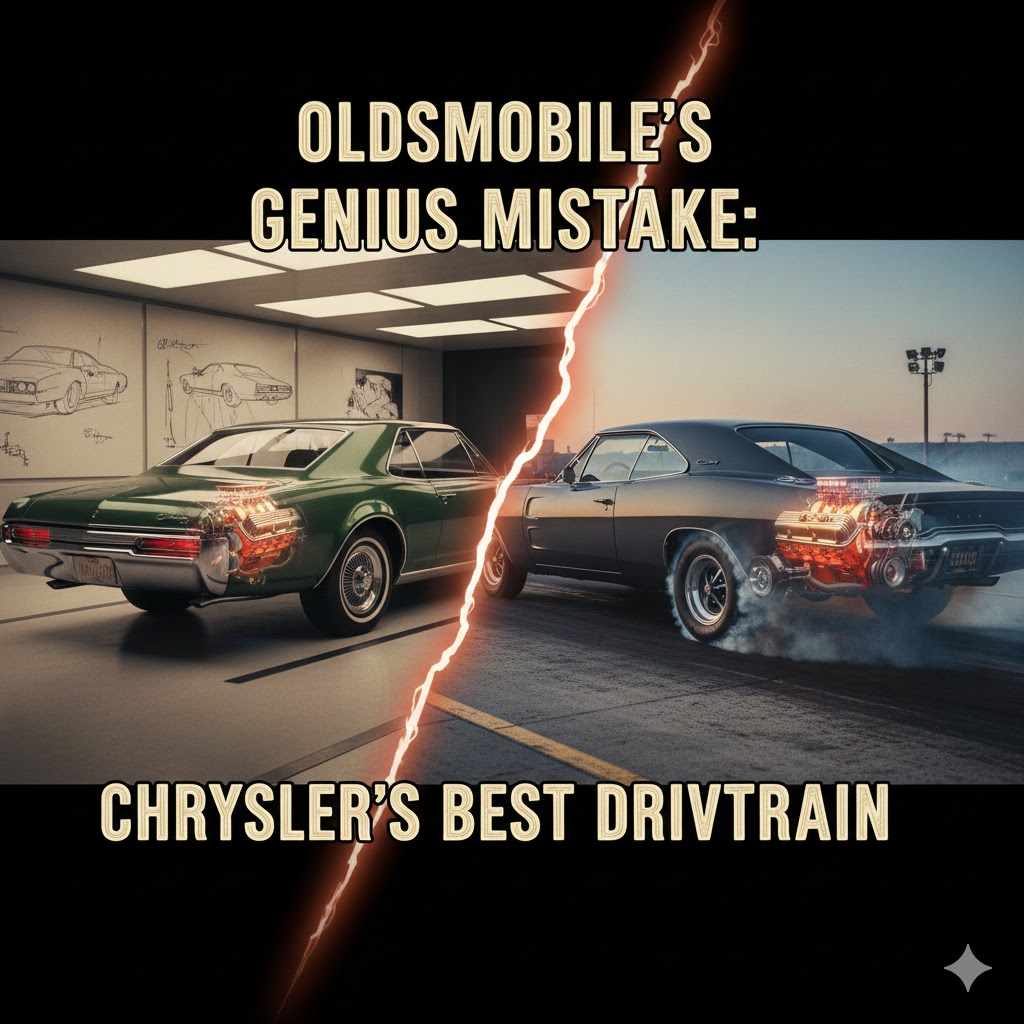
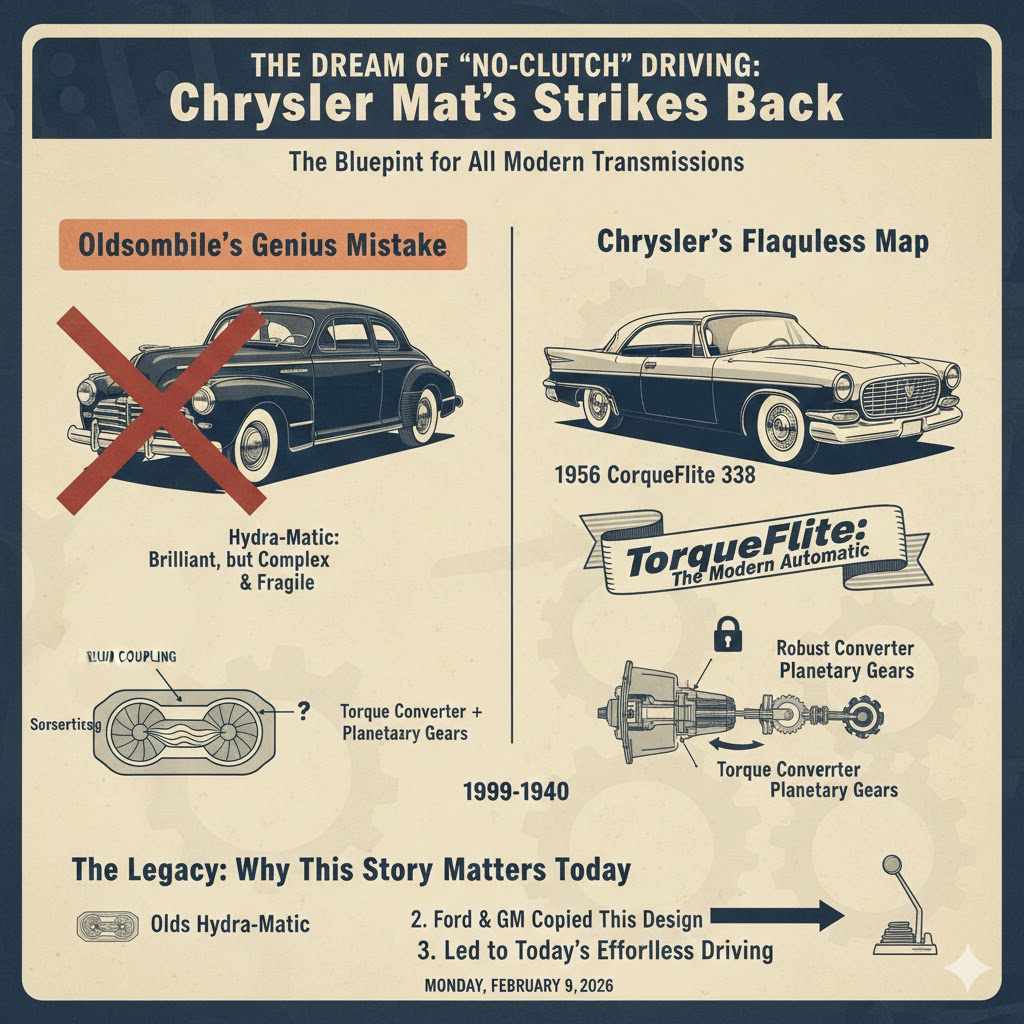
Oldsmobile invented the first mass-produced automatic transmission, the Hydra-Matic, which was a revolutionary but flawed design with harsh shifts. Chrysler later perfected the concept with its TorqueFlite transmission, which was incredibly smooth and reliable, setting the standard for the modern automatic drivetrain that we still use in principle today.
Have you ever thought about how easy it is to drive your car? You put it in “Drive” and you go. There’s no clutch pedal to press, no gears to grind. It’s simple. But it wasn’t always this easy. The journey to the smooth, effortless driving we enjoy today is a fascinating story of a brilliant idea and a perfect correction. It’s a tale of two car giants, Oldsmobile and Chrysler, and how one’s “genius mistake” led to the other’s greatest success. In this guide, we’ll explore this amazing piece of car history in a way that’s easy to understand. Let’s dive in!
The Dream of “No-Clutch” Driving: Oldsmobile’s Hydra-Matic
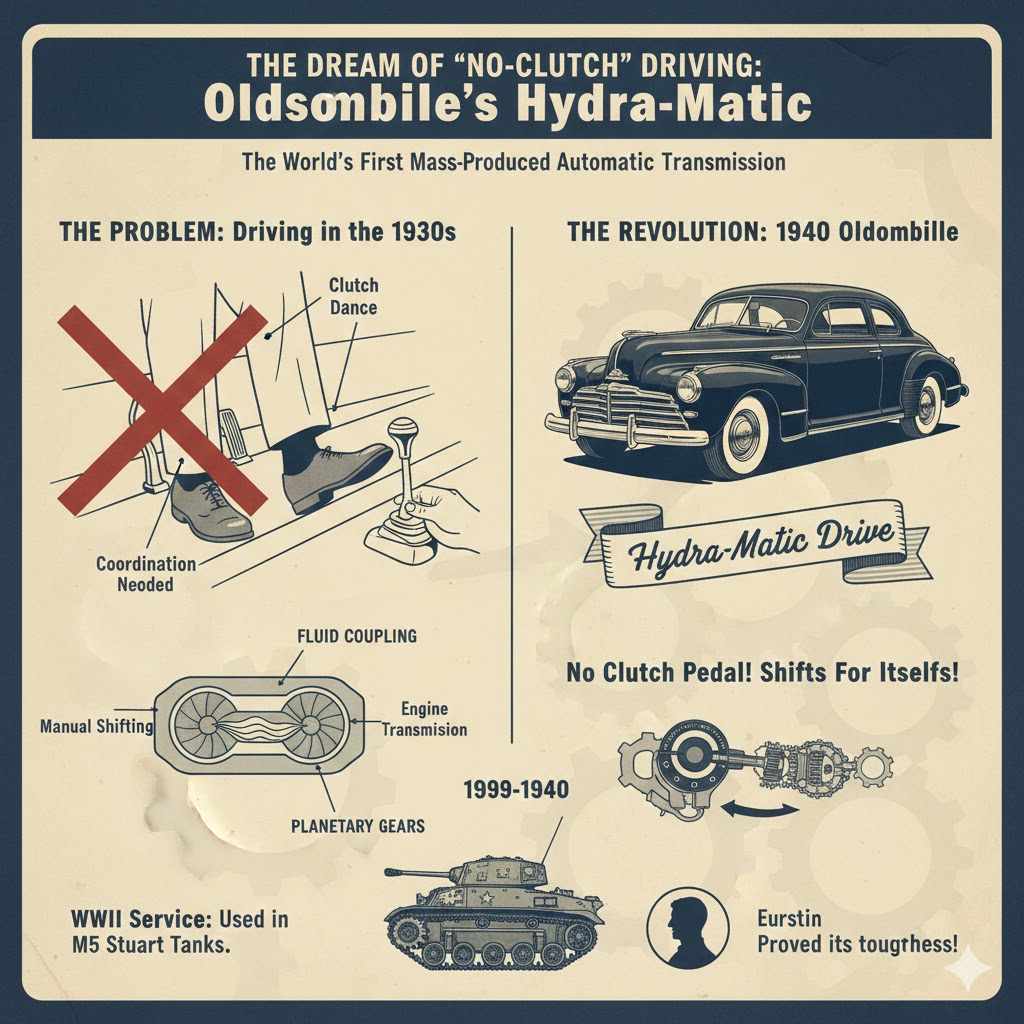
Imagine driving in the 1930s. Every stoplight, every hill, and every change in speed required a dance between your feet and your right hand. You had to press the clutch pedal with your left foot, move the gear shifter with your hand, and carefully release the clutch while giving it gas with your right foot. It took skill and coordination. For many, it was a barrier to driving altogether. General Motors (GM), the parent company of Oldsmobile, saw an opportunity to change everything.
Their engineers, led by a visionary named Earl Thompson, worked for years on a secret project. Their goal was simple but incredibly ambitious: create a transmission that could shift gears all by itself. They wanted to build a car that anyone could drive without the hassle of a clutch pedal. After countless designs and tests, they finally succeeded.
In 1939, for the 1940 model year, Oldsmobile introduced the “Hydra-Matic Drive.” It was the world’s first mass-produced, fully automatic transmission available to the public. This wasn’t a half-step; it was a giant leap into the future. For an extra fee, you could buy an Oldsmobile that did the shifting for you. It was pure magic to the average driver.
How Did the Hydra-Matic Work?
Without getting too technical, the Hydra-Matic replaced the traditional clutch with something called a “fluid coupling.” Think of it like two fans facing each other. The engine spins one fan, and the air from that fan spins the second fan, which is connected to the transmission. There’s no physical connection, just a transfer of power through fluid. This allowed the engine to idle while the car was stopped without stalling.
From there, a complex system of hydraulic controls and planetary gears (sets of gears within gears) would automatically select one of its four forward speeds. It was an engineering marvel. The public was amazed, and it was a huge selling point for Oldsmobile and Cadillac, which soon offered it as well.
The Hydra-Matic even proved its toughness during World War II, where a modified version was used in light tanks like the M5 Stuart. This wartime service gave it a reputation for being strong. But despite its brilliance, it wasn’t perfect.
A Brilliant Idea with a Few Hiccups: The Hydra-Matic’s Flaws
Oldsmobile’s Hydra-Matic was a genius invention. It completely changed the automotive landscape and proved that clutchless driving was possible. But being the first to do something often means you’re also the first to discover the problems. This is what I call the “genius mistake.” The idea was brilliant, but the execution had room for improvement.
Drivers who owned a Hydra-Matic-equipped car noticed a few things. The biggest issue was the shift quality. The transmission worked, but it wasn’t exactly graceful.
- Harsh Shifts: When the Hydra-Matic shifted from first to second gear, there was a very noticeable “clunk.” The car would lurch a bit as the gears changed. While it was better than stalling a manual, it lacked the smoothness drivers craved.
- Complexity: For its time, the Hydra-Matic was incredibly complex. It had a maze of internal valves, tubes, and controls. If something went wrong, many mechanics were not equipped or trained to fix it properly. This could lead to expensive and frustrating repairs.
- Maintenance Needs: It required careful maintenance. If the fluid level was low or the bands inside were not adjusted correctly, its performance suffered dramatically, making the shifts even harsher.
So, while Oldsmobile gets full credit for inventing the automatic transmission, they also created a system that left people wanting something a little bit better. They opened the door, but another company would walk through it and build a masterpiece.
Hydra-Matic: Strengths vs. Weaknesses
Here’s a simple breakdown of the good and the not-so-good of Oldsmobile’s groundbreaking transmission.
| Feature | Strength (The Genius) | Weakness (The Mistake) |
|---|---|---|
| Innovation | It was the first true automatic. It changed driving forever! | Being first meant it had undiscovered flaws. |
| Driving Experience | No clutch pedal made driving in traffic much easier. | The shifts between gears could be clunky and jarring. |
| Mechanics | It used a clever system of gears to provide four speeds. | It was very complex and difficult for mechanics of the era to service. |
| Legacy | Proved that a reliable automatic transmission was possible. | Its imperfections created an opportunity for a competitor to build something better. |
Chrysler Steps In: Perfecting the Automatic Transmission
While GM was busy selling its revolutionary Hydra-Matic, engineers at the Chrysler Corporation were watching, learning, and taking notes. Chrysler had a reputation for solid, careful engineering. They preferred to release products that were thoroughly tested and exceptionally durable, rather than rushing to be first to market.
Chrysler didn’t jump straight into a fully automatic transmission. They took it step-by-step. First, they introduced “Fluid Drive” in the 1940s. This was a semi-automatic system. It used a fluid coupling like the Hydra-Matic, so you could stop the car in gear without using the clutch. However, you still had to use the clutch to change between gear ranges (low and high). It was an improvement, but not fully automatic.
Their next step was the PowerFlite transmission in 1953. This was Chrysler’s first two-speed, fully automatic transmission. It was simpler and smoother than the Hydra-Matic, but having only two gears limited its performance. It was a good transmission, but it wasn’t the game-changer they were looking for.
All this time, Chrysler’s engineers were working on their masterpiece. They had analyzed the Hydra-Matic’s strengths and weaknesses. They knew they needed to create something that was not only automatic but also incredibly smooth and “bulletproof” in its reliability. In 1956, they unveiled it: the TorqueFlite.
What Made the Chrysler TorqueFlite So Good?
The TorqueFlite wasn’t just another automatic transmission; it was a complete re-imagining of what an automatic could be. It was so well-designed that its basic principles dominated the industry for decades and are still influential today. So, what was Chrysler’s secret sauce?
There were two key ingredients that made the TorqueFlite superior:
1. The Torque Converter
This was the biggest leap forward. The TorqueFlite replaced the simple fluid coupling with a true torque converter. While they sound similar, a torque converter is much more advanced. In addition to transferring power through fluid, it could also multiply the engine’s torque (its twisting force) at low speeds.
Think of it this way: when you step on the gas from a dead stop, the torque converter gives the drivetrain an extra “shove.” This resulted in incredibly smooth, strong, and seamless acceleration. The “clunk” of the Hydra-Matic was gone, replaced by a silky-smooth surge of power. For more detail on how this amazing device works, you can explore exhibits on automotive technology at museums like the Smithsonian’s National Museum of American History.
2. Simple, Strong Design
Chrysler’s engineers were masters of simplicity. While the Hydra-Matic was a puzzle of complex parts, the TorqueFlite was elegant in its design. It used a clever arrangement of planetary gears (called a Simpson gearset) that was both more compact and much stronger. It had fewer internal parts to fail, making it far more reliable and easier to build and service.
The result was a transmission that was famous for its toughness. The TorqueFlite could handle the massive power of Chrysler’s Hemi V8 engines without breaking a sweat. It quickly earned a reputation for being nearly indestructible, a quality that hot-rodders and everyday drivers alike came to appreciate.
- Unmatched Smoothness: The combination of the torque converter and three speeds made driving feel luxurious and effortless.
- Legendary Durability: The TorqueFlite could last for hundreds of thousands of miles with basic care. Many are still on the road today.
- Push-Button Control: For a touch of futuristic flair, early TorqueFlite-equipped cars featured a panel of push-buttons on the dashboard to select gears, instead of a traditional column or floor shifter.
Head-to-Head: Hydra-Matic vs. TorqueFlite
Let’s put the two pioneering transmissions side-by-side to see how they stacked up.
| Feature | Oldsmobile Hydra-Matic (1940) | Chrysler TorqueFlite (1956) |
|---|---|---|
| Core Technology | Fluid Coupling | Torque Converter |
| Number of Gears | Four Forward Speeds | Three Forward Speeds |
| Shift Quality | Functional, but often harsh and clunky. | Exceptionally smooth and nearly seamless. |
| Reliability | Good for its era, but complex and prone to issues if not maintained. | Legendary. Considered one of the most durable automatics ever made. |
| Overall Impact | The Pioneer: It proved automatics could work. | The Blueprint: It set the standard for all future automatics. |
Why This Story Matters to You Today
This piece of automotive history isn’t just a fun fact; it directly impacts the car sitting in your driveway. The automatic transmission you use every day is a direct descendant of the Chrysler TorqueFlite. The core principles—a torque converter smoothly sending power to a set of robust planetary gears—became the gold standard for the entire auto industry.
Ford, GM, and car companies around the world eventually abandoned their early, complex designs and adopted systems that worked much more like the TorqueFlite. Oldsmobile’s “genius mistake” was in creating a product that was 80% of the way there. It showed everyone the destination, but Chrysler was the one that drew the perfect map to get there.
This story is a perfect example of how innovation works. Sometimes, the person with the initial idea doesn’t create the final, perfect version. It takes a second look, a fresh perspective, and a focus on refinement to turn a brilliant concept into a flawless reality. The competition between these companies ultimately benefited everyone. It pushed engineers to build better, stronger, and smoother transmissions, leading directly to the reliable and effortless driving experience we take for granted today.
Frequently Asked Questions
So, did Oldsmobile invent the very first automatic transmission?
Yes, Oldsmobile was the first to mass-produce and sell a fully automatic transmission, the Hydra-Matic, starting in 1939. While other inventors had experimented with automatic shifting concepts before, Oldsmobile was the first to make it a commercially successful reality for the average car buyer.
What was so special about Chrysler’s TorqueFlite?
The TorqueFlite’s magic was in its combination of smoothness and strength. It used a modern torque converter for seamless acceleration and had a simpler, more robust internal design. This made it far more reliable and pleasant to drive than its competitors at the time.
Was the Oldsmobile Hydra-Matic a total failure?
Absolutely not! The Hydra-Matic was a revolutionary success. It was sold in millions of cars and proved that the concept of an automatic transmission was viable. It was a hugely important stepping stone, but its design had flaws (like harsh shifting) that were later improved upon by competitors.
Why do you call it a “genius mistake”?
It’s a “genius mistake” because the idea itself—a fully automatic transmission for the public—was pure genius. It changed driving forever. The “mistake” part refers to the execution, which wasn’t perfect. Its flaws, like the clunky shifts, left the door open for another company like Chrysler to come in and perfect the design.
Do modern cars still use this technology?
Yes, in principle. While modern automatic transmissions have more gears (some have 8, 9, or even 10 speeds) and are controlled by computers, most of them are still based on the fundamental design of the TorqueFlite: a torque converter connected to a set of planetary gears. The blueprint Chrysler created in 1956 was that good.
Which was better for its time, the Hydra-Matic or the TorqueFlite?
When the Hydra-Matic was launched in 1940, it was the best in the world because it was the only one. However, by the time the TorqueFlite arrived in 1956, it was clearly the superior design in terms of smoothness, reliability, and performance. It made the Hydra-Matic feel dated almost overnight.
Could you buy other car brands with a Hydra-Matic transmission?
Yes, you could. The Hydra-Matic was so successful and well-regarded (despite its flaws) that GM sold it to many other automakers, including Lincoln, Hudson, Nash, and even Rolls-Royce for a time. This was before every company designed its own transmissions in-house.
From Clunky Shifts to Smooth Sailing
The next time you slide your car’s shifter into “D” and pull away from a curb without a second thought, take a moment to appreciate the journey that made it possible. It started with Oldsmobile’s bold and brilliant leap into the unknown. They dared to build something no one else had, and in doing so, they changed the world of driving. Their Hydra-Matic wasn’t perfect, but it was the essential first step.
Then came Chrysler, the methodical engineers who studied that first step, understood its shortcomings, and built a better path forward. The TorqueFlite wasn’t just an improvement; it was the perfection of an idea. It delivered the smooth, strong, and reliable performance that drivers had dreamed of.
In the end, this isn’t a story of one winner and one loser. It’s a story of innovation and refinement. Oldsmobile’s genius gave us the dream of automatic driving, and Chrysler’s engineering excellence made that dream a flawless reality for generations to come. Understanding this history doesn’t just make you a more knowledgeable car owner—it gives you a deeper appreciation for the incredible machine you rely on every single day.