Car Culture: Lifestyle or Passion? Signs, Costs, and Fit
Car culture usually starts as a hobby. It becomes a lifestyle when it shapes spending, schedule, and social circle, and it becomes an identity when cars steer daily choices. A useful rule is around 5 or more hours a week or a notable share of discretionary money. Miss that line, and you can overcommit cash, time, and attention to something that should fit your life, not strain it. This guide breaks down the signs of each level, the costs, and a quick self-check to find where you fit.
What car culture actually means
Car culture is a shared set of beliefs, values, and community practices around automobiles, not just the act of owning one. It includes car meets in parking lots and fairgrounds, custom builds, online forum threads, and the idea that vehicles can signal identity, taste, and status.
Shared values, rituals, and knowledge
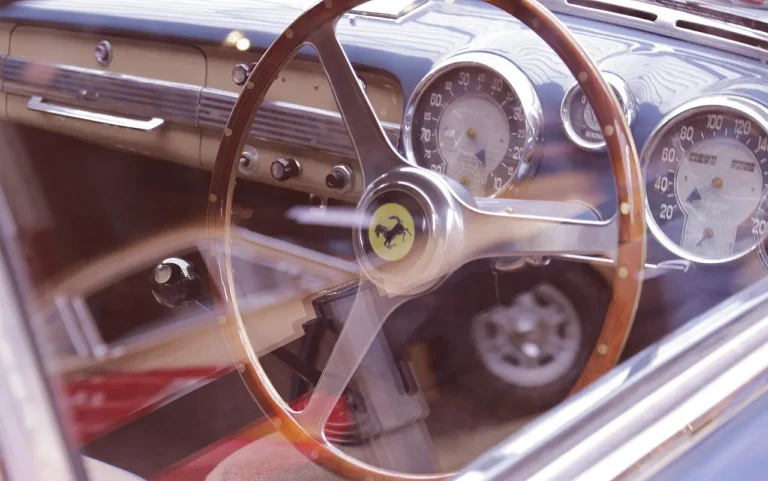
At its core, car culture depends on participation. Early car culture grew from a strong passion for automobiles, with enthusiasts gathering to talk parts, compare builds, and plan events. Today that can include classic car restoration, street racing circles, and EV owners who follow efficiency and charging data.
The rituals are familiar: cleaning a car before a meet, opening the hood for questions, swapping part numbers, or posting progress photos after a garage session. Those habits turn a machine into a social object.
How car culture differs from simple car ownership
Car ownership means you have a vehicle for transport. Car culture means the vehicle becomes part of how you spend time, how you learn, and how you connect with others. Car ownership can be practical. Car culture adds involvement.
A daily driver with no clubs, events, or maintenance interest is still car ownership. Add weekend detailing, forum research, meet attendance, and planned upgrades, and the car starts to sit inside a wider culture.
Why identity and personality matter here
Cars can signal identity and taste. That is why status symbols matter in this space. A build can say more about taste, technical priorities, or social belonging than about transportation alone.
That identity layer is why car culture reaches beyond owning and driving vehicles. It can shape what people wear, what they listen to, and what they post on Instagram or TikTok. It can also shape how they present themselves at a meet or show.
📊 Road & Track’s car culture hub includes features like Dakar, rally, F1, and Monterey Car Week. Source: Car Culture.
Is car culture a lifestyle or a passion?
Car culture is often a passion first, but it becomes a lifestyle when cars influence your budget, schedule, appearance, and social habits. Most people sit somewhere in the middle. The difference is not the car itself; it is how deeply the car shapes the rest of life.
Passion as interest and participation
Passion can be light or intense. A person may follow motorsport, read build threads, or attend the occasional show without organizing life around cars. That is real participation, but it is still a hobby unless it starts taking regular time and money.
Lifestyle as a broader pattern
A lifestyle pattern appears when cars affect weekend planning, storage choices, insurance decisions, clothing, photography, travel, and social circles. Car culture now influences fashion, social media, career paths, and city planning, so the lifestyle version reaches beyond the garage.
Say your calendar fills around meets, track days, or restoration deadlines, and your discretionary budget consistently goes toward tires, tools, and entry fees. That is no longer casual interest. It is a recurring way of living.
Where most readers will land
Most people are not full-time lifestyle participants. They are hobbyists with selective intensity. They may love a platform, follow a few builders, and spend on maintenance and occasional upgrades without letting the car scene dictate daily choices.
What activities count as car culture?
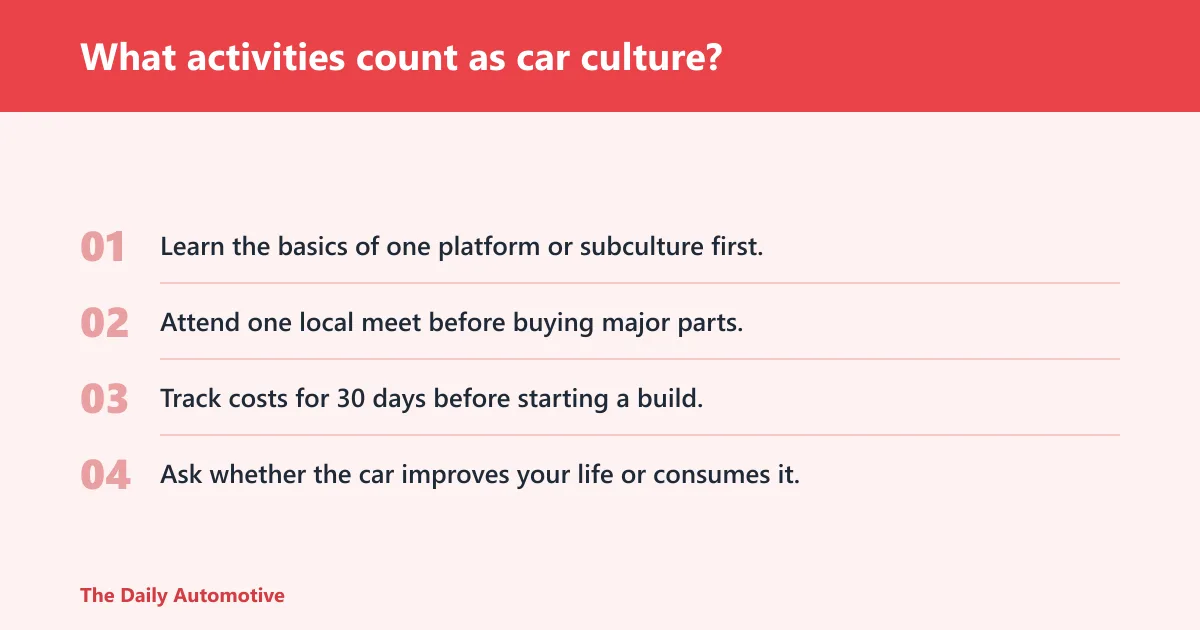
Car culture includes social events, technical work, and online participation. The common thread is active involvement. Car meets, car shows, customization, forums, and social media groups are the clearest touchpoints.
Car meets and the social side of the scene
Car meets are social gatherings built around parked cars, conversation, and comparison. They are a community-building activity, often paired with parts swaps and group photos. The event format matters because it gives people a reason to gather, ask questions, and learn by proximity.
Car shows and public recognition
Car shows are a public marker of participation. They reward preparation, presentation, and networking. For some people, a show is about winning. For others, it is about meeting builders, seeing rare parts, or checking how a project compares with others in the same segment.
Customization, from visual changes to mechanical upgrades
Customization is one of the defining practices of car culture. It includes visual changes such as wheels, wraps, and lighting, but also mechanical work such as suspension, brakes, cooling, tuning, and restoration. It is a way to express personality and status while changing performance or usability.
Online forums and social media groups
Online forums and social media groups are central to the digital-age community. They help link enthusiasts across cities, archive repair knowledge, and spread event news. They also create pressure to keep up with trends, parts, and presentation standards.
- Learn the basics of one platform or subculture first.
- Attend one local meet before buying major parts.
- Track costs for 30 days before starting a build.
- Ask whether the car improves your life or consumes it.
How car culture affects identity and community
Car culture affects identity by giving people a language of taste, effort, and belonging. It affects community by creating shared rituals, technical exchanges, and informal status systems around builds, attendance, and knowledge. The car becomes a signal, not only a machine.
Status, taste, and self-expression
Within a scene, a car can signal restraint, originality, financial commitment, or technical skill. A classic restoration says something different from a track-focused hatchback or a lifted overlander. The message is not universal, but it is legible to people inside the culture.
Picture a driver with a clean, stock-looking sedan at a meet. One crowd reads it as understated taste; another sees missed potential. That split shows why car culture can reward very different choices at once.
How enthusiasts build community across distance
Community does not require the same zip code. Online groups, message boards, and platform-specific communities allow people to trade advice, compare parts, and plan meetups across cities. That is why car culture can feel local and national at the same time.
Why certain builds become signals within the scene
Some builds become signals because they are expensive, rare, difficult to finish, or tied to a specific heritage. Classic cars often signal patience and preservation. JDM builds may signal platform knowledge. Off-road and overlanding setups signal utility, travel, and a readiness for rough terrain.
How car culture changed in the digital age
Car culture changed in the digital age by moving discovery, advice, and reputation online. Forums, group chats, and social platforms made it easier for enthusiasts to find each other, compare builds, and organize events. The tradeoff is that expectations rose just as access widened.
Forums, group chats, and platform-based communities
Online spaces made niche interests easier to sustain. A person interested in diesels, Vespas, kid ride-on electric cars, Dakar, rally, F1, or Monterey Car Week can now find a community quickly. That wider access changed who gets included and how fast knowledge spreads.
Social media as a discovery tool and a pressure source
Social media helps new people discover events, parts, and build styles. It also creates a comparison loop. Cars are photographed, edited, and ranked for attention, which can make the scene feel more polished than real life and more expensive than it has to be.
How online spaces widened access and raised expectations
The upside is connection. The downside is pressure. A beginner can learn a lot online, but can also feel pushed toward expensive modifications, constant posting, or a polished identity that does not match their budget or goals.
Car culture across subcultures
Car culture is not one thing. Classic restoration, JDM, stance, motorsport, off-road, EV, and overlanding each value different vehicles, skills, and social rules. The same culture looks different depending on what the group rewards.
Classic cars and restoration
Classic cars often center on heritage, parts sourcing, and restoration. The work can be slow and expensive, with storage, paint, and trim parts adding up fast. The reward is preservation and mechanical history as much as driving.
JDM, stance, motorsport, off-road, EV, and overlanding
JDM culture often prizes platform knowledge and parts compatibility. Stance emphasizes fitment and appearance. Motorsport prioritizes lap times and setup. Off-road and overlanding focus on durability, clearance, and range. EV enthusiasts often center efficiency, software, and charging strategy.
These lanes can overlap, but they do not ask for the same budget or the same kind of commitment. A track setup can be expensive in tires and brake pads. An overland build can be expensive in storage, racks, and recovery gear. An EV crowd may spend more time on charging access and software than on wrenching.
Can car culture turn into a career?
Yes. Automotive passion can lead into engineering, design, mechanics, journalism, racing, and photography. It does not happen automatically, but the same interest that drives weekend activity can become technical skill, content work, or paid performance.
Engineering, design, mechanics, journalism, racing, and photography
These careers map directly onto different parts of car culture. Engineering and design shape future vehicles. Mechanics keep them running. Journalism explains them. Racing uses them in competition. Photography records them for events, launches, and features.
When passion becomes professional work
The shift changes the relationship to the hobby. Deadlines replace free time. Spending may drop in one area and rise in another. Passion still matters, but income, reliability, and reputation become part of the equation.
What changes when the hobby becomes income
Once a car interest becomes work, the behavior changes. Personal taste may matter less than client needs, editor needs, or team goals. That can be rewarding, but it can also reduce the freedom that made the hobby appealing in the first place.
How to tell where you fit on the participation ladder
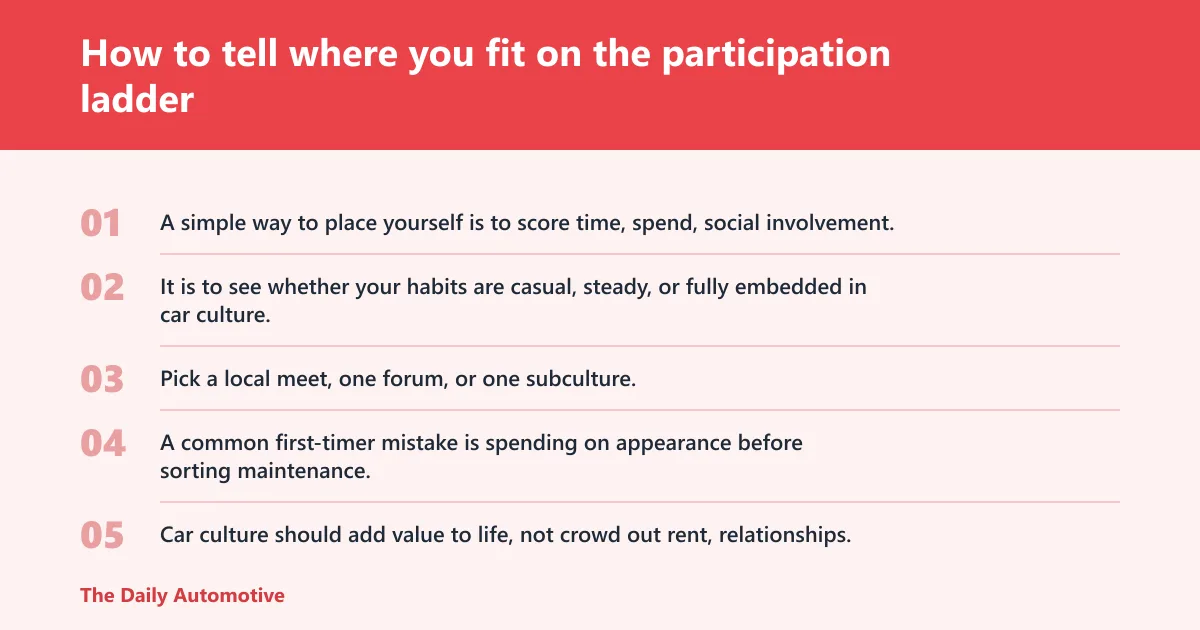
A simple way to place yourself is to score time, spend, social involvement, and modification intensity. The point is not to rank people. It is to see whether your habits are casual, steady, or fully embedded in car culture.
3-tier participation checklist
| Tier | Time | Spend | Social involvement | Modification intensity |
|---|---|---|---|---|
| Hobbyist | Under 5 hours a week | Under 5% of discretionary money | Occasional meet or online browsing | Maintenance and light cosmetic changes |
| Enthusiast | 5-10 hours a week | 5-10% of discretionary money | Regular meets, forums, or club activity | Moderate visual or mechanical upgrades |
| Lifestyle participant | 10+ hours a week | 10%+ of discretionary money | Frequent events, group chats, travel, and content sharing | Ongoing builds, track prep, restoration, or multiple cars |
Self-assessment table
| If most of these are true | Your likely fit |
|---|---|
| You enjoy cars but plan around them only sometimes | Hobbyist |
| You attend meets, follow builds, and budget for upgrades | Enthusiast |
| Your schedule, spending, and social circle revolve around cars | Lifestyle participant |
How to join without overcommitting
Start with one lane. Pick a local meet, one forum, or one subculture, then set a budget and a storage limit before buying parts. A common first-timer mistake is spending on appearance before sorting maintenance, insurance, and space. That order gets expensive fast.
Car culture should add value to life, not crowd out rent, relationships, or basic reliability. If the numbers do not work, step back and keep the participation level where it fits.
Frequently asked questions
What makes car culture different from a hobby?
A hobby can be occasional and self-contained. Car culture adds shared practices, meetups, knowledge exchange, identity, and community. It is less about a single activity and more about a network of habits around vehicles, events, and modification.
What activities are part of car culture?
Common activities include car meets, car shows, customization, DIY maintenance, forum participation, and social media group discussions. Road trips, track days, restoration projects, and event attendance also fit, depending on the subculture and the level of commitment.
How has car culture changed in the digital age?
Online forums and social media groups made it easier for enthusiasts to find one another, share knowledge, and organize events. That widened access across regions, but it also raised expectations around presentation, speed of progress, and constant online participation.
Can car culture lead to career paths?
Yes. Car passion can lead into engineering, design, mechanics, journalism, racing, and photography. The same interest that starts with weekend events or build threads can become technical training, media work, or competition if it is developed with purpose.
Products related to this article
Sponsored / affiliate links. As an Amazon Associate I earn from qualifying purchases. I may earn additional commission from eligible campaigns.