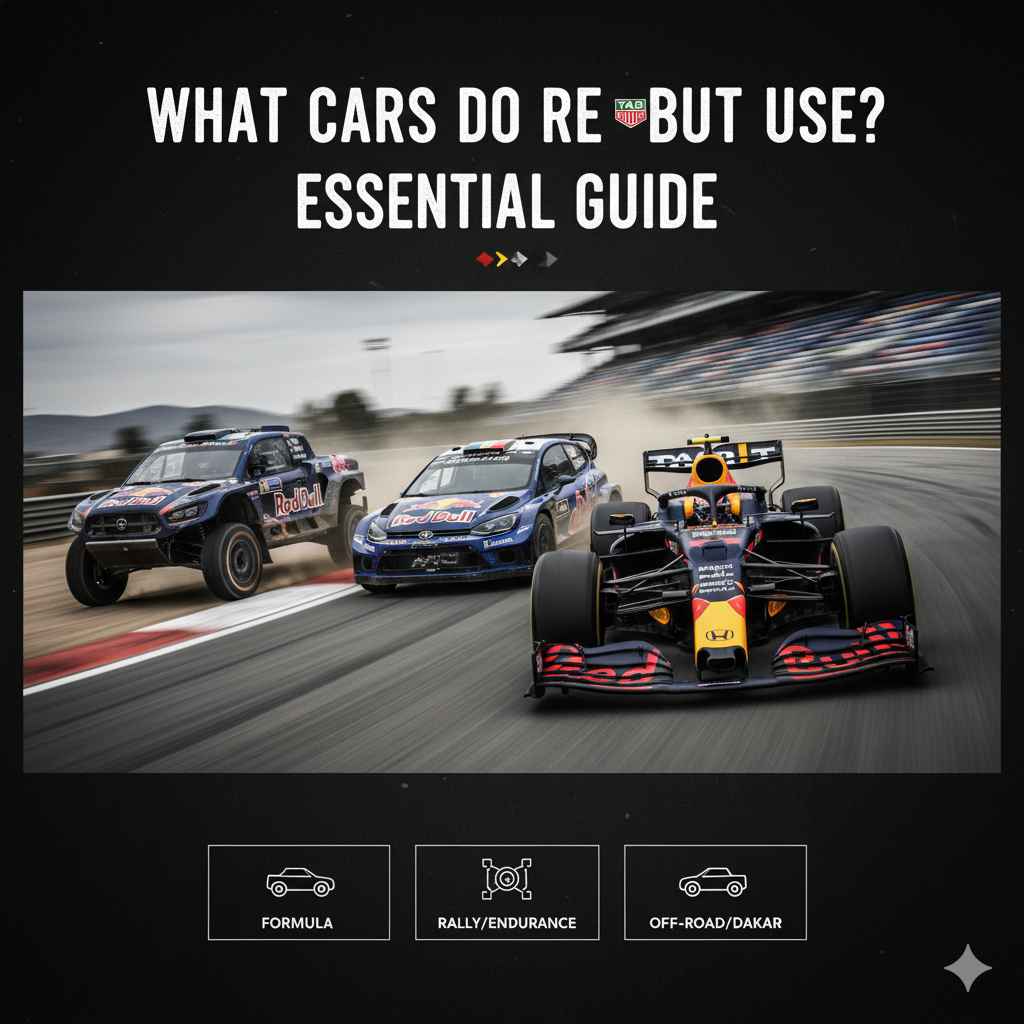
What Cars Do Red Bull Use? Essential Guide
Red Bull Racing primarily uses specialized Formula 1 cars for their racing team, not standard production vehicles. These high-performance machines are custom-built for competition and are distinct from any road-legal cars you’d find at a dealership.
Ever wondered what amazing machines power the Red Bull Racing team? It’s a question many fans ask, especially when seeing those incredible speeds on screen. You might picture sleek sports cars or powerful SUVs, but the reality is quite different and much more specialized! Red Bull doesn’t just drive any car; they engineer the pinnacle of motorsport technology for their Formula 1 team. This guide will break down exactly what kind of “cars” Red Bull uses, why they’re so unique, and what makes them so fast. Get ready to discover the fascinating world of Formula 1 engineering!
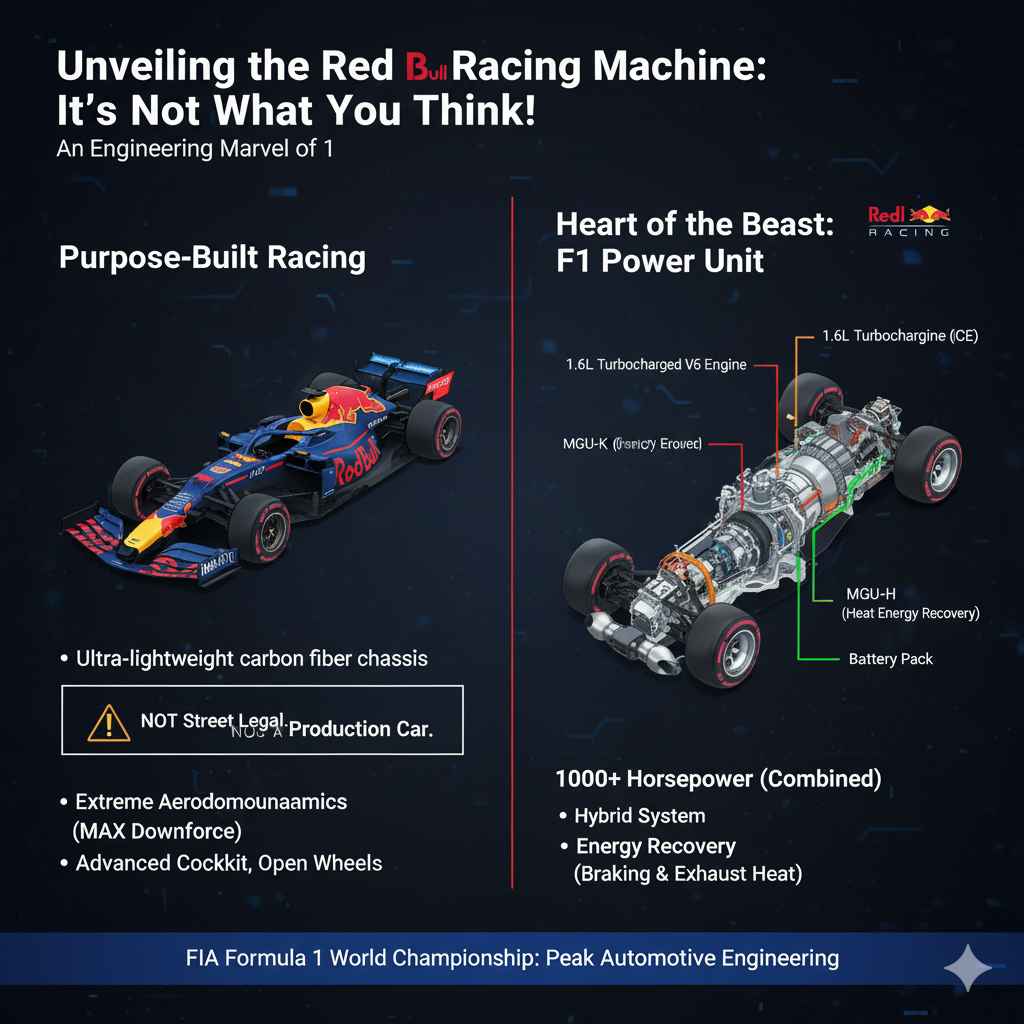
Unveiling the Red Bull Racing Machine: It’s Not What You Think!
When we talk about “cars” Red Bull uses, it’s crucial to understand we’re not discussing everyday vehicles. Red Bull Racing competes in the FIA Formula One World Championship, the highest class of international racing for single-seater formula racing cars. The cars they use are purpose-built, incredibly complex, and designed purely for speed and performance on the racetrack. These aren’t cars you can buy at a dealership or even see on public roads. They are bespoke racing machines, each component meticulously crafted and tested.
Think of them as ultra-lightweight, aerodynamic rockets on wheels. They have open cockpits, open wheels, and an open engine, unlike the enclosed bodies of production cars. The design philosophy is all about generating maximum downforce to hug the track at extreme speeds, advanced suspension systems for precise handling, and powerful hybrid powertrains for blistering pace.
The Heart of the Beast: Formula 1 Power Units
The engine, or rather, the power unit, in a Formula 1 car is a marvel of engineering. It’s not just a V8 or V6 engine like you might find in some sports cars. Modern F1 power units are highly complex hybrid systems. They combine a turbocharged 1.6-liter V6 internal combustion engine with sophisticated energy recovery systems.
These energy recovery systems are key to their incredible performance and efficiency. They capture energy in two main ways:
- MGU-K (Motor Generator Unit – Kinetic): This unit recovers kinetic energy that would normally be lost as heat during braking. It then deploys this energy as an electrical boost, much like a KERS (Kinetic Energy Recovery System) or ERS (Energy Recovery System) of the past, providing extra power to the wheels.
- MGU-H (Motor Generator Unit – Heat): This unit captures heat energy from the exhaust gases. This energy can be used to power the MGU-K or to spool up the turbocharger, reducing turbo lag and ensuring a more immediate power delivery.
This hybrid setup allows F1 cars to produce over 1000 horsepower combined, yet still operate with remarkable fuel efficiency. The intricate balance between the internal combustion engine and the electric components is what gives these cars their explosive acceleration and sustained high speeds.
For the official technical specifications, you can refer to the FIA Formula 1 Technical Regulations, which govern every aspect of these cars’ design.
Red Bull Racing Not a Car Manufacturer: Understanding the Distinction
It’s a common misconception that Red Bull Racing, like some other racing teams, designs and manufactures their own road cars. Red Bull Racing is a professional Formula 1 team operated by the Austrian company Red Bull GmbH. While they are deeply involved in the design and creation of their F1 cars, these are not production vehicles meant for street use. They are specialized racing machines built to the strict regulations set by the FIA.
Red Bull provides the funding, the team, and the branding for the racing operation. The actual design and construction of the F1 cars are carried out by their technical department, working closely with engine partners. Historically, Red Bull Racing has partnered with different engine manufacturers, and currently, they develop their own power units in-house.
Red Bull Powertrains: Building the Future
In a significant move, Red Bull Racing established Red Bull Powertrains Limited. This company was formed to bring the design, development, and production of power units in-house. Following their successful partnership with Honda, Red Bull acquired the intellectual property for Honda’s F1 power units. This strategic decision allows Red Bull to have full control over the most critical part of their racing car.
This means that the “Red Bull” badged cars are increasingly powered and designed by Red Bull’s own engineering expertise, pushing the boundaries of automotive technology in a racing context.
The Chassis and Aerodynamics: The Art of Speed
Beyond the power unit, the chassis and aerodynamic package are what make an F1 car truly special. The chassis, or the car’s frame, is constructed primarily from advanced carbon fiber composites. This material is incredibly strong yet remarkably lightweight, allowing the car substantial structural integrity while keeping mass to an absolute minimum.
Aerodynamics are arguably the most critical element in F1 car design. The shape of the car is sculpted to interact with the air in a way that generates downforce. Downforce is essentially aerodynamic grip, pushing the car into the track. The more downforce an F1 car has, the faster it can corner without losing traction. This is why F1 cars look so different from road cars, with complex wings, floor designs, and bodywork.
Key Aerodynamic Components:
- Front Wing: This is the most visible aerodynamic device. Its primary role is to generate downforce and direct airflow around the sides of the car and over the bodywork. Different configurations are used depending on track characteristics.
- Rear Wing: Located at the back of the car, it generates substantial downforce, essential for stability under braking and through high-speed corners.
- Floor: The underside of the car is meticulously designed to create a powerful aerodynamic effect, often referred to as “ground effect.” This works in conjunction with diffusers at the rear to accelerate air and create a low-pressure zone.
- Bodywork: The surfaces of the car are shaped to manage airflow efficiently, feeding air to cooling systems and minimizing drag.
The constant pursuit of aerodynamic perfection involves extensive use of computational fluid dynamics (CFD) simulations and wind tunnel testing. Wind tunnels are specialized facilities where scale models or full-size cars are placed in a powerful airstream to study how air flows over them. This iterative process of design, simulation, testing, and refinement is what allows teams like Red Bull to continuously improve their performance throughout the season.
What About Other Red Bull Vehicles? Support and Promotional Cars
While the Formula 1 team uses bespoke F1 cars, Red Bull as a brand is associated with motorsports across various disciplines. You might see Red Bull branding on:
- Support Vehicles: The F1 team needs a fleet of vehicles for logistics, hospitality, and transporting staff and equipment to and from races. These are typically standard, reliable vehicles from partner manufacturers, often emblazoned with Red Bull livery.
- Promotional and Showcase Cars: Red Bull often uses visually striking cars for marketing events, shows, and simulator experiences. These can range from modified road cars to existing F1 cars used for demonstration runs. For example, you might see former F1 cars driven by legendary drivers at special events.
-
Other Racing Series: Red Bull is involved in support for drivers and teams in various motorsport categories, including:
- Formula 2 (F2)
- Formula 3 (F3)
- Drifting
- Supercars (Australia)
- Esports
These other racing operations might use different types of vehicles, but the core Red Bull Racing team is dedicated to Formula 1.
Essential Tools for Building an F1 Car (For Context)
Just to give you an idea of the complexity, building and maintaining an F1 car requires incredibly advanced tooling and technology. While you won’t be using these at home, it’s fascinating to see what goes into building a racing machine:
| Category | Examples of Specialized Equipment |
|---|---|
| Manufacturing & Machining: | CNC machines (5-axis milling), 3D metal printers, autoclaves (for carbon fiber curing), precision grinders. |
| Aerodynamic Testing: | Wind tunnels, computational fluid dynamics (CFD) software suites, smoke flow visualization equipment. |
| Data Acquisition & Analysis: | Hundreds of sensors on the car, high-speed data loggers, telemetry systems, advanced data analysis software. |
| Materials Science: | Advanced composites (carbon fiber pre-pregs), specialized resins, alloys, testing equipment for material strength and fatigue. |
| Assembly & Pit Stop Tools: | Lightweight pneumatic wheel guns, specialized torque wrenches, custom lifting equipment, diagnostic interfaces. |
These tools and technologies are what enable Red Bull’s engineers to push the limits of what’s possible in motorsport. For a look at materials used, the CompositesWorld website offers insights into the materials science involved.
Comparing F1 Cars to Road Cars: A Vast Difference
The gulf between an F1 car and a road car is immense. They are designed with completely different objectives in mind.
| Feature | Red Bull Formula 1 Car | Typical Road Car |
|---|---|---|
| Purpose: | Maximum speed and performance on a closed race track. | Safe, comfortable, and practical transportation for public roads. |
| Design: | Single-seater, open-wheel, open-cockpit, extremely low ride height. | Two-to-five-seater, closed body, enclosed cabin, higher ride height. |
| Engine: | 1.6L V6 Turbocharged Hybrid (over 1000 hp). | Varies widely (e.g., 4-cylinder, V6, V8), typically 100-500 hp. |
| Aerodynamics: | Aggressive wings, diffusers, and bodywork designed for extreme downforce. | Designed primarily for fuel efficiency, stability, and aesthetics; minimal downforce. |
| Tires: | Slick, high-performance tires for maximum grip on dry tracks; different compounds. | Treaded, all-weather tires for road use, durability, and safety in various conditions. |
| Brakes: | Carbon-ceramic discs designed for extreme heat and deceleration. | Typically iron or steel discs, designed for consistent performance in road conditions. |
| Durability & Maintenance: | Components have a limited lifespan and require constant, detailed maintenance. | Designed for tens of thousands of miles with periodic servicing. |
| Cost: | Millions of dollars per car, plus millions in development and operation. | Thousands to tens of thousands of dollars. |
The technology and engineering put into an F1 car are simply not practical or necessary for everyday driving. For instance, an F1 car’s suspension is incredibly stiff to minimize body roll during cornering, which would make driving on uneven roads very uncomfortable. The slick tires offer phenomenal grip but would wear out extremely quickly on tarmac and offer no traction in wet conditions.
The Red Bull Racing Car: Model Names
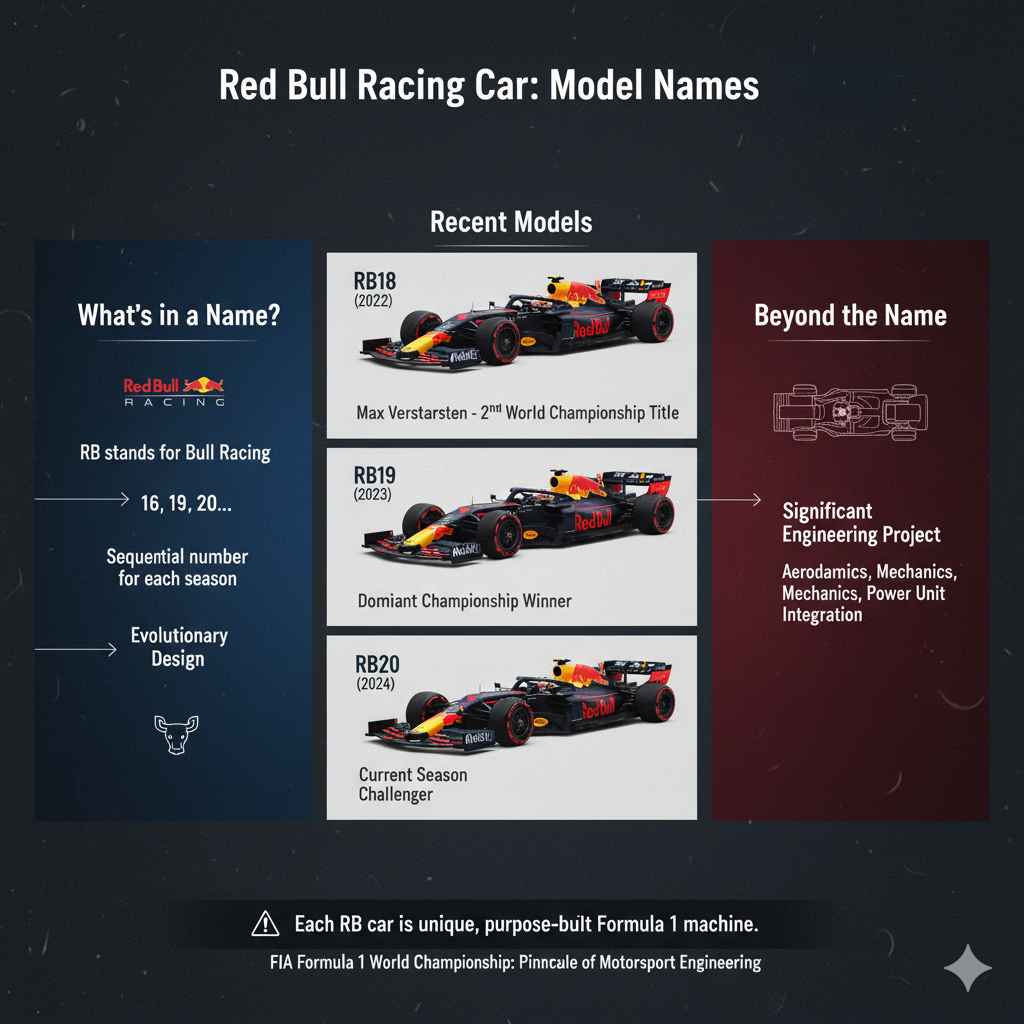
Each year, Red Bull Racing unveils a new Formula 1 car for the upcoming season. These cars are designated by a specific model name that typically follows a pattern. For instance, in recent years, they have used:
- RB16B: Used in the 2021 season.
- RB18: Used in the 2022 season, which saw Max Verstappen win his second World Championship.
- RB19: Used in the 2023 season, another dominant championship-winning car.
- RB20: The current car for the 2024 season.
The “RB” stands for Red Bull, and the number increases sequentially each year, reflecting the ongoing development and evolution of their Formula 1 challenger. These aren’t just cosmetic changes; each new chassis is a significant engineering project, incorporating the latest advancements in aerodynamics, mechanics, and power unit integration.
Frequently Asked Questions (FAQ)
Is there a specific “Red Bull car” that I can buy?
No, you cannot buy the Red Bull Formula 1 car as a production vehicle. These are highly specialized racing machines built for competition and are not road-legal.
What kind of engines power the Red Bull F1 cars?
Red Bull Racing uses 1.6-liter V6 turbocharged hybrid power units. These units include sophisticated energy recovery systems (MGU-K and MGU-H) to boost performance and efficiency.
How much does a Formula 1 car like Red Bull’s cost?
A brand new Formula 1 car can cost upwards of $15 million, and sometimes even more, depending on the level of development and technology integrated into it. This includes the chassis, power unit, and all the associated systems.
Who designs and builds the Red Bull F1 cars?
The Red Bull Racing Formula 1 cars are designed and built by the team’s in-house technical department, led by their chief technical officer and aerodynamicists. Red Bull Powertrains handles the development of the power units.
Can a Red Bull F1 car be driven on public roads?
Absolutely not. F1 cars are not designed to meet any road safety or emissions regulations. They lack essential components like headlights, taillights, mirrors, and a conventional suspension, and their extreme aerodynamics and open-wheel design make them unsafe for public roads.
What is Red Bull Powertrains and why was it created?
Red Bull Powertrains Limited is a division of Red Bull Racing responsible for designing, developing, and manufacturing their own Formula 1 power units. It was created to bring crucial engine technology in-house, ensuring greater control over performance and future development, especially in anticipation of new engine regulations.
Conclusion: The Ultimate Racing Machines
So, to sum it up, when you ask “what cars do Red Bull use?” the answer is the pinnacle of motorsport engineering: their custom-built Formula 1 cars. These aren’t cars for commuting; they are meticulously crafted racing machines designed for one purpose – to win races and championships. From their complex hybrid power units to their incredibly sophisticated aerodynamic packages, every element is pushed to its absolute limit.
While Red Bull as a brand is involved in many forms of motorsport and uses various support vehicles, the iconic “Red Bull cars” you see competing at the highest level are the result of immense talent, cutting-edge technology, and relentless dedication to performance. Understanding these cars gives us a deeper appreciation for the sport and the incredible engineering that goes into each Grand Prix weekend. It’s a world away from your everyday driving, a true testament to human innovation in the pursuit of speed.