How Much Does a Car Cost? New and Used Price Guide
A 2026 car purchase will usually mean roughly the high teens to low 30s for a used vehicle, before taxes, fees, insurance, and financing. If you budget only the sticker price, you can come up short by thousands and push the monthly payment past your limit. This guide breaks down 2026 price benchmarks by segment and turns them into realistic ownership budgets for cash buyers and financed buyers.
How much does a car cost in 2026?
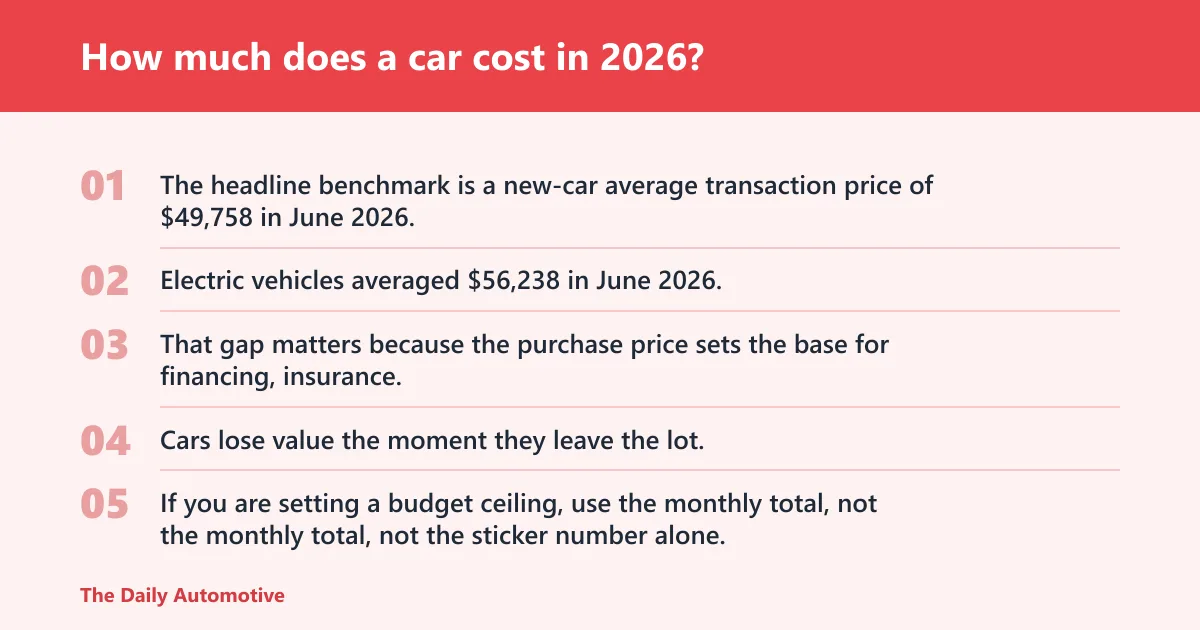


The headline benchmark is a new-car average transaction price of $49,758 in June 2026, with the market briefly peaking above $51,900 that same month. Electric vehicles averaged $56,238 in June 2026, so the EV segment still sat above the overall market. That gap matters because the purchase price sets the base for financing, insurance, and depreciation.
That is only the starting point. Cars lose value the moment they leave the lot, and total ownership also includes insurance, fuel or charging, registration, taxes, maintenance, and repairs. If you are setting a budget ceiling, use the monthly total, not the sticker number alone.
Why EVs cost more on average
Battery packs, high-spec software, and richer standard equipment keep many EV transaction prices above gasoline models. In June 2026, the average EV transaction price was $56,238, which was higher than the average for the broader new-car market. That does not mean every EV is expensive, but it does mean you should compare trims carefully.
Some models sold well under MSRP, while other models sold well above MSRP. Prices vary sharply by segment, and that is why the market average can hide big differences between compact sedans, three-row SUVs, work trucks, and premium EVs.
What that means for budget planning
A practical budget plan should start with the payment you can carry after insurance and fuel, not before them. Loan payments are a major part of monthly car cost, and the term you choose changes the payment a lot. A longer term lowers the monthly bill, but it also keeps you paying longer on a car that is already losing value.
📊 A new car cost an average of $49,758 in June 2026. Source: How Much Does a Car Cost in 2026?.
Will car prices go up or down in 2026?
Sticker prices can move either way in 2026, depending on the segment, inventory, and incentives. A few models may rise if supply is tight or content changes push trims upward, while carryover models can fall at the transaction level if discounts widen. The safest forecast is a range, not a promise.
What pushes prices higher
Higher trim mix, stronger demand for certain SUVs or EVs, and limited availability can keep transaction prices elevated. If a model sells above MSRP, the buyer may face a higher effective price than the sticker suggests. That is more likely on hot trims and limited-run versions.
What pulls prices lower
Incentives, dealer discounts, and softer demand can reduce what buyers actually pay. Some models sold well under MSRP in June 2026, which shows how much transaction price can diverge from list price. That is why two shoppers can see very different numbers for vehicles in the same segment.
What to watch before you buy
- Check transaction prices, not only MSRP.
- Compare the same trim and option package across dealers.
- Ask whether a model is selling under or above sticker.
- Look at financing rates and loan term together.
- Get insurance quotes before you sign.
How much does a new car cost on average in 2026?
A new car cost an average of $49,758 in June 2026, with a brief peak above $51,900. Gasoline models generally sit below the EV average, while higher-trim trucks, SUVs, and luxury models can push far above the market mean. Trim level and option packages matter as much as the badge on the hood.
Gasoline vehicles versus EVs
Gasoline cars often come in below the EV average on sticker price, though that is not universal. The EV average of $56,238 reflects a segment with many higher-content vehicles and fewer low-cost entry models. If your budget is tight, compare total ownership costs as well as the purchase price.
Suppose you are choosing between a compact gas sedan and a midsize EV crossover. The EV may cost more up front, but charging can be cheaper than gasoline, especially if home charging is available. The right answer depends on how many miles you drive and what your local utility charges.
When new-car pricing makes sense
New cars may offer lower maintenance expenses and better long-term value. They also come with the benefit of a full warranty and no prior wear history. If you plan to keep the car for many years, a higher purchase price can be easier to justify.
How much does a used car cost compared with a new car in 2026?
Used cars generally have a lower initial price tag than new cars, which is why they remain the budget-first choice for many shoppers. The tradeoff is that mileage, age, and condition can raise maintenance and repair costs later. Used is cheaper at the counter, but not always cheaper over time.
Upfront savings versus long-term costs
A used car can reduce the amount you finance, lower your sales tax bill in many states, and shrink monthly payments. The downside is more uncertainty around tires, brakes, battery health, and prior ownership. Depreciation still matters too, but the first owner has already absorbed the steepest drop.
How age, mileage, and condition change price
Two cars of the same model can have very different prices if one has low mileage, a clean history, and recent maintenance, while the other needs work. Maintenance includes oil changes, tire rotations, and brake replacements, so the service record matters. A cheap used car with worn tires can cost more in the first year than a cleaner example.
When used is the better budget move
Used makes the most sense when your monthly ceiling is firm and you need to keep financing small. It is also a strong choice if you value slower depreciation over the first few ownership years. If you want the lowest total outlay, a well-kept used car is usually the safer move.
What hidden costs should you budget for when buying a car in 2026?
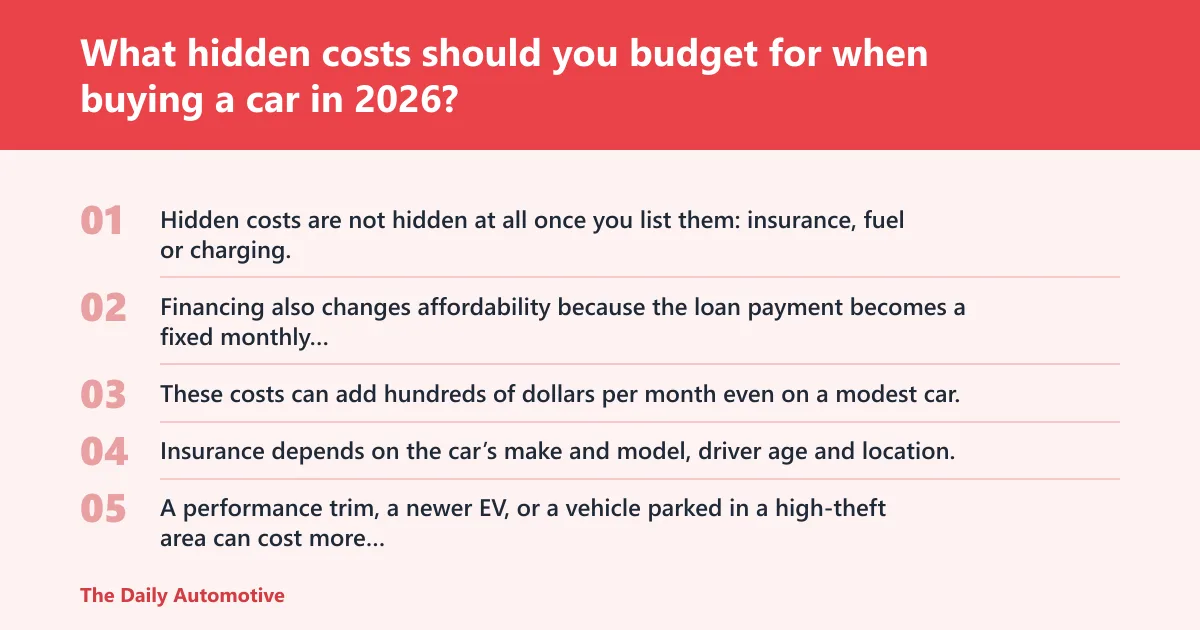
Hidden costs are not hidden at all once you list them: insurance, fuel or charging, registration fees, taxes, maintenance, repairs, parking, and depreciation. Financing also changes affordability because the loan payment becomes a fixed monthly burden. These costs can add hundreds of dollars per month even on a modest car.
Insurance
Insurance depends on the car’s make and model, driver age and location, and coverage options chosen. A performance trim, a newer EV, or a vehicle parked in a high-theft area can cost more to insure. Get quotes before you buy, not after.
Fuel and charging
Gasoline costs typically range from $2 to $4 per gallon, while electric vehicles can be charged for as little as $0.10 per kWh. Your actual bill depends on driving habits, local rates, and whether you charge at home, at work, or at public stations. For many buyers, this is the biggest operating-cost difference between gas and EV ownership.
Registration, taxes, maintenance, and repairs
Registration fees vary by state and are paid after purchase. Taxes can also be significant, especially on higher-priced vehicles. Maintenance and repairs include oil changes, tire rotations, brake replacements, and the occasional unexpected fix, which is why a cheaper purchase price does not always mean a cheaper ownership experience.
Depreciation and financing
Cars lose value the moment they leave the lot, and depreciation is one of the biggest ownership-cost drivers. Financing affects monthly affordability because the loan payment is tied to car price, interest rate, and loan term. A lower sticker price still may not be affordable if the payment crowding leaves no room for insurance or repairs.
2026 car-cost calculator: new gas, new EV, used gas, used EV
This table uses simple planning estimates to turn sticker price into a first-year ownership snapshot. Monthly payment figures assume a conventional 60-month loan at a typical rate, and they are meant as planning placeholders, not exact quotes. Insurance and fuel vary by driver, location, and usage.
| Scenario | Sticker price | Estimated monthly payment | Insurance per month | Fuel or charging per month | First-year ownership total |
|---|---|---|---|---|---|
| New gas | $49,758 | $1,000 | $180 | $150 | $19,680 |
| New EV | $56,238 | $1,130 | $200 | $35 | $16,380 |
| Used gas | $27,000 | $540 | $145 | $140 | $9,300 |
| Used EV | $31,000 | $620 | $170 | $40 | $10,440 |
These totals exclude taxes, registration, parking, and any down payment, so the real number can move higher. Still, the pattern is useful: the new-car payment is the heaviest burden, EV fuel can be lower, and used cars usually reduce the first-year cash hit.
How much should you spend each month on a car?

Your monthly car ceiling should come from total ownership cost, not sticker price alone. A good budget leaves room for payment, insurance, fuel or charging, and routine maintenance without forcing tradeoffs elsewhere. If the car only works by stretching the loan term, the budget is too tight.
How loan term changes affordability
Longer loan terms lower the monthly payment, but they also keep you in debt longer and may leave you upside down if the car depreciates faster than the balance falls. A shorter term costs more each month and usually less over the full loan. That is the core tradeoff.
A common first-timer mistake is choosing a vehicle based on a payment target alone. For example, a shopper may fixate on a payment under $600, then find that insurance, fuel, and registration push the real monthly cost well above that number. Build the full budget first.
A simple decision rule for buyers
Start with a monthly all-in number that still leaves breathing room after housing, food, savings, and debt. Then work backward to the maximum sticker price you can support. If you are choosing between trims, pick the one that keeps you under the ceiling with insurance and fuel included.
Price ceilings by income
There is no single income rule that fits every household, but the safer approach is to keep transportation from crowding out savings and fixed bills. If a car payment forces you to delay maintenance, cut retirement contributions, or carry credit card balances, the price ceiling is too high. Budget for the car you can own comfortably, not the one you can barely finance.
How much does a lowrider car cost in 2026?
There is no single lowrider price because the base car and the build quality drive the total. A simple custom project can start in the low five figures, while fully built show cars can run far higher once paint, hydraulics, interior work, and body modifications are added. The retail market is highly individual.
How much does a f1 car cost in 2026?
An F1 car is not a normal consumer purchase, so there is no retail sticker like there is for a road car. Formula 1 machinery is built for teams, not private shoppers, and the spending tied to it sits in a completely different budget category. If you mean a race-inspired replica, pricing depends entirely on the builder.
Frequently asked questions
How much does a car cost in 2026?
A new car cost an average of $49,758 in June 2026, while used cars generally sat much lower depending on age, mileage, and condition. The real number you should budget is higher than the sticker because insurance, fuel or charging, taxes, registration, and financing all add to the total.
How much does an electric car cost in 2026?
Electric vehicles averaged $56,238 in June 2026, which kept them above the broader new-car average. The purchase price is only part of the story, though, because EVs can cost less to fuel at around $0.10 per kWh if you charge at home. Local charging access matters.
How much do car prices vary by segment in 2026?
Prices vary sharply by segment, and that includes compact cars, pickups, SUVs, and EVs. Some models sold well under MSRP, while others sold above it. That spread means the segment average can hide very different transaction prices for shoppers comparing trims within the same category.
How much will car prices increase in 2026?
There is no single increase number that fits the whole market. Some models may rise if demand stays strong or supply stays tight, while others may fall at the transaction level because of incentives. The smarter move is to track the exact model and trim you want before you shop.
How much will car prices drop in 2026?
Price drops are most likely where inventory is healthy and incentives are active. That can happen on carryover gas models, selected EV trims, or vehicles that dealers want to move quickly. Transaction price matters more than MSRP because the discount can be the real savings.
How much does a used car cost compared with a new car in 2026?
Used cars usually cost less up front than new cars, which lowers the loan amount and the monthly payment. The tradeoff is possible maintenance and repair costs later, plus more uncertainty about wear. If your budget is tight, used often wins on price; if you want lower repair risk, new can make sense.
Products related to this article
Sponsored / affiliate links. As an Amazon Associate I earn from qualifying purchases. I may earn additional commission from eligible campaigns.