Cammed Car Meaning: What It Really Does to Your Engine and Daily Driving
You hear it before you see it. That uneven, stuttering idle that sounds like the engine is about to stall—then it snarls when the driver taps the throttle. Someone nearby says, “Oh, that car is cammed.” But what does that actually mean? Is it a simple bolt-on, or a serious commitment? Does a cammed car still pass emissions? Will it idle well in traffic? These are the questions that matter, and most explanations skip right past them.
This guide explains the cammed car meaning in practical terms. You’ll learn what a camshaft does inside your engine, why people swap them, how different cam profiles behave, what it costs by engine type, and the legal and mechanical realities most builders discover too late. By the end, you’ll know whether a cam swap fits your goals—or whether you should leave the stock cam alone.

Dynosty
Texas Speed TSP Chopacabra Cam Kit with…
- TSP CHOPacabra Truck Cam Specs: 214/222 .550/.550 108 LSA 106 ICL
- Cam Kit includes .560 Lift Beehive Springs, Valve Seals and OE Replacement Pushrods
- Introducing the CHOPacabra cam! This is a nasty little beast of cam. Designed to work with LS6 valve springs and a factory torque…
One popular way to get that classic aggressive lope without sacrificing daily drivability is a kit like the Texas Speed TSP Chopacabra Cam Kit from Dynosty. It bundles the camshaft, springs, seals, and pushrods for LS truck engines, which simplifies the parts-buying process considerably. We’ll reference it as a real-world example later, but the principles apply to any cam swap.
What Does “Cammed Car” Mean? (Simple Definition)
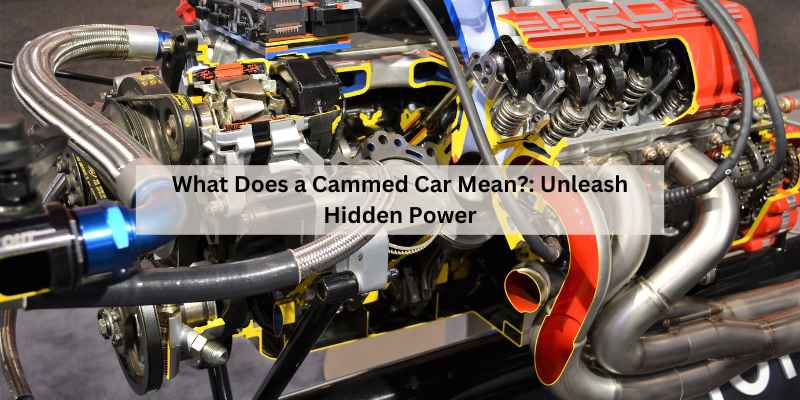
A cammed car has an aftermarket camshaft installed in its engine. The camshaft is a metal shaft with egg-shaped lobes that open and close the intake and exhaust valves. Swapping the factory cam for one with different lobe profiles changes when those valves open, how far they open, and how long they stay open. That changes the engine’s power delivery, sound, and idle character.
Most people use the term to describe a car with a noticeable “lope” at idle—that rhythmic, choppy shaking that sounds like a V8 with a misfire. But that sound is a side effect, not the goal. The real goal is moving the power band to a different RPM range, usually higher in the rev range, where the engine can make more peak horsepower.
It’s worth noting that not all cammed cars sound aggressive. A mild aftermarket cam can be nearly invisible at idle while still improving mid-range torque. The term covers a wide spectrum, from a subtle bump in lift and duration to a full race-spec grind that barely idles.
How a Camshaft Works: The Engine’s Brain
The camshaft controls valve timing—the precise moment each intake and exhaust valve opens and closes relative to piston position. The factory cam is a compromise. It has to balance fuel economy, emissions, smooth idle, low-end torque, and high-RPM power. Automakers tune it for the average driver, which means leaving performance on the table.
An aftermarket cam shifts that compromise. More duration (how long the valve stays open) lets the engine breathe better at high RPM. More lift (how far the valve opens) increases airflow into the cylinder. A different lobe separation angle (LSA) changes how much the intake and exhaust valve events overlap, which affects idle quality and where power comes on.
Here’s the trade-off: aggressive valve timing that helps top-end power usually hurts low-end torque and idle stability. That’s why a big cam feels gutless below 2,500 RPM but pulls hard past 4,000. You’re trading the part of the power band you use every day for the part you use at full throttle.
Valve timing also interacts with the engine’s computer. The ECU uses the camshaft position sensor to time fuel injection and ignition. A cam with different lobe centers can trick that sensor into reading incorrectly, which is why a tune is mandatory after a cam swap. Without recalibration, the engine runs rich, stalls, or throws codes.
Why People Cam Their Cars: Performance and Sound Goals
Two reasons dominate: power and sound. On the power side, a camshaft is one of the best upgrades for a pushrod V8 like an LS or a small-block Ford. A well-matched cam can add 30 to 80 horsepower on a naturally aspirated engine, depending on the rest of the build. That’s a massive gain compared to bolt-ons like an intake or headers, which might add 10 to 15 horsepower combined.
The sound is a different matter. The choppy idle comes from the cam’s lobe separation angle. A tight LSA (like 108 degrees) creates more valve overlap, where both valves are open at the same time. That overlap lets some fresh air-fuel mixture escape into the exhaust, causing the uneven firing pulses you hear as a lope. The sound is aggressive, raw, and unmistakable—especially on a V8.
But the sound has a cost. The same overlap that creates the lope also hurts fuel economy at idle and low speeds. The engine is literally wasting fuel out the exhaust pipe. A cammed car might get 2 to 4 miles per gallon less in city driving, and the idle can be rough enough to shake the dashboard.
There’s also the social aspect. Car meets, cruise nights, and YouTube videos have made the lope a status symbol. It signals that the owner invested time and money into the engine. That’s fine, but it’s worth being honest about the fact that a cammed car is less pleasant to daily drive than a stock one. The sound is cool for five minutes; it gets old on a long commute.
The Different Types of Cam Profiles (Mild, Street, Race)
Camshafts are sold by their specs: duration, lift, and LSA. Those numbers determine where the power lands and how the car behaves. Here’s a breakdown of the three broad categories.
Mild Cam
A mild cam has duration in the 190-210 degree range and lift around 0.470-0.510 inches. It works with the stock torque converter and often passes emissions in most states. Idle is nearly stock, maybe a slight lope. Power improves across the entire RPM range, with a bias toward low-end and mid-range torque. This is the right choice for a daily driver, a tow rig, or someone who wants a bump in power without changing driving habits.
Street Performance Cam
A street performance cam is the sweet spot for most enthusiasts. Duration sits around 210-230 degrees, lift around 0.520-0.570 inches, and the LSA is usually in the 110-114 range. You get a noticeable lope at idle, strong mid-range pull, and a power band that starts around 2,500-3,000 RPM. It still works with a factory torque converter in many cases, though a higher-stall converter helps. This category includes the TSP Chopacabra cam, which specs out at 214/222 duration, 0.550/0.550 lift, and a 108 LSA. That tight LSA gives it a mean, aggressive idle while the moderate duration keeps it streetable.
Race Cam
A race cam has duration over 240 degrees and lift above 0.600 inches. It’s designed for high-RPM power, usually above 4,500 RPM. Idle is rough and often stalls without a tune. The engine needs a high-stall torque converter, upgraded valvetrain, and often a higher compression ratio to work properly. This is not a daily driver cam. It’s for track cars, drag cars, and people who trail the car to the track.
How to Choose a Cam for Your Driving Style
Start with your goal. If you want a car you can drive to work every day, choose a mild or street performance cam. If you want maximum quarter-mile times and don’t care about comfort, go with a race cam. Then consider your engine’s displacement and compression. A bigger engine with more compression can handle a bigger cam without losing low-end torque. A smaller engine needs a smaller cam to stay responsive.
Also think about the rest of the drivetrain. A stock torque converter will feel lazy with a large cam because the engine doesn’t make power until higher RPM. A higher-stall torque converter lets the engine get into its power band faster. Similarly, stock valve springs will fail with high-lift cams—the springs can’t control the valve at high RPM, causing valve float. That’s why cam kits that include matched springs, like the TSP kit, are a smart investment.
Finally, be honest about your tolerance for rough idle and poor fuel economy. A cammed car is a compromise. It’s faster, sounds better, but it’s less refined. If you’re not willing to accept that trade, stick with a mild cam or no cam at all.
The Pros and Cons of a Cammed Car
Here’s the honest list, not the marketing version.
Pros:
- Significant horsepower and torque gains, especially in the mid-to-high RPM range
- The unmistakable lope that turns heads
- Better throttle response when the cam is matched to the rest of the build
- Potential for even more power when combined with headers, intake, and a tune
Cons:
- Rough idle that can shake the car and make it annoying in traffic
- Reduced fuel economy, often 2-4 MPG in the city
- Loss of low-end torque with larger cams, making the car feel sluggish off the line
- Requires a professional tune, adding cost and complexity
- May fail emissions tests in strict states
- Increased valvetrain wear, meaning more maintenance
- Can reduce resale value if the buyer wants a stock car
Drivability and Daily Driving Realities
Driving a cammed car in traffic is a different experience. The lope means the engine speed fluctuates at idle, so you’ll feel a constant vibration through the seat and steering wheel. On hot days, the engine might stall if the tune isn’t perfect. You’ll also need to keep the RPMs up when launching from a stop, or the engine bogs down.
That said, a properly tuned street cam is drivable. It’s not like driving a race car. The key is matching the cam to the torque converter and rear gears. A car with a 3.73 or 4.10 rear axle will feel much more responsive with a big cam than one with 2.73 highway gears.
Cost Breakdown by Engine Type
Costs vary wildly depending on the engine platform. Here’s a realistic breakdown of parts and labor for a professional install.
| Engine Type | Cam Kit Cost | Supporting Mods | Labor (Pro Install) | Total Estimate |
|---|---|---|---|---|
| Pushrod V8 (LS, LT, small-block Ford) | $400 – $1,500 | Springs, pushrods, lifters, timing set ($300 – $800) | $800 – $1,500 | $1,500 – $3,800 |
| Modular V8 (Ford 4.6/5.0, Coyote) | $600 – $2,000 | Springs, phaser locks, timing chains ($500 – $1,200) | $1,200 – $2,000 | $2,300 – $5,200 |
| Import 4-cylinder (Honda, Subaru, etc.) | $300 – $1,000 | Springs, retainers, sometimes new valves ($400 – $1,000) | $1,000 – $2,000 | $1,700 – $4,000 |
These are ballpark figures. A DIY install on an LS engine can save $1,000 or more, but you need mechanical skill and specialized tools like a degree wheel and dial indicator. The tune itself costs $400-$800 on top of the parts and labor, and it’s not optional.
Legal and Emissions Considerations (State-by-State)
This is where many builders get burned. A camshaft changes the engine’s emissions profile, and in many states, that’s illegal unless the car passes a tailpipe test.
California is the strictest. The California Air Resources Board (CARB) requires all aftermarket emissions-related parts to have an Executive Order (EO) number. Most aftermarket cams do not have one. That means a cammed car in California is technically illegal to drive on public roads unless it passes a smog check, which a big cam often won’t due to increased hydrocarbons at idle. The workaround is to swap the stock cam back in for the test, which is a pain.
Other states with emissions testing include New York, New Jersey, Connecticut, Massachusetts, and Colorado. Most of these use an OBD-II plug-in test plus a visual inspection. If the camshaft doesn’t throw a check engine light and the car passes the tailpipe test, it often slips through. But a visual inspection can flag a cam if the inspector knows what to look for.
States without emissions testing—like Florida, Texas (most counties), and Michigan—are far more lenient. You can run a race cam and never worry about the law. But even in those states, a cammed car must still pass a safety inspection in some areas, which usually doesn’t include emissions.
The federal angle: under the Clean Air Act, tampering with emissions equipment is illegal. In practice, enforcement is rare for individual car owners, but it’s a risk. If you live in a county with emissions testing, check the local rules before buying a cam. A cam that fails the test means you either reinstall the stock cam or pay for a tune that may not fully fix the emissions output.
How to Tell If a Car Is Cammed (Sound and Visual Clues)
You can often spot a cammed car before you see the engine. Here’s what to listen for.
- Mild cam: Slight lope at idle, like a faint miss. The car might shake a little, but it’s not dramatic. At cruising speed, it sounds nearly stock.
- Street cam: A pronounced lope that’s rhythmic and consistent. The exhaust note is deeper and more aggressive. You’ll hear it clearly from 50 feet away.
- Race cam: An aggressive, almost violent shake at idle. The engine sounds like it’s misfiring badly. When revved, it barks and crackles. This is the unmistakable “cammed car” sound.
Visually, look for a few clues. A cammed car often has an aftermarket intake and exhaust, because those are needed to support the cam. The engine bay might show signs of recent work—new valve covers, fresh gaskets, or a tuning device plugged into the OBD-II port. If the owner is proud of it, they’ll often have the cam card or a sticker from the tuner in the window.
One more clue: the idle speed. A cammed car often idles higher, around 800-1,000 RPM, to keep the engine stable. Stock cars usually idle at 600-700 RPM. If the tach reads high and the engine is shaking, that’s a cammed car.
Common Cam Swap Mistakes and How to Avoid Them
Cam swaps fail for predictable reasons. Here are the most common mistakes and how to avoid them.
Mistake 1: Skipping the tune. A cam changes the airflow through the engine. The stock ECU map is wrong for that airflow. Without a tune, the engine runs rich, misfires, and may stall. A professional tune is non-negotiable.
Mistake 2: Reusing old lifters and springs. High-lift cams put more stress on the valvetrain. Old lifters may not pump up properly, and weak springs cause valve float at high RPM. Valve float means the valve doesn’t seat fully, which can bend a pushrod or break a spring. Always replace springs, and inspect or replace lifters and pushrods. A kit like the TSP Chopacabra includes the springs, seals, and pushrods, which removes the guesswork.
Mistake 3: Ignoring piston-to-valve clearance. A big cam with high lift and duration can push the valves into the pistons if the engine has high compression or domed pistons. This causes catastrophic engine failure. You need to check clearance with clay or a dial indicator before final assembly.
Mistake 4: Choosing a cam that’s too big. Everyone wants the biggest cam they can find, but a huge cam in a stock engine is a recipe for a miserable driving experience. The engine will be gutless below 3,000 RPM, and the idle will be so rough it stalls. Match the cam to your engine’s displacement, compression, and intended use.
Mistake 5: Not degreeing the cam. Camshafts are ground to spec, but manufacturing tolerances and timing chain stretch can shift the timing slightly. Degreeing the cam ensures the intake and exhaust lobes open exactly when they should. Skipping this step costs power and can cause drivability issues.
FAQs About Cammed Cars
Will a cammed car pass emissions?
It depends on the cam size and your state’s laws. A mild cam often passes a tailpipe test because it doesn’t dramatically increase hydrocarbons. A street or race cam with a tight LSA will likely fail, especially at idle. States with OBD-II testing are more lenient if the tune clears all readiness monitors, but California and other visual-inspection states are strict. Check your local laws before buying.
Does a cammed car use more fuel?
Yes. The increased valve overlap and higher idle speed burn more fuel, especially in city driving. Expect a 2-4 MPG drop with a street cam, and more with a race cam. On the highway, the difference is smaller because the engine is at a steady cruise where the cam’s effects are less pronounced.
Can I daily drive a cammed car?
You can, but it requires the right cam choice. A mild or street performance cam with a proper tune is drivable in traffic. A race cam is not—it will stall, overheat in stop-and-go traffic, and be exhausting to drive. If you daily drive your car, choose a cam with a wider LSA (112-114 degrees) and moderate duration.
Does a camshaft damage the engine?
A camshaft itself doesn’t damage the engine, but the supporting changes can. High lift puts more stress on valve springs, pushrods, and lifters. If those parts aren’t upgraded, they fail. Piston-to-valve clearance is also a risk with big cams. A properly built and tuned engine with quality parts will last just as long as stock.
Does camming a car hurt resale value?
Usually, yes. Most buyers want a stock, reliable car. A cammed car is a red flag for potential buyers who don’t want the maintenance or the rough idle. You’ll likely get fewer offers, and the offers you get will be lower. Some buyers specifically look for modified cars and will pay a premium, but they’re rare. If resale value matters to you, keep the stock cam and install it before selling.
Final Verdict: Is Camming Worth It?
Camming a car is a serious modification with real trade-offs. It’s not a simple bolt-on that makes everything better. You gain power and sound, but you lose fuel economy, idle refinement, and often legality in strict states. The decision comes down to your priorities.
- Know your goal: power, sound, or both. Choose the cam profile to match.
- Budget for the tune. It’s not optional.
- Replace springs, pushrods, and lifters at the same time. A complete kit like the TSP Chopacabra simplifies this.
- Check your local emissions laws before buying. A cam that fails the test is a wasted investment.
- Be honest about your daily driving tolerance. A race cam in a commuter car is a mistake.
- Consider resale value. A cammed car is harder to sell.
- If you’re unsure, start with a mild cam. You can always go bigger later.
For the right person, a cammed car is pure joy. The sound, the power, the reaction from other drivers—it’s an experience you can’t get from any other single modification. But it’s not for everyone. If you’re willing to accept the rough idle and the maintenance, a cam swap is one of the most rewarding upgrades you can make to a pushrod V8. Just go in with your eyes open, and you’ll end up with a car you love. For more context on how modifications fit into the broader picture of car ownership, check out our guide on service car meaning and why maintenance still matters. And if you’re curious about other performance terms, our piece on DSM car meaning covers a different tuning culture entirely.
Products related to this article
Sponsored / affiliate links. As an Amazon Associate I earn from qualifying purchases. I may earn additional commission from eligible campaigns.