Best Oxygen Sensors for Daily Driving: we compared
For daily driving, buy the exact sensor type your ECU expects, then favor Denso, NTK/NGK, or Bosch OE-fit parts; if fitment is uncertain, match the OE part number before price. A wrong sensor can trigger fuel-trim faults, poor MPG, rough idle, and a wasted weekend. I have seen that more than once in the bay. This guide shows how to pick the best oxygen sensor by type, brand, and fitment risk for real commuter use.
Quick comparison
| Product | Badge | Best for | Price | ||
|---|---|---|---|---|---|
 |
NTK 23023 Oxygen SensorNTK | Our pick | OEM application design · factory connector | $38.94
Price as of 26 Sep 2026
|
View |
 |
BOSCH 11027 Premium Universal Fitment 1-Wire Oxygen SensorBosch | Budget pick | Universal fit · 1-wire · stainless steel | $15.50
Price as of 26 Sep 2026
|
View |
 |
MOTOKU Oxygen O2 Sensor Extension Harness for ChryslerMOTOKU | Pair with it | Chrysler Dodge Jeep · 12" and 24" harnesses | $20.99
Price as of 26 Sep 2026
|
View |
For most daily drivers, a direct-fit, OE-style sensor matched to the car’s original sensor type and location is often the safest starting point. I would only use a universal part when the connector and wiring plan are already set and the vehicle-specific part is unavailable.
The real split is fitment risk. In many cases, Denso and NTK/NGK are the cleaner bets for OEM-style replacement, Bosch has broader catalog coverage, and budget universal options only make sense when the application is simple and the installer can verify connector, wire length, and sensor type before opening the box.
How we chose
The selection criteria were fitment accuracy, OEM-supplier pedigree, daily-driving reliability, and how well each option lines up with actual fault codes and sensor locations. A sensor that fits the wrong bank, wrong connector, or wrong sensing type is a comeback waiting to happen.
Direct-fit parts were favored over universal parts because daily drivers need fewer surprises. The review also weighed whether the part is appropriate for upstream control, downstream catalyst monitoring, heater-circuit faults, and the narrowband versus wideband split that causes the most mistakes.
Finally, the choices were judged on practical install risk: connector lead length, plug shape, thread size, reach, and whether the listing gives enough detail to avoid a return.
Denso: best for OEM-style daily drivers
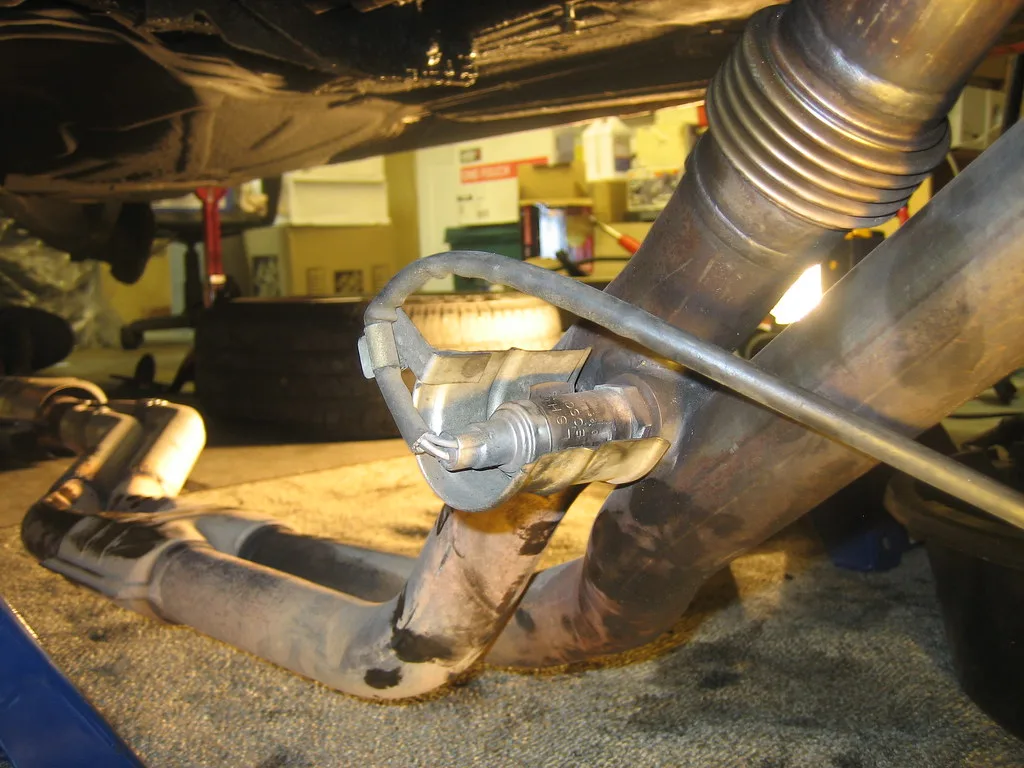
Denso is the safest first pick for many commuter cars because it tends to match OE calibration and connector behavior without drama. It is the kind of replacement that suits a daily driver that needs stable fuel trims, clean closed-loop operation, and the least chance of a warning light coming back after a week.
This is the better path for upstream heated oxygen sensor jobs on OE-style narrowband applications, especially when the original part number was supplied by a Japanese or Japanese-built application. The factory connector and application-specific design matter more than shaving a few dollars off the invoice.
The drawback is simple: Denso still has to match the exact application. If the car uses a wideband air-fuel ratio sensor, the wrong Denso listing can be as wrong as any other brand, so connector count, lead route, and sensor reach still need to be checked before ordering.
Bosch: best for broad vehicle coverage
Bosch makes sense when catalog coverage is wider than the local parts counter and the goal is a direct replacement for a common application. For older daily drivers with a straightforward universal-style installation path, Bosch can be a practical budget-friendly choice if the wiring plan is already clear.
The strong point here is reach and availability, especially when the buyer is dealing with a simple one-wire style or a platform that accepts a universal replacement without upsetting the exhaust routing. That said, the part still has to match the vehicle’s sensor strategy, not just the bung size.
The drawback is the fitment trap. A universal sensor can look compatible on paper and still create a mess if the connector, heater circuit, or sensor type is wrong. On a commuter, that often means extra splicing, extra diagnostic time, and a higher comeback risk than a direct-fit part.
NTK/NGK: best for Japanese makes
NTK and NGK are often the closest match for Honda, Toyota, Subaru, and similar applications because the supplier pedigree usually lines up well with original calibration. For daily driving, that matters most on cars that live in short trips, cold starts, and frequent closed-loop transitions.
This is especially useful for upstream sensors, including heated oxygen sensors and many OE-style narrowband applications where the ECU expects a very specific switching behavior. When the sensor type is wideband, the margin for error drops fast, so the part number has to be matched carefully.
The drawback is that “Japanese application” does not mean universal fit. Connector count, plug shape, lead length, and sensor reach still vary by engine family and emissions package, and those details matter more than the badge on the box.
Walker: best budget direct-fit
A lower-priced direct-fit sensor can make sense when the car is older, the emissions repair needs to be contained, and the part number is verified against the original sensor. The value is in reducing wiring work and avoiding a universal splice job.
For daily drivers, budget buys still need the same fitment checks as premium parts. The lead length must reach without tension, the connector must lock cleanly, and the thread and sensor length must clear the exhaust bung and nearby heat shields.
The drawback is quality spread. In the budget tier, one listing can be acceptable and another can be a headache, so no-name options are a poor gamble when the car depends on clean fuel-trim control for every commute.
Should you buy OEM or aftermarket oxygen sensors?
For daily driving, OEM-style aftermarket sensors are usually the smart middle ground when they match the original sensor type and connector layout. Dealer parts are worth the extra money when the vehicle is sensitive to sensor calibration, the application uses wideband control, or the car has a history of repeat sensor faults after cheaper replacements.
The mistake is treating “aftermarket” as one category. A reputable OE-equivalent sensor from an OEM supplier is very different from a no-name listing with the right plug in the photo and the wrong heater strategy in the carton. For a commuter, that difference often determines whether the MIL stays off.
No-name listings are a bad bet because sensor response, heater resistance, and connector quality are the usual failure points. A cheap part that leads to P0130, P0133, or a heater fault a week later ends up costing more than it saved.
Fitment-first decision table: location, connector, and do not buy warnings
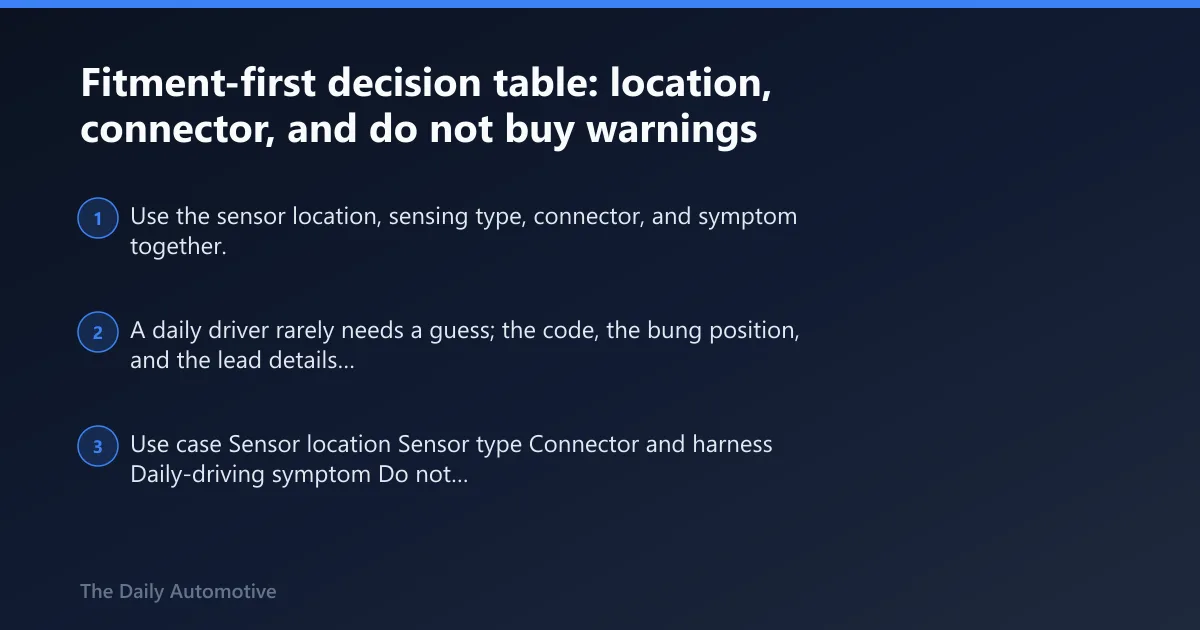
Use the sensor location, sensing type, connector, and symptom together. A daily driver rarely needs a guess; the code, the bung position, and the lead details usually point to the right part if they are read carefully.
| Use case | Sensor location | Sensor type | Connector and harness | Daily-driving symptom | Do not buy if |
|---|---|---|---|---|---|
| Fuel economy drop, rough idle, fuel-trim codes | Upstream, before the catalytic converter | Heated narrowband oxygen sensor or wideband air-fuel ratio sensor, depending on OE design | Match pin count, plug shape, and wire length exactly | Check-engine light, poor MPG, unstable idle, P0131 or P0132 family codes | The listing is downstream-only, the connector does not match, or the part is universal when the car uses a dedicated upstream sensor |
| MIL on, drivability mostly normal | Downstream, after the catalytic converter | Usually narrowband or catalyst monitor sensor, per OE design | Lead length must reach the post-cat bung without tension | P0133 or P0134 style slow-response faults, catalyst monitor issues | You buy the upstream part by mistake or assume a downstream fault explains rough running |
| Short-trip commuter with repeated cold starts | Usually upstream | Heated oxygen sensor | Connector seal and heater-circuit pinout must match | Long open-loop time, lazy warmup, intermittent heater faults | The sensor lacks the heater circuit, has the wrong pin count, or uses a different terminal style |
| Wideband-equipped engine | Upstream only in many applications | Wideband / air-fuel ratio sensor | Exact OE lead and connector required | Fuel-trim instability, mixture codes, poor throttle response | You buy a narrowband sensor because the bung thread looks similar |
| Universal replacement idea | Any location | Only if OE application allows it | Splicing, wire routing, and connector adaptation must be planned | Only acceptable on simple applications with confirmed wiring and thread match | The car needs a direct-fit plug, a specific reach, or a tightly controlled heater circuit |
What is the best oxygen sensor for daily driving?
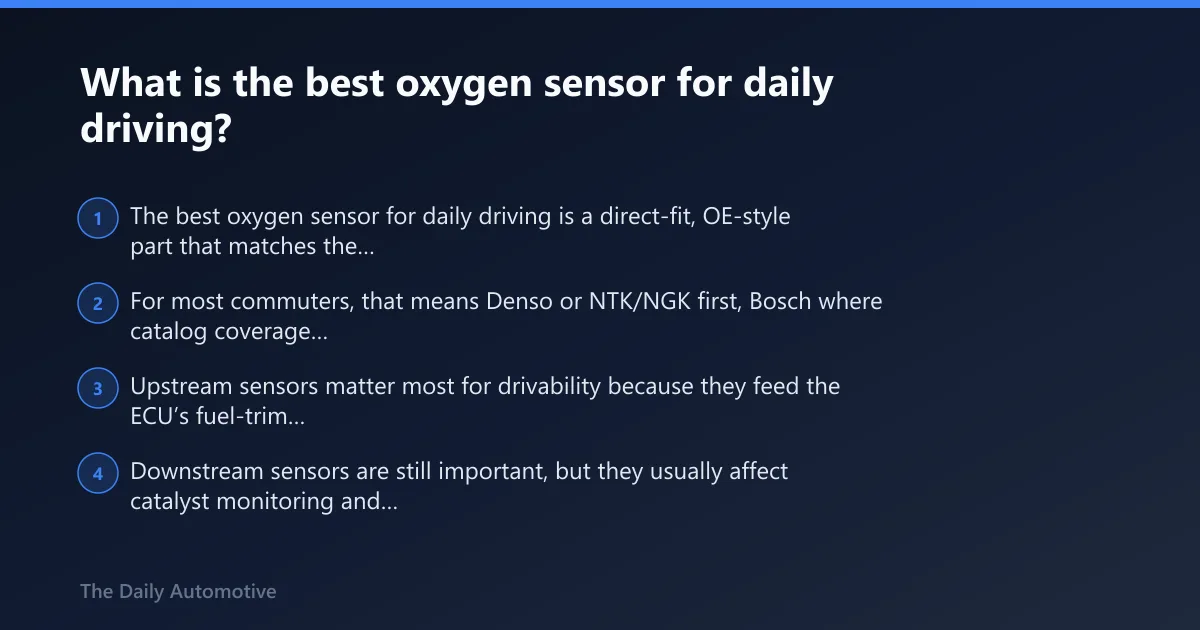
The best oxygen sensor for daily driving is a direct-fit, OE-style part that matches the vehicle’s original sensor type, connector, and location. For most commuters, that means Denso or NTK/NGK first, Bosch where catalog coverage fits, and an exact part-number match when the car uses a more sensitive wideband setup.
Upstream sensors matter most for drivability because they feed the ECU’s fuel-trim decisions. Downstream sensors are still important, but they usually affect catalyst monitoring and MIL status more than daily throttle feel, idle quality, or fuel economy.
How do I know if I need upstream or downstream oxygen sensor?
Upstream sensors sit before the catalytic converter and help control air-fuel feedback. Downstream sensors sit after the converter and mainly check catalyst efficiency, so a rough idle or poor MPG often points upstream, while a catalyst monitor code may point downstream.
Scan the codes first. P0130, P0131, P0132, and P0133 often relate to the front sensor circuit or response, while a rear sensor fault may still leave the car running fairly normally. A vacuum leak or exhaust leak can imitate either one, so the part should not be guessed from the warning light alone.
What brands make the most reliable oxygen sensors?
The most reliable oxygen sensors are usually the OE-equivalent brands with real supplier pedigree and consistent fitment, not the cheapest listing with the best photo. Denso and NTK/NGK are common first choices for daily drivers, while Bosch is useful when the vehicle family is well covered and the part number is verified.
Brand reputation matters because heater circuits, connector quality, and switching behavior affect whether the repair sticks. The same brand can still have poor listings if the application data is wrong, so the box brand should never replace a part-number check.
How long do oxygen sensors last on a daily driver?
Oxygen sensor life varies with heat, fuel quality, oil consumption, and driving pattern, but daily drivers usually wear sensors faster when they see short trips, rich running, or coolant and oil contamination. Heated sensors on commuter cars often last longer in highway use than in stop-and-go, cold-start service.
If the car has high mileage and slow fuel-trim response, a tired upstream sensor is a reasonable suspect. That said, a catalyst problem, exhaust leak, or vacuum leak can create the same symptoms, so age alone is not proof.
Can a bad oxygen sensor hurt fuel economy?
Yes. A bad upstream oxygen sensor can push the ECU into an incorrect fuel strategy, which may hurt MPG, cause rough idle, and set mixture-related trouble codes. That effect is strongest when the sensor is slow, biased, or has a heater fault that delays closed-loop operation.
But poor fuel economy does not automatically mean the sensor is bad. Vacuum leaks, exhaust leaks ahead of the sensor, misfires, and a tired catalyst can all confuse the picture. The repair should follow the code and the sensor location, not the other way around.
How do I match an oxygen sensor by connector and thread?
Match the sensor by connector pin count, plug shape, wire length, thread size, and sensor reach. Those details decide whether the part fits the bung, clears the exhaust, and reaches the lead without tension or splicing, which is where many daily-driver installations go wrong.
Before ordering, compare the old sensor to the listing and the OE part number. If the application uses a heated sensor, wideband sensor, or a unique lead route, the connector match is non-negotiable. A correct thread with the wrong plug still becomes a return.
NTK 23023 Oxygen Sensor: best for exact OE-style replacement
NTK 23023 is the best fit when the goal is an OE-style replacement with a factory connector and application-specific design. It is aimed at buyers who want the least mismatch risk on daily-driven cars that rely on steady closed-loop operation and clean emissions behavior.
The strongest point is the direct-fit approach. That lowers the odds of pin-count errors, poor lead routing, and connector-adaptation mistakes that can keep a repaired commuter off the road for another day.
The drawback is that it is still application-specific. If the car uses a different sensing strategy or a different reach than the original sensor, the part is the wrong answer even if the brand is right.
Bosch 11027 Premium Universal Fitment 1-Wire Oxygen Sensor: best for simple budget installs
Bosch 11027 is the better choice only when the vehicle truly accepts a universal one-wire sensor and the installer understands the wiring and connector plan. It can work for older or simpler daily drivers where the exhaust layout and sensor strategy are straightforward.
The sealed stainless body and OE Smart Link Connector are useful details, and the low price is attractive for budget repairs. That said, this is not the part to buy when the car needs a direct-fit lead, a heater circuit, or a sensor with a more specific response profile.
The drawback is the obvious one: universal fitment creates room for splicing errors and wire-routing mistakes. For a commuter, those errors often cost more time than the saved money.
MOTOKU Oxygen O2 Sensor Extension Harness for Chrysler Dodge Jeep: best for lead correction
MOTOKU’s extension lead kit makes sense when the original sensor reaches are short or the replacement sensor’s connector location needs extra slack on certain Chrysler, Dodge, and Jeep applications. It is a fitment aid, not a sensor substitute.
That matters for daily driving because lead tension and poor routing can create intermittent faults, heat damage, or a connector that never quite seats correctly. The included 12-inch and 24-inch lead pieces give some flexibility where the OE layout is awkward.
The drawback is that it solves only one problem. It does not fix the wrong sensor type, the wrong bank, or a heater or mixture code that points to the actual sensor rather than the extension lead.
Which one should you buy?
For most daily drivers, the best buy is the direct-fit OEM-style sensor that matches the original part number, with Denso or NTK/NGK first on the list. If the vehicle is a common Japanese application, NTK/NGK is often the safer first look; if the catalog is wide and the install is simple, Bosch can be fine.
If the car has a known OE number, buy by part number before brand. If the vehicle is older and the budget is tight, a verified direct-fit budget part is better than a universal guess. If the fault might be upstream or downstream and the code is unclear, scan first and do not replace the rear sensor just because it is easier to reach.
How to choose
- Read the code first and note whether it points to sensor response, heater circuit, or catalyst monitoring.
- Confirm the location: upstream before the converter or downstream after it.
- Identify the sensor type: narrowband, wideband / air-fuel ratio, or heated oxygen sensor.
- Match the connector by pin count, plug shape, and wire length.
- Check thread size, sensor length, and reach so the bung and heat shields clear.
- Prefer direct-fit parts for daily drivers unless the application clearly supports a universal sensor.
- Use penetrating oil on seized threads, an oxygen sensor socket for removal, and torque to spec on install.
- Use anti-seize only if the manufacturer allows it; many new sensors are already coated as specified.
Frequently asked questions
Are universal oxygen sensors worth it for a daily driver?
Usually not, unless the vehicle is simple and the installer can confirm wiring, connector, and reach in advance. Universal sensors save money only when the part is truly compatible; otherwise, splicing and routing errors can create heater faults, response issues, or a return visit.
Products related to this article
Sponsored / affiliate links. As an Amazon Associate I earn from qualifying purchases. I may earn additional commission from eligible campaigns.