Best Parking Sensors for Tight Spots (2026): Research Shows
For tight parking spots, the best parking sensors are usually a front-and-rear ultrasonic kit with a display when you need both garage-entry control and reverse protection, or a rear-only 4-sensor kit when the problem is mainly backing into a short space. Pick the wrong fit, and you can get false alarms, missed obstacles, or a bumper scrape that costs more than the kit.
Quick comparison
| Product | Badge | Best for | Price | ||
|---|---|---|---|---|---|
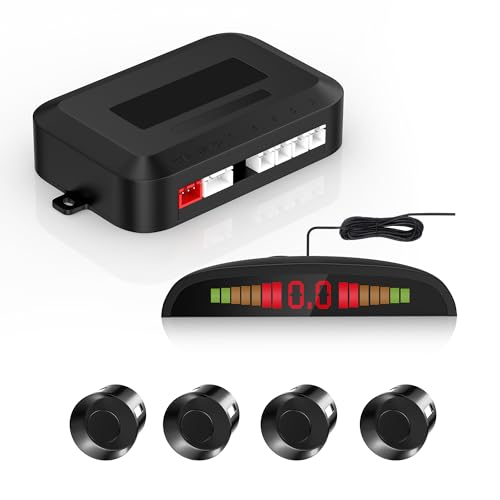 |
Car Reverse Backup Sensor – Universal Parking Sensors forEKYLIN | Our pick | 4 rear sensors · LED display · black | $16.99
Price as of 29 Oct 2026
|
View |
 |
Front & Rear 8 Parking Sensor Kit with LCD DisplayELSNU | Upgrade pick | 8 sensors · LCD display · black | $67.60
Price as of 29 Oct 2026
|
View |
 |
Promata PS02 Car Rear Parking Sensor Kit with Buzzer,4Promata | Also great | 4 sensors · buzzer · black | $65.00
Price as of 29 Oct 2026
|
View |
Use the table below to match the sensor type to the parking problem, not the other way around. The right answer depends on where the obstruction sits: in front of the bumper, behind it, or along the side of a narrow bay.
This is where many buyers go wrong. A laser guide helps with a repeatable stop point in a garage; it does not watch for a post, a low curb, or a moving object near the car.
Parking matrix table
| Parking scenario | What matters most | Recommended sensor style | Failure-mode note |
|---|---|---|---|
| Garage depth | Stopping at the same point every time in a short bay | Garage parking guide laser | Can miss moving obstacles and does not measure bumper clearance |
| Side-mirror clearance | Leaving enough room on both sides in a narrow drive or bay | Front-and-rear ultrasonic kit with display | May miss small poles or flat edges if the bumper is dirty |
| Bumper height | Low curbs, posts, shelves, or tall parking stops at sensor height | Ultrasonic sensors mounted to match the bumper line | Wrong mounting height can create false alerts or blind spots |
| Parallel parking | Side and rear obstacles during a slow curbside approach | Front and rear coverage with audible plus visual alerts | Flat objects and narrow posts are harder targets than cars or walls |
| Front clearance only | Pulling nose-first into a tight garage or short apron | Front parking sensors | Low-speed systems can still miss very low curbs or dirt on the bumper |
| Rear-only reversing | Backing out of a space with a clear front approach | Rear parking sensors, often a 4-sensor kit | Budget kits do not help with the front bumper or side corners |
| Full-perimeter coverage | Large vehicle, tight garage, and frequent low-speed maneuvering | 8-sensor parking kit | More wiring and setup time; installation errors can create noisy alerts |
How we chose
Selection here is based on manufacturer specs, listing details, and published buyer feedback. The main filters were fit for tight-space geometry, alert clarity, installation effort, and known limits in dirt, rain, snow, and low-clearance situations.
We also checked whether each kit is rear-only, front-only, or full coverage, and whether it includes a display, a buzzer, or both. That matters more than brand hype when the real problem is a wall, post, curb, or shelf.
Say your garage opens onto a short apron and the hood stops too far from the wall every time. A front sensor can help the final approach, but a laser guide may solve the stop-point problem better if the spot is always the same.
Rear parking sensors: best for reversing
Rear parking sensors are the default choice for backing into a garage or out of a driveway because they warn you about what sits behind the bumper. A rear-only 4-sensor kit is usually the simplest and cheapest route for compact cars and sedans that mainly need help when reversing.
Ultrasonic parking sensors use high-frequency sound waves to detect nearby objects by reflected pulses. They are common for rear or front bumper mounting, but rain, wind, dirt, mud, snow, and grime can create misses or false alerts.
The Promata rear kit is the cleaner match if you want a rear-only setup with self-test support and tow-bar recognition. Based on the listing, that matters if your rear bumper has a protrusion that can confuse ordinary sensors.
Its drawback is the same one that comes with most rear-only systems: it will not help you with a tight nose-in stop. If the real problem is the front bumper sliding toward a wall, this is the wrong tool.
Front parking sensors: best for nose-in parking
Front parking sensors help with forward-clearance in narrow garages, short aprons, and tight urban parking. They are most useful at low speed, when the driver is inching toward a wall, post, or workbench and needs help with the last bit of alignment.
The ELSNU 8-sensor kit is the broadest option here because it supports front-and-rear coverage. The listing also says it activates rear sensors during reverse and front sensors during forward movement, which is exactly the behavior many tight-garage drivers need.
The drawback is complexity. An 8-sensor parking kit is more involved to wire, and the extra coverage only helps if the sensors are mounted and calibrated correctly.
Front sensors can still fail on low curbs, narrow poles, and dirty bumper surfaces. Ultrasonic sensors can miss small, narrow objects like poles, so they should not be treated as a complete replacement for careful mirror use and a slow approach.
Ultrasonic vs electromagnetic sensors
Ultrasonic parking sensors are the familiar choice. They detect distance with reflected sound pulses, and the trade-off is exposure to weather and grime.
Electromagnetic parking sensors mount inside the bumper, so they are less exposed to dirt than bumper-mounted sensors. They are useful for nearby-object detection and can be paired with a camera, which helps when the car already has a screen and the bumper is hard to modify.
The choice comes down to the failure mode you care about most. If the problem is a dirty bumper or messy winter roads, inside-bumper mounting has an advantage. If the problem is precise distance warning at both ends of the car, ultrasonic coverage is still the more common layout.
A common first-timer mistake is expecting any sensor to spot everything. Flat objects, narrow posts, and low obstacles are still the weak points, especially when the bumper height and sensor height do not line up well.
Tight garage parking guide
A garage parking guide laser solves a different problem from car-mounted sensors. It marks a repeatable stop point in the garage, and a dual-laser layout can help with centering in a narrow bay.
The Wearify listing describes a dual-laser parking guide as a premium garage option. That fits a home-garage problem better than a driveway obstacle problem, because the goal is to stop in the same place every time.
The FIMXSD garage sensor shows distance from 6 inches to about 6.5 feet. The STKR side garage sensor detects from 4 inches to 2 feet away and gives green, yellow, and red alerts, which makes it easier to judge clearance in a cramped side gap.
Use a laser when the issue is repeatable parking position. Do not use it as a replacement for obstacle detection, because it does not tell you whether a bike, post, or curb is in the way.
Which one should you buy?
Choose a rear-only 4-sensor kit if you want budget-friendly help with reversing into a compact space. The EKYLIN rear kit is the entry-level option here, and its LED distance display can help when beeps alone are hard to judge in a bright garage.
Choose an 8-sensor kit if you need front-and-rear coverage for a larger vehicle or a garage with very little clearance. That is the better answer when the nose and tail both need protection.
Choose an electromagnetic setup if dirt exposure is high and you want nearby-object detection with a camera. Choose a garage laser if your real problem is stopping in the same place every time.
If the vehicle already has factory park assist, compare replacement sensor compatibility before buying an aftermarket kit. Park assist systems combine cameras and sensors, can judge parking-space size, and may steer into a spot, but they are typically factory features on higher-end cars.
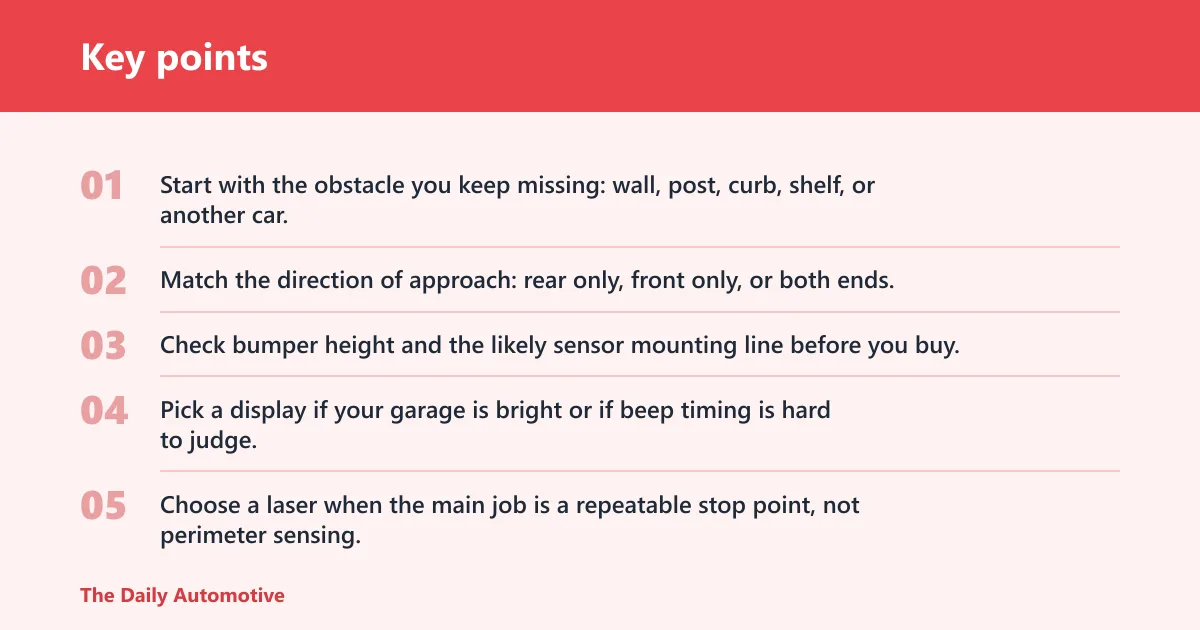
- Start with the obstacle you keep missing: wall, post, curb, shelf, or another car.
- Match the direction of approach: rear only, front only, or both ends.
- Check bumper height and the likely sensor mounting line before you buy.
- Pick a display if your garage is bright or if beep timing is hard to judge.
- Choose a laser when the main job is a repeatable stop point, not perimeter sensing.
EKYLIN 4-sensor rear kit: best for budget reversing
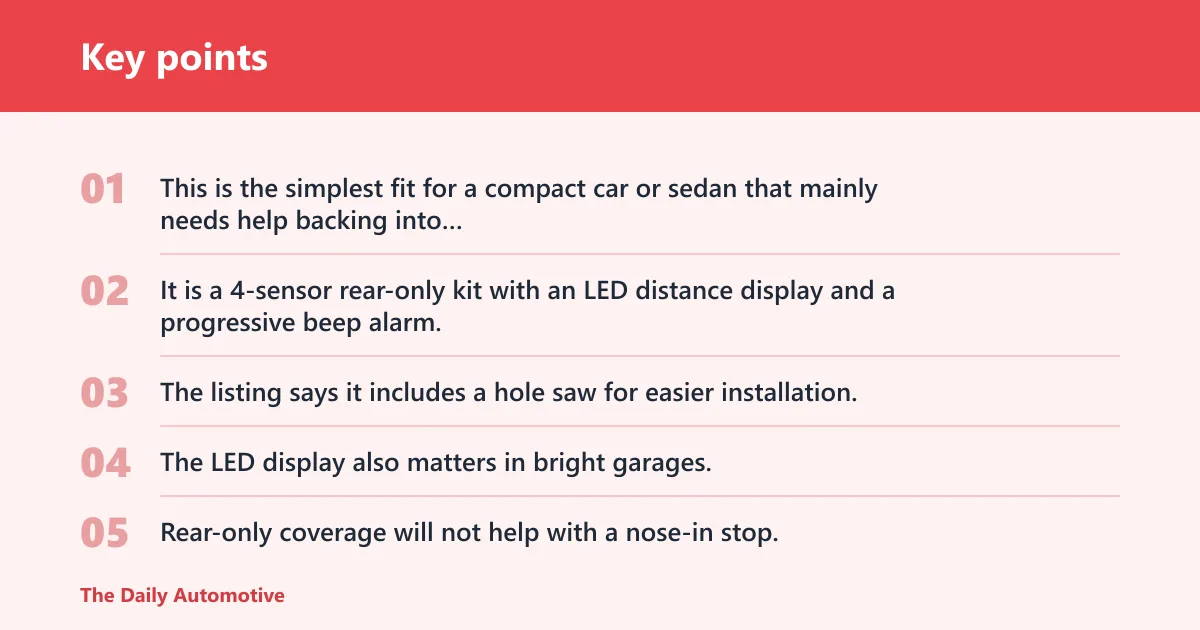
This is the simplest fit for a compact car or sedan that mainly needs help backing into a garage or out of a tight driveway. It is a 4-sensor rear-only kit with an LED distance display and a progressive beep alarm, so it covers the most common reversing use case without adding front-end wiring.
The listing says it includes a hole saw for easier installation, which is useful if you are replacing a basic rear setup. The LED display also matters in bright garages, where beeps alone can be hard to interpret.
The drawback is scope. Rear-only coverage will not help with a nose-in stop, and ultrasonic sensors can still be affected by dirt, grime, rain, and wind.
ELSNU 8-sensor kit: best for full coverage
This is the strongest match when you need front-and-rear coverage around a larger vehicle or a garage with very little clearance. The listing says it uses 8 sensors, includes an LCD display, and offers four alarm sound modes plus adjustable volume.
The front-and-rear layout is the key reason to choose it. The kit activates rear sensors during reverse and front sensors during forward movement, which covers both directions of a tight parking routine.
The drawback is installation effort. More sensors usually mean more wiring, more setup time, and more chances to place a probe at the wrong height if you rush the job.
Promata rear kit: best for tow-bar awareness
This is a rear-only option for drivers who need a smarter reversing setup, especially if a tow bar or rear protrusion is part of the parking problem. The listing calls out auto tow-bar recognition, self-test function, adjustable alarm volume, and 4 OE standard sensors.
That self-test feature can help identify sensor issues before you rely on the kit in a cramped space. It is the most practical advantage here if you are replacing a broken rear system and want some diagnostic help built in.
The drawback is that it remains a rear-only kit. If the tight spot is a nose-in garage stop, you will still need front help or a separate garage guide.
Frequently asked questions
What are the best parking sensors for tight parking spots?
For most tight parking spots, the best choice is a front-and-rear ultrasonic kit with a display. That setup handles reversing near a wall, moving forward into a short garage, and slow parallel parking better than rear-only coverage. If your main issue is a fixed stop point, a garage laser may be the better tool.
Should I get front parking sensors or rear parking sensors?
Get rear sensors if your main problem is backing out or reversing into a spot. Get front sensors if the trouble starts when you nose into a short garage or narrow driveway. If you need both directions covered, an 8-sensor kit is usually the better fit.
Are aftermarket parking sensors worth it for a small car?
Yes, if the small car is parked in a cramped garage, a narrow driveway, or a blind rear corner. A 4-sensor rear kit is usually enough for simple reversing help. If the car’s nose also gets uncomfortably close to a wall, move up to front-and-rear coverage.
What parking sensor works best in a garage with very little clearance?
A front-and-rear ultrasonic kit works best when the issue is both entry and exit clearance. If the only problem is stopping in the same place, a garage parking guide laser can be better. Use a display or clear alert tones when the garage is bright and beep timing is hard to judge.
Do ultrasonic parking sensors work better than laser garage guides?
They solve different problems. Ultrasonic sensors are better for obstacle detection around the bumper, while laser guides are better for repeatable parking position in a garage. If you need to avoid posts, low curbs, or other moving hazards, sensors win. If you need a fixed stop point, the laser wins.
Will parking sensors still work in rain, dirt, or snow?
They can work, but performance can drop. Ultrasonic systems can be affected by rain and wind, and dirt, mud, and grime can cause them to fail. Clean the sensor surfaces often, and do not assume a beep means the path is clear if visibility is poor or the sensor face is dirty.
Products related to this article
Sponsored / affiliate links. As an Amazon Associate I earn from qualifying purchases. I may earn additional commission from eligible campaigns.