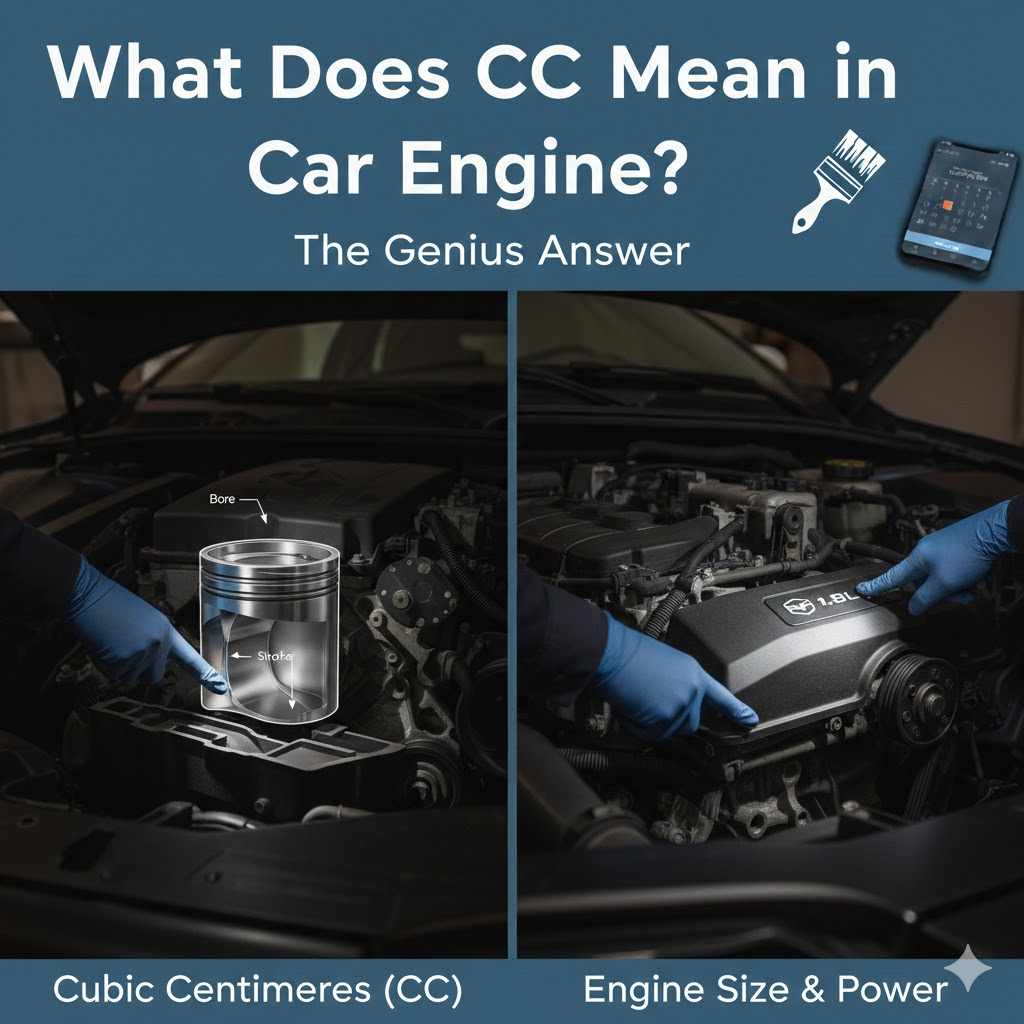
What Does CC Mean in a Car Engine? Engine Displacement Explained
CC in a car engine stands for Cubic Capacity — the total volume of all cylinders in cubic centimeters, also called displacement. 1,000cc equals exactly 1.0 liter, so a “2.0L engine” and a “2000cc engine” are the same thing. Higher CC generally means more power, but CC doesn’t equal horsepower directly — modern turbocharged small-displacement engines routinely outperform older, larger naturally-aspirated ones.
So, What Exactly Does CC Mean in an Engine?
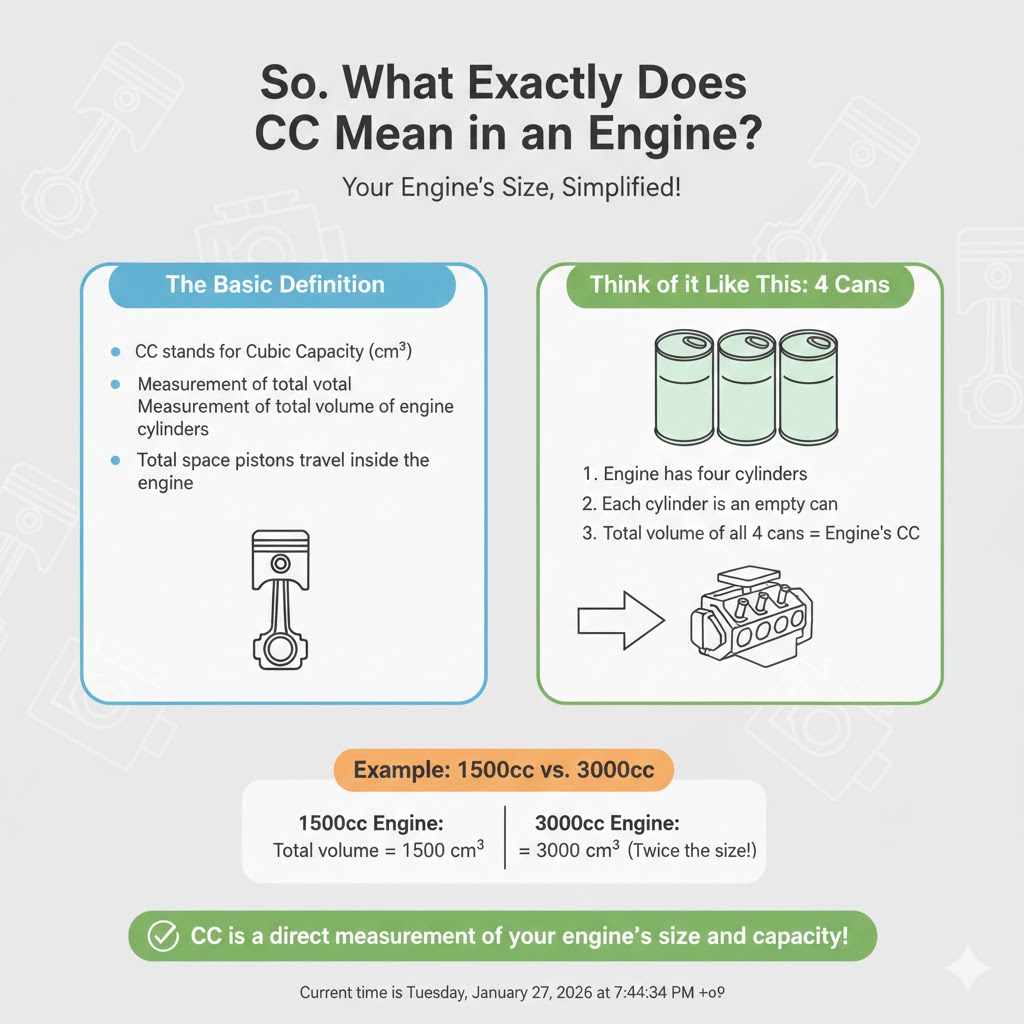
CC stands for Cubic Capacity. It is a measurement of volume — specifically, the total volume of all the cylinders in your engine in cubic centimeters (cm³). Cubic Capacity and Engine Displacement are two names for the same thing.
Inside each cylinder, a piston moves up and down. The space the piston sweeps through during one full stroke is its displacement. Multiply that by the number of cylinders and you get the engine’s total Cubic Capacity. A 1500cc engine has 1,500 cubic centimeters of combined cylinder volume across all its cylinders. A 3000cc engine has twice that.
- A 4-cylinder engine with 375cc per cylinder = 1500cc total
- A 6-cylinder engine with 500cc per cylinder = 3000cc total
- The number tells you how much air and fuel the engine can take in per combustion cycle
Why You Should Care About Your Engine’s CC
CC is the single most useful number for quickly understanding an engine’s power potential and fuel consumption tradeoff. The basic principle of an internal combustion engine: mix air and fuel, ignite with a spark, the explosion pushes the piston down, turning the crankshaft, which turns the wheels. A larger CC means more air and fuel per explosion — and a more forceful push on the piston.
- Power and Performance: Higher CC generally means more horsepower and torque — faster acceleration and better ability to haul heavy loads or climb grades.
- Fuel Economy: Larger engines consume more fuel to fill their larger cylinder volume. A high CC car will typically use more gas than a low CC car doing the same work.
- Vehicle Type: Small city cars have low CCs for efficiency; large trucks and SUVs have high CCs for payload and towing capacity.
- Insurance and Running Cost: Cars with larger engines are generally more expensive to buy, insure, and maintain.
CC, Liters, and Horsepower: Untangling the Terms
When researching cars, CC, Liters (L), and Horsepower (HP) all appear together. They measure different things but are closely related.
CC vs. Liters: Two Sides of the Same Coin
CC and Liters are both volume measurements — like inches and feet for length. The conversion is exact: 1,000 CC = 1 Liter (L). A “2.0L engine” and a “2000cc engine” are identical. North American and European markets tend to use liters; many Asian markets and the motorcycle industry use CC.
| Cubic Centimeters (CC) | Liters (L) | Common Vehicle Type |
|---|---|---|
| 800cc | 0.8L | Small Economy / City Car |
| 1000cc | 1.0L | Compact Car / Hatchback |
| 1500cc | 1.5L | Compact Sedan / Small SUV |
| 2000cc | 2.0L | Mid-Size Sedan / SUV |
| 3000cc | 3.0L | Large Sedan / Sports Car / SUV |
| 5000cc | 5.0L | Muscle Car / Large Truck |
Does More CC Equal More Horsepower?
CC and horsepower are related but not directly proportional. Horsepower measures an engine’s work rate — force delivered over time — not its size. A bigger engine has the potential to produce more horsepower, but technologies like turbocharging, supercharging, direct injection, and variable valve timing change the equation significantly.
For example: a modern Ford 1.5L EcoBoost (1500cc) turbocharged engine produces approximately 181 hp, while older 2.5L (2500cc) naturally-aspirated engines of comparable design produced around 170 hp. The CC gives a baseline for potential — technology determines how efficiently that potential is realized.
That horsepower number only tells half the story on paper — how quick a car actually feels also depends on how much weight that power has to move. See our power-to-weight ratio guide for how engineers balance horsepower against curb weight to get quicker acceleration.
The Great Debate: Is a Bigger CC Engine Always Better?
The “bigger is better” principle does not apply universally to car engines. The right CC depends entirely on how and where you drive.
| Feature | High CC Engine (3000cc / 3.0L+) | Low CC Engine (1500cc / 1.5L or less) |
|---|---|---|
| Power & Torque | Excellent — suited for towing, hauling, fast acceleration | Adequate for daily driving; strained under heavy load |
| Fuel Economy | Generally poor — more fuel per cycle | Excellent — economical for commuting |
| Driving Feel | Smooth, effortless power at highway speeds | Can feel buzzy at high RPM; best for city use |
| Best For | Highway, mountains, towing, performance driving | City commuting, budget-conscious drivers |
| Cost | Higher purchase price and maintenance costs | Lower purchase price, cheaper to maintain |
The Perks of a High CC Engine
A large displacement engine delivers effortless power — highway merging, full passenger loads, and trailer towing feel unstrained. High CC engines are typically smoother and quieter under load because they do not have to operate near their rev limit to maintain speed. For anyone who regularly tows or prioritizes driving feel on open roads, a high CC engine is the better choice.
The Advantages of a Low CC Engine
Low CC engines excel at fuel efficiency — the primary priority for most city commuters. A 1.0L–1.5L engine provides all the power needed for urban traffic at a fraction of the fuel cost of a 3.0L+ engine. These engines are also lighter, which benefits handling in smaller vehicles. Modern turbocharged small engines have closed much of the performance gap with larger naturally-aspirated alternatives.
How CC Affects Your Daily Drive
CC has two direct impacts on the day-to-day ownership experience: fuel cost and performance feel.
CC’s Impact on Your Wallet: Fuel Economy
A larger cylinder volume needs more fuel to fill it per combustion cycle. According to the U.S. Department of Energy’s FuelEconomy.gov, engine displacement is one of the primary factors determining fuel economy — smaller displacement engines consistently achieve better mpg ratings when all other factors are equal. A 1.2L engine will nearly always outperform a 3.5L engine on fuel economy in comparable driving conditions.
CC Across Different Vehicle Types
- Motorcycles: 50cc scooters to 2000cc+ touring bikes — the widest CC range of any vehicle category.
- Small City Cars (Hatchbacks): 800cc–1200cc (0.8L–1.2L) — maximum efficiency for urban use.
- Family Sedans: 1500cc–2500cc (1.5L–2.5L) — balanced power and economy for highway and city use.
- SUVs and Trucks: 2000cc–6000cc+ (2.0L–6.0L+) — heavier vehicles need more displacement for payload and towing.
- Sports and Performance Cars: 3000cc–8000cc (3.0L–8.0L), often turbocharged or supercharged for maximum output.
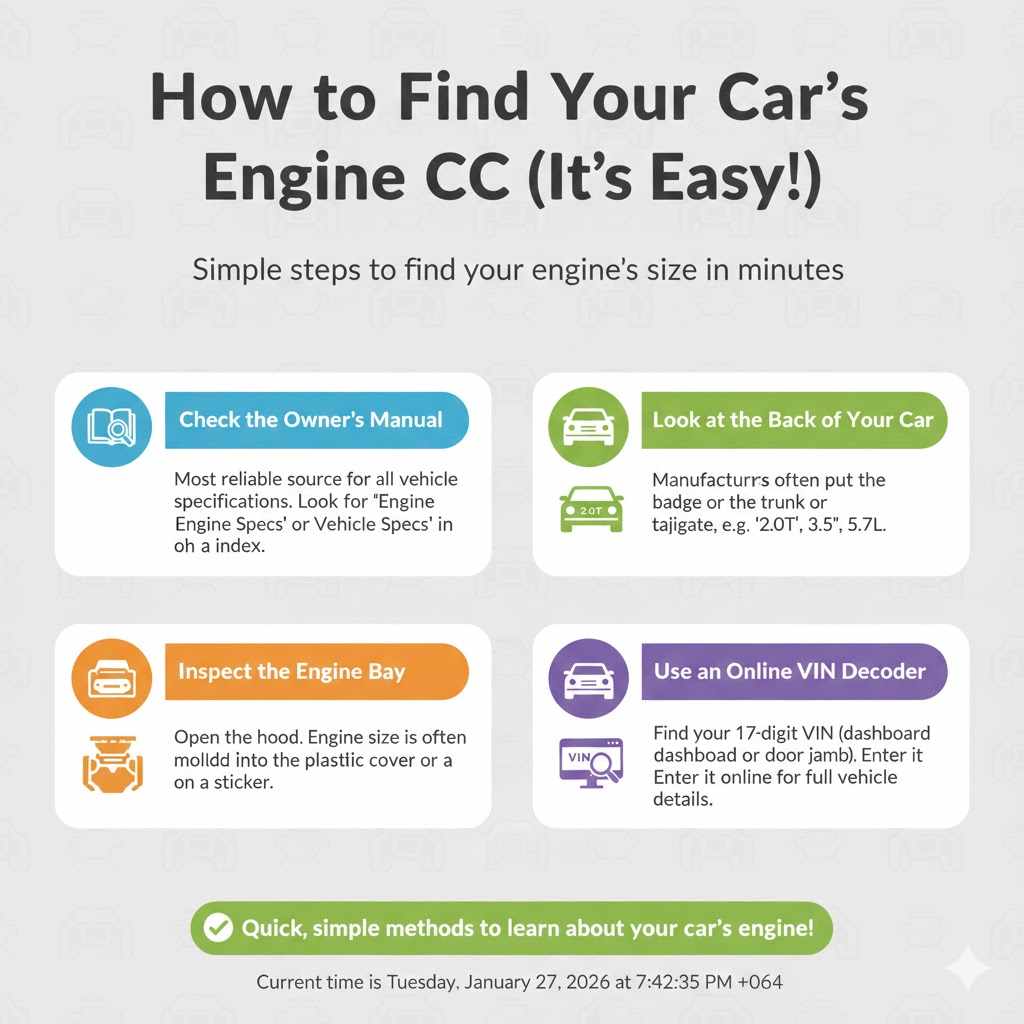
How to Find Your Car’s Engine CC (It’s Easy!)
Finding your own car’s engine size takes under a minute using any of these methods:
- Owner’s Manual: Look under “Engine Specifications” or “Vehicle Specifications” — this is the most reliable source.
- Badge on the car: Many manufacturers stamp the engine size on the trunk lid or tailgate: “2.0T,” “3.5,” or “5.7L.”
- Engine bay: A plastic engine cover often has the displacement molded in or printed on a sticker.
- Vehicle registration or title: Official documents list engine displacement in cc or liters.
- VIN decoder: Enter your 17-digit Vehicle Identification Number (found on the dashboard or driver’s door jamb) into a free online VIN decoder — it returns complete engine specifications.
Frequently Asked Questions About Engine CC
What is a good CC for a car?
There is no single “good” CC — the right size depends on use. For city driving and fuel savings: 1,000cc–1,600cc. For a versatile family car with adequate highway performance: 1,800cc–2,500cc. For towing, off-road, or high performance: 3,000cc and above. In each range, turbocharged engines deliver more power per CC than naturally-aspirated alternatives.
Is 1500cc a powerful engine?
A 1,500cc (1.5L) engine is considered a well-balanced all-rounder in modern cars. In a small, lightweight vehicle it feels capable and responsive. In a turbocharged configuration it can produce 150–200 hp — competitive with older 2.0L–2.5L naturally-aspirated engines. It is one of the most common engine sizes globally because it balances power and fuel economy effectively for most driving conditions.
Does CC affect car insurance?
Yes. Insurance companies use engine size as one factor in calculating premiums. Higher CC engines are associated with faster acceleration, higher top speeds, and statistically higher claim costs — which generally results in higher insurance rates. The effect varies by insurer and is weighted alongside other factors like driver age, location, and claims history.
Can I increase my car’s CC?
No. CC is determined by the physical dimensions of the engine — cylinder bore, stroke length, and number of cylinders. These cannot be changed without replacing the engine block itself. To meaningfully increase output without changing displacement, the practical options are adding a turbocharger, supercharger, or upgrading engine management and fuel delivery systems.
Are CC and engine displacement the same thing?
Yes — “Cubic Capacity” and “Engine Displacement” are two names for the identical measurement: the total volume swept by the pistons inside the cylinders. Both describe the same physical characteristic of the engine.
Why do some small engines feel so powerful?
Forced induction — turbocharging or supercharging — forces more air into the cylinders than they can draw naturally. More air allows more fuel, producing a larger combustion event than the cylinder’s natural volume would allow. A turbocharged 1.0L engine can produce the same horsepower as a naturally-aspirated 1.6L–1.8L engine from a decade ago, at substantially better fuel economy.
Is a 1.0L engine the same as a 1000cc engine?
Yes — exactly. 1,000 cubic centimeters equals 1.0 liter. A 1.0L engine and a 1000cc engine are the same displacement described in two different units. The conversion applies at every size: 1500cc = 1.5L, 2000cc = 2.0L, 5000cc = 5.0L.
Conclusion
CC (Cubic Capacity) is the most fundamental specification for understanding an engine’s size, power potential, and fuel consumption tradeoff. The conversion is exact: 1,000cc = 1 liter. Higher CC means more air and fuel per combustion cycle, which generally produces more power — but turbocharged smaller engines have significantly closed the gap with larger naturally-aspirated alternatives. For buyers, matching engine CC to actual driving needs — city commuting vs. highway vs. towing — is more important than maximizing CC as a number.
Products related to this article
Sponsored / affiliate links. As an Amazon Associate I earn from qualifying purchases. I may earn additional commission from eligible campaigns.