What Does EML Mean on BMW? Warning Light Explained
BMW’s EML light means the engine management has found a throttle or electronic throttle-control fault. Treat it as urgent if the car is in limp mode, misfiring, or losing power. Ignoring it can leave you stranded, cause rough running, or turn a minor sensor issue into a costly throttle-body, pedal, or wiring repair. This guide explains what the light means, how color and symptoms change the urgency, and which BMW fault codes point to the likely cause.
What does EML mean on a BMW?
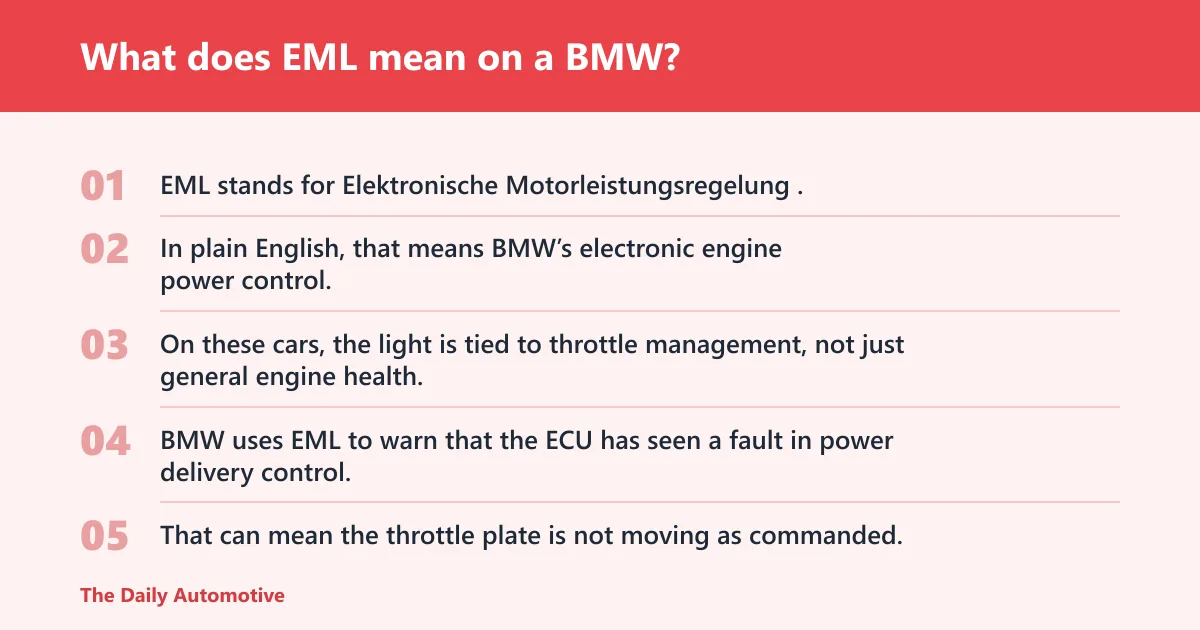


EML stands for Elektronische Motorleistungsregelung. In plain English, that means BMW’s electronic engine power control. On these cars, the light is tied to throttle management, not just general engine health, so it often points first to the electronic throttle system and the ECU’s response to a bad signal.
BMW uses EML to warn that the ECU has seen a fault in power delivery control. That can mean the throttle plate is not moving as commanded, a sensor signal looks implausible, or the system has entered reduced-power protection. A drive-by-wire throttle system replaces the older mechanical cable linkage in this context.
Why BMW uses EML for power-management faults
The point is control. If the ECU cannot trust the throttle position, pedal input, airflow reading, or related wiring, it may cut power to protect the engine and the drivetrain. That is why EML can appear with limp mode, poor throttle response, or a hard power limit.
That distinction matters. A generic engine warning may point to many systems, but BMW’s EML language is more specific: it often starts with electronic throttle control and then spreads outward to airflow, emissions, or wiring faults when the first part is not the real root cause.
Is EML the same as the check engine light?
Not exactly. Some BMW faults trigger EML, some trigger the regular engine warning, and some can trigger both. One source even describes EML as another name for the check engine light, but BMW-specific throttle-control behavior makes EML a separate warning path in practice.
That overlap is why the scan result matters more than the lamp name. If the car has EML plus reduced power, the diagnosis should start with throttle control, pedal input, airflow, and plausibility checks rather than treating it like a routine emissions-only fault.
Where the two warnings overlap
Both lights can point to the ECU detecting a problem. A failed oxygen sensor, for example, may light an engine warning and contribute to EML-related limp behavior if fuel control becomes unstable enough. A loose gas cap can also trigger some warning paths, though it is rarely the whole story when throttle response is restricted.

What does the EML color or behavior tell you?
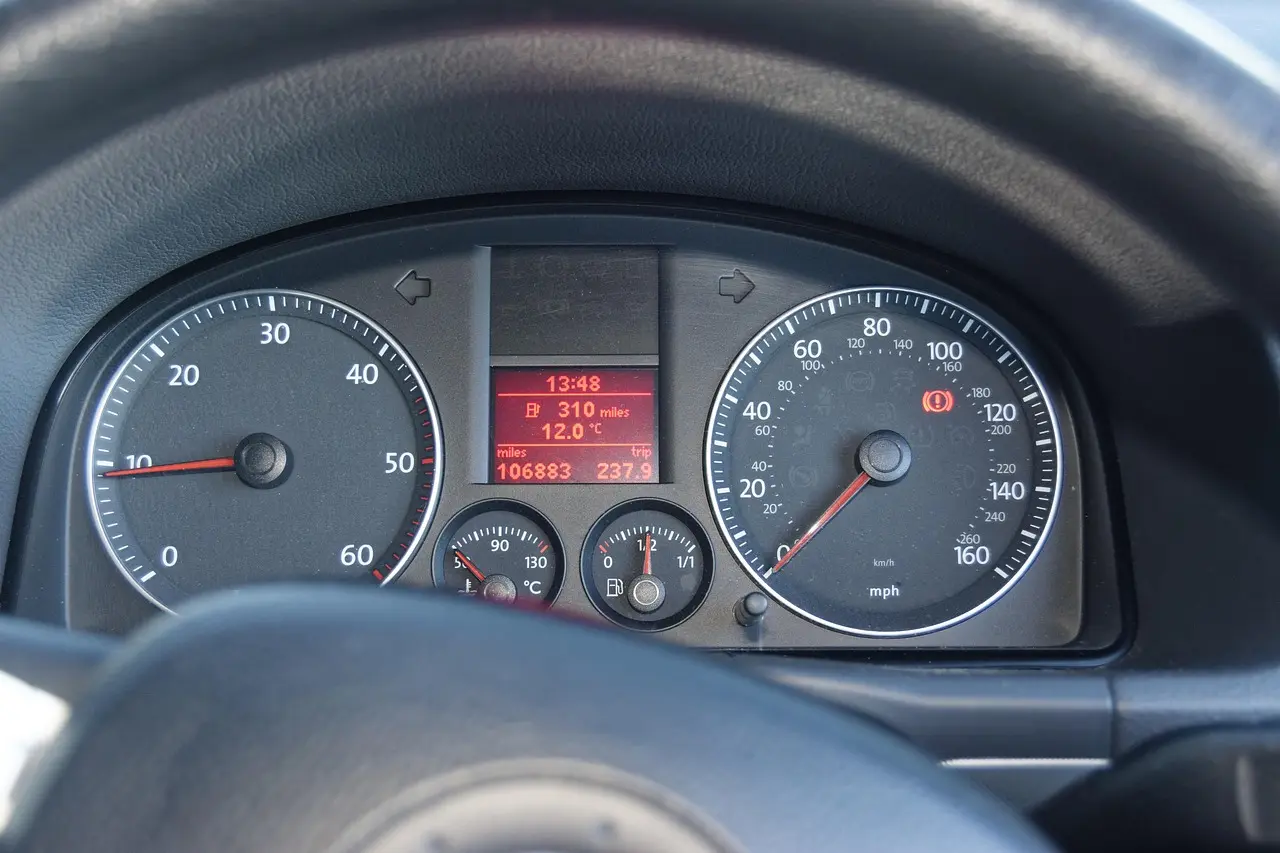
Color and flashing pattern matter. An amber or yellow EML is often described as a minor issue that may allow driving, while a flashing EML is serious and a red EML is the most critical warning. If the car also loses throttle response or stalls, the risk level rises fast.
Use the light as a severity guide, not a diagnosis. A steady amber lamp can still mean the ECU has limited power and stored a real fault. A red lamp, flashing lamp, or sudden no-throttle event changes the answer from “drive carefully” to “stop and inspect.”
Amber or steady EML
A steady amber EML usually means the car has noticed a fault but may still have enough control to keep moving. The engine may feel flat, the throttle may lag, or idle may wander. That is a reason to scan the car soon, not to ignore it for a week.
Flashing EML
A flashing EML is the type that should push you toward stopping the car. It is often treated as serious enough to avoid driving and arrange towing if there is power loss, misfire, or harsh running. Continued driving can turn a control fault into additional damage.
Red EML or hard shutdown symptoms
A red EML, or an EML paired with a dead throttle pedal, stalling, or immediate safe mode, is the highest urgency. At that point the ECU may be protecting the engine with a hard reduction in output. If the car will not respond predictably, do not keep driving it.
What should you do right away if EML comes on?
Start by checking how the car behaves, not just what the lamp looks like. If it is idling normally and still responds to the pedal, you may be able to limp it to a safe place for diagnosis. If it is misfiring, stalling, or refusing throttle input, stop driving.
A good rule is simple: steady power with an amber warning is one thing; unstable running is another. EML can mean safe mode has already limited output, and that is the system telling you to reduce load while you figure out the fault.
Do-not-drive checklist
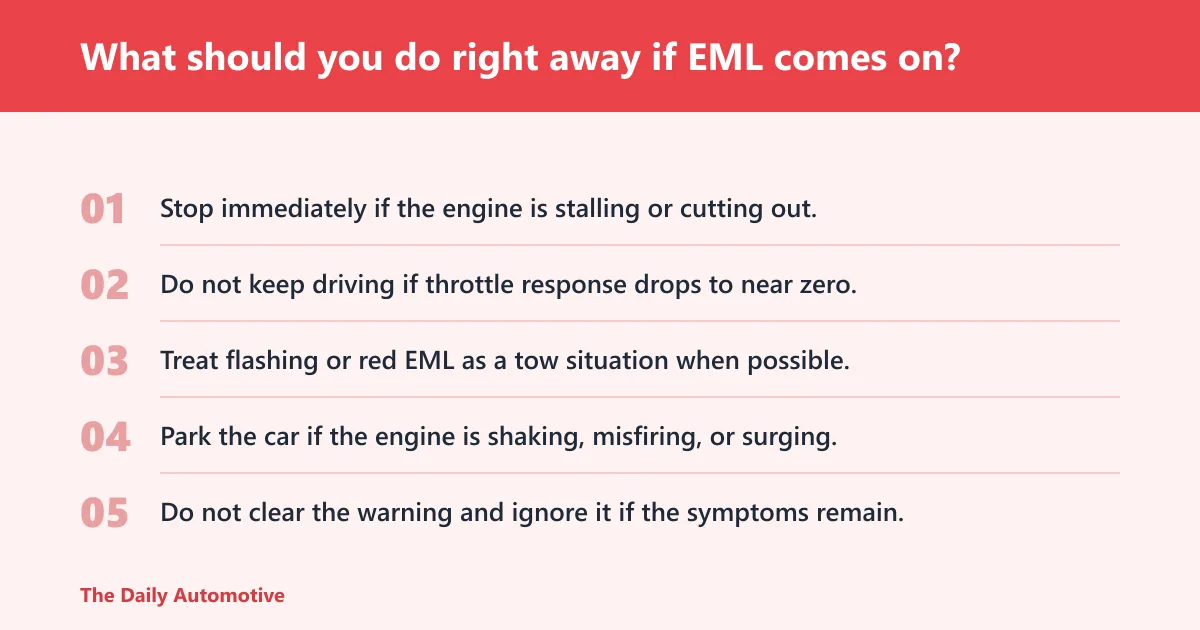
- Stop immediately if the engine is stalling or cutting out.
- Do not keep driving if throttle response drops to near zero.
- Treat flashing or red EML as a tow situation when possible.
- Park the car if the engine is shaking, misfiring, or surging.
- Do not clear the warning and ignore it if the symptoms remain.
When reduced power is tolerable
Reduced power can be tolerable only when the car is otherwise stable, traffic is light, and you are moving the vehicle a short distance to a driveway, shoulder, or repair bay. Keep load low, avoid hard acceleration, and watch for worsening behavior. If the warning grows, stop.
Say your BMW shows an amber EML after a cold start, but it still idles smoothly and reaches a nearby parking lot without drama. That is a case for cautious movement and immediate scanning, not normal driving for the rest of the day.
What usually causes a BMW EML warning?
The most common path is still throttle control. A faulty throttle position sensor is a common trigger, and an electronic throttle control malfunction is another. On many newer BMWs, the TPS may be integrated into the throttle body, so the fault can look like one part even when the issue sits in the assembly.
Other triggers include the MAF, oxygen sensor faults, wiring or connector problems, vacuum leaks, pedal module issues, and diesel DPF problems. The ECU watches signal plausibility, so two parts can fail together and create a confusing mix of codes and limp mode.
Throttle body and throttle position sensor faults
The electronic throttle body is a frequent suspect because it directly controls airflow. If the motorized butterfly valve sticks, responds slowly, or reports an implausible position, the ECU may limit power immediately. A bad TPS signal can produce the same effect, especially if voltage drops in and out.
MAF, oxygen sensor, and other airflow or emissions inputs
A bad mass airflow sensor can confuse fuel delivery and cause poor acceleration or rough running. Oxygen sensor faults can upset emissions control and fuel trimming. Those faults do not always cause EML alone, but they can contribute to a throttle-related protection state when the ECU cannot reconcile the data.
Wiring, connectors, pedal module, vacuum leaks, and DPF issues
Wiring faults matter because a bad ground, corroded connector, or broken signal wire can mimic a failed sensor. The pedal module can also cause EML if the ECU does not trust the accelerator signal. On diesel BMWs, a blocked DPF can trigger warning behavior related to soot buildup and regeneration issues.
Picture a diesel BMW that feels normal on a short street drive but then loses power on the highway and stores a blocked DPF fault plus an EML. That is not a throttle body story by default; the scan data is pointing at exhaust restriction and regeneration failure.
How do you diagnose EML the right way?
Use an OBD-II scanner that can read BMW-specific data, not just a basic generic reader. EML diagnosis depends on fault code families, live data, and module context. A full-system scan can show whether the ECU, throttle module, pedal input, airflow sensor, or emissions system started the chain.
The scan tool matters because the same warning can come from different systems on different BMWs. One fault path may be a sensor voltage issue. Another may be a throttle actuator problem. Another may be a plausibility fault caused by vacuum leaks or wiring noise.
Why a BMW-capable scan tool matters
Generic scanners often give only broad codes and miss the modules that explain why the ECU chose limp mode. A BMW-capable tool can read manufacturer-specific faults, pending codes, and related data from the DME or DDE, plus supporting information from throttle and body electronics.
First inspection order at home
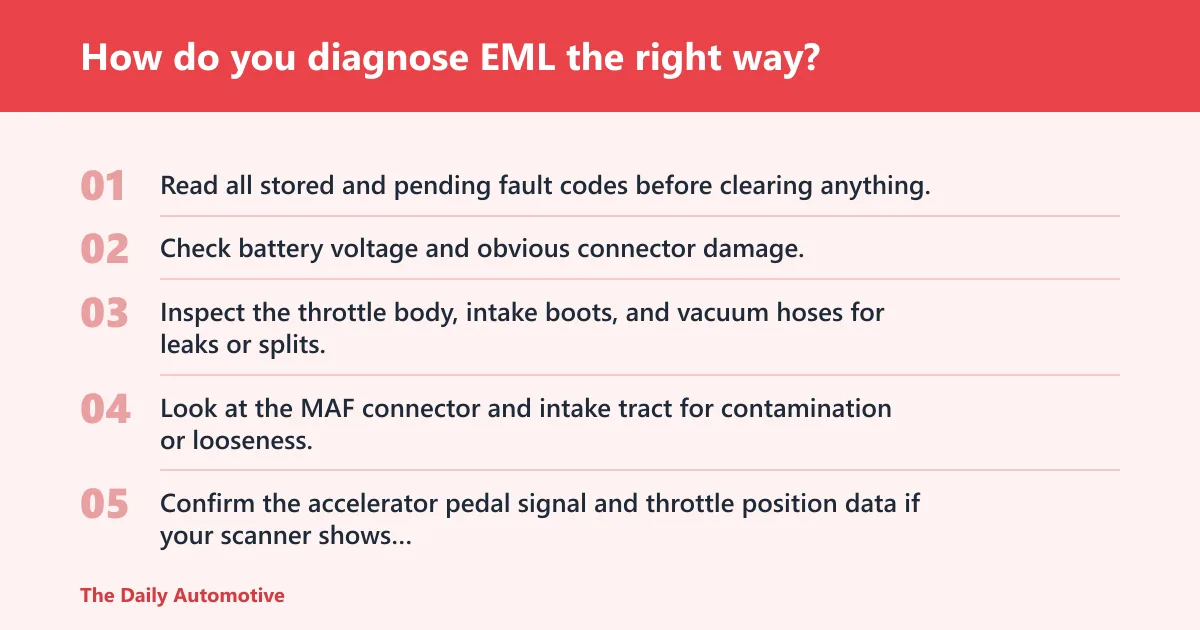
- Read all stored and pending fault codes before clearing anything.
- Check battery voltage and obvious connector damage.
- Inspect the throttle body, intake boots, and vacuum hoses for leaks or splits.
- Look at the MAF connector and intake tract for contamination or looseness.
- Confirm the accelerator pedal signal and throttle position data if your scanner shows live values.
- Check diesel soot loading and regeneration history if the car is a diesel.
What you are looking for is the first fault, not the last one. An ECU may set several codes after it sees one signal fail. Start with the code family that fits the symptom: throttle control, airflow, pedal input, emissions control, or wiring plausibility.
EML triage table: light, symptoms, and likely fault path
Use this table to narrow urgency and the first likely subsystem. It is not a replacement for a scan, but it helps separate a throttle-body problem from a wiring or emissions fault before parts are replaced.
| Light / behavior | Drivability symptoms | First scan finding | Most likely subsystem |
|---|---|---|---|
| Steady amber EML | Runs but feels flat or delayed | Throttle plausibility, MAF, or minor sensor code | Sensor input or electronic throttle control |
| Amber EML with rough idle | Idle hunts, light hesitation, reduced pull | Throttle body adaptation, TPS, or vacuum leak code | Throttle body, TPS, or unmetered air leak |
| Flashing EML | Severe power loss, misfire, harsh running | Multiple faults, safe mode, or misfire plus throttle fault | ECU protection response, wiring, or major control fault |
| Red EML or immediate limp mode | No-throttle response, stalling, or shutdown | Critical throttle control or pedal signal failure | Throttle actuator, pedal module, ECU input, or power supply |
| EML plus diesel smoke or regen issues | Restricted power, soot buildup, repeated warning | DPF, exhaust pressure, or regeneration faults | Diesel emissions system |
Common first codes in these cases often point toward throttle correlation, accelerator pedal position, MAF plausibility, oxygen sensor response, or emissions control faults. The exact code format varies by BMW system, but the family tells you more than the lamp does.
Frequently asked questions
What does the EML light mean on a BMW?
EML means Elektronische Motorleistungsregelung, BMW’s electronic engine power control warning. It signals a fault in throttle management or a related input the ECU does not trust. Depending on severity, the car may reduce power, enter safe mode, or limit throttle response.
Can I drive my BMW with the EML light on?
If the light is steady amber and the car still drives normally, limited careful driving may be possible. If the light flashes, turns red, or the engine misfires, stalls, or loses throttle response, stop driving and arrange towing or immediate inspection.
Why is my BMW EML light amber, flashing, or red?
Amber usually points to a less urgent fault that may still allow limited driving. Flashing suggests a serious problem that needs prompt attention. Red is the most critical warning and can mean the ECU has triggered a major protection mode or the engine is at risk.
Is EML the same as the check engine light on a BMW?
Not exactly. Some sources treat EML as another name for the check engine light, but BMW uses it more specifically for throttle and power-management faults. The two can overlap, yet EML usually deserves a closer look at throttle control, sensor signals, and limp mode.
What causes a BMW EML warning besides the throttle body?
Other common causes include a faulty throttle position sensor, MAF faults, oxygen sensor problems, wiring or connector damage, vacuum leaks, pedal module faults, and diesel DPF restriction. The ECU may also react to implausible signal combinations rather than one obviously failed part.
How do I diagnose an EML light on a BMW at home?
Read the fault codes with a BMW-capable OBD-II scanner first. Then inspect the intake tract, throttle body, connectors, and vacuum hoses, and compare live data for throttle and pedal signals. Do not clear codes until you have written them down and checked the symptom pattern.
What codes or faults usually trigger the EML on BMWs?
Faults tied to throttle correlation, throttle position, accelerator pedal input, MAF plausibility, oxygen sensor response, and emissions control often trigger EML. On diesel cars, a blocked DPF can also bring on related warnings. Multiple codes usually mean one fault caused a chain reaction.
DOES Definition & Meaning — Dictionary.com — DOES definition: a plural of doe. See examples of does used in a sentence.
That dictionary entry is unrelated to BMW EML. If it appears in search results, it is only a language definition and not a car diagnostic term. For BMW problems, focus on throttle management, stored fault codes, and drivability symptoms instead of unrelated dictionary content.
Products related to this article
Sponsored / affiliate links. As an Amazon Associate I earn from qualifying purchases. I may earn additional commission from eligible campaigns.