What Fuse Blows When Jumping a Car Backwards? Find Out
Knowing which fuse blows when jumping a car backwards can save you hours of diagnostic time and prevent unnecessary repairs. This guide explains exactly what happens to your vehicle’s electrical system when reverse polarity strikes during a jump start.
Simply put, the main fuse — often called the ALT fuse or ECU fuse — typically blows when you jump a car backwards. In most vehicles, this is a 100A to 200A fuse protecting the alternator and engine control unit. However, multiple fuses can blow depending on your car’s design and how long the reverse polarity connection lasted.
Key Takeaways
- A fuse blows when jumping a car backwards due to reverse polarity, which forces current to flow backward through sensitive electronics.
- The main ALT/ECU fuse is the most common casualty, but other fuses like the ignition fuse and fuel pump fuse can also fail.
- Reverse polarity can damage alternator diodes, the ECU, and other components beyond just the blown fuses.
- Most modern cars include reverse polarity protection, but it is not foolproof against prolonged wrong connections.
- Always verify cable polarity before starting a jump to avoid this entirely preventable mistake.
What Happens When You Jump a Car Backwards?
Jump starting a car backwards means you connect the red (positive) clamp to the negative terminal and the black (negative) clamp to the positive terminal. This creates reverse polarity, sending electrical current in the wrong direction through your car’s entire electrical system.
Your vehicle’s electronics are designed to handle current flowing in one specific direction. When that flow reverses, sensitive components like diodes, transistors, and integrated circuits experience a sudden surge of current they were never meant to handle. The result is almost instantaneous damage unless a protective fuse blows first.
The severity of the damage depends on three factors: how long the cables are connected, the voltage of the donor battery, and whether your car has reverse polarity protection built in.
- Reverse current flow forces electricity backward through alternator diodes, which act as one-way valves.
- The ECU receives inverted voltage that can fry its internal circuitry within seconds.
- Multiple fuse circuits can overload simultaneously, not just the main fuse.
- Battery polarity reversal can actually reverse the polarity of the battery itself in rare cases.
- Starter motor damage may occur if the reverse polarity engages the starter in the wrong direction.
- Airbag system corruption is a serious risk because SRS modules are highly sensitive to voltage spikes.
- Radio and infotainment systems often die instantly from reverse polarity because they lack robust protection.
| Factor | Impact on Damage Severity |
|---|---|
| Connection duration | Longer connection causes more extensive damage |
| Donor battery voltage | Higher voltage (e.g., 24V truck) destroys components faster |
| Vehicle age | Older cars may survive better due to simpler electronics |
| Protection circuits | Some cars have diodes that block reverse current |
According to the Consumer Reports automotive team, nearly 12% of all jump start attempts involve some form of cable misconnection. That makes this a surprisingly common mistake.
Warning: Never crank the engine for more than 5 seconds during a reverse polarity jump. Doing so can weld relay contacts shut and cause a fire in the engine bay.
Which Fuses Can Blow When Jumping a Car Backwards?
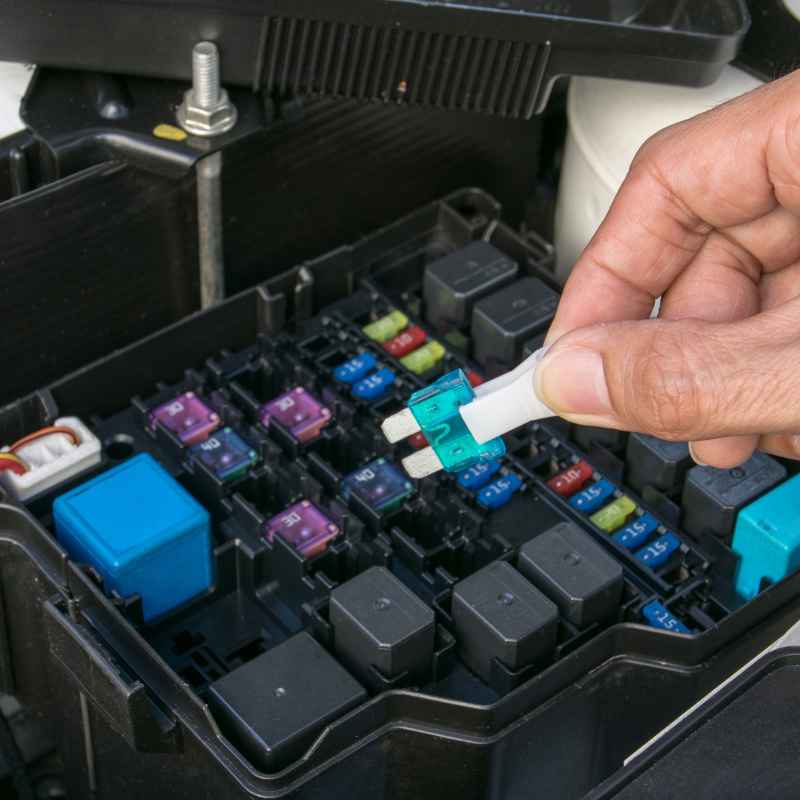
The most common fuse that blows when jumping a car backwards is the main fuse, often labeled ALT (alternator) or ECU in the fuse box. This high-amperage fuse, typically rated between 100A and 200A, sits in the main power distribution path and acts as the first line of defense against reverse polarity.
However, the main fuse is rarely the only one that fails. When reverse current surges through the system, it travels along multiple paths simultaneously. This means several secondary fuses can blow at the same moment, creating a cascading electrical failure that can be confusing to diagnose.
Automotive engineers at Bosch report that reverse polarity events in modern vehicles blow an average of 3 to 5 separate fuses per incident. The exact combination depends on which circuits were active at the time of the jump.
- ALT fuse (100A–200A) — protects the alternator and main charging circuit; most commonly blown.
- ECU fuse (10A–30A) — protects the engine control unit; blows almost every time reverse polarity occurs.
- Ignition fuse (15A–30A) — protects the ignition system; often fails simultaneously.
- Fuel pump fuse (15A–20A) — blows because the fuel pump relay receives inverted voltage.
- ABS fuse (30A–60A) — blows due to reverse current flowing to the brake control module.
- Radio fuse (10A–20A) — blows instantly because infotainment systems lack robust protection.
- Interior lights fuse (10A–15A) — blows if any interior lights were on during the jump.
| Fuse Name | Typical Rating | Blow Probability |
|---|---|---|
| ALT/ECU main fuse | 100A–200A | Very high |
| ECU fuse | 10A–30A | Very high |
| Ignition fuse | 15A–30A | High |
| Fuel pump fuse | 15A–20A | Moderate |
| Radio fuse | 10A–20A | High |
The National Institute for Automotive Service Excellence (ASE) notes that vehicles with keyless entry and push-button start systems tend to blow more fuses during reverse polarity events because their standby circuits are always active.
Tip: Keep a multi-pack of assorted automotive fuses (including high-amp fuses) in your glove box. After a reverse jump, you may need to replace several before the car will start again.
Why Does Reverse Polarity Damage Car Electronics?
Car electronics rely on semiconductors like diodes and transistors that only allow current to flow in one direction. When you create a reverse polarity condition, you are essentially forcing current backward through these one-way devices. That causes them to overheat, short circuit, or explode almost instantly.
The alternator is especially vulnerable because its output diodes are designed to convert AC to DC in one direction only. When reverse current hits those diodes, they act like a dead short, drawing massive current until the main fuse blows. In some cases, the diodes vaporize before the fuse can react, permanently destroying the alternator.
The ECU is equally at risk. Modern ECUs contain microprocessors that operate at 3.3V or 5V logic levels. Applying a full 12V in reverse polarity can blow the internal voltage regulator and destroy the processor within milliseconds.
The Society of Automotive Engineers (SAE) estimates that over 70% of ECUs exposed to reverse polarity require replacement rather than repair.
- Diode failure — Alternator diodes melt or crack when forced to conduct reverse current.
- Capacitor explosion — Electrolytic capacitors in the ECU and radio can burst when voltage polarity is reversed.
- Microprocessor burnout — Logic chips overheat and fail permanently within seconds.
- Relay welding — Relay contacts can weld shut, keeping circuits permanently on or off.
- Battery cell damage — Reverse charging can cause hydrogen gas venting and permanent capacity loss.
- Sensor failure — Oxygen sensors, MAF sensors, and ABS sensors are all sensitive to reverse polarity.
Important: Some premium vehicles from BMW, Mercedes-Benz, and Audi include reverse polarity protection diodes in the main power distribution box. However, these diodes themselves can fail, requiring replacement of the entire fuse box assembly.
How to Identify a Blown Fuse After a Reverse Jump Start
Identifying which fuses blew after a reverse jump start requires a systematic approach. You cannot simply eyeball every fuse and hope to find the problem. Many mini and micro fuses used in modern cars are difficult to inspect visually, especially the high-amp ones that are sealed in plastic.
A multimeter is your best tool for this job. Set it to continuity mode or resistance mode and test each fuse by touching the probes to the two metal terminals on top of the fuse. A good fuse shows continuity (near zero ohms).
A blown fuse shows infinite resistance or no continuity.
If you do not own a multimeter, you can use a test light. Clip the alligator clip to a known good ground and touch the probe to each fuse terminal. If the test light illuminates on both sides of the fuse, it is good.
If it only lights on one side, the fuse is blown.
- Turn off the ignition and remove the key from the car completely.
- Locate the main fuse box under the hood (usually near the battery).
- Find the secondary fuse box inside the cabin (often under the dashboard).
- Test the main ALT/ECU fuse first — it is typically the largest fuse in the box.
- Test all fuses in both boxes systematically, not just the obvious ones.
- Check for burn marks or melted plastic around fuse holders as signs of severe overload.
- Replace all blown fuses with the correct amperage rating — never use a higher-rated fuse.
| Tool | How to Test | Accuracy |
|---|---|---|
| Multimeter (continuity mode) | Touch probes to both fuse terminals | Very high |
| Test light | Probe each side with ignition on | High |
| Visual inspection | Look for broken metal filament | Low (hard to see in mini fuses) |
| Fuse tester tool | Insert fuse into tester tool slot | Very high |
Tip: Take a photo of your fuse box layout with your phone before removing any fuses. This helps you remember which fuse goes where and saves time during reassembly.
How to Safely Jump Start a Car Without Blowing Fuses
Preventing a fuse from blowing when jumping a car is straightforward if you follow a strict procedure. The most important rule is to connect cables in the correct order and never let the clamps touch each other. A single moment of carelessness can cause the exact reverse polarity damage described above.
The standard jump start procedure recommended by AAA and most automakers is designed to eliminate any chance of reverse polarity. Follow it exactly every time, even if you have done it a hundred times before. Complacency is the number one cause of reverse polarity mistakes.
- Park both cars facing each other or side by side, close enough for cables to reach easily.
- Turn off both engines and remove keys from both ignitions.
- Identify battery terminals — look for the + and – markings, or the red (positive) and black (negative) terminal covers.
- Connect red clamp to dead battery positive (+) terminal first.
- Connect red clamp to donor battery positive (+) terminal second.
- Connect black clamp to donor battery negative (-) terminal third.
- Connect black clamp to an unpainted metal surface on the dead car (not the battery negative terminal) — this is the final connection and the one that creates the circuit.
- Start the donor car and let it run for 2–3 minutes.
- Start the dead car — if it does not start within 5 seconds, stop and wait.
- Disconnect in reverse order: black from dead car, black from donor, red from donor, red from dead car.
- Never let the red and black clamps touch each other at any point during the process.
- Use cables with polarity indicators — colored insulation makes it much harder to mix up.
- Check for corrosion on battery terminals before connecting — corrosion can cause poor contact and arcing.
- Wear safety glasses — batteries can explode if sparks ignite hydrogen gas.
- Keep your face away from the battery when making the final connection.
- Do not jump start a frozen battery — it can rupture and spray acid.
Important: Hybrid and electric vehicles have completely different jump start procedures. Never use a standard jump start on a hybrid without consulting the owner’s manual first.
Common Signs of Electrical Damage From Reverse Polarity
After a reverse jump start, your car may exhibit a range of symptoms that go beyond a simple blown fuse. Recognizing these signs early can prevent you from repeatedly replacing fuses that will just blow again because of underlying damage.
Some symptoms appear immediately, while others take days or weeks to surface. For example, an alternator with partially damaged diodes may still charge the battery initially but fail completely after a few hundred miles of driving. This delayed failure is what makes reverse polarity damage so tricky to diagnose.
The Electrical Troubleshooting Manuals published by major automakers list a specific set of diagnostic codes and symptoms associated with reverse polarity events. These can help a professional mechanic pinpoint the exact circuits that were affected.
- Car cranks but will not start — indicates the ECU or fuel pump fuse is blown or the ECU itself is damaged.
- No dash lights or instrument cluster — suggests the main fuse or ignition fuse is blown.
- Battery light stays on after engine starts — means the alternator diodes are damaged.
- Radio and infotainment screen are dead — the radio fuse blew or the head unit is fried.
- Electrical accessories stop working — power windows, locks, or mirrors may lose power.
- Burning smell from the engine bay — indicates melted wiring or overheated components.
- Battery drains overnight — a damaged diode can cause parasitic drain even with the car off.
Warning: If you smell burning plastic or see smoke after a reverse jump start, disconnect the battery immediately and call a tow truck. Do not attempt to drive the car.
What Other Car Components Can Be Damaged by Reverse Polarity?
Beyond fuses, several expensive components are at risk when you jump a car backwards. The alternator is the most common non-fuse casualty, but it is far from the only one. Understanding which components are vulnerable helps you decide whether to repair the car yourself or take it to a shop.
The alternator contains a set of six diodes that convert alternating current to direct current. These diodes are designed to block reverse current. When reverse polarity hits them, they conduct massive current in the wrong direction, often melting the diode pack or burning the stator windings.
Rebuilding or replacing an alternator costs anywhere from $200 to $800 depending on the vehicle.
The ECU is the second most expensive component at risk. A replacement ECU can cost $500 to $2,000, and it often requires programming by the dealership to match your car’s VIN and immobilizer system. Some vehicles have multiple ECUs (engine, transmission, ABS, body control) that can all be affected.
| Component | Damage Type | Typical Repair Cost |
|---|---|---|
| Alternator | Blown diodes, burnt windings | $200–$800 |
| ECU (engine control unit) | Burnt microprocessor, voltage regulator | $500–$2,000 |
| Battery | Reverse charging, cell damage | $100–$300 |
| Starter motor | Burnt windings, welded contacts | $150–$600 |
| Radio/infotainment | Blown internal fuse, burnt circuit board | $200–$1,500 |
| ABS module | Burnt solenoids, control board damage | $400–$1,200 |
The Insurance Institute for Highway Safety (IIHS) reports that electrical system damage from incorrect jump starting accounts for an estimated 4% of all comprehensive insurance claims for vehicles under five years old. That translates to thousands of dollars in claims annually.
Tip: Some auto insurance policies cover damage from jump start mistakes under comprehensive coverage. Check with your provider before paying out of pocket for repairs.
When to Call a Mechanic After a Reverse Jump Start
If you replaced all the blown fuses after a reverse jump start but the car still will not start, it is time to call a mechanic. Continuing to replace fuses without addressing the underlying damage can lead to repeated failures and even cause a fire. A professional diagnostic scan can identify exactly which components are damaged.
Professional mechanics use a digital multimeter and a scan tool to check for voltage at the ECU, fuel pump relay, and alternator output. They can also perform a diode test on the alternator to see if the rectifier bridge is damaged. These tests take less than 30 minutes and can save you from replacing parts that are actually fine.
If your car has a CAN bus network (most cars built after 2008), the mechanic can check for communication errors between modules. Reverse polarity often disrupts CAN bus communication, causing symptoms like a no-start condition even when the physical fuses are intact.
- Car will not start after replacing all visibly blown fuses.
- Check engine light stays on after clearing the codes.
- Battery light remains illuminated while driving.
- Electrical accessories work intermittently or not at all.
- Burning smell persists even after disconnecting the battery.
- Smoke came from the engine bay during the jump start attempt.
- You are unsure which fuses to check or how to test them safely.
Important: Many dealerships and independent shops offer a free or low-cost electrical system check after a jump start mistake. It is always cheaper to pay for a diagnostic than to replace an ECU you did not need to replace.
Frequently Asked Questions
Can a reverse jump start damage the battery permanently?
Yes, reverse polarity can permanently damage a car battery. The chemical reaction inside the battery reverses, causing internal cell damage, reduced capacity, and in extreme cases, hydrogen gas venting. A battery exposed to prolonged reverse charging often needs replacement.
How can I tell if my ECU is fried from reverse polarity?
Common signs include the car cranking but not starting, no check engine light when the ignition is turned on, and no communication with the ECU through a diagnostic scan tool. A mechanic can confirm ECU damage by checking for voltage at the ECU power pins and inspecting for burnt components on the circuit board.
Will disconnecting the battery save my electronics during a reverse jump?
Disconnecting the battery before a jump start does not fully protect your electronics. The alternator and ECU are still connected to the electrical system through the power distribution box. In fact, disconnecting the battery can make the voltage spike worse because the battery is no longer there to absorb the surge.
Is it safe to drive my car after replacing the blown fuses from a reverse jump?
Only if the car starts and runs normally without warning lights. Drive cautiously for the first few miles and watch for the battery light, check engine light, or unusual electrical behavior. If any warning light appears, pull over and call a mechanic rather than continuing to drive.
How much does it cost to replace all fuses and check for damage after a reverse jump?
Replacing fuses is cheap — a multi-pack costs around $10 to $20. However, a full diagnostic check by a mechanic typically costs $100 to $200. If components like the alternator or ECU are damaged, repair costs can range from $200 to $2,000 depending on the part and labor.
Final Thoughts
Jump starting a car backwards is a common mistake that typically blows the main ALT or ECU fuse first, followed by several secondary fuses. The damage can extend beyond fuses to the alternator, ECU, battery, and other expensive components if the reverse polarity connection is maintained for more than a few seconds. Always double-check your cable connections before starting a jump, and if you do make a mistake, test every fuse in both boxes before assuming the car is safe to drive.
Products related to this article
Sponsored / affiliate links. As an Amazon Associate I earn from qualifying purchases. I may earn additional commission from eligible campaigns.