What Is a Car Frame? Simple Guide
Many people wonder, “What Is a Car Frame? Simple Guide” because it sounds technical. It can be hard to figure out exactly what it is and why it matters.
This guide makes it easy. We will break down what a car frame is, step by step, so you can understand it clearly. Get ready to learn all about the backbone of your vehicle.
The car frame is like a car’s skeleton. It’s the main structure that holds all the other parts together. Think of it as the chassis or foundation of the vehicle.
It supports the engine, the body, the wheels, and everything else that makes a car work. A strong frame is super important for a car’s safety and how it drives. Without a solid frame, a car would just fall apart.
This guide will help you understand its importance.
The Purpose of a Car Frame
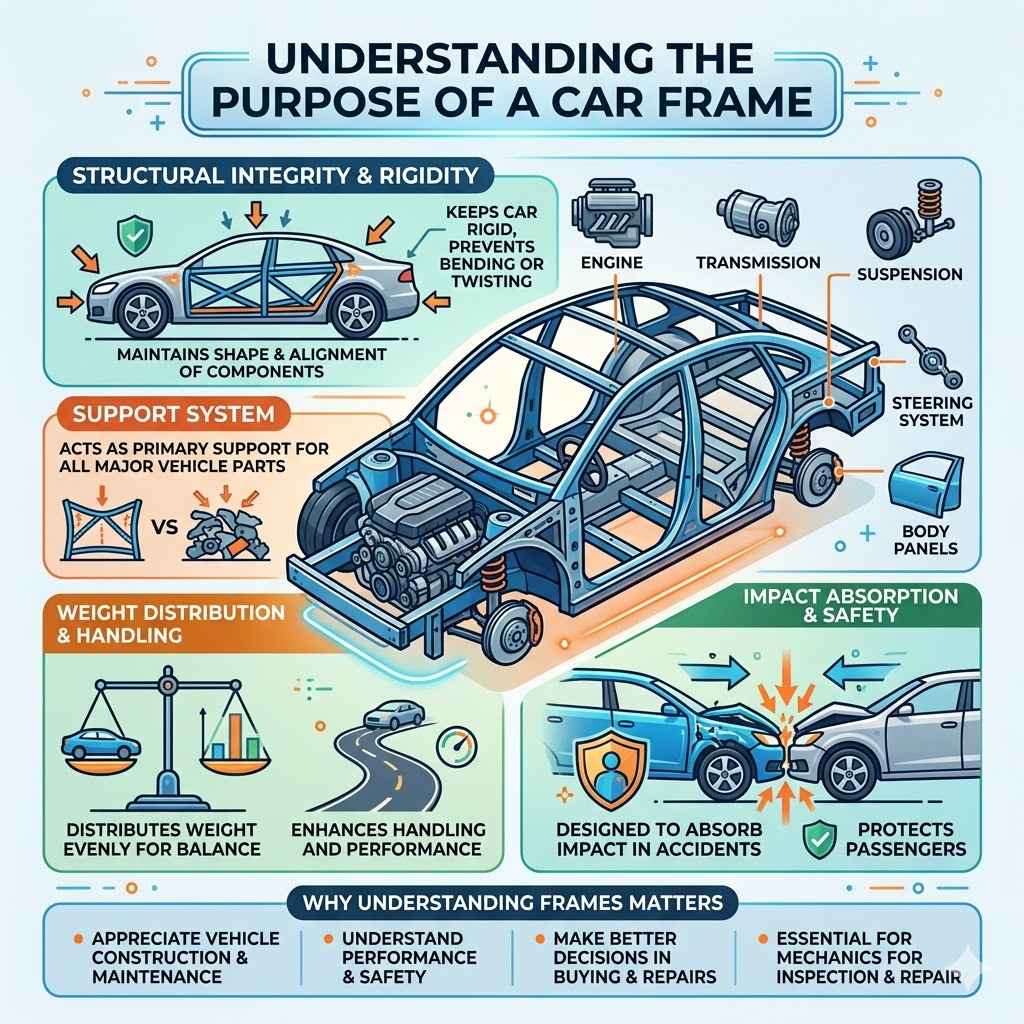
The main job of a car frame is to provide structural integrity. It keeps the car rigid and prevents it from bending or twisting while driving. This rigidity is vital for maintaining the car’s shape and ensuring that all the components remain aligned.
Imagine a car without a frame; it would be like a pile of loose parts. The frame handles the stresses and strains of driving, from bumps in the road to the forces of acceleration and braking.
It acts as the primary support system for all other vehicle components. This includes the engine, transmission, suspension, steering system, and the car’s body panels. Without this central support, these parts would not be able to function correctly.
The frame distributes weight evenly, which helps with balance and handling. It is the silent hero that keeps everything in its place.
Why Understanding Frames Matters
Knowing about car frames helps you appreciate how vehicles are built and maintained. It also plays a role in how cars perform and how safe they are. For instance, when a car is in an accident, the frame is designed to absorb some of the impact.
This helps protect the people inside. Understanding frames can help you make better decisions when buying a car or when it needs repairs.
For mechanics, a deep understanding of frames is essential. They need to know how to inspect for damage, repair bends, or even
Types of Car Frames Explained
There are two main types of car frames used today: body-on-frame and unibody construction. Each has its own advantages and disadvantages, and they are used for different types of vehicles. The choice of frame type depends on the vehicle’s intended use, its size, and the desired performance characteristics.
Body-on-Frame Construction
Body-on-frame construction is the older and more traditional method of building vehicles. In this design, the car’s body is a separate unit that is bolted onto a strong, ladder-like frame. This frame is typically made of thick steel beams.
It’s like building a house on a solid foundation. The frame carries most of the vehicle’s weight and handles all the stresses of driving.
This type of frame is very strong and durable. It’s excellent for heavy-duty applications. Trucks, SUVs, and some older cars often use body-on-frame designs.
They are great for carrying heavy loads and for off-roading because the frame can flex without damaging the car’s body. This makes them very rugged and reliable for tough jobs.
Advantages of Body-on-Frame
- Durability and Strength: The thick steel frame is incredibly robust. It can withstand significant forces, making it ideal for vehicles that face harsh conditions. This strength is a key reason why trucks and large SUVs continue to use this design.
- Load Capacity: Vehicles with body-on-frame construction can typically haul heavier payloads and tow larger trailers. The rigid frame provides a stable platform for carrying heavy items.
- Easier Repairs for Major Damage: In some cases, if the frame is damaged in an accident, it can be repaired or even replaced separately from the body. This can sometimes be more cost-effective than repairing a unibody structure.
- Off-Road Capability: The separate frame allows for more suspension articulation, which is beneficial for off-road driving. It can handle rough terrain better than a unibody design.
Disadvantages of Body-on-Frame
- Weight: These frames are generally heavier than unibody structures. This extra weight can affect fuel economy and performance.
- Ride Comfort: Because the body is just bolted on, vibrations and road noise can be more noticeable inside the cabin. This often leads to a less refined and comfortable ride compared to unibody vehicles.
- Handling Dynamics: The higher center of gravity and less integrated structure can sometimes lead to less precise handling, especially on winding roads.
- Corrosion Susceptibility: The exposed frame can be more vulnerable to rust and corrosion, especially in areas with harsh weather conditions or road salt.
Unibody Construction
Unibody construction, also known as monocoque, is a more modern approach. Instead of a separate frame, the car’s body and frame are integrated into a single, strong structure. The outer shell of the car acts as its own chassis.
It’s like building a structure where all the walls, roof, and floor are interconnected and share the load.
Most passenger cars, sedans, and smaller SUVs use unibody designs today. This method allows for lighter vehicles, which generally means better fuel efficiency and handling. The integrated structure also provides excellent crash safety because it can be engineered to absorb and redirect impact energy more effectively.
Advantages of Unibody
- Lighter Weight: By eliminating a separate frame, unibody vehicles are significantly lighter. This improves fuel economy and allows for better acceleration and braking.
- Improved Handling and Ride Quality: The integrated structure offers greater rigidity, leading to better handling characteristics. It also allows for better isolation of road noise and vibrations, resulting in a quieter and more comfortable ride.
- Enhanced Safety: Unibody designs can be engineered with crumple zones that absorb impact energy during a collision, better protecting occupants. The stiff structure helps maintain the integrity of the passenger cabin.
- Better Fuel Efficiency: The lighter weight directly translates to better gas mileage, making unibody cars more economical to operate.
Disadvantages of Unibody
- More Difficult Major Repairs: If the unibody structure is severely damaged in an accident, repairs can be very complex and expensive. It often requires specialized equipment to realign the structure accurately.
- Limited Load Capacity: Unibody vehicles are generally not designed for very heavy towing or hauling compared to body-on-frame trucks.
- Off-Road Limitations: While some SUVs have unibody designs, they are generally less suited for extreme off-road conditions where the chassis might be subjected to significant twisting forces.
Comparison of Frame Types
Choosing between body-on-frame and unibody depends heavily on the vehicle’s intended use. For heavy-duty tasks like towing, hauling, and serious off-roading, body-on-frame remains the preferred choice due to its sheer strength and durability. Vehicles like pickup trucks and large SUVs often use this method.
On the other hand, for everyday driving, passenger comfort, and fuel efficiency, unibody construction is superior. Sedans, hatchbacks, and most crossovers benefit from the lighter weight and more refined ride of a unibody design. The safety features engineered into unibody structures are also a major advantage for passenger vehicles.
| Feature | Body-on-Frame | Unibody |
|---|---|---|
| Construction | Separate frame with body bolted on | Integrated body and frame structure |
| Weight | Heavier | Lighter |
| Ride Comfort | Less refined, more noise | More comfortable, quieter |
| Handling | Less precise | More responsive |
| Towing/Hauling | Excellent capacity | Moderate capacity |
| Off-Roading | Very capable | Limited capability |
| Safety (Crash) | Good, but less energy absorption | Excellent energy absorption and occupant protection |
| Common Uses | Trucks, large SUVs, heavy-duty vehicles | Cars, sedans, crossovers, smaller SUVs |
The Backbone of Your Car What Is a Car Frame? Simple Guide
The frame is the foundation of any vehicle. It’s essential for its structural integrity, safety, and performance. Understanding the different types of frames, like body-on-frame and unibody, helps explain why certain vehicles are better suited for specific tasks.
This knowledge allows us to appreciate the engineering that goes into making our cars safe and functional.
Materials Used in Car Frames
Car frames are primarily made from metals, with steel being the most common. The type of steel and its thickness can vary depending on the vehicle and its intended use. High-strength steel alloys are often used to provide maximum durability while keeping weight down.
Some modern vehicles may also incorporate other materials for specific components to optimize weight and strength.
Steel is chosen for its strength, rigidity, and affordability. It can be shaped and welded to create complex structures. For body-on-frame vehicles, thick steel beams form a robust ladder structure.
In unibody designs, various stamped steel panels are welded together to form a cohesive, load-bearing shell. The precise engineering of these metal components is what gives a car its ability to withstand the demands of driving.
Steel Alloys and Their Importance
Steel alloys used in car frames are not just plain steel. They are specially formulated mixtures of iron and carbon, with other elements like manganese, chromium, or nickel added to enhance specific properties. For example, high-strength low-alloy (HSLA) steel is often used.
It offers greater tensile strength than regular steel, meaning it can withstand more force before deforming or breaking.
Using these advanced steel alloys allows manufacturers to design frames that are both strong and relatively lightweight. This balance is crucial for vehicle performance, fuel efficiency, and safety. A stronger frame can better protect occupants in a crash, while a lighter frame improves the car’s overall dynamics and economy.
The selection and processing of these materials are highly technical.
Other Materials
While steel is dominant, manufacturers are always exploring new materials. Aluminum is sometimes used, especially in high-performance vehicles or to reduce weight in specific areas. It’s lighter than steel but can be more expensive and require different manufacturing processes.
Carbon fiber, a very strong and lightweight material, is also used in some high-end sports cars for its exceptional stiffness and weight savings, though it is considerably more costly.
However, for the main structural frame of most mainstream vehicles, steel remains the most practical and cost-effective choice. Its widespread availability, ease of manufacturing, and proven reliability make it the go-to material for creating a safe and durable vehicle foundation.
What Is a Car Frame? Simple Guide Structural Integrity
The core function of any car frame is to provide structural integrity. This means keeping the vehicle’s shape and ensuring all its parts work together as intended, no matter what kind of road conditions it encounters. A strong frame is the difference between a safe ride and a potential disaster.
It handles the forces that a car experiences every single day.
How the Frame Handles Driving Forces
When a car accelerates, its frame experiences forces that try to twist it. Braking creates forces that push forward. Going over bumps or uneven surfaces puts stress on different parts of the frame.
The frame’s job is to resist these forces and keep the car stable. It needs to be rigid enough to prevent excessive flexing, which could affect steering and suspension.
Imagine a car frame as a very strong box. When you push on one side, the whole box wants to maintain its shape. The metal in the frame is engineered to distribute these forces evenly.
This prevents any single point from becoming overloaded and failing. This continuous distribution of stress is key to the car’s longevity and safety.
Torsional Rigidity Explained
Torsional rigidity is a measure of how resistant a structure is to twisting. For a car frame, high torsional rigidity is very desirable. It means the frame will twist very little when subjected to forces from turning or uneven terrain.
This leads to a more predictable and controlled driving experience.
A car with low torsional rigidity might feel wobbly or unstable, especially when cornering. You might notice the car leaning excessively or feeling like it’s not responding precisely to steering inputs. Manufacturers use advanced engineering techniques and materials to maximize the torsional rigidity of their frames, especially in unibody designs where the body itself contributes significantly to this rigidity.
Impact Absorption
In the unfortunate event of a collision, the car frame plays a critical role in protecting occupants. Modern frames, especially unibody structures, are designed with specific “crumple zones.” These are areas engineered to deform in a controlled manner during an impact. They absorb a significant amount of the crash energy, preventing it from being transferred directly to the passenger compartment.
For body-on-frame vehicles, the strong frame itself can absorb some impact, but the separate body can also contribute to how energy is managed. The goal is always to dissipate the force of a collision away from the people inside. This is a primary focus of automotive safety engineering and is heavily reliant on the design and materials of the frame.
Real-Life Scenarios
Consider a truck carrying a heavy load of construction materials. The frame of the truck needs to be incredibly strong to support this weight without sagging or bending excessively. The frame also needs to handle the stresses of driving on roads that might not always be perfectly smooth, ensuring the load remains stable and the truck remains controllable.
Now think about a sports car taking a sharp turn on a race track. The frame needs to be extremely rigid to provide precise handling and keep the car planted on the asphalt. Any significant flexing of the frame would lead to a loss of grip and control, making it impossible to achieve high performance.
The frame is the silent partner in every driving maneuver.
Car Frame Maintenance and Inspection
Just like any other part of your car, the frame needs attention. Regular checks can catch problems early, preventing more serious and expensive issues down the line. Damage to the frame can affect everything from your car’s alignment to its overall safety.
It’s not something you want to overlook.
Common Issues and How to Spot Them
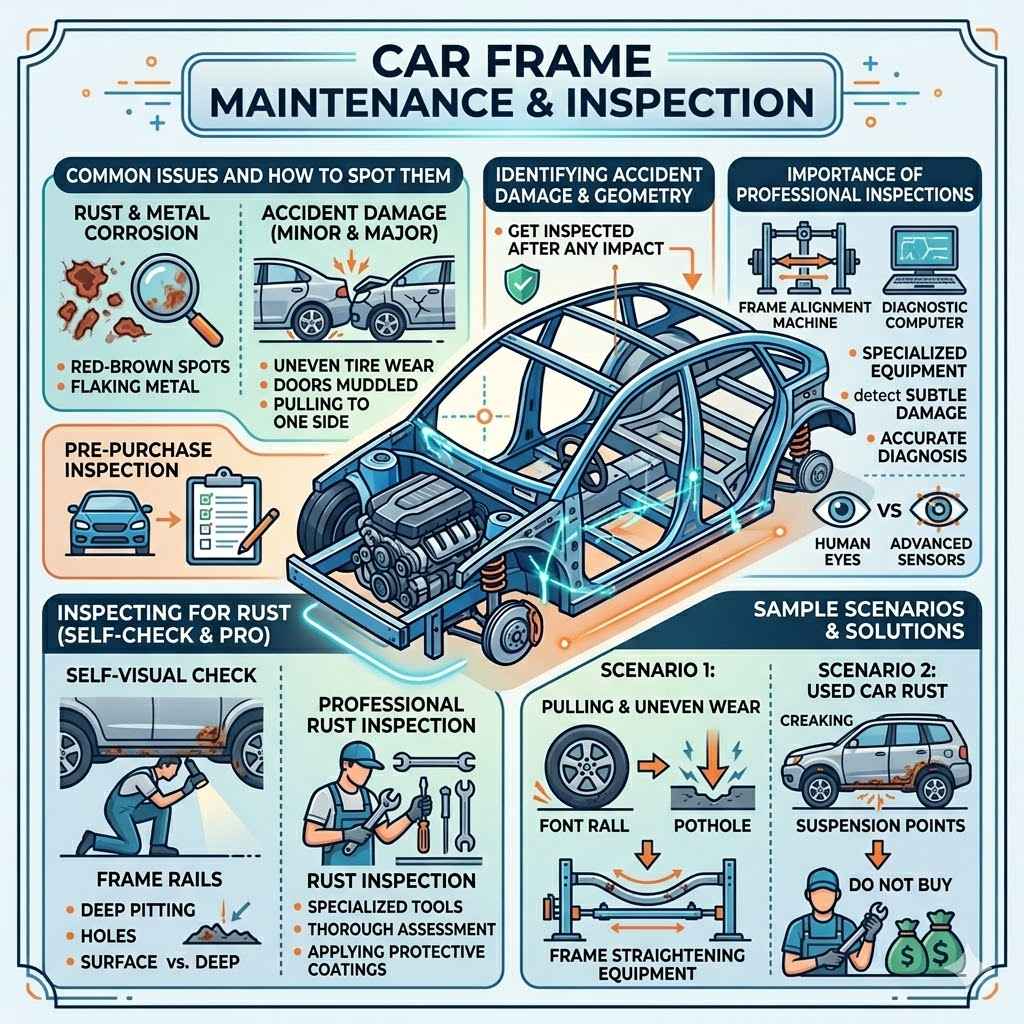
The most common issues with car frames are rust and damage from accidents. Rust can weaken the metal over time, especially in areas where salt is used on roads in winter. You might notice reddish-brown spots or flaking metal on the frame.
If you see this, it’s important to have it checked by a professional.
Accident damage can cause the frame to bend or crack. Even a minor fender-bender can sometimes cause subtle frame damage that might not be immediately obvious. Signs of frame damage can include uneven tire wear, doors that don’t close properly, or the car pulling to one side.
Any suspicion of frame damage should lead to a professional inspection.
Inspecting for Rust
Regularly look underneath your car, especially after driving in wet or snowy conditions. Pay attention to the frame rails, which are the main structural beams. Look for any signs of deep pitting, flaking paint, or holes.
Surface rust might not be a major concern, but if you can poke a hole in the metal, it’s a serious problem.
If your car is older or has been driven in areas with heavy road salt use, consider having a mechanic perform a thorough frame inspection. They have the tools and expertise to identify even minor rust issues before they become critical. Protective coatings can sometimes be applied to slow down rust progression.
Identifying Accident Damage
After any accident, no matter how small, it’s wise to have the frame inspected. A mechanic can use specialized tools to measure the frame and ensure it’s perfectly straight. They can also look for cracks or deformations in the metal that might not be visible to the naked eye.
A slight misalignment can cause significant problems with how your car drives and wears its tires.
If you’re buying a used car, always get a pre-purchase inspection that includes a check of the frame. This can save you from buying a vehicle with hidden structural problems that could be very costly to repair later on. Vehicle history reports can sometimes reveal past accidents, but a physical inspection is essential.
The Importance of Professional Inspections
While you can do basic visual checks yourself, professional inspections are crucial for accurate diagnosis. Mechanics have specialized equipment, like frame alignment machines and diagnostic tools, that can detect subtle damage. They also have the knowledge to understand how different types of damage affect a car’s safety and performance.
If a frame issue is detected, professionals can advise on the best course of action, whether it’s a repair, reinforcement, or in severe cases, deeming the vehicle unsafe to drive. Trusting a qualified mechanic ensures your car’s structural integrity is properly maintained.
Sample Scenario 1
Imagine you notice your car is pulling slightly to the left, and the front tires are wearing unevenly on the inside edge. You might initially think it’s just an alignment issue. However, a mechanic might discover that a minor impact from hitting a pothole some time ago caused a slight bend in one of the frame rails.
This slight bend, even if not visible from the outside, is enough to throw off the wheel alignment significantly. Simply adjusting the alignment would be a temporary fix. The underlying frame damage needs to be addressed.
The mechanic would then propose straightening the frame rail to restore the car’s proper geometry and prevent further tire wear.
Sample Scenario 2
You are looking to buy a used SUV that looks great on the outside. During the test drive, you notice a strange creaking sound when you go over bumps. The seller says it’s nothing.
You decide to get a professional pre-purchase inspection.
The mechanic finds that the SUV has significant rust on its frame, particularly around the suspension mounting points. This rust has weakened the frame. The creaking sound is the frame flexing under stress.
The mechanic advises against buying the vehicle, as repairing this level of frame rust would be extremely expensive and might not even restore it to full safety standards.
Frequently Asked Questions
Question: What is the main job of a car frame?
Answer: The main job of a car frame is to provide a strong foundation for all the other parts of the car. It holds everything together, supports the weight, and helps the car maintain its shape and stability while driving.
Question: What is the difference between body-on-frame and unibody?
Answer: In body-on-frame, a separate chassis supports the body. In unibody, the car’s body and frame are one integrated structure.
Question: Are unibody cars safe?
Answer: Yes, unibody cars are very safe. They are designed with crumple zones that absorb impact energy and protect passengers effectively in a crash.
Question: What causes car frames to rust?
Answer: Car frames can rust due to exposure to moisture, salt used on roads, and if the protective coating is damaged, allowing metal to be exposed to the elements.
Question: Can a damaged car frame be repaired?
Answer: Yes, minor to moderate frame damage can often be repaired by straightening or reinforcing the affected areas. However, severe damage may make a repair impractical or unsafe.
Summary
A car frame is the fundamental structure that supports all vehicle components. It’s vital for safety, stability, and performance. We explored body-on-frame and unibody types, their pros and cons, and the materials used.
Regular inspections for rust and damage are key to maintaining your vehicle’s integrity.