Best Brake Fluid Testers for Cars: Top 3 Picks Reviewed
The best brake fluid tester depends on how you maintain your vehicles: pick a pen-style tester for quick pass/fail checks, a digital meter for numeric moisture readings, or a gooseneck-style probe when reservoir access is tight. Ignoring fluid condition can mean longer stopping distances, internal corrosion, and brake repair bills. This guide compares the top 3 tester types and shows which one fits your maintenance routine.
Quick comparison
| Product | Badge | Best for | Price | ||
|---|---|---|---|---|---|
 |
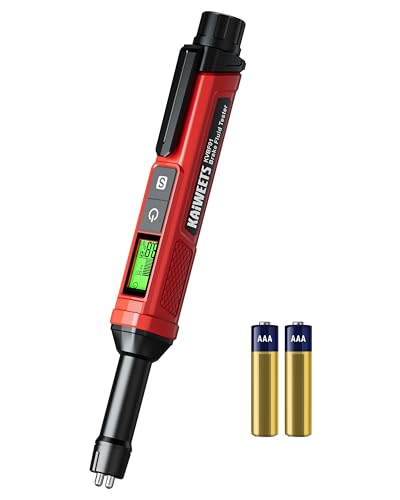
Digital Brake Fluid Tester LCD Display for dot3 DOT4 DOT5.1BildeeMait | Our pick | Digital LCD display · DOT3/DOT4/DOT5.1 compatible · ABS pen-style body | $21.86
Price as of 19 Oct 2026
|
View |
 |
Car Brake Fluid Liquid Tester Pen, DOT 3 DOT 4 DOT 5.1LTDCVTR | Budget pick | 5 LED indicators · Nickel-plated probe · Universal vehicle compatibility | $6.29
Price as of 19 Oct 2026
|
View |
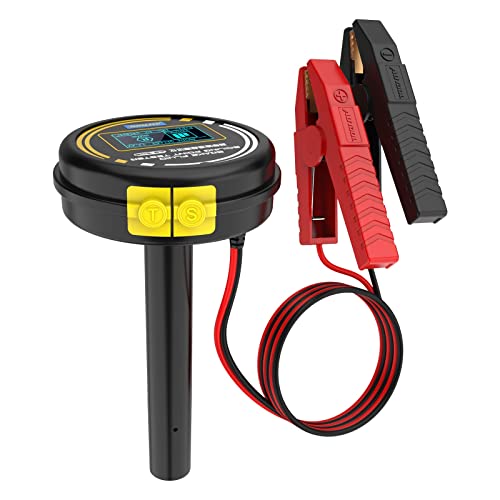 |
Brake Fluid Boiling Point Tester, 16-Second Fast Test withAUTOOL | Upgrade pick | OLED display · 16-second testing · 12V powered | $75.99
Price as of 19 Oct 2026
|
View |
For speed and value, an LED pen is the default for most daily drivers. For tracking change over time, a digital tester is the better choice because it shows moisture percentage and, on some models, a boiling-point estimate.
How we chose
We compared the listed testers on four things buyers actually use: fluid compatibility, reading style, probe durability, and display visibility. DOT 3 and DOT 4 support is commonly treated as the baseline, while DOT 5.1 support can matter for some European and higher-spec vehicles.
We also looked at how each tool fits a real maintenance habit. A commuter who wants a fast yes/no check needs a different tool than a multi-car owner who wants to track moisture over time or a shop that checks several vehicles in dim light.
Comparison table
| Tester type | Fluid compatibility | Reading style | Best fit | Common weak point |
|---|---|---|---|---|
| LED pen tester | Usually DOT 3 and DOT 4; some also support DOT 5.1 | Go/no-go, often green/yellow/red | Daily drivers, quick checks, low cost | Can miss small moisture changes and can be thrown off by probe wear or contamination |
| Digital brake fluid tester | Often DOT 3, DOT 4, and DOT 5.1 | Moisture percentage; some estimate boiling point | Multi-car owners, trend tracking, shop use | Costs more and still depends on a clean sample and a healthy probe |
| Gooseneck tester | Varies by model; often similar to LED or digital units | Either pass/fail or percentage, depending on the tool | Awkward reservoirs, motorcycles, some heavy-truck service points | Reach helps, but tiny reservoirs and tight caps can still complicate sampling |
LED pen tester: best for quick checks
The LTDCVTR pen-style tester is the easiest fit for most daily drivers who want a fast answer and a low buy-in. Based on the product details, it uses a three-LED style readout, and the listing says it supports DOT 3, DOT 4, and DOT 5.1 compatibility; competitor material also places pen-style units in the cheaper, pocket-sized category.
That makes it a strong choice for routine maintenance where you only need to know whether the fluid looks acceptable or overdue for attention. The nickel-plated probe is the part that matters most here, because repeated contact with brake fluid can wear cheaper tips and increase the chance of drift over time.
The drawback is the same one that applies to most LED pens: they give a threshold-style result, not a moisture percentage. If you want to track gradual change, or you maintain several vehicles and want more detail than green/yellow/red, this is not the best format.
Where LED pens fall short
LED pens are fast, but their simplicity can hide borderline cases. A dirty reservoir cap, residue in the sample area, or probe corrosion can create false positives or false negatives, especially if the tool has been used often and not kept clean.
They also tend to be less helpful for owners who want to compare one service interval with the next. If your goal is “is it bad yet?” the pen works. If your goal is “how much has it changed since last spring?” a digital tester is better.
Digital brake fluid tester: best for exact readings
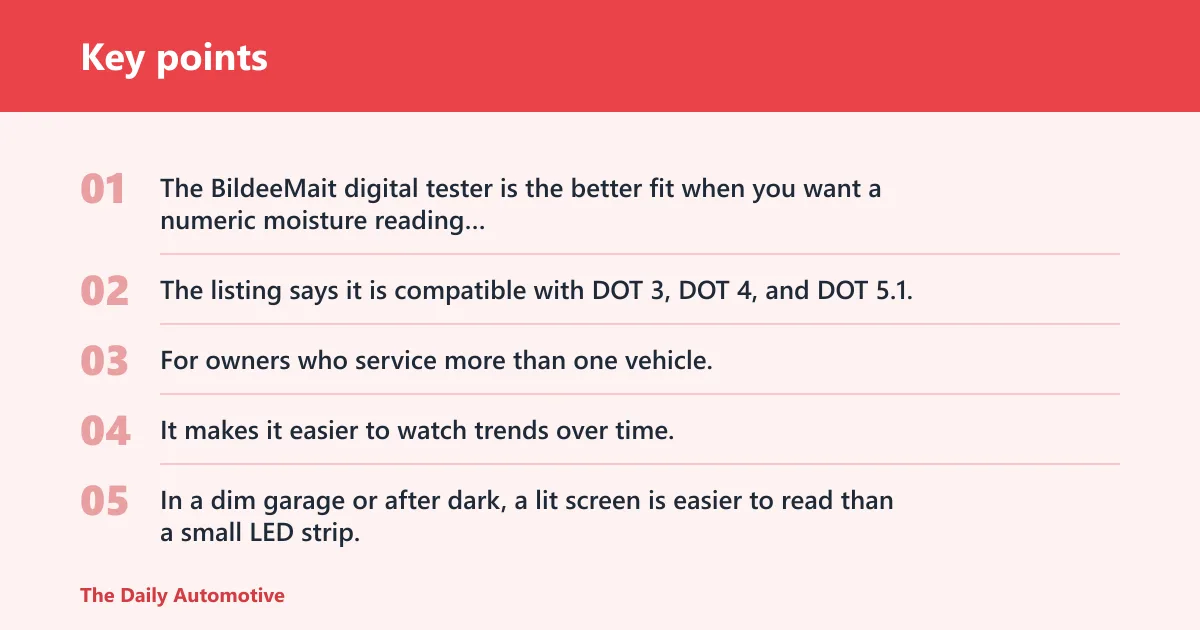
The BildeeMait digital tester is the better fit when you want a numeric moisture reading instead of a simple light pattern. The listing says it is compatible with DOT 3, DOT 4, and DOT 5.1, and the product details describe a digital LCD readout that measures water content to help prevent brake failure.
For owners who service more than one vehicle, that percentage readout is the real advantage. It makes it easier to watch trends over time, and the comparison data says this top digital pick also provides boiling-point information, which is useful when you want a more cautious flush decision before hard use, towing, or high-heat driving.
The backlit display matters too. In a dim garage or after dark, a lit screen is easier to read than a small LED strip. The stated AAA battery setup is also a practical plus for buyers who want common replacement cells.
The drawback is price and complexity. At roughly $25–$35, it costs more than a basic LED pen, and the sample still has to be clean. A worn probe or contaminated reservoir cap can still distort the result.
When percentage readings matter most
Percentage readings are most useful when you care about change, not only status. A fleet, a track-day car, or a household with three vehicles benefits from a number you can compare later, especially when the braking system sees heat and repeated service intervals.
They also help when you want a more conservative flush plan. If a digital tester shows a rising moisture figure, that is more actionable than a vague light pattern, especially on cars used in wet climates or for mountain driving.
Brake fluid tester matrix
The right tester depends on the job. A daily commuter usually needs fast pass/fail feedback. A multi-car owner benefits from a digital reading. A shop or an owner who services awkward reservoirs should pay attention to reach and probe shape before anything else.
| Use case | Best tester type | Fluid compatibility to verify | Reading style | Common failure mode |
|---|---|---|---|---|
| Daily driver | LED pen tester | DOT 3 and DOT 4 | Green/yellow/red go-no-go | Probe wear or contamination skews the light pattern |
| Multi-car owner | Digital tester | DOT 3, DOT 4, and preferably DOT 5.1 | Moisture percentage, sometimes boiling point | Dirty reservoir or corroded probe can create a false number |
| Shop use | Digital tester | DOT 3, DOT 4, and DOT 5.1 | Numeric output with backlit display | Slow sampling and worn probe tips reduce confidence over time |
| Awkward reservoir or tight access | Gooseneck tester | Match by model; do not assume universal support | Either pass/fail or percentage | Reach helps, but a tiny reservoir can still be hard to sample cleanly |
One-line rule: daily drivers should start with an LED pen, multi-car owners should spend more for a digital tester, and shop use favors a digital model with a backlit display and corrosion-resistant probe.
Gooseneck tester: best for awkward reservoirs
A gooseneck tester is the right answer when access, not speed, is the problem. Some reservoirs sit under braces, bodywork, or tight packaging, and a flexible probe makes it easier to reach the fluid without fighting the cap or spilling along the neck.
This style can matter on motorcycles and some heavy trucks with small or specialized reservoirs, where a straight pen may be awkward to position. It is also useful on certain European cars where the reservoir opening sits deep in the bay.
The limitation is that reach does not fix everything. In very small reservoirs, even a flexible tip can be awkward, and if the cap area is dirty, any tester can still give a misleading result. The same contamination and corrosion concerns apply here.
When reach beats speed
Picture a compact motorcycle with a shallow reservoir tucked under bodywork. A straight pen may fit poorly, while a flexible probe can sample the fluid without a struggle. The better tool is the one that reaches the sample cleanly on the first try.
Suppose a European sedan calls for DOT 5.1 support and has a reservoir tucked beneath a strut brace. In that case, a gooseneck model can solve the access issue, but the buyer still needs to verify fluid compatibility before assuming the reading is valid.
Choose BildeeMait if… / Choose LTDCVTR if… / Choose AUTOOL if…
Choose BildeeMait if you want a digital moisture percentage, you maintain more than one vehicle, you need DOT 3, DOT 4, and DOT 5.1 support, or you want a backlit display for low-light work. It is the strongest pick for tracking change over time.
Choose LTDCVTR if you want the fastest low-cost check, only need a simple LED result, or you are buying for a daily driver and do not want to spend more than necessary. It is the practical default for routine brake-fluid checks.
Choose AUTOOL if reach and service access matter more than speed, especially on awkward reservoirs. Its fast-test and boiling-point orientation make sense for buyers who want a more specialized tool, but the higher price means it is harder to justify unless you need that format.
Which one should you buy?
Buy an LED pen if you want the fastest low-cost check and your car uses standard DOT 3 or DOT 4 fluid. Buy a digital tester if you want a percentage, a clearer flush plan, or support for DOT 5.1 applications. Buy a gooseneck model if the reservoir is hard to reach.
If you only check one commuter car twice a year, a simple pen is usually enough. If you service family vehicles, a winter beater, and a weekend car, the digital route gives you better comparison data and less guesswork.
For European vehicles and any application that calls for DOT 5.1, do not buy on price alone. Verify the label first, because some basic LED pens support only DOT 3 and DOT 4.
Two practical examples help. A common first-timer mistake is buying a cheap pen for a DOT 5.1 car and assuming all brake fluids read the same; the better move is to confirm compatibility before purchase. Another is checking fluid through a dirty cap opening and trusting a strange reading without cleaning the area first.
What to look for before you buy
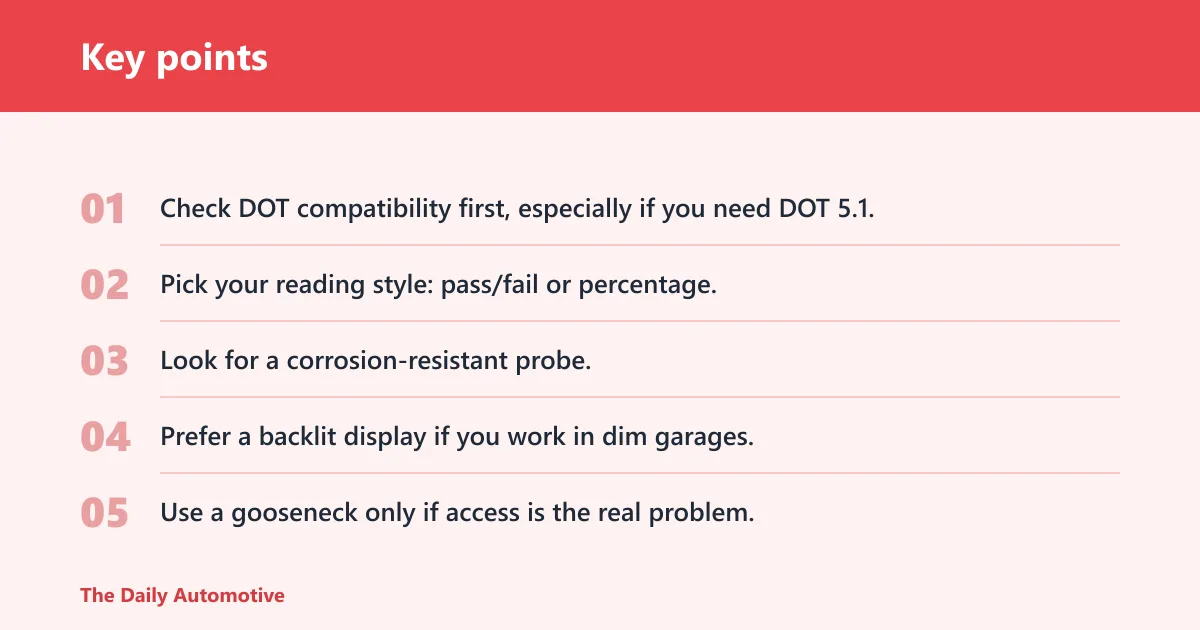
- Check DOT compatibility first, especially if you need DOT 5.1.
- Pick your reading style: pass/fail or percentage.
- Look for a corrosion-resistant probe.
- Prefer a backlit display if you work in dim garages.
- Use a gooseneck only if access is the real problem.
Frequently asked questions
What is the best brake fluid tester for a car?
The best brake fluid tester for most cars is a simple LED pen if you want a quick go/no-go answer, or a digital tester if you want a percentage reading. For daily drivers, the pen is usually enough. For multi-car owners or shops, the digital option is more informative.
Are digital brake fluid testers better than LED pens?
Digital testers are better when you want a moisture percentage, a boiling-point estimate, or a reading you can compare over time. LED pens are better when you want speed, lower cost, and a fast check. Neither is universally better; the right choice depends on how much detail you need.
Which brake fluid tester works with DOT 3, DOT 4, and DOT 5.1?
Look for a digital tester or a higher-spec pen that explicitly lists DOT 3, DOT 4, and DOT 5.1. Many basic LED pens cover only DOT 3 and DOT 4. If your vehicle uses DOT 5.1, compatibility is the first filter, not the last.
How accurate are cheap brake fluid testers?
Cheap testers can be useful for a basic pass/fail check, but they are more vulnerable to probe wear, dirty reservoirs, and contaminated caps. That means they can produce false positives or false negatives. A corrosion-resistant probe improves consistency, but clean sampling still matters.
Can a brake fluid tester tell me when to change brake fluid?
Yes, within limits. A tester can tell you when moisture has risen enough to schedule a flush, but it should not replace maintenance intervals or common-sense inspection. If the reading is high, or the fluid has been in service for years, plan the flush sooner rather than later.
What is the difference between moisture percentage and LED tester readings?
Moisture percentage gives you a numeric estimate of water content, while LED tester readings translate that condition into a simple pass/fail or color result. Percentage is better for tracking changes over time. LED output is better when you only need a quick answer.
Do brake fluid testers work on all brake fluids?
No. Compatibility varies by model, and that matters. Some basic LED pens support DOT 3 and DOT 4 only, while select digital models also support DOT 5.1. Always check the fluid label before buying, especially on European vehicles or higher-spec cars.
What should I look for when buying a brake fluid tester?
Start with compatibility, then decide whether you want a percentage reading or a simple LED result. After that, look for a corrosion-resistant probe and a display you can read in poor light. For awkward reservoirs, a gooseneck design may matter more than any extra feature.
Products related to this article
Sponsored / affiliate links. As an Amazon Associate I earn from qualifying purchases. I may earn additional commission from eligible campaigns.