Collision Car Insurance Coverage: A Decision-Making Calculator
You’re sitting at a stoplight, and out of nowhere, the driver behind you taps your bumper. It’s not bad, but your trunk won’t close, and the tail light is shattered. You’re not hurt, but your car is damaged. Your first thought is usually, “Who pays for this?” If you only carry liability insurance, the answer gets complicated fast.
Collision car insurance coverage is the piece of your auto policy that pays to repair or replace your vehicle when it’s damaged in an accident, regardless of who’s at fault. It’s optional in most states, but it’s often required by lenders. This guide walks you through exactly how it works, what it costs, and — most importantly — how to decide if it’s worth the money for your specific car and budget. You’ll leave with a simple formula to calculate your own answer, not a generic “it depends.”

ROVE
ROVE R2-4K Dual Dash Cam Front and…
- UPSCALED 4K FRONT + 1080P REAR DUAL DASH CAM: The ROVE R2-4K DUAL records the road ahead and behind at the same time. The front ca…
- SONY STARVIS 2 IMX675 SENSOR + SUPER NIGHT VISION: The front camera uses a Sony STARVIS 2 IMX675 5MP image sensor with a wide F1.5…
- ULTRA FAST 5.8GHz WIFI/ UP TO 20MB/s DOWNLOAD SPEED: With its built-in dual-band 5.8GHz and 2.4GHz WiFi, you can use the ROVE dash…
Before we get into the weeds, a quick note on evidence. A dash cam is one of the best ways to protect yourself during a collision claim. The ROVE R2-4K Dual Dash Cam records both the road ahead and behind you in high detail, which can help prove fault and speed up your claims process. It’s a small investment that pays for itself the first time you need it.
What Is Collision Car Insurance Coverage?
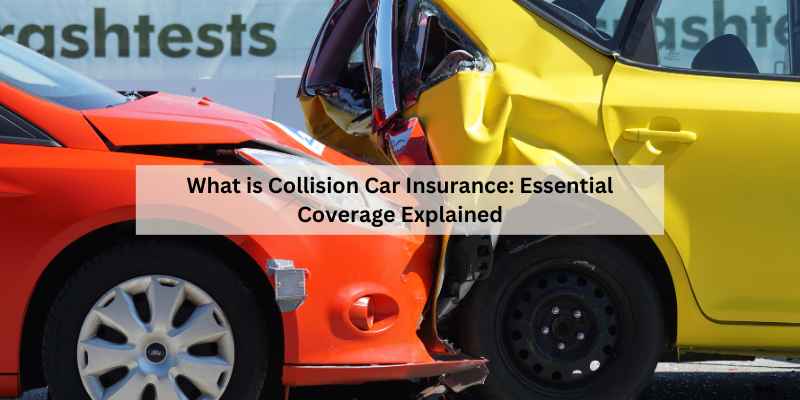
Collision coverage is pretty straightforward. It pays for damage to your car when it hits another object. That object can be a car, a tree, a guardrail, a fence, or a pothole. It also covers you if another driver hits you and they don’t have insurance, as long as you have uninsured motorist property damage or collision coverage.
The tricky part is understanding how it fits with the other parts of your policy. Most people lump everything into “full coverage,” but that’s not a real insurance product. It’s a combination of three distinct coverages.
Collision vs. Comprehensive vs. Liability (The 3-Way Breakdown)
Think of your auto policy as three separate buckets. Each one pays for different types of damage.
- Liability insurance: This pays for damage you cause to other people and their property. It does not pay a single cent for your own car. Every state requires some form of this.
- Collision coverage: This pays for damage to your car from a crash with another vehicle or object. It’s the bucket you use when you hit a deer? No, that’s comprehensive. You hit a parked car? That’s collision.
- Comprehensive coverage: This pays for damage to your car that isn’t from a crash. Think theft, vandalism, fire, hail, flood, or hitting an animal. People often confuse a deer strike with collision, but it’s comprehensive.
So, if you back into a light pole in a parking lot, you use collision. If a tree limb falls on your hood during a storm, you use comprehensive. If you rear-end someone, your liability pays for their bumper, and your collision pays for your hood.
What Does Collision Coverage Pay For? (Real-World Scenarios)
Collision coverage is broad, but it’s not unlimited. Here are the most common situations where it kicks in.
- At-fault accidents: You run a red light and T-bone another car. Your collision coverage pays to fix your car, minus your deductible.
- Single-car accidents: You slide on ice and hit a concrete barrier. No other car involved. Collision pays.
- Hit-and-run: You park your car, come back, and find a dent in the door. If the other driver is gone, collision covers this (in most states), but you’ll pay your deductible.
- Hit while parked: A shopping cart hits your door? That might be comprehensive. Another car backs into your parked car? That’s collision.
Here’s a real-world example. Let’s say your repair estimate is $2,400 and your deductible is $500. Your insurance company writes you a check for $1,900, and the repair shop handles the rest. If the other driver is clearly at fault, your insurer will often try to recover your deductible from their insurance company through a process called subrogation. You might get that $500 back eventually, but it’s not guaranteed.
One thing to watch: rental reimbursement is not included in collision coverage. It’s a separate add-on. If your car is in the shop for two weeks, you’ll be paying for a rental out of pocket unless you added this endorsement to your policy. It usually costs $20-$40 a year, and it’s worth it if you rely on your car daily.
What Collision Coverage Does NOT Cover (Critical Exclusions)
Collision coverage has clear limits. Knowing what it doesn’t do saves you from a nasty surprise at the claims desk.
- Mechanical breakdowns: Your engine blows up on the highway. That’s a mechanical failure, not a collision. You need an extended warranty or mechanical breakdown coverage, not collision.
- Normal wear and tear: Brake pads, tires, and oil changes are your responsibility.
- Injuries: Collision pays for car damage only. Your medical bills and your passengers’ medical bills fall under personal injury protection (PIP) or medical payments coverage, depending on your state.
- Other people’s vehicles: Collision only touches your car. The other driver’s repairs come out of your liability coverage.
The biggest confusion point is vandalism. If someone keys your car or smashes your window, that is not a collision. That’s a comprehensive claim. Collision requires a physical impact from a moving vehicle or object. Intentional damage by a person is comprehensive.
Do You Legally Need Collision Coverage? (Lender vs. State Rules)
No state legally requires you to buy collision coverage. The law only mandates liability insurance. However, if you have a car loan or a lease, your lender will require it.
Think about it from the bank’s perspective. They own the title until you pay off the loan. If you total their asset and you have no insurance, they lose thousands of dollars. So, they force you to carry both collision and comprehensive coverage with a deductible that usually can’t exceed $1,000. You don’t really have a choice until the loan is paid off.
Once you own the car free and clear, the decision is yours. That’s when the math gets interesting.
How Much Does Collision Coverage Cost? (Average Rates & Factors)
Collision coverage isn’t cheap, but it’s not outrageous either. The average cost is roughly $300 to $700 per year, depending on where you live and what you drive. That’s about $25 to $60 a month.
Several factors move that number up or down:
- Your car’s value: Insuring a $50,000 truck costs more than a $10,000 sedan because the potential payout is higher.
- Your deductible: Higher deductible equals lower premium. It’s a direct trade-off.
- Your driving record: A single at-fault accident can raise your collision premium by 20% to 40% for three to five years. Some insurers offer accident forgiveness if you’ve been with them for several years without a claim.
- Your location: Urban areas with higher accident rates cost more than rural areas.
Here’s the part most articles skip: how a claim affects your future premiums. If you file a collision claim, your insurer will likely surcharge you for three to five years. That surcharge can easily exceed the payout you received. For example, if you file a $1,500 claim and your premium goes up $300 a year for four years, that’s $1,200 in extra costs. You barely came out ahead.
This is why you should treat collision coverage like a safety net for big losses, not a maintenance plan for small scratches. If the repair costs less than your deductible, you’re paying for it anyway. If it costs slightly more than your deductible, you might be better off paying out of pocket to avoid the premium surcharge. Run the numbers before you file.
How to Choose Your Deductible (A Smart Money Strategy)
Your deductible is the amount you pay before insurance kicks in. Common options are $250, $500, $1,000, and $2,000. The right choice depends on your savings, not just your monthly budget.
Here’s the strategy: pick a deductible you could comfortably write a check for tomorrow. If you have $1,500 in your emergency fund, a $1,000 deductible is reasonable. If you only have $300 in savings, a $500 deductible is risky because you can’t cover it without going into debt.
The premium difference between a $500 and $1,000 deductible is usually 15% to 25%. On a $500 annual premium, that’s $75 to $125 in savings. You’d need to go several years without a claim to make the higher deductible worth it. If you’re a safe driver, go higher. If you’re accident-prone, stick with a lower deductible.
A quick rule: don’t carry a deductible you can’t cover. It defeats the purpose of insurance if you have to borrow money to fix your car after a crash.
What Happens If Your Car Is Totaled? (The Claims Process Explained)
A total loss means the repair cost exceeds a certain percentage of your car’s value. Most insurers use a threshold around 70% to 75%. If repairs cost $6,000 and your car is worth $8,000, they’ll likely total it.
When your car is totaled, your insurer doesn’t write you a check for what you paid. They pay the actual cash value (ACV) of the car at the moment of the crash. ACV is the replacement cost minus depreciation. That new car you bought for $30,000 three years ago might only have an ACV of $18,000 today.
Here’s how the payout works:
- Your insurer calculates the ACV using comparable sales in your area.
- They subtract your deductible from that amount.
- They cut you a check for the difference.
So, if your ACV is $18,000 and your deductible is $500, you get $17,500. If you still owe $20,000 on your loan, you’re $2,500 in the hole. That’s where gap insurance comes in.
You can negotiate the ACV. Don’t just accept the first number. Pull listings for similar cars with similar mileage in your area. If you find comparable cars selling for $20,000, send those to your adjuster. They have room to move. It’s not a fun process, but it’s worth an extra hour of work to potentially get an extra $1,000 or $2,000.
Collision vs. Gap Insurance: Do You Need Both?
This is the most common source of confusion. Collision pays the ACV of your car. Gap insurance pays the difference between that ACV and what you owe on your loan or lease.
Let’s put it in plain numbers. You buy a $25,000 car with a $2,000 down payment. You owe $23,000. Six months later, you total it. The ACV is $20,000. Collision pays $19,500 (after your $500 deductible). You still owe $23,000 to the bank. You’re responsible for the $3,500 gap.
Gap insurance covers that $3,500. It’s cheap, usually $200 to $400 as a one-time fee or about $20 a year as an endorsement. If you put less than 20% down or you financed for more than 60 months, you should seriously consider gap insurance. The moment your loan balance drops below your car’s market value, you can cancel it.
| Scenario | Collision Coverage | Gap Insurance |
|---|---|---|
| You owe $10k, car is worth $12k | Pays $11.5k (minus $500 deductible) | Not needed — you’re not upside down |
| You owe $15k, car is worth $12k | Pays $11.5k | Pays the remaining $3.5k to your lender |
| You own the car free and clear | Pays ACV, no loan payoff involved | Not available — no loan exists |
If you lease a car, gap insurance is almost always required by the lease agreement. Don’t skip it.
Is Collision Coverage Worth It for an Older Car? (The 50% Rule)
This is the classic question. Your car is 10 years old, has 150,000 miles, and is worth maybe $3,000. You’re paying $600 a year for collision coverage. That’s 20% of the car’s value annually. It doesn’t take a mathematician to see the problem.
Here’s the rule of thumb: if your annual collision premium is more than 10% of your car’s value, drop it. Let’s do the math.
- Car value: $3,000
- Annual collision premium: $600
- Ratio: 20% — way too high
In this case, you’re better off dropping collision and putting that $600 into a savings account. If you total the car in two years, you’ve saved $1,200, which is close to the ACV payout you’d have received anyway. And you avoided the premium surcharge.
On the flip side, if your car is worth $15,000 and your collision premium is $500, the ratio is about 3.3%. That’s a good deal. You’re paying a small amount to protect a significant asset.
Most financial advisors recommend dropping collision once your car’s value drops below $4,000 to $5,000. At that point, the maximum payout is so low that the premium isn’t worth the risk transfer. You’re essentially self-insuring.
How to File a Collision Claim (Step-by-Step Guide)
Filing a claim is stressful, but the process is predictable. Here’s what to do, in order.
- Check for injuries first. If anyone is hurt, call 911 immediately. Your insurance claim can wait.
- Call the police. Get a police report, even for minor fender benders. It creates an official record and helps with fault determination.
- Exchange information. Get the other driver’s name, phone number, license plate, insurance company, and policy number. Take photos of their license, their car, and the damage from every angle.
- Call your insurer. Report the accident as soon as possible, even if you’re not sure you’ll file a claim. They’ll open a file and assign an adjuster.
- Get an estimate. Your adjuster will either inspect the car in person or ask you to take it to an approved repair shop. Some insurers allow you to upload photos and get an estimate remotely.
- Choose a repair shop. You have the right to choose any shop. Your insurer can’t force you to use their preferred shop, but using one often speeds up the process.
- Pay your deductible. You’ll pay this directly to the repair shop when you pick up your car. Your insurer pays the rest.
One tip: don’t admit fault at the scene. Even if you think you caused it, let the police and the insurers sort out liability. Anything you say can be used against you later.
If you need to drive another car while yours is being repaired, check your policy first. Collision coverage typically follows the car, not the driver. For more on this, see our guide on driving another car.
Frequently Asked Questions About Collision Coverage
Does collision coverage cover a hit-and-run?
Yes, in most states. If your car is damaged by a driver who leaves the scene, your collision coverage pays for the repairs, minus your deductible. You’ll need to file a police report. Some states require uninsured motorist property damage coverage for hit-and-runs, which may have a lower deductible. Check your policy.
Will my premium go up if I file a collision claim?
Probably. An at-fault collision claim typically raises your premium by 20% to 40% for three to five years. Even a not-at-fault claim can trigger a surcharge in some states. That’s why it’s often smarter to pay for minor repairs out of pocket if they’re only a few hundred dollars over your deductible. Ask your agent for a hypothetical surcharge amount before you file.
Can I drop collision coverage on a financed car?
No. Your lender requires it as a condition of the loan. If you drop it, they’ll force-place their own policy on your car, which is usually much more expensive and provides less coverage. You’re stuck with it until the loan is paid off.
Is collision coverage the same as full coverage?
No. “Full coverage” isn’t a legal term. It usually means you have liability, collision, and comprehensive together. But the exact combination varies by lender and state. Always read your declarations page to see what you actually have.
Does collision coverage pay for a rental car?
No. Rental reimbursement is a separate endorsement you have to add to your policy. It typically costs $20 to $40 a year and covers a rental up to a daily limit (like $30 per day) for a set number of days (like 30). If you don’t have it, your insurer won’t pay for a rental after a claim.
Bottom Line: How to Decide If You Need Collision Coverage
Here’s the decision-making formula you came for. It’s not complicated, but it requires honest answers about your car and your finances.
- Step 1: Find your car’s current market value. Use Kelley Blue Book or Edmunds.
- Step 2: Get a quote for collision coverage alone from your insurer.
- Step 3: Divide the annual premium by the car’s value. If the result is over 10%, drop the coverage.
- Step 4: If the ratio is under 5%, keep it. You’re getting good protection for a fair price.
- Step 5: If you’re between 5% and 10%, consider your savings. Can you afford to replace the car without insurance? If not, keep collision.
- Step 6: If you have a loan or lease, keep collision until the balance is less than the car’s value. Then reconsider.
- Step 7: Always carry a deductible you can cover from your emergency fund, and never file a claim for damage under $1,000 if you can avoid it.
Collision coverage is a tool, not a requirement. Use it when it protects you from financial ruin, and drop it when it’s just eating your budget. Run the numbers every year or two, especially as your car ages. Your premium and your car’s value change constantly, so your decision should too.
And if you’re in an accident, having clear footage helps. The ROVE R2-4K dash cam records both front and rear, which makes the claims process faster and more honest. Check the current price on Amazon if you’re interested.
For more on related coverage questions, read our breakdown of full coverage vs. comprehensive insurance.
Products related to this article
Sponsored / affiliate links. As an Amazon Associate I earn from qualifying purchases. I may earn additional commission from eligible campaigns.