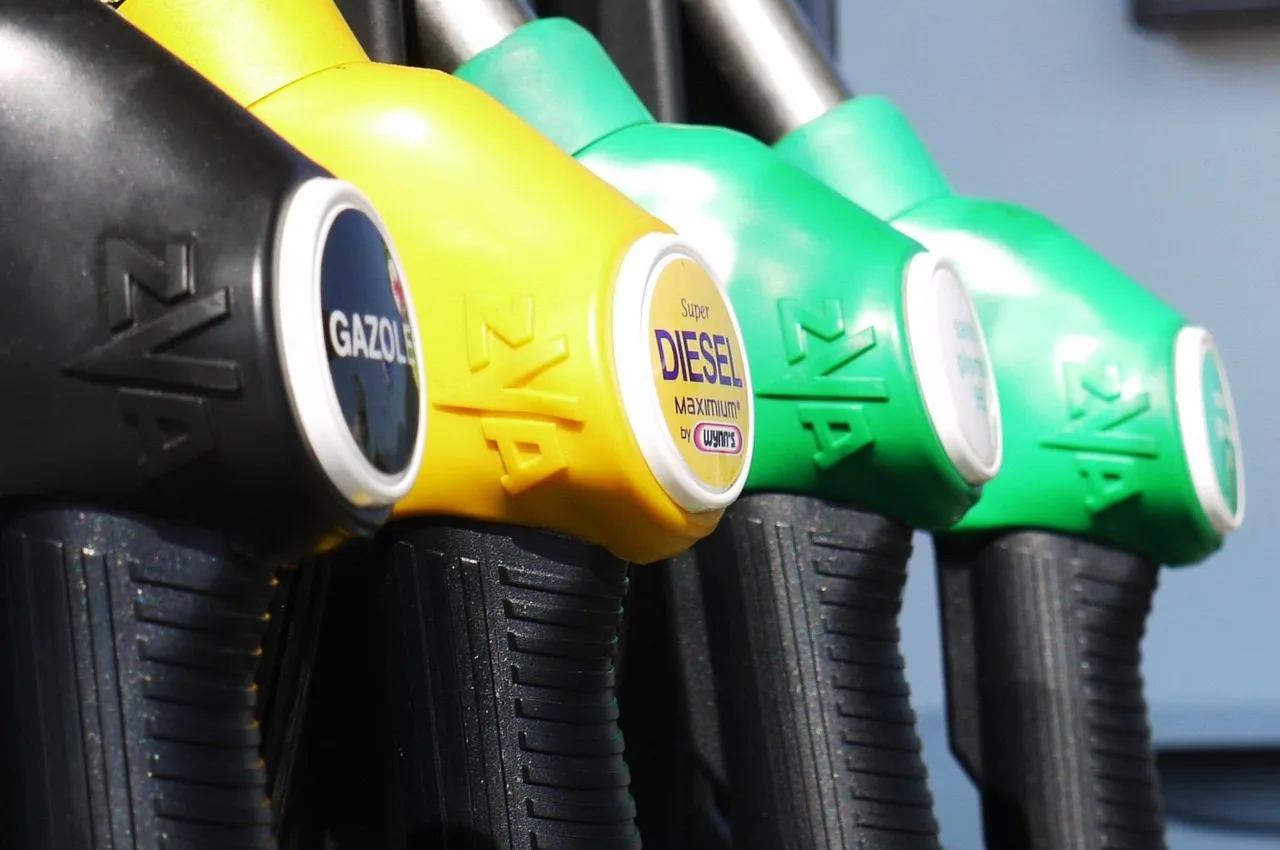
What Kind of Gas Does a Chevy Silverado Take by Engine?
In many cases, Chevy Silverado engines run on regular unleaded 87 octane, while some higher-output versions may call for premium fuel and diesel models need the appropriate low-sulfur diesel. Wrong fuel can cut power, hurt fuel economy, or damage a diesel system fast. This guide breaks the choice down by Silverado engine, with a yes/no pump checklist and a regular-vs-premium cost check.
What kind of gas does a Chevy Silverado take?
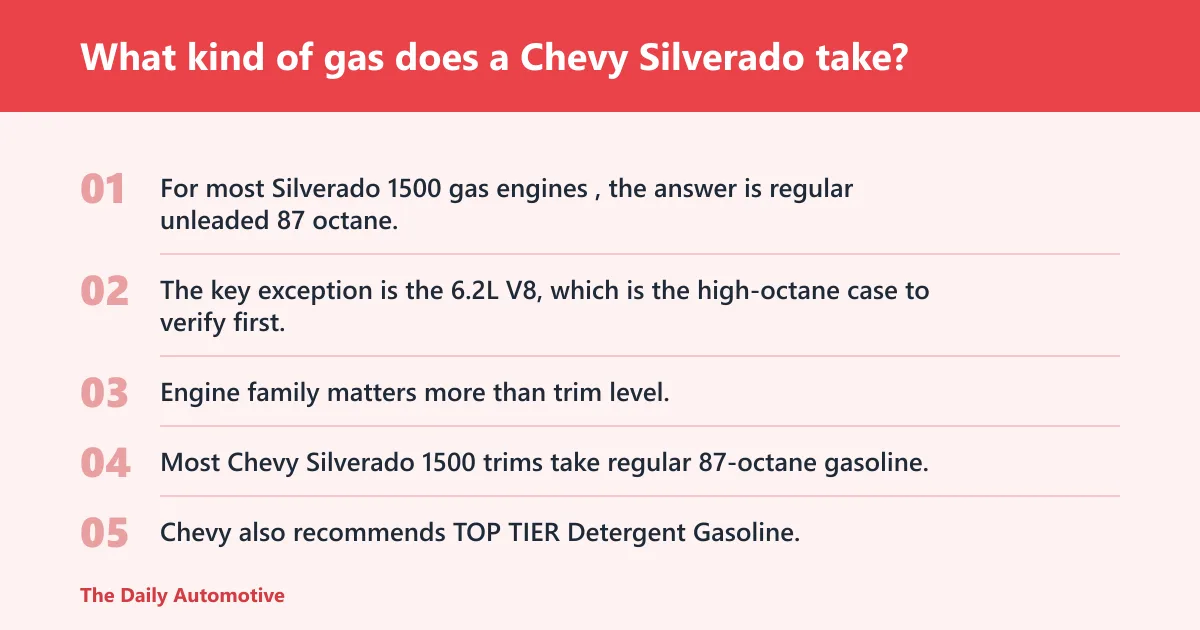


For most Silverado 1500 gas engines, the answer is regular unleaded 87 octane. The key exception is the 6.2L V8, which is the high-octane case to verify first. Engine family matters more than trim level, because Silverado fuel needs follow the powertrain, not the badge on the fender.
The short answer for most Silverado engines
Most Chevy Silverado 1500 trims take regular 87-octane gasoline, and the truck is built to run properly on that fuel. Chevy also recommends TOP TIER Detergent Gasoline, a fuel quality standard aimed at deposit control. That recommendation does not mean premium is required.
Why engine family matters more than trim level
A Silverado WT, LT, RST, or High Country can share fuel rules if the engine is the same. The 5.3L EcoTec3 is often approved for regular unleaded, while the 6.2L V8 is a case where premium fuel may be recommended for best performance. A turbo badge alone does not make premium fuel required.
Which Silverado engines need regular unleaded, and which may call for premium?
The 5.3L EcoTec3 is a regular-fuel engine in most guide references. The 2.7L Turbo needs year-by-year verification, because some guides list premium and others do not; the turbo label is not enough by itself. The 6.2L V8 is the high-output exception that commonly calls for premium.
Suppose you are renting a Silverado 1500 for a weekend move and the fuel door only says “87 minimum.” That truck gives you the answer already. If the door label or manual says 87, regular unleaded is the right buy at the pump.
📊 Most Silverado models are designed to run efficiently on regular unleaded gasoline with an octane rating of 87. Source: What Kind of Gas Does a Chevy Silverado Take?.
Does a Chevy Silverado need premium gas?
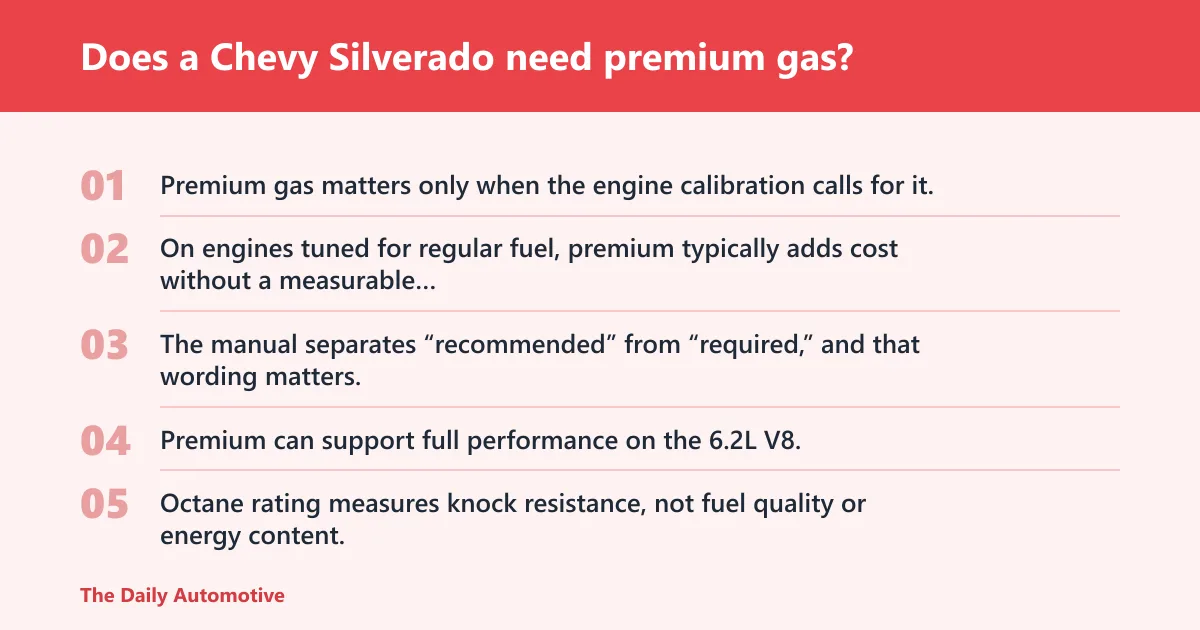
Usually, no. Premium gas matters only when the engine calibration calls for it, most clearly on some Silverado 6.2L V8 setups. On engines tuned for regular fuel, premium typically adds cost without a measurable benefit. The manual separates “recommended” from “required,” and that wording matters.
When premium helps
Premium can support full performance on the 6.2L V8, where Chevy recommends 93 premium unleaded gasoline in the sourced guidance. Octane rating measures knock resistance, not fuel quality or energy content. Higher octane lets an engine tuned for it keep timing and power where the calibration wants them.
When premium only raises your fuel bill
Putting premium in a 2.7L Turbo or 5.3L EcoTec3 adds cost without benefit, according to the cited guidance. That is the part many shoppers miss. If the engine is built to run on 87, premium usually does not create extra power, better mileage, or lower wear.
What the owner’s manual means by recommended versus required
“Recommended” often means the engine can run on regular fuel, but premium may allow the factory power target or keep knock control from pulling timing as often. “Required” is stricter and should be followed. The owner’s manual and fuel door label set the rule for your exact truck.

Can I use regular 87 octane in my Silverado?
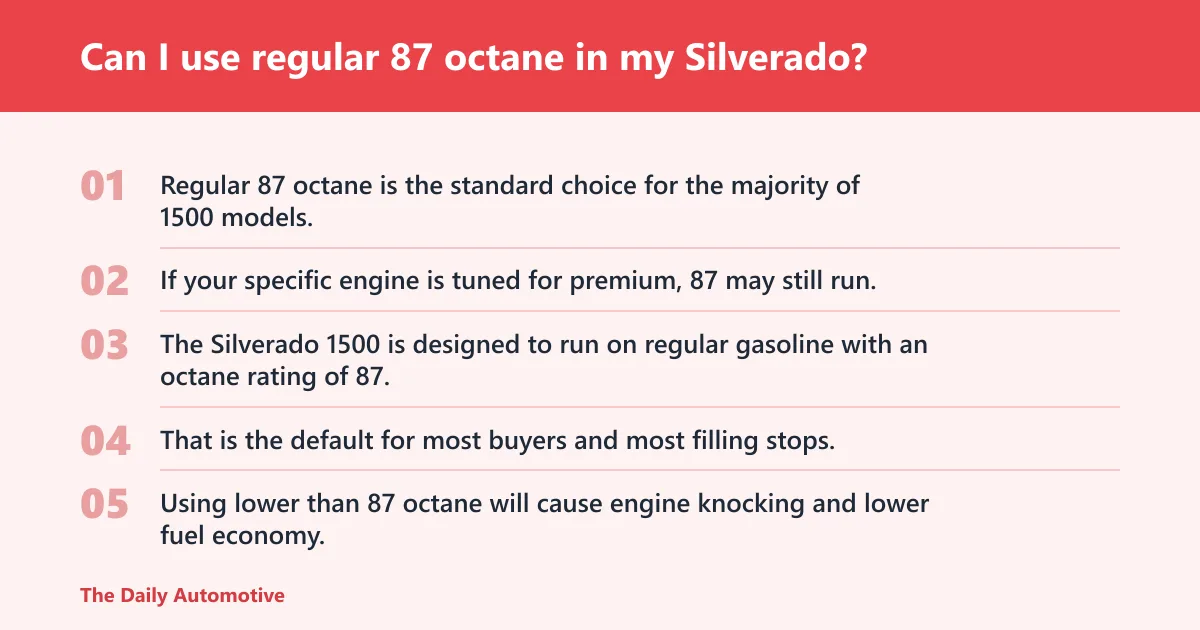
Yes, in most Silverado gasoline engines. Regular 87 octane is the standard choice for the majority of 1500 models, including many 5.3L setups. If your specific engine is tuned for premium, 87 may still run, but power can drop and knock control may step in.
Why 87 octane works in most Silverado gas engines
The Silverado 1500 is designed to run on regular gasoline with an octane rating of 87, and most Silverado models are designed to run efficiently on regular unleaded gasoline with an octane rating of 87. That is the default for most buyers and most filling stops.
What happens if an engine is tuned for higher octane
Using lower than 87 octane will cause engine knocking and lower fuel economy. On a premium-recommended engine, regular fuel is more likely to trigger knock control, which can pull timing and reduce output. The truck usually protects itself, but the driver may feel less power and see worse mileage.
How knock control protects the engine
Modern engine management listens for knock and adjusts timing when needed. That protection is why using regular in some premium-recommended engines does not automatically mean immediate damage. It does mean the calibration may not deliver the power and efficiency the engine was built to make.
Picture a driver who fills a 6.2L Silverado with regular for a cross-country trip because premium was sold out. The truck may still run, but it may feel flatter during passing and towing. That is a performance penalty, not a fuel savings win.
Silverado fuel decision table by engine
Use this as a quick pump guide, then confirm the exact year and trim in the owner’s manual or on the fuel door. Silverado fuel rules shift by engine family and model year, so the safest approach is to match the truck you are standing next to, not a broad forum answer.
| Model year family | Engine | Recommended octane | Does premium add a benefit? | Verdict |
|---|---|---|---|---|
| Most Silverado 1500 model years | 5.3L EcoTec3 | 87 | No | Safe to use regular; avoid premium unless the manual says otherwise. |
| Most Silverado 1500 model years | 2.7L Turbo | Check manual | No in many guide references | Verify manual; turbo does not automatically mean premium is needed. |
| 2019 and newer 4th-generation Silverado 1500 | 6.2L V8 | 93 | Yes | Verify manual; premium is the safe first choice for full performance. |
| Duramax-equipped Silverado | Diesel | Diesel fuel only | No | Avoid gasoline; use diesel only. |
| Flex-fuel Silverado, if equipped | Gasoline engine compatible with E85 | 87, E85 when approved | Depends on fuel used | Safe to use only if the fuel door or manual confirms E85 compatibility. |
Which Silverado engines require 91 or 93 octane?
The clear high-octane case is the Silverado 1500 6.2L V8, which is associated with premium 93-octane fuel for full power. Many other Silverado gasoline engines do not need premium. The correct answer depends on the engine code and model year, so check the manual before paying extra.
The 6.2L V8 is the high-octane exception to verify first
The 6.2L V8 engines were introduced in the fourth generation of Silverados released in 2019, and the 6.2L V8 recommends 93 premium unleaded gasoline. Some competitor tables list the 2023 6.2L V8 with premium fuel. That does not automatically apply to every Silverado.
What about the 2.7L Turbo?
The 2.7L Turbo is where shoppers often get mixed messages. One guide lists the 2023 turbocharged 2.7L I4 with premium fuel, but other references say premium adds no benefit. That conflict is why the manual and fuel door label matter more than the word “turbo.”
What about the 5.3L EcoTec3?
The 5.3L EcoTec3 is commonly a regular-fuel engine, and premium does not add a benefit in the cited guidance. For most owners, 87 octane is the right answer and the cheaper one. If the manual for a specific year says otherwise, follow that document.
Can a Chevy Silverado run on E85?
Only if the truck is flex-fuel compatible. E85 is up to 85% ethanol, and it is not a universal Silverado fuel. The fuel door or owner’s manual should confirm compatibility, because Silverado vehicles should not use gasoline or ethanol levels greater than 15% without the yellow fuel cap or sticker. (caranddriver.com)
Diesel Silverado models: diesel only
Duramax Silverado models use diesel fuel, not gasoline. That includes no regular gasoline, no premium gasoline, and no E85. Diesel and gasoline are not interchangeable, and putting the wrong liquid into a diesel truck can create an expensive repair path quickly.
Flex-fuel Silverado models: when E85 is allowed
E85 is only for trucks built to accept it. If your Silverado has a yellow fuel cap or sticker that indicates flex-fuel compatibility, the truck can use higher-ethanol fuel within that design. Without that marking, stick to the fuel listed in the manual.
How to confirm compatibility on the fuel door or in the manual
- Open the fuel door and look for a yellow cap or sticker.
- Check the owner’s manual fuel section for approved ethanol content.
- Match the engine code and model year to the listed fuel requirement.
- If the labels and manual disagree, follow the manual.
What happens if you put the wrong gas in your Silverado?
The consequence depends on what “wrong” means. Using regular in a premium-recommended gasoline engine usually means reduced power and possible knock-control intervention, not instant failure. Putting gasoline into a diesel Silverado is far more serious and can damage the fuel system fast.
Using regular in a premium-recommended engine
If your 6.2L V8 wants premium, regular fuel can reduce performance and economy. The truck’s knock controls may keep it running safely, but the engine may not deliver the output you paid for. That is why the manual’s fuel recommendation matters before you fill up.
Using premium in a regular-fuel engine
Premium in a 5.3L EcoTec3 or a regular-tuned 2.7L Turbo is usually just extra spend. It does not turn a regular-fuel engine into a higher-output one. If the engine is designed for 87, that is typically the smartest purchase at the pump.
What to do if you filled the wrong tank
If you caught the mistake before starting, stop and get the tank drained or corrected by a qualified service facility. If a diesel truck received gasoline, do not keep driving it. Have it towed and corrected quickly. The smaller the amount of wrong fuel, the better the odds of limiting damage.
Does the Silverado take diesel or gasoline?
Silverado models can take either fuel, but not in the same truck. Gasoline Silverado 1500 engines use unleaded fuel, while Duramax Silverado models use diesel. The engine badge and fuel door labeling tell you which one to buy, and the wrong choice can create a major repair problem.
Gasoline Silverado models
Most Silverado 1500 gasoline engines use regular 87-octane gasoline. That includes many 5.3L EcoTec3 trucks and other non-premium-calibrated engines. The fuel is common, easy to find, and usually the least expensive choice for this pickup.
Diesel Silverado models
Duramax variants are diesel trucks. They do not want gasoline at all. If you are buying fuel for a borrowed truck, a work truck, or a used truck with faded badging, check the fuel door and the manual before you lift the nozzle.
Is Top Tier gasoline recommended for a Silverado?
Yes. Chevy recommends TOP TIER Detergent Gasoline. That recommendation is about deposit control and fuel quality, not octane increase. You still need the correct octane for the engine, because TOP TIER 87 is not the same thing as premium 93.
What TOP TIER does and does not mean
TOP TIER fuel meets a detergent standard set to help keep intake valves and injectors cleaner than the bare minimum standard. It does not change the octane rating on the pump. A TOP TIER regular-grade fuel can still be the right choice for a Silverado that calls for 87.
How to choose at the pump
- Read the fuel door label first.
- If the label says 87, buy regular unleaded.
- If the label or manual says 91 or 93, buy premium.
- If the truck is flex-fuel, confirm E85 approval before using it.
- If it is a diesel Silverado, buy diesel only.
A common first-timer mistake is assuming a Silverado Z71 package automatically means it needs premium gas. That is not how Silverado fuel guidance works. The correct fuel depends on the exact engine, model year, and label on the truck.
Frequently asked questions
What kind of gas does a Chevy Silverado take?
Most Silverado 1500 engines take regular unleaded 87 octane. The main exception is the 6.2L V8, which is tied to premium fuel for full performance. Diesel Duramax models do not take gasoline at all, and flex-fuel versions can use E85 only if the truck is marked for it.
Does a Chevy Silverado need premium gas?
Usually not. Premium gas is mainly for Silverado engines that are calibrated for it, especially some 6.2L V8 models. On regular-fuel engines like the 5.3L EcoTec3, premium usually adds cost without benefit. The owner’s manual and fuel door label decide the exact answer.
Can I use regular 87 octane in my Silverado?
Yes, if your Silverado engine is built for regular fuel. That includes most Silverado 1500 trims and many common gas engines. If your truck is a premium-recommended 6.2L V8, regular may still run, but it can reduce power and trigger knock control more often.
Which Silverado engines require 91 or 93 octane?
The best-known premium case is the Silverado 1500 6.2L V8, which recommends 93 premium unleaded gasoline for full power. Some competitor material also lists the 2023 turbocharged 2.7L I4 with premium, so that engine should be checked by year and manual instead of assumption.
Can a Chevy Silverado run on E85?
Only flex-fuel Silverado models can run on E85. E85 is up to 85% ethanol, so it is not approved for every truck. Look for the yellow fuel cap or sticker and confirm the manual. If the truck is not labeled for it, use the fuel grade the manual specifies.
What happens if I put the wrong gas in my Silverado?
Using regular in a premium-recommended gasoline Silverado can lower performance and economy, but it usually will not cause instant failure. Putting gasoline into a diesel Silverado is much more serious and can damage the fuel system quickly. If you notice the mistake, stop and get professional help right away.
Products related to this article
Sponsored / affiliate links. As an Amazon Associate I earn from qualifying purchases. I may earn additional commission from eligible campaigns.