What to Do If You Hit a Parked Car: Note, Police & Insurance Steps
Stop, check for damage and injuries, then try to find the owner — if you cannot, leave a note with your name, phone number, and insurance information before you go. Driving away without doing this is legally considered a hit-and-run in every state, even when no one was hurt and the only “victim” is an empty, unattended car.
The good news: handling this correctly takes just a few minutes and almost never leads to legal trouble. Below is exactly what to do, what the law actually requires (it varies more by state than most guides admit), and how the insurance claim works when there is no other driver to blame.
Quick Answer: Stop immediately, check for injuries and damage, and make a reasonable effort to find the car’s owner. If you cannot find them, leave a note with your name, phone number, and insurance details in a visible spot — most states legally require this. Take photos of the damage and both vehicles, then call your insurance company. Leaving without doing this is a hit-and-run in every state and can carry fines, jail time, and license points, even for property-only damage.
Step 1: Stop, Stay Safe, and Check for Damage
Never drive off right after impact, even if the damage looks minor. Put your hazard lights on and, if your car is blocking traffic or a driving lane, move it to a nearby parking spot first — you are still required to stop and identify yourself, just not to leave your vehicle sitting in the road.
Once you are safely stopped, check yourself and any passengers for injuries, and look at both vehicles for visible damage. If anyone is hurt, or if you smell fuel or see broken glass or leaking fluid, call 911 before doing anything else.
Step 2: Try to Find the Owner (Then Wait a Reasonable Time)
FOR PROTECTING YOUR OWN PARKED CAR
 |
70mai A810 Lite 4K Dash Cam – $89.99 A dash cam with 24-hour parking mode records automatically if someone hits your car while it is parked and drives off — and it can just as easily prove you were not at fault if you are ever wrongly accused.
|
Look around the parking lot, street, or garage for the driver. If you can identify the vehicle’s owner via a nearby business, security desk, or someone standing nearby, exchange information directly the same way you would after any other accident.
If no one is around, there is no legally fixed number of minutes you must wait — the standard everywhere is a “reasonable effort” to locate the owner, based on the circumstances. A few minutes of waiting and looking around is generally considered reasonable; leaving within seconds of impact can look like you were trying to avoid being caught, even if that was not your intent. Use your judgment: waiting is easy in a daytime shopping-center lot, but not realistic or safe in an empty garage at night.
Step 3: Leave a Note if You Cannot Find the Owner
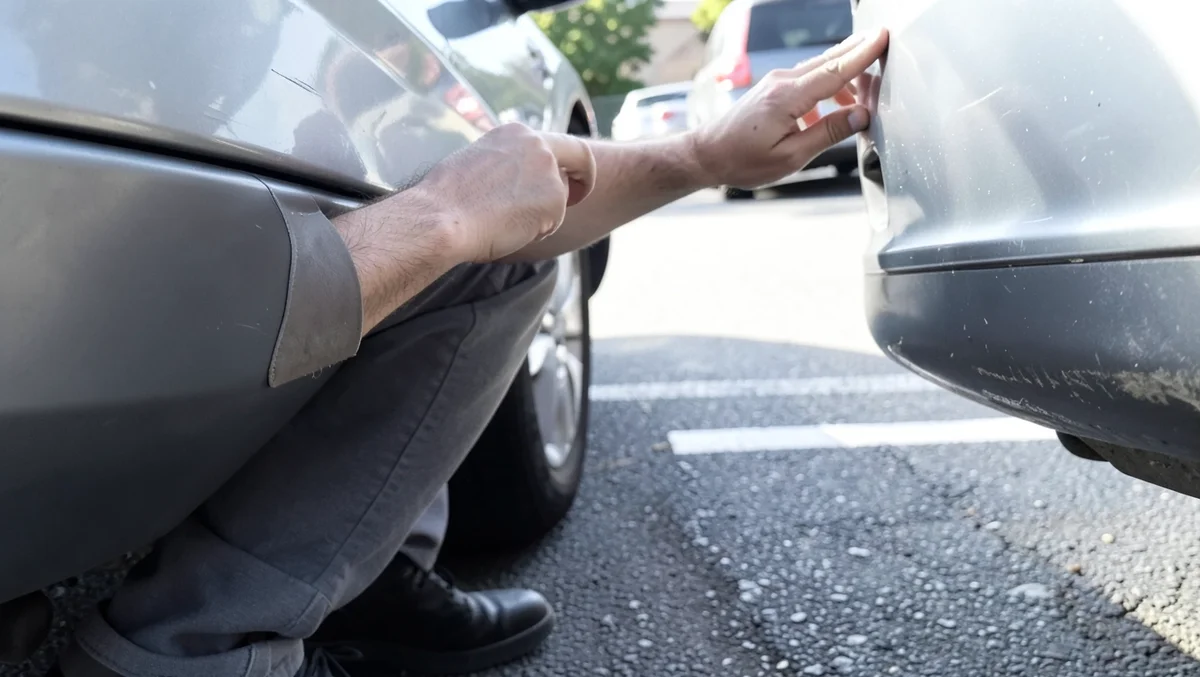
If you cannot locate the owner after a reasonable effort, write a note and leave it somewhere visible — tucked under a wiper blade facing out, not left loose on a seat or dashboard where wind or a locked door can make it disappear. At minimum, include:
- Your full name and phone number
- Your insurance company and policy number, if you have them handy
- A brief, honest description of what happened (“I backed into your rear bumper while parking”)
- The date and approximate time
Some states go further. Texas law specifically expects a note to include your address and insurance provider on top of your name and phone number, so when in doubt, include more contact information rather than less.
Is Leaving a Note Legally Required? How State Laws Compare
Yes — every state treats driving away from a parked car you damaged, without making a reasonable effort to notify the owner, as a hit-and-run. The exact wording and penalties vary by state, but the core requirement is nearly universal:
| State | What the Law Requires | Penalty for Not Complying |
|---|---|---|
| California | Locate the owner or leave a note with name, address, and a description of what happened; also notify police if you cannot locate the owner | Misdemeanor — up to 6 months in jail, a fine up to $1,000, and 2 points on your record |
| Florida | Try to locate the owner; if you cannot, leave a note with your name, address, and vehicle registration number | Considered a hit-and-run under Florida law; can include fines and criminal charges |
| Texas | Leave a note with your name, address, phone number, insurance provider, and a description of the incident | Criminal offense; potential fines and license consequences |
The takeaway: do not assume that because no one saw you, or because the damage looks minor, leaving without a note is a low-risk shortcut. It is one of the most common ways an honest fender-bender turns into a criminal charge.
When You Must Also Call the Police
Beyond leaving a note, many states also require you to notify police once property damage crosses a certain dollar amount — even if no other driver was involved. Thresholds vary widely by state:
| State | Police Report Required Above |
|---|---|
| California | $1,000 in property damage |
| Florida | $500 in property damage |
| Washington | $500 in property damage |
Modern bumper repairs on newer cars routinely exceed these thresholds even for damage that looks cosmetic, so when in doubt, it rarely hurts to call. A police report also creates an official, time-stamped record that protects you if the owner later disputes what happened or how much damage you actually caused. For a full walkthrough of what to expect, see our guide on how to file a police report for a car accident.
What Happens If You Do Not Report It
Skipping the note or the report is not a shortcut — it converts a routine fender-bender into a hit-and-run, which is a criminal matter, not just an insurance one. In California, for example, failing to comply with the notification requirement is a misdemeanor punishable by up to six months in county jail, a fine of up to $1,000, or both, plus restitution for the damage and points added to your driving record. Other states carry similar or steeper penalties, and if the accident somehow involved a person rather than just an empty vehicle, the charge escalates from misdemeanor to felony hit-and-run in most states.
There is also an insurance angle most people do not think about: if you are later identified as the driver who left the scene, your insurer may treat the incident as more serious than a standard at-fault claim, and some policies allow the insurer to deny coverage for damage caused during an unreported hit-and-run. Reporting it yourself, even if no one is watching, is almost always the better outcome.
Document the Damage: What to Photograph and Record
Before you leave the scene, use your phone to build a clear record:
- Wide shots of both vehicles showing their position relative to each other
- Close-up photos of the damage on both cars, from multiple angles
- The other car’s license plate, make, and model
- The exact location, date, and time
- Contact information for any witnesses, if someone happened to see it
This documentation matters even when you plan to leave a note and take full responsibility — it protects you if the owner later claims more damage occurred than actually did, and it speeds up your own insurance claim considerably.
Filing Your Insurance Claim (and Whether Your Rate Will Go Up)
Since there is no other driver’s insurance to pursue, this claim runs through your own policy — and specifically, it is your property damage liability coverage, not your collision coverage, that pays for the parked car’s repairs. Liability coverage pays for damage you cause to someone else’s property; collision coverage only covers damage to your own vehicle, and only if you carry it and pay your deductible.
This distinction matters for your wallet: many states set minimum property-damage liability limits as low as $5,000–$25,000, which can fall short against a newer or luxury vehicle given that the average new car now costs roughly $48,800. If your state minimum is on the low end and you drive an older, lower-value car, it is worth checking whether your liability limits are high enough to fully cover an expensive vehicle you might hit.

A liability claim for hitting a parked car is generally treated as an at-fault claim, and at-fault claims typically raise your premium at your next renewal. The exact increase varies by insurer and state, but it is a realistic trade-off against the far larger financial and legal risk of not reporting the accident at all.
Frequently Asked Questions
Is Hitting a Parked Car and Leaving Considered a Hit-and-Run?
Yes. Every state treats leaving the scene of a parked car you damaged, without making a reasonable effort to notify the owner or leave a note, as a hit-and-run — even though no other driver or person was involved.
How Long Do I Have to Wait Before Leaving a Note?
There is no fixed legal number of minutes. The standard is a “reasonable effort” to locate the owner based on the situation — a few minutes of looking around is generally seen as reasonable, while leaving within seconds of impact can look like you were trying to avoid responsibility.
Do I Have to Call the Police If the Damage Is Minor?
It depends on your state’s property-damage threshold — commonly $500 to $1,000 — and a dented or crumpled door alone can easily cost more than that to fix, so do not assume minor-looking damage falls under the threshold. If the damage is above that amount, a police report is legally required in many states. Below that, it is optional but still a good idea, since it creates an official record of what happened.
Which Insurance Coverage Pays for a Parked Car I Hit?
Your property damage liability coverage pays for the parked car’s repairs, since you damaged someone else’s property. Your own collision coverage, if you have it, would separately cover damage to your own vehicle after your deductible.
Will My Insurance Rate Go Up After I Report It?
Usually, yes, since a liability claim for hitting a parked car is typically recorded as an at-fault claim. The size of the increase varies by insurer and state, but it is generally a smaller consequence than the fines, jail time, and license points that can follow an unreported hit-and-run.
What Should I Do If I Cannot Find the Car’s Owner at All?
Leave a note with your contact and insurance information in a visible spot, take thorough photos of the damage and location, and consider notifying police, especially if the damage is significant. If you can identify the vehicle but not its owner, a service that helps find a car owner by license plate may also be able to help you reach them directly.
The Bottom Line
Hitting a parked car is stressful, but handling it correctly is straightforward: stop, check for injuries and damage, make a reasonable effort to find the owner, and leave a detailed note if you cannot. Document everything with photos, call the police if the damage crosses your state’s threshold, and report it to your own insurance right away. Doing this the right way protects you far more than driving off ever could — a modest premium increase is a much better outcome than a hit-and-run charge.
Products related to this article
Sponsored / affiliate links. As an Amazon Associate I earn from qualifying purchases. I may earn additional commission from eligible campaigns.