When Was the First Car Made? 1769, 1886 or 1908 Explained
There is no single date for the first car, because the answer changes with the question. The first self-propelled road vehicle was a French steam wagon from 1769. The first practical gasoline automobile was Karl Benz’s three-wheeled Patent-Motorwagen, completed in 1885 and patented in 1886. The first car most families could afford was Henry Ford’s Model T of 1908. This guide sorts those three answers, corrects a few details that are commonly repeated wrongly, and shows what each source actually says.
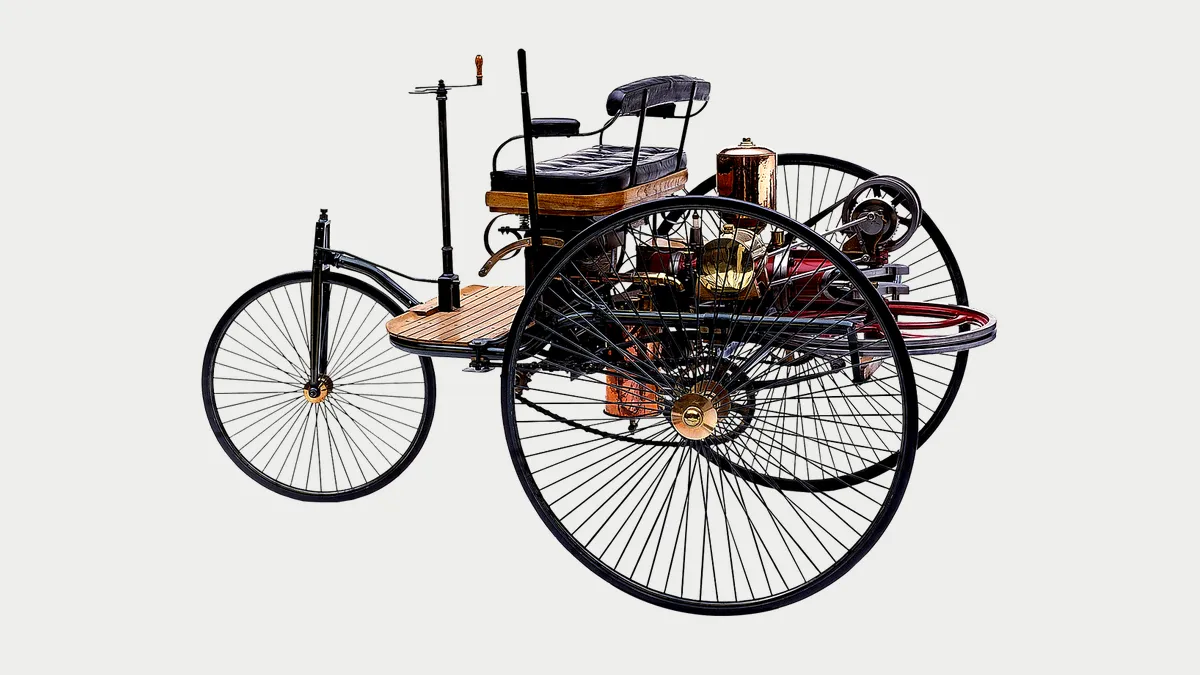
Most histories name Karl Benz’s Patent-Motorwagen as the first practical gasoline car: built in 1885, patent application filed January 29, 1886, patent DRP 37435 granted November 2, 1886, first public drive July 3, 1886. If you count any self-propelled road vehicle, the answer goes back to Cugnot’s steam wagon of 1769.
When Was the First Car Made? The Exact Date
Best Model T Deep-Dive Pick
|
The Complete Ford Model T Guide: Enlarged Illustrated Special Edition If the Model T is the part of this story you want to read more about, this is a book dedicated to that one car.
As an Amazon Associate we earn from qualifying purchases. Price and availability change; check the listing. |
For the car most people mean, the date is 1886, with a catch. Benz built his first working Patent-Motorwagen in 1885, and the vehicle’s first successful run is usually placed in spring 1885. The paperwork came next: Benz filed his patent application on January 29, 1886, and the German patent office granted it as DRP 37435 on November 2, 1886. In between, on July 3, 1886, Benz made his first public outing in Mannheim.
That distinction matters because January 29, 1886 is often written as the day the car was patented. It was the filing date. The grant came more than nine months later. The German Patent and Trade Mark Office (DPMA) describes the document as the birth certificate of the automobile, and the patent has been part of UNESCO’s Memory of the World register since 2011.
What Counts as the First Car? Five Definitions, Five Answers
Arguments over the first car are mostly arguments over the definition. This table lays out the common definitions, the vehicle that fits each one and what the sources say. It is the quickest way to see why one site says 1769, another says 1886 and another says 1908.
| If “first car” means… | The answer | Date | What sources say |
|---|---|---|---|
| First self-propelled road vehicle | Cugnot steam wagon (fardier) | 1769 | Britannica and other histories call it the first true automobile in the sense of a self-propelled road vehicle. It reportedly ran about 2.25 mph and hauled artillery. The original is at the Musee des Arts et Metiers in Paris. |
| First electric car | Trouve three-wheeler (France); Parker (England) | 1881; 1884 | History of the automobile summaries credit Gustave Trouve with a working electric three-wheeler in 1881 and Thomas Parker with a rechargeable-battery car in London in 1884. |
| First practical gasoline automobile | Benz Patent-Motorwagen | 1885-1886 | Mercedes-Benz history and the DPMA treat it as the first practical car with an internal combustion engine, and Wikipedia calls it the first car put into production. |
| First legally protected car | Benz, patent DRP 37435 | Filed Jan 29, 1886; granted Nov 2, 1886 | DPMA and the UK National Motor Museum both give the January 1886 filing and November 1886 grant. |
| First four-wheeled gasoline car | Daimler motorized carriage | 1886 | Daimler and Maybach built a gasoline carriage in Stuttgart the same year as the Benz patent. Their 1889 steel-wheel car is often called the first designed from scratch as a motor vehicle. |
| First American gasoline car company | Duryea Motor Wagon Company | 1893 | The Duryea brothers road-tested their gasoline car in Springfield, Massachusetts on September 21, 1893, and the company is described as the first American maker of gasoline cars. |
| First mass-affordable car | Ford Model T | 1908 | Henry Ford museum records say Model T production began in 1908 and the price fell from $850 to as low as $260 by the end of the run. |
Notice that the Benz row and the Daimler rows overlap. The two engineers worked independently, and the credit for the first car goes to Benz mainly because his vehicle was a complete, patented, self-contained design that reached customers.
When Was the First Automobile Manufactured?
If you mean the first automobile built to be sold, the answer is the Benz Patent-Motorwagen again, but later than the prototype. Mercedes-Benz history describes the model as sold between 1887 and 1893, and a commonly quoted figure is that about 25 Patent-Motorwagen were built in total. Counts differ between sources because Benz kept improving the design, so treat any single number as approximate. For more on the factory side of the story, see our guide on when the first automobile was manufactured.
| Benz Patent-Motorwagen | Detail |
|---|---|
| Engine | Single-cylinder four-stroke, 954 cc |
| Output | Roughly 0.7 horsepower (about 0.5 kW) at 400 rpm |
| Top speed | About 16 km/h (10 mph) |
| Layout | Three wheels, rear engine, tiller steering |
| Patent | DRP 37435, filed Jan 29, 1886, granted Nov 2, 1886 |
| Build period | Prototype 1885; sold 1887 to 1893 (about 25 built, figures vary) |
Who Made the First Car?
Karl Benz made the first practical gasoline car, which is why the Patent-Motorwagen is the usual answer. He was not the only person experimenting. Gottlieb Daimler and Wilhelm Maybach produced a motorized carriage and a motorized cycle in the same years, and French and English inventors had earlier built steam and electric vehicles. If you want a deeper look at the credit question, our guides on who invented the first car and who created the first car cover the people behind it.
Did Henry Ford Invent the Car?
No. Ford’s contribution was manufacturing. The Model T went into production in 1908, and in October 1913 Ford’s Highland Park plant first operated the moving assembly line for automobiles. Ford’s own corporate history says output rose from hundreds of cars a day to thousands after that change, and the Henry Ford museum records more than 15 million Model T cars built through 1927. Ford made cars affordable, not possible.
For the Ford-specific side of the timeline, see when the Ford automobile was invented.
Before Benz: Steam and Electric Experiments
Cugnot’s 1769 fardier is the best-known earlier machine. Nicolas-Joseph Cugnot, a French army engineer, built a heavy three-wheeled steam tractor meant to haul cannons. Reports describe a top speed of roughly 2.25 mph and very short runs between fuel and water stops. It was a landmark, but steam road vehicles stayed impractical for ordinary travel: they were heavy, slow to start and hard to steer.
Electric vehicles followed in the 1880s, with Trouve in France (1881) and Parker in London (1884) credited with early battery-powered cars. These worked, but battery capacity limited them, and electric cars stayed a minority until they competed with steam and gasoline models around 1900. The gasoline engine, steering design and drivetrain that Benz combined are what made the 1886 car practical.
Bertha Benz and the First Long-Distance Drive
The Patent-Motorwagen proved itself on the road because of Bertha Benz. In August 1888, without telling her husband, she drove her two sons from Mannheim to Pforzheim in a Benz Patent-Motorwagen, a trip of roughly 100 km one way via Heidelberg, Wiesloch and Bruchsal. When the tank ran low, she bought three litres of ligroin, a petroleum solvent, from a pharmacy in Wiesloch, which is often described as the world’s first petrol station. A blacksmith in Bruchsal repaired a broken drive chain, and the brake pads were reinforced with leather.
A frequent error is to call this a 66-mile round trip from Mannheim to Pforzheim and back. The commonly cited distance is for the one-way journey to Pforzheim, and the return trip makes the total much longer. That journey is why her route is now marked as the Bertha Benz Memorial Route in Germany.
After Benz: Daimler, Duryea and the Spread of the Car
Once Benz had shown the concept worked, development moved quickly in several countries at once.
- Daimler and Maybach, 1886: a four-wheeled motorized carriage in Stuttgart. In 1889 they designed a car widely described as purpose-built as a motor vehicle rather than a modified carriage.
- Panhard et Levassor, 1891: the French firm is generally credited with the front-engine, rear-wheel-drive layout that became standard for decades.
- Duryea, 1893: Charles and Frank Duryea tested their gasoline car in Springfield, Massachusetts, on September 21, 1893, and their company became America’s first gasoline car maker. For the American side, see who built the first car in America.
- Olds, 1901: Ransom Olds introduced the Curved Dash Oldsmobile, which summaries describe as built with assembly-line methods, showing that cars could be built in numbers before Ford’s moving line.
The Rise of Mass Production: Model T and the Moving Line
The Patent-Motorwagen was built by hand in small numbers. The Model T changed the scale. Ford introduced it in 1908, and after the moving assembly line began at Highland Park in October 1913, the time it took to build a car dropped sharply. Commonly cited figures put chassis assembly at about 12.5 hours before the line and 93 minutes afterward, though the exact numbers vary between accounts.
| Year | Milestone | Who |
|---|---|---|
| 1769 | Steam fardier, first self-propelled road vehicle | Nicolas-Joseph Cugnot |
| 1881 / 1884 | Early electric cars in France and England | Trouve / Parker |
| 1885 | Patent-Motorwagen completed; first runs | Karl Benz |
| Jan 29, 1886 | Patent application filed | Karl Benz |
| Jul 3, 1886 | First public outing, Mannheim | Karl Benz |
| Nov 2, 1886 | Patent DRP 37435 granted | Karl Benz |
| 1886 | Four-wheeled gasoline motorized carriage | Daimler and Maybach |
| Aug 1888 | First long-distance drive to Pforzheim | Bertha Benz |
| 1893 | First American gasoline car tests and company | Duryea brothers |
| 1908 | Model T production begins | Henry Ford |
| Oct 1913 | Moving assembly line at Highland Park | Ford Motor Company |
By the end of production in 1927, the museum record shows more than 15 million Model T cars built and a price that had fallen from $850 to as little as $260. Mass production, not invention, is the real Ford story.
Common Myths About the First Car
- Myth: the first car was patented on January 29, 1886. That is the filing date; the patent was granted on November 2, 1886.
- Myth: the first car was a Ford. The Model T arrived 22 years after the Benz patent, and Olds and others built cars before Ford did.
- Myth: Bertha Benz drove 66 miles round trip. The commonly cited one-way distance is about 100 km, so the full journey was longer.
- Myth: Benz and Daimler worked together. They worked separately, and their companies merged only in 1926 into Daimler-Benz.
Frequently Asked Questions
When was the first car made?
It depends on the definition. The first practical gasoline car, the Benz Patent-Motorwagen, was built in 1885, patented (filed) on January 29, 1886 and shown publicly on July 3, 1886. The first self-propelled road vehicle was Cugnot’s steam wagon of 1769.
When was the first automobile manufactured?
The Benz Patent-Motorwagen was sold between 1887 and 1893, with a commonly quoted total of about 25 built, though counts vary by source.
Who made the first car?
Karl Benz made the first practical gasoline automobile. Nicolas-Joseph Cugnot built the first self-propelled road vehicle, a steam wagon, in 1769, and Daimler and Maybach built their own gasoline vehicles in 1885 and 1886.
What was the first car?
The first practical gasoline car was the Benz Patent-Motorwagen: three wheels, a rear single-cylinder 954 cc four-stroke engine, tiller steering and a top speed of about 16 km/h (10 mph).
Was the Model T the first car?
No. The Ford Model T was introduced in 1908, more than 20 years after the Benz patent. It is best described as the first mass-affordable car, helped by the moving assembly line that began at Highland Park in October 1913.
Was the first car made in 1920?
No. By 1920 cars had been sold for more than 30 years, and the Model T had been in production since 1908.
When were cars invented?
Steam road vehicles date to 1769, electric cars to the 1880s and the practical gasoline car to 1885-1886. Which date you choose depends on how you define a car.
Conclusion
The first car was made in 1886 if you mean the practical gasoline automobile, 1769 if you mean any self-propelled road vehicle, and 1908 if you mean the first mass-affordable car. Karl Benz’s patent was filed January 29, 1886 and granted November 2, 1886, and his wife Bertha’s 1888 drive proved the idea worked on real roads. Daimler, Duryea, Olds and Ford each added a piece of the story. For related dates, see when the motor car was invented, when the first car was invented and where the first car was invented.
Sources consulted for this update: Wikipedia entries on the Benz Patent-Motorwagen and the history of the automobile, the Henry Ford museum assembly line collection page, Ford Motor Company’s Highland Park history page, the UK National Motor Museum Benz page, Germany Tourism’s Bertha Benz Memorial Route page, and search summaries of Mercedes-Benz Group, DPMA, Britannica and Smithsonian pages whose own sites blocked direct access.
Products related to this article
Sponsored / affiliate links. As an Amazon Associate I earn from qualifying purchases. I may earn additional commission from eligible campaigns.