Pre-Purchase Car Inspection: Complete Used-Car Checklist
Quick answer: A pre-purchase car inspection (PPI) is an independent mechanical and safety check completed before you buy a used vehicle. A qualified technician examines the car on a lift, scans its computers, road-tests it when permitted, and documents current defects, maintenance needs, and likely near-term costs. Arrange the inspection before signing final paperwork or paying a nonrefundable balance.
A clean-looking used car can still hide fluid leaks, previous collision repairs, worn suspension parts, incomplete readiness monitors, or expensive maintenance that is about to come due. A vehicle history report is useful, but it only shows events that were reported. The physical condition of the car has to be checked separately — see our related guide, What Does a Recall on a Car Mean? Full Explanation.
This checklist explains what a professional inspection should cover, what you can check before the appointment, and how to use the written findings to negotiate or walk away. It is educational guidance, not a substitute for an inspection by a qualified automotive professional.
What is a pre-purchase car inspection?
A pre-purchase inspection is an unbiased assessment of a used car before ownership changes hands. The buyer normally chooses the shop or mobile inspector and pays the inspection fee. The mechanic should have no financial connection to the seller, dealer, or vehicle. For more on car dealer fees, see our full guide.
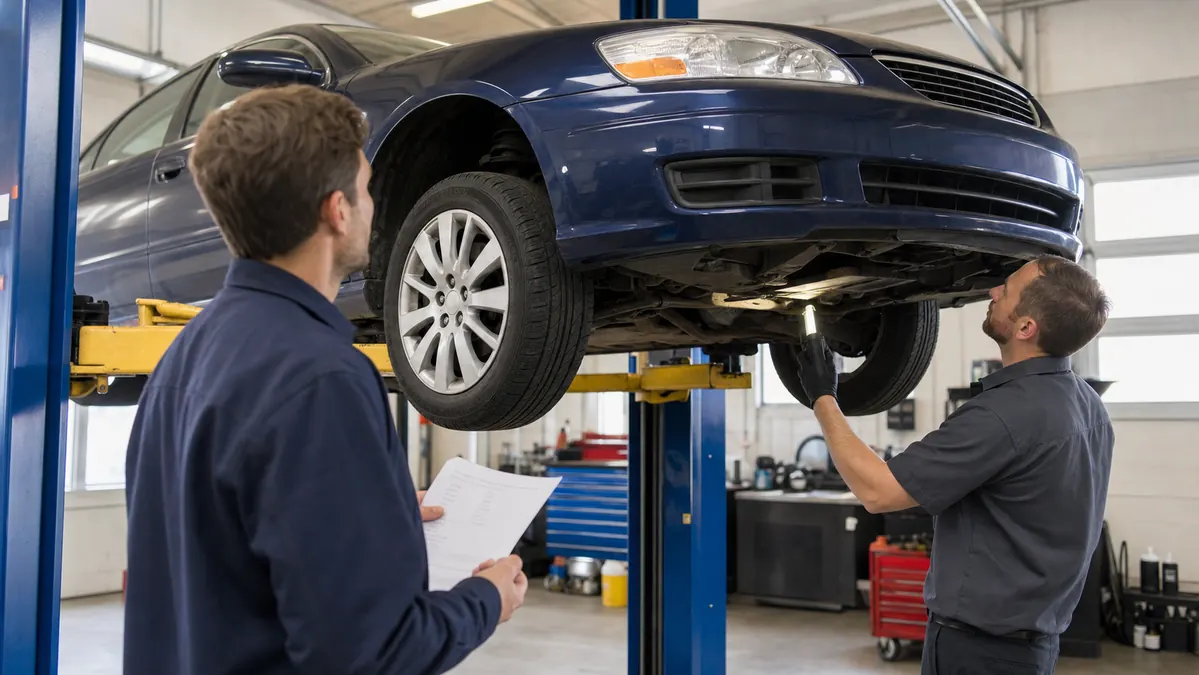
The inspection is deeper than a quick walk-around. It commonly includes an underbody examination, fluid and leak checks, tire and brake measurements, an OBD-II scan, a road test, and a written summary. It does not guarantee that nothing will fail later, but it reduces the risk of buying a car with visible warning signs or neglected maintenance.
Is a used-car inspection worth it?
For most used-car purchases, yes. The inspection fee is small compared with the cost of a transmission failure, structural repair, neglected timing-belt service, or a set of tires and brakes immediately after purchase. The report can also give you evidence to request repairs, renegotiate the price, or decline the vehicle.
Age and odometer mileage alone do not determine condition. Our guide to good mileage for a second-hand car explains why maintenance history and use matter alongside the number on the odometer. A properly serviced higher-mileage car can be a better choice than a neglected low-mileage one.
When should you schedule the inspection?
Schedule the PPI after you have identified a serious candidate and completed an initial test drive, but before signing final purchase documents. Ask the seller for permission to take the car to your chosen shop. If the vehicle cannot leave the lot, ask whether an independent mobile inspector can examine it there.
- Confirm that the seller will allow an independent inspection.
- Give the shop the year, make, model, mileage, VIN, and known modifications.
- Ask what the standard inspection includes and whether a road test and scan are included.
- Request a written report with photos, measurements, fault codes, and repair priorities.
- Do not let a deposit deadline pressure you into skipping the inspection.
If you are buying through a dealer, complete the inspection before the transaction reaches its final paperwork stage. The broader car-buying process at a dealership includes price, financing, test-drive, inspection, and contract decisions that should stay separate.
What should a mechanic check?
1. VIN, records, title, and recalls
The VIN on the dashboard, driver-door label, title paperwork, and history report should match. Review service records for regular oil changes and mileage-based maintenance. A history report can reveal reported accidents, title brands, odometer entries, or flood records, but it cannot confirm the car’s present mechanical condition.
The federal Consumer.gov car-buying guidance recommends reviewing a vehicle history report, checking recalls, reading service records, test-driving the car, and hiring a trusted mechanic before purchase. You can also enter the 17-character VIN in the official NHTSA recall lookup to check for unrepaired safety recalls.
If you are comparing commercial history reports, read what a Carfax report can and cannot tell you. Treat the report as a paperwork check and the PPI as a physical-condition check.
2. Exterior, body, glass, and structure
The inspector should compare panel gaps, paint texture, overspray, fastener marks, door operation, lighting, glass, and weather seals. Uneven gaps or paint thickness can indicate prior repairs. The lift inspection should examine frame rails, pinch welds, mounting points, floor pans, and crash structures for deformation, corrosion, or poor welding.
Surface rust is different from deep scaling, perforation, or weakened mounting points. Cars driven in salted winter regions deserve a careful underbody inspection; our explanation of the car rust belt shows why location history changes the risk.
3. Engine, fluids, cooling, and exhaust
Ask for a cold start when possible. A warmed-up engine can hide hard starting, timing-chain rattle, smoke, or rough idle. The mechanic should inspect oil and coolant condition, fluid levels, belts, hoses, mounts, visible leaks, exhaust smoke, and signs of overheating. Milky oil, oil in coolant, dried coolant residue, strong fuel odors, or active leaks need explanation.
4. Transmission and driveline
Automatic shifts should be consistent without slipping, harsh engagement, delayed drive or reverse, or shuddering. A manual clutch should engage predictably without slipping under load. The inspector should check transmission and differential leaks, axle and CV boots, driveshaft joints, wheel bearings, and unusual noise during acceleration and deceleration.
5. OBD-II scan and readiness monitors
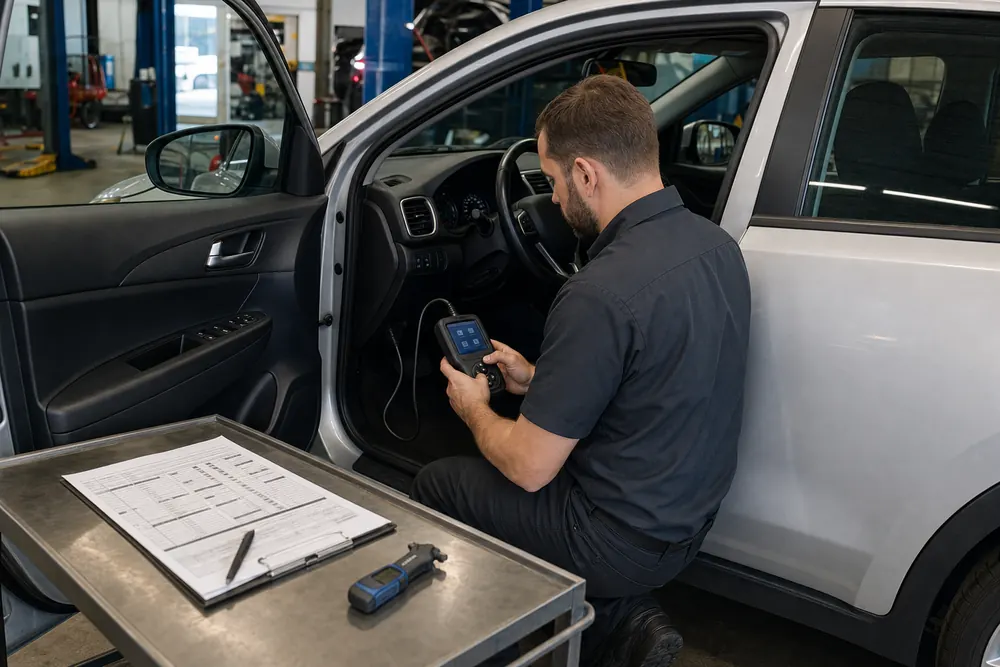
An OBD-II scan can identify current, pending, and stored diagnostic trouble codes. The technician should also review readiness monitors. Several “not ready” monitors can mean the battery was disconnected or codes were recently cleared, so emissions-related faults may not have had time to return. A scan alone is not a diagnosis; the codes must be interpreted alongside the physical inspection and road-test symptoms.
6. Brakes, steering, suspension, and tires
Brake-pad thickness, rotor condition, fluid condition, hoses, parking-brake operation, and warning lights should be checked. Steering and suspension checks include ball joints, tie rods, control-arm bushings, shocks or struts, springs, and alignment clues. Tire tread depth, uneven wear, sidewall damage, and DOT date codes help estimate both safety and near-term replacement cost.
7. Interior, safety equipment, and electronics
Test every seat belt, window, lock, mirror, light, camera, sensor, climate-control mode, audio control, charging port, and driver-assistance feature. Confirm that dashboard warning lamps illuminate during the bulb check and then switch off normally. Damp carpet, musty odors, corrosion under seats, or inconsistent electronics can point to water intrusion.
8. Hybrid and electric vehicle checks
A hybrid or EV needs model-specific checks beyond a basic combustion-car inspection. Ask about high-voltage battery state of health, charging performance, battery-cooling operation, isolation faults, underbody battery-case damage, and remaining battery warranty. Choose a shop with the training and equipment required for that vehicle.
What should happen during the test drive?
Drive the car on streets similar to those you use regularly, with the seller’s permission and appropriate insurance. Start with low-speed turns and stops, then include rough pavement and highway speed if safe and legal. Turn the audio system off so you can hear clunks, humming, wind noise, brake grinding, or driveline vibration.
- Start the engine cold and observe warning lights, idle quality, and exhaust.
- Check steering effort, straight-line tracking, and return-to-center behavior.
- Test light and moderate braking in a safe area; note pulling, vibration, or noise.
- Accelerate smoothly and watch for hesitation, misfire, smoke, or abnormal shifts.
- Drive over uneven pavement and listen for suspension knocks or body rattles.
- After the drive, recheck for new leaks, odors, warning lights, or cooling-fan problems.
How to read the inspection report
Ask the mechanic to separate findings into safety-critical repairs, immediate mechanical needs, scheduled maintenance, and cosmetic observations. Request approximate repair priorities rather than only a pass-or-fail opinion.
| Finding level | Examples | Practical response |
|---|---|---|
| Safety critical | Structural corrosion, unsafe tires, serious brake or steering defects | Do not drive or buy until a qualified repair plan is confirmed |
| Major mechanical | Transmission slip, overheating, heavy leaks, internal engine noise | Get a written estimate; often a reason to walk away |
| Negotiable repair | Worn brakes, weak battery, leaking shock, overdue service | Use documented cost and urgency during negotiation |
| Normal wear | Minor cosmetic marks or serviceable wear with useful life remaining | Budget for future maintenance without treating it as a hidden defect |
Do not negotiate from a vague verbal comment. Use the written report, photos, measurements, and a repair estimate. If the seller agrees to complete repairs, put the exact work and deadline in writing and verify the repair before purchase.
Red flags that justify walking away
- The seller refuses an independent inspection or will only allow the seller’s mechanic.
- The VIN does not match the title, vehicle, or history documents.
- The scanner shows recently cleared monitors without a credible explanation.
- There is structural damage, unsafe corrosion, flood evidence, or poor collision repair.
- The engine overheats, transmission slips, or major warning lights remain active.
- The seller rushes the transaction or will not put promises in writing.
- The repair cost or uncertainty exceeds your budget and risk tolerance.
These precautions matter because many used vehicles are sold “as is.” Our guide on returning a used car explains why buyers should not assume they can undo the transaction after a problem appears.
Questions to ask the mechanic
- Is the vehicle safe to drive today?
- Which repairs are urgent, and which can wait?
- Do the wear and condition appear consistent with the mileage?
- Is there evidence of overheating, collision repair, flooding, or odometer concerns?
- Are the diagnostic monitors complete, and are any codes current or pending?
- What maintenance is due within the next 12 months?
- Would you buy this vehicle at the proposed price?
Pre-purchase car inspection checklist
- VIN matches every document and location on the car.
- Title status, odometer history, accidents, service records, and recalls reviewed.
- Cold start completed without abnormal noise, smoke, or warning lights.
- Body panels, paint, glass, frame, and underbody inspected.
- Engine, transmission, cooling system, exhaust, fluids, and leaks checked.
- Brakes, steering, suspension, tires, wheel bearings, and driveline measured.
- OBD-II codes and readiness monitors documented.
- Interior electronics, climate control, safety systems, and ADAS checked.
- Road test completed in appropriate conditions.
- Written findings, photos, priorities, and likely repair costs received.
Frequently asked questions
Who pays for a pre-purchase inspection?
The buyer usually pays because the inspection protects the buyer and the buyer chooses the independent shop. Payment arrangements can vary, so confirm them before the appointment.
How long does a PPI take?
Time varies by vehicle and inspection depth. A basic inspection may take about an hour, while specialty vehicles, EV battery checks, compression testing, or a detailed body assessment can take longer. Ask what is included rather than choosing by speed alone.
Can a dealership refuse an outside inspection?
A seller can set access rules for its vehicle, but a refusal removes an important layer of buyer protection. Ask whether a mobile inspector is allowed. If no independent option is permitted, consider a different vehicle.
Does a clean history report replace an inspection?
No. A history report summarizes reported events; it cannot measure brake wear, identify a current coolant leak, assess shift quality, or confirm the condition of suspension and safety systems.
Final decision
A good pre-purchase car inspection turns uncertainty into a documented decision. Verify the paperwork, let an independent professional inspect the vehicle, review the findings by urgency, and be willing to walk away when the risk is larger than the deal. The safest used-car purchase is not necessarily the cheapest listing; it is the one whose condition, history, and future costs you understand before signing.
Products related to this article
Sponsored / affiliate links. As an Amazon Associate I earn from qualifying purchases. I may earn additional commission from eligible campaigns.
 V800 OBD2 Professional Car Diagnostic Scanner, AI Intelligent Fault Analysis, Whole System Diagnostics, Read/Erase Error Codes, Compatible with All 16-Pin Models After 1996
 Roadside Assistance Emergency Kit,Vehicle Truck Car Safety Roadside Emergency Kit with Reflective Warning Triangle Tow Strap Reflective Vest etc