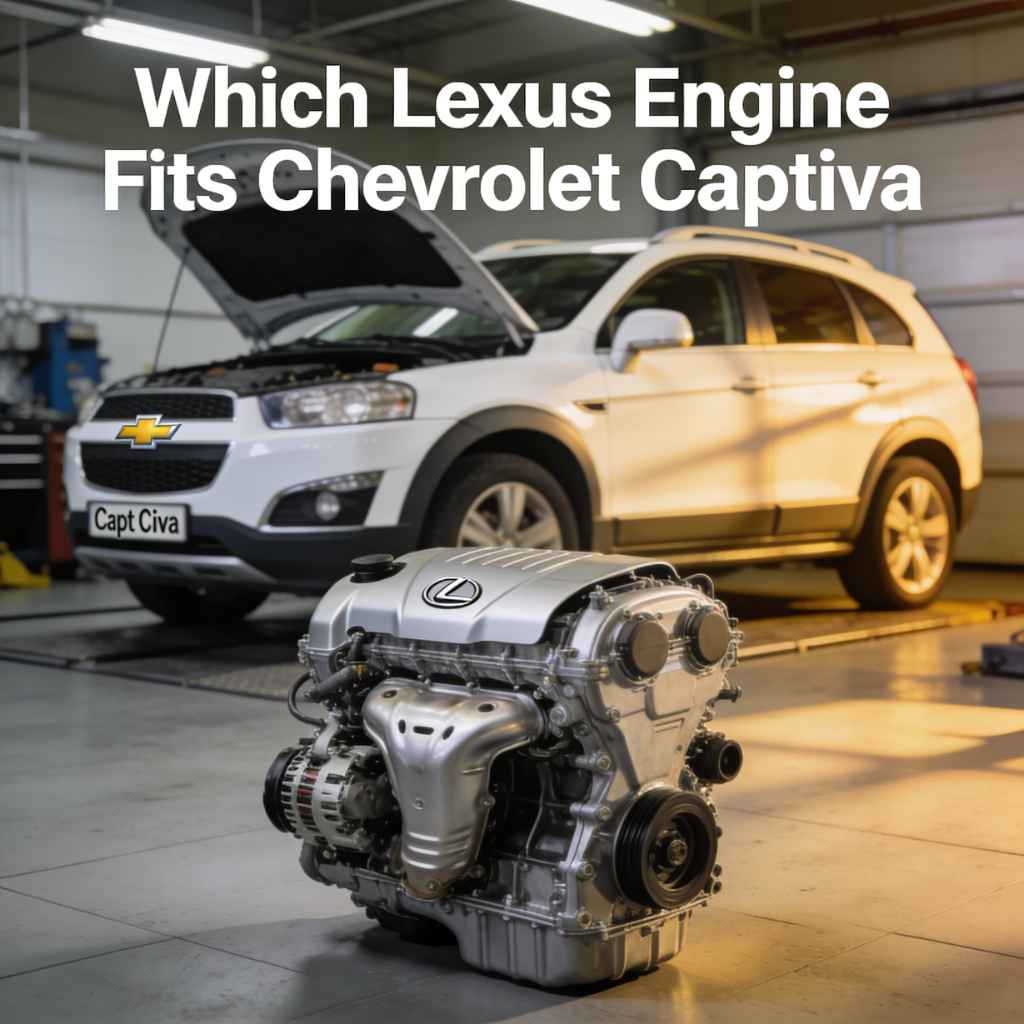
Which Lexus Engine Fits Chevrolet Captiva
It might sound a little unusual to ask Which Lexus Engine Fits a Chevrolet Captiva? This is a question that can pop up when someone is looking to swap out an engine or maybe wants something different for their car. For folks new to car projects, this can feel like a puzzle. But don’t worry!
We’ll break down exactly what you need to know, step by step. We’ll make it easy to figure out if this kind of engine swap is possible and what you should consider before starting.
Exploring Lexus Engines for a Chevrolet Captiva
This section looks at the idea of putting a Lexus engine into a Chevrolet Captiva. We’ll talk about why someone might consider this and what makes it a tricky question for many car owners. The goal is to give you a clear picture of the challenges and potential benefits.
We’ll cover the basic compatibility factors you need to think about right away.
Understanding Engine Compatibility Basics
When you think about putting one car’s engine into another, there are a few main things to check first. It’s not just about if the engine physically fits. You need to think about how the engine will connect to the car’s other parts.
This includes the transmission, the electrical system, and even how it mounts to the car’s frame.
Engine compatibility is about more than just size. You have to look at things like the engine’s bolt patterns, its overall dimensions, and its weight. These details are super important for making sure the engine can be securely installed and work correctly with the rest of the vehicle.
A good fit means less hassle later on.
-
Engine Size and Physical Fit
This is often the very first thing people look at. How big is the Lexus engine compared to the original Captiva engine? Will it physically fit in the engine bay?
This involves measuring the length, width, and height of the engine. You also need to consider where the engine mounts will line up. Sometimes, even if an engine is the right size, the mounting points are completely different, making installation very hard.
For example, a common Lexus engine like a 3.5L V6 from a Camry or ES might be a different shape and size than the typical Captiva engine. You’d need to carefully measure the Captiva’s engine bay. You might also need to check online forums or talk to mechanics who have done similar swaps.
They can offer real-world advice on what might fit and what won’t.
-
Transmission Matching
An engine is no good without a way to send its power to the wheels. This is where the transmission comes in. Can the Lexus engine be connected to the Chevrolet Captiva’s original transmission?
Or would you need a transmission from the Lexus vehicle as well? This is a critical question because automatic transmissions are very different from manual ones, and even different automatic transmissions can have wildly different connection points and electronic controls.
Connecting a Lexus engine to a Chevrolet transmission, or vice versa, can be a major hurdle. Many times, the bell housing (the part that connects the engine to the transmission) has a unique bolt pattern for each type of engine and transmission. If these patterns don’t match, you might need an adapter plate.
Sometimes, even with an adapter, the electronics won’t talk to each other properly, making the transmission shift incorrectly or not at all.
-
Electrical System Integration
Modern cars have complex electrical systems. The engine control unit (ECU) manages everything from fuel injection to ignition timing. If you swap engines, you need to make sure the new engine’s ECU can communicate with the Captiva’s dashboard, sensors, and other electronic modules.
This is often one of the most challenging parts of an engine swap.
Think about all the wires and sensors connected to your current engine. Now imagine a completely different engine with its own set of wires and sensors. You’ll need to figure out how to connect these.
This might involve custom wiring harnesses, reprogramming the ECU, or even using a standalone engine management system. Without proper integration, warning lights will stay on, the engine might run poorly, or it might not start at all.
Evaluating Specific Lexus Engine Options
Here, we’ll look at some popular Lexus engines and discuss how they might compare to what a Chevrolet Captiva typically uses. This will help you understand the real-world possibilities and challenges. We aim to give you practical insights into which engines might be more or less feasible for such a swap.
Common Lexus Engine Families
Lexus has used several engine families over the years. The most common are the UZ series (V8 engines), the GR series (V6 engines), and the AR series (four-cylinder engines). Each series has different characteristics in terms of power, size, and complexity.
For example, the 1UZ-FE is a well-known 4.0L V8. It’s powerful but also quite large and heavy. Putting this into a Captiva would likely require significant modifications to the engine bay and suspension.
On the other hand, a 2GR-FE 3.5L V6 is found in many Lexus models like the Camry, ES, and RX. This V6 is often considered a good balance of power and size, making it a more popular choice for engine swaps in various vehicles.
-
The 2GR-FE V6 Engine
The 2GR-FE is a 3.5-liter V6 engine that has been used in many Toyota and Lexus vehicles since the mid-2000s. It’s known for its reliability and smooth power delivery. This engine typically produces around 268 horsepower in its Lexus applications, though this can vary slightly by model year and specific vehicle.
Its compact V6 design makes it a strong candidate for swaps where space might be a concern compared to a V8.
When considering this engine for a Captiva, its dimensions are often more manageable than a V8. However, the complexity of its electronic systems remains a significant factor. The ECU for the 2GR-FE is designed to work with the vehicle it came from.
Integrating it into a different car’s electrical network requires careful planning and often custom wiring solutions to ensure all the engine functions are controlled properly. This V6 is a popular choice for enthusiasts looking for an upgrade in power without going to a full V8 setup.
-
The 1UZ-FE V8 Engine
The 1UZ-FE is a 4.0-liter V8 engine that Lexus produced for many years, famous for its durability and smooth operation. It’s found in older Lexus LS models. This engine is a powerhouse, offering substantially more torque and horsepower than most stock Captiva engines.
However, its size and weight are considerable. Installing a 1UZ-FE would likely require widening the engine bay, reinforcing the chassis, and upgrading the suspension to handle the extra load.
One of the main benefits of the 1UZ-FE is its robust build, making it capable of handling significant power increases with aftermarket modifications. The challenge lies in its physical dimensions and the complexity of its engine management system. The engine’s large physical footprint means it might not clear the firewall or the front crossmember of a Captiva without extensive modification.
Additionally, its older electronic system, while simpler than some newer V8s, still needs to be properly integrated with the Captiva’s systems for optimal performance and drivability.
-
Smaller Four-Cylinder Options
Lexus also uses four-cylinder engines, such as those in the AR series (e.g., 2AR-FE). These are typically found in models like the Camry and RAV4. While less powerful than the V6 or V8 options, they offer better fuel economy and are generally smaller and lighter, which can simplify installation.
A four-cylinder engine might be a more straightforward swap in terms of fitting into the engine bay and managing weight distribution.
However, the power output of these four-cylinder engines might not provide the significant performance upgrade some people are looking for when considering an engine swap. The main advantage is potentially easier integration. The electrical systems, while still complex, might be more manageable than their V6 or V8 counterparts.
If the goal is simply to
Technical Challenges and Solutions for Engine Swaps
This part delves into the specific technical hurdles you’ll face when trying to put a Lexus engine into a Chevrolet Captiva. We’ll explore common problems and discuss potential solutions that enthusiasts and mechanics use. The aim is to give you a practical understanding of what needs to be done.
Custom Fabrication and Mounts
One of the most common needs in any engine swap is custom fabrication. This means modifying or creating new parts to make the engine fit and function correctly. Engine mounts are a prime example.
The original engine mounts in the Captiva will almost certainly not line up with the bolt holes on a Lexus engine. Mechanics will need to create new mounts or modify existing ones to securely anchor the new engine to the car’s chassis.
This fabrication work requires specialized tools and skills, like welding and metalworking. It’s not a job for beginners. The mounts need to be strong enough to hold the engine under all driving conditions, including acceleration, braking, and cornering.
Poorly made mounts can lead to engine vibrations, damage to the chassis, or even the engine coming loose, which is extremely dangerous. Professionals often use CAD software to design these mounts before fabrication to ensure precise fitment.
-
Engine Mounts
Engine mounts are crucial components that isolate the engine’s vibrations from the car’s body and also secure the engine in place. When swapping engines between different makes and models, the factory engine mounts will rarely align with the new engine’s mounting points. This necessitates the creation of custom engine mounts.
These can be fabricated from scratch using steel brackets and rubber or polyurethane bushings to absorb vibrations.
The process involves precise measurement of the engine’s position within the engine bay, considering clearance for the hood, firewall, and other components. Welders and fabricators will then construct custom brackets that attach to the engine’s block or subframe and bolt securely to the Captiva’s chassis. This requires a deep understanding of structural integrity and vibration dampening to ensure the engine is stable and the ride remains comfortable.
For instance, a custom mount might involve a plate that bolts to the Lexus engine’s existing bosses and then has a new tab welded onto it, which then bolts to a new bracket welded to the Captiva’s frame.
-
Driveshaft and Axle Modifications
If the Lexus engine is from a rear-wheel-drive vehicle, or if you are using a transmission that has a different output shaft than the Captiva’s original, you will likely need to modify the driveshaft. This is the shaft that transmits power from the transmission to the differential. The length and diameter of the driveshaft must be precise for it to function correctly.
Similarly, if the new engine and transmission combination results in a different track width or hub pattern, the axles (or CV shafts) might need to be custom-made or sourced from a compatible vehicle. An improperly balanced or fitted driveshaft can cause severe vibrations and premature wear on components. Mechanics will often take measurements from the transmission’s output flange to the differential’s input flange and have a custom driveshaft fabricated by a specialist company.
This ensures perfect alignment and smooth power transfer. Some swaps might require a custom differential or hub assembly if the bolt patterns are significantly different.
-
Exhaust System Fabrication
The exhaust system routes engine exhaust gases away from the vehicle. When you install a new engine, its exhaust manifold or headers will likely be in a different position, and its outlets might be angled differently. This means the factory exhaust system will not connect properly to the new engine.
You will need to fabricate a custom exhaust system that connects from the new engine’s exhaust ports all the way to the rear of the car.
This fabrication involves bending and welding exhaust pipes to clear the chassis, suspension components, and fuel tank. It requires knowledge of exhaust flow and backpressure to ensure the engine performs optimally. Custom exhaust systems can also be designed to provide a specific sound.
For example, a stainless steel exhaust system with a high-flow catalytic converter and muffler can improve exhaust scavenging, which helps the engine breathe better and produce more power. The process usually involves cutting the old system, fitting new pipes, and welding them into place, ensuring no leaks.
-
Cooling System Integration
The new engine will have its own cooling system requirements. This includes a radiator, hoses, and possibly an oil cooler. You will need to ensure the cooling system can adequately dissipate the heat generated by the Lexus engine.
The original Captiva radiator might be too small, or its mounting points might not work with the new engine.
You might need to install a larger, universal radiator or a radiator from a vehicle that uses the Lexus engine. Custom radiator hoses may also be required to connect the engine’s water pump to the radiator. Proper coolant flow and temperature regulation are essential for engine longevity.
An overheating engine can quickly lead to severe damage. For instance, if a high-performance Lexus V8 is installed, a significantly larger aluminum radiator with dual electric fans might be necessary. This ensures that even under heavy load or in hot weather, the engine stays within its optimal operating temperature range.
The Verdict Which Lexus Engine Fits a Chevrolet Captiva
After going through all these details, it’s clear that directly “fitting” a Lexus engine into a Chevrolet Captiva without significant effort is not straightforward. There isn’t a simple bolt-in solution. It’s a complex project that requires extensive mechanical knowledge, custom fabrication skills, and a considerable budget.
The mechanical and electrical systems of the two vehicles are vastly different, and bridging that gap involves many custom parts and expert work.
If you’re thinking about this kind of swap, be prepared for a challenging but potentially rewarding project. It’s not for the faint of heart or beginners. The question of Which Lexus Engine Fits a Chevrolet Captiva? has a complicated answer: one that fits with a lot of custom work.
It’s more about making it fit through expertise and modification than finding a direct match.
Frequently Asked Questions
Question: Is it possible to put any Lexus engine into a Chevrolet Captiva?
Answer: While theoretically almost any engine can be made to fit with enough custom work and fabrication, it’s not a simple bolt-in process. Compatibility with the transmission, electrical systems, and physical space are major hurdles. Some Lexus engines will be much harder to swap than others.
Question: What are the biggest challenges when swapping engines?
Answer: The biggest challenges include matching the transmission, integrating the complex electrical and computer systems (ECU), fabricating custom engine mounts, and ensuring the engine physically fits within the engine bay while allowing for other necessary components like the radiator and exhaust.
Question: Do I need to change the transmission if I swap engines?
Answer: Very often, yes. The transmission’s bell housing and its electronic control systems need to be compatible with the engine’s. If they aren’t, you might need to swap the transmission as well, or find specialized adapter plates and custom wiring solutions, which adds significant complexity.
Question: How much does an engine swap like this typically cost?
Answer: The cost can vary wildly depending on the engine chosen, the amount of custom fabrication needed, and whether you do the work yourself or hire professionals. It can range from a few thousand dollars for basic swaps to tens of thousands for complex V8 installations with new transmissions and full rewiring.
Question: Are there any simpler engine swap options for a Chevrolet Captiva?
Answer: For a Chevrolet Captiva, simpler and more compatible engine swap options would generally involve engines from other General Motors vehicles that share a similar platform or were offered in different trims of the Captiva or its siblings. This would minimize compatibility issues with transmissions and electronics.
Final Thoughts
Putting a Lexus engine into a Chevrolet Captiva is a serious undertaking. It requires deep mechanical know-how and significant custom work. There is no single Lexus engine that perfectly fits without extensive modifications.
Success hinges on your ability to adapt and fabricate parts to bridge the gap between two very different vehicle designs.