Different Types of Race Cars: 10 Categories in One Chart
The different types of race cars split by what they are built to do: single-seaters chase lap time, prototypes and GT cars share endurance races, rally cars cover gravel and snow, and drag cars are judged over one short run. Each category has its own rules body and example series, so a car that wins in one is often not even eligible in another. This guide gives a one-page chart, then each category with figures from official series pages read on 2026-10-14.
Types of Race Cars Chart: 10 Categories at a Glance
The last column names the page each feature came from. Where an official page could not be read, the cell says so.
Best Kid-Friendly F1 Primer

|
All About Race Cars: A Guide to Formula 1 Race Cars A 40-page illustrated hardcover on the technology behind Formula 1 cars, from aerodynamics and engines to tires, brakes and safety. Listed at $20.99 on 2026-10-14.
As an Amazon Associate we earn from qualifying purchases. Spec-based pick from the listing, not a hands-on test. |
| Category | What defines it, per the source | Example series | Source read |
|---|---|---|---|
| Open-wheel (single-seater) | FIA calls Formula One the pinnacle of single seater racing; INDYCAR calls its championships open-wheel and uses spec chassis | FIA Formula One World Championship; NTT INDYCAR SERIES; INDY NXT | fia.com, indycar.com |
| Prototype (sports-car) | Built uniquely for the racetrack to showcase the latest technology; GTP has run a common hybrid powertrain on most entries since 2023 | IMSA GTP and LMP2; FIA WEC Hypercar | imsa.com, fiawec.com |
| GT | Based on road-going production models; GTD PRO and GTD use the FIA GT3 specification | IMSA GTD PRO and GTD; FIA WEC LMGT3 | imsa.com, fiawec.com |
| Stock car | Not sourced: NASCAR’s site blocked automated reading, so no figures are quoted | NASCAR (see sibling pages below) | none read |
| Touring car | FIA lists a TCR World Tour; no technical definition was read | FIA TCR series | fia.com |
| Rally | Rally1 tops the FIA Rally Pyramid; 2026 rounds mix asphalt, gravel and ice and snow | FIA World Rally Championship | fia.com |
| Drag | Acceleration contest from a standing start over a measured distance; NHRA lists 200+ classes in 15 categories | NHRA drag racing | nhra.com |
| Drifting | Formula DRIFT runs Pro and PROSPEC championships; scoring rules were not read | Formula DRIFT; FIA Intercontinental Drifting Cup | formulad.com, fia.com |
| Off-road and desert | Contested across deserts, forests, mountains and purpose-built courses (Petersen); SCORE has truck, buggy, UTV and motorcycle classes | SCORE World Desert Championship | petersen.org, score-international.com |
| Karting | CIK-FIA develops, promotes and regulates karting worldwide | FIA karting circuit | fia.com |
Single-Seater Race Cars: Formula One and IndyCar
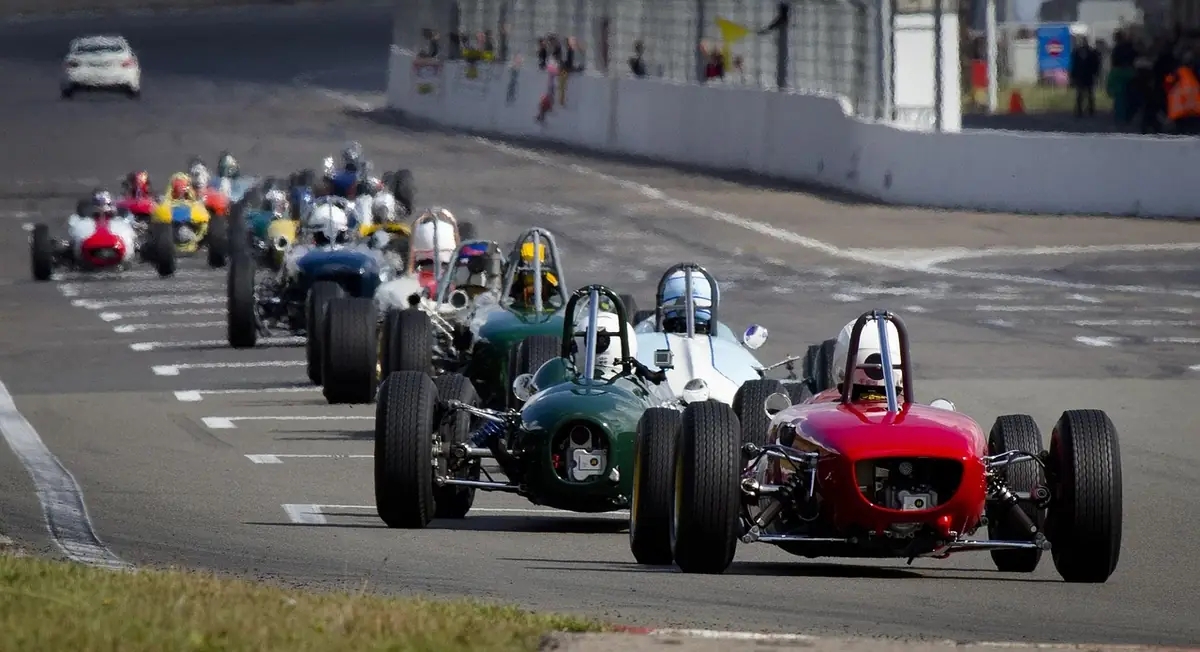
Single-seaters carry one driver and are built around a purpose-made chassis. The FIA describes the Formula One World Championship, running since 1950, as the pinnacle of single seater racing. INDYCAR, a separate sanctioning body, runs the NTT INDYCAR SERIES and INDY NXT by Firestone, which it calls its official development series (formerly Indy Lights). For deeper head-to-head detail see our IndyCar vs F1 comparison.
INDYCAR’s own explainer pages give figures that show how a category is defined by its rules, not only by its looks:
- No electronic driver aids. INDYCAR says its cars have no power steering, traction control or anti-lock brakes, so success leans on driver strength and technique.
- Hybrid since 2024. The series combines a 2.2-liter twin-turbocharged V6 with an energy recovery unit that captures braking energy and redeploys it on driver demand.
- Cockpit protection. The aeroscreen, a polycarbonate windscreen with a titanium frame, was introduced in 2020.
- Very different tracks. The calendar mixes superspeedways, short ovals, road courses and street circuits, and INDYCAR says its oval tires are built for sustained speeds above 230 mph.
- Next car, 2028. The IR-28 is announced with a 2.4-liter twin-turbocharged V6 rated at up to 760 horsepower.
The 760 horsepower figure is INDYCAR’s stated capability for the 2028 engine formula, not a track result. Related reading: how many g-forces an F1 car pulls, what a Formula 1 car costs and what fuel IndyCar uses.

Sports-Car Racing: Prototype and GT Cars
IMSA’s WeatherTech SportsCar Championship is the clearest official explanation of the two sports-car styles. It says Prototype cars showcase the latest automotive technology and are uniquely designed for the racetrack, while GT cars are based on road-going production models. Those two styles make up four classes:
| IMSA class | Style | What the IMSA page says |
|---|---|---|
| Grand Touring Prototype (GTP) | Prototype | First raced in 2023; most entries share a hybrid powertrain. Acura, Aston Martin (non-hybrid), BMW, Cadillac and Porsche are entered |
| Le Mans Prototype 2 (LMP2) | Prototype | Closed-cockpit car from four approved constructors, also eligible for the FIA World Endurance Championship (which includes the 24 Hours of Le Mans) |
| GT Daytona Pro (GTD PRO) | GT | Debuted in 2022; built to FIA GT3 technical regulations, open to factory teams |
| GT Daytona (GTD) | GT | Uses the global FIA GT3 specification |
The FIA World Endurance Championship uses its own class names. Its standings pages show a Hypercar class and an LMGT3 class, so the same Prototype versus GT split carries over even though the labels differ. To help fans follow mixed fields, IMSA fits an LED Leader Light System that shows each car’s position in its own class.
IMSA requires at least two drivers per race, with up to three or four in its longest events, and enforces a 60 kilometers per hour pit lane limit. Our race car types and specs by class and hardware guide goes further on the hardware side.
Touring Cars and Stock Cars: Where the Official Data Stops
Two familiar categories are thin on checkable numbers in this guide, and that is deliberate. For touring cars, the FIA competition menu lists a Kumho FIA TCR World Tour and a TCR World Ranking Final, but no technical definition was read, so the chart does not describe them beyond naming the series.
For stock cars, NASCAR’s official site blocked automated reading this session. Rather than repeat figures from memory, this page leaves them out. Our NASCAR guides cover the rules side: why NASCAR switched to stages, whether NASCAR races in the rain, how fast stock cars go and stock car vs sprint car. For a first look at the whole field in plainer language, see types of race cars explained for beginners.
Rally Cars: Gravel, Asphalt and Snow
Rally is the category defined most by surface. The FIA says its World Rally Championship has run since 1973, and its flagship Rally1 category came on stream in 2022 at the top of the FIA Rally Pyramid. Rally1 cars were developed from three vehicle types (B-Class, C-Class and Compact Crossover) and use a tubular safety cell that the FIA says reduces accident intrusion by up to 50 per cent.
| 2026 WRC fact (FIA page) | Figure |
|---|---|
| Rounds | 14, across five continents |
| Surfaces | 4 asphalt, 9 gravel, 1 ice and snow |
| Car categories contesting titles | Rally1, Rally2 and Rally3 |
The surface mix is the information most guides skip: nine of fourteen 2026 rounds are on gravel, so most of the season is run on loose surfaces. For a grassroots version, SCCA’s SCCA RallyCross page describes RallyCross as dirt motorsport on a non-paved plot with the course marked by traffic cones, where in most locations you need only a safe hardtop vehicle and the entry fee. Our short explainer are rally cars all-wheel drive covers the drivetrain question.
Drag Racing Cars: Top Fuel, Funny Car and Pro Stock
NHRA defines a drag race as an acceleration contest from a standing start between two vehicles over a measured distance, run as a tournament-style elimination. Its class page lists more than 200 classes in 15 categories. The table uses NHRA’s own class descriptions (the page shows no date).
| NHRA class | Engine and build, per NHRA | Performance NHRA states |
|---|---|---|
| Top Fuel | Supercharged, fuel-injected 500-cubic-inch adaptation of the Chrysler Hemi; 25 feet long, 2,330 pounds race-ready; up to 15 gallons of nitromethane per run | About 11,000 horsepower; under 3.7 seconds at more than 330 mph |
| Funny Car | Same 500-inch engines as Top Fuel, shorter wheelbase, carbon-fiber body; no transmission, power goes through a multistage clutch | 3.8-second range at more than 330 mph |
| Pro Stock | Tube chassis, 500 cubic inch maximum, electronic fuel injection, spec gasoline; minimum weight 2,350 pounds | More than 1,300 horsepower; 6.5 seconds at more than 210 mph |
| Top Alcohol Dragster | Supercharged methanol engine or injected nitromethane combination; generally 1,975 to 2,125 pounds | 5.1 seconds at more than 285 mph |
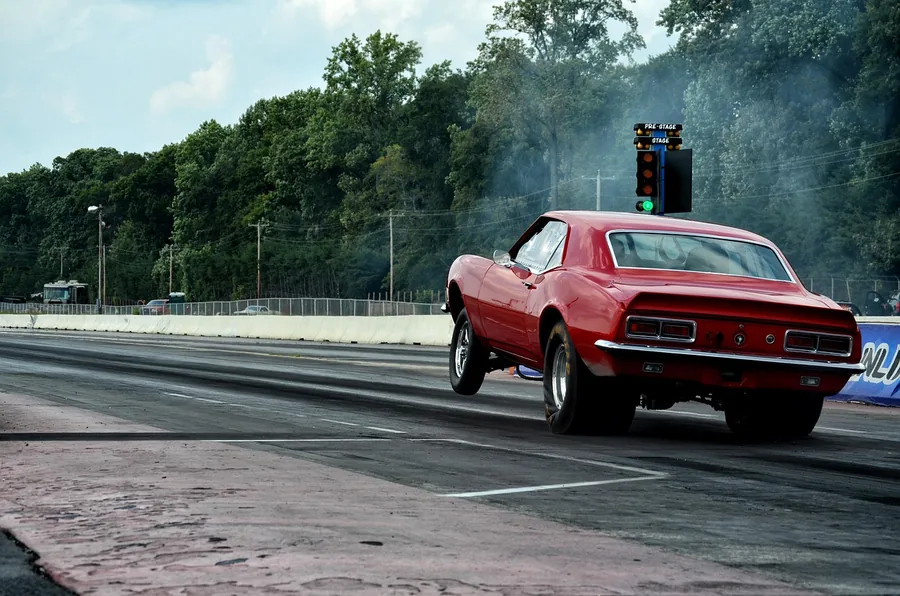
Two details separate drag racing from other categories. First, the start: NHRA says each run is started by an electronic tree, and in a Pro start all three amber lights flash together, then the green follows four-tenths of a second later, while a Sportsman start flashes them one after another five-tenths apart. Second, the win condition: the first vehicle across the finish line wins, unless in applicable categories it runs quicker than its dial-under or index, which NHRA calls a breakout.
A safety note on where this happens: NHRA says that since its formation in 1951 it has worked to combat the dangerous and illegal practice of street racing, and it runs Street Legal events at member tracks instead. Its NHRA Street Legal page sets conditions such as proof of registration and insurance and DOT-approved tires. Drag cars belong on a sanctioned strip, never a public road. Our wider guide to getting into car racing covers first steps.
Drifting, Off-Road and Karting Cars
Drifting. Formula DRIFT calls itself a professional drifting championship and runs a Pro series and a PROSPEC series. The FIA’s competition menu also lists an Intercontinental Drifting Cup and a Central Asia Drifting Cup. How judges score a run was not read for this guide, so no scoring claim is made.
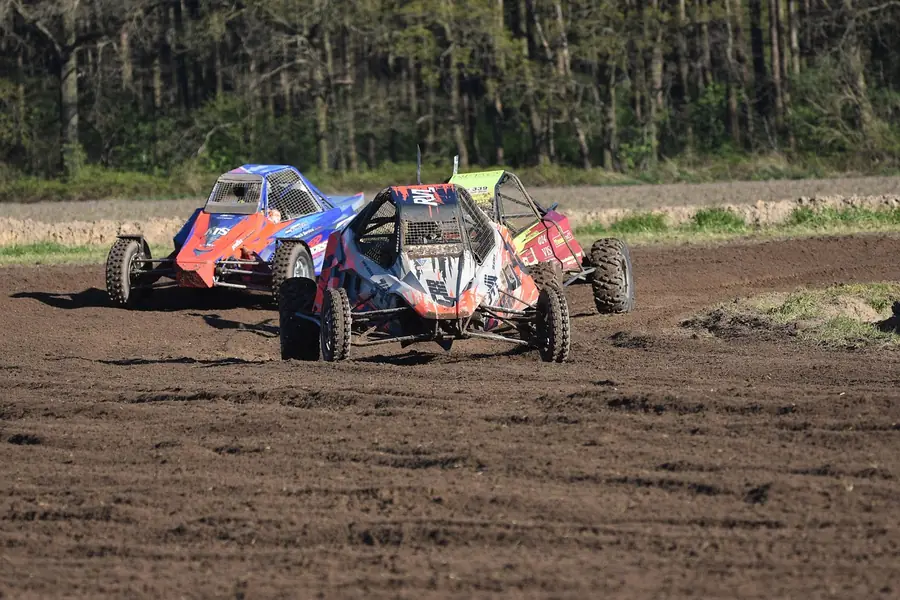
Off-road and desert. The Petersen Automotive Museum describes off-road motorsport as contested across deserts, forests, mountains and purpose-built courses, where simply reaching the finish line is often seen as an achievement. SCORE International, founded in Southern California in 1973, says all four rounds of its 2026 World Desert Championship are held in Baja California, Mexico. Its class menu is split into trucks (including SCORE Trophy Truck), buggies (including Class 1), UTV and motorcycle classes. At the 58th SCORE Baja 500 (June 3 to 7, 2026) its results list 200 starters and 144 finishers over 468.70 miles.
Karting. The CIK-FIA is the FIA commission that develops, promotes and regulates karting worldwide, including rules for the equipment and the venues used.
Race Car Myths Checked Against Official Pages
| Myth | What the official page says | Source |
|---|---|---|
| Every modern race car has traction control and ABS | INDYCAR says its cars have no power steering, traction control or anti-lock brakes | indycar.com |
| A race car is just a tuned road car | IMSA says only GT cars are based on road-going production models; Prototype cars are uniquely designed for the racetrack | imsa.com |
| The first car over the line always wins a drag race | NHRA says the first vehicle wins unless, in applicable categories, it runs quicker than its dial-under or index | nhra.com |
| Rally cars are one-off specials | The FIA says Rally1 cars were developed from B-Class, C-Class and Compact Crossover vehicle types | fia.com |
| You need a dedicated race car to compete | SCCA says an autocross participant may use the same car driven to work, and RallyCross needs only a safe hardtop vehicle | scca.com |
How to Watch or Get Involved Safely
Every option below is organized, on a closed course or a track. None involves racing on public roads.
| Option | What the page says | Source |
|---|---|---|
| IMSA race weekends | An Open Grid/Fan Walk before every event lets spectators see cars up close | imsa.com |
| SCCA autocross (Solo) | Cones form a mini road course in a parking lot or airport; lowest time without hitting cones wins, with classes for different degrees of modification | scca.com |
| SCCA Starting Line School | A full-day hands-on performance driving school that includes an SCCA membership and entries for future events | scca.com |
| SCCA RallyCross | Dirt course marked by cones; many Regions loan helmets and help first-timers through tech inspection (SCCA RallyCross page) | scca.com |
| SCCA HillClimb | A closed-down public road; competition cars need roll bars and racing harnesses at minimum, drivers need approved flame retardant suits, and some events do not allow novices (SCCA HillClimb page) | scca.com |
| NHRA Street Legal | Events at NHRA member tracks for street-driven vehicles with registration, insurance and working OEM safety systems | nhra.com |
If you are weighing the lifestyle side of all this, car culture from hobby to lifestyle is the natural next read, and racing car types explained simply is the short version of this guide.
Frequently Asked Questions
How many types of race cars are there?
There is no official count. This guide groups them into 10 categories, but NHRA alone lists more than 200 classes in 15 categories, so the total depends on how finely you count.
What is the difference between a prototype and a GT race car?
IMSA says Prototype cars are uniquely designed for the racetrack to showcase the latest technology, while GT cars are based on road-going production models. IMSA’s GTD PRO and GTD classes use FIA GT3 specifications.
What are race cars called?
The name depends on the category: single-seaters or open-wheel cars (Formula One, INDYCAR), prototypes and GT cars in sports-car racing, Rally1 cars in the top rally class, and dragsters, Funny Cars and Pro Stock cars in NHRA drag racing.
Which race car category is the fastest?
The figures measure different things. NHRA says Top Fuel dragsters cover the strip in under 3.7 seconds at more than 330 mph from a standing start, while INDYCAR says its oval tires handle sustained speeds above 230 mph, so a single ranking would be misleading.
Conclusion
The different types of race cars come down to rules: who writes them, what surface they run on, and how a result is decided. Use the chart to pick a category, then check the series’ own pages for current figures, because rule sets change. Figures here are as of 2026-10-14.
Products related to this article
Sponsored / affiliate links. As an Amazon Associate I earn from qualifying purchases. I may earn additional commission from eligible campaigns.