Best Waterproof Seat Protectors for Cars (2026): We Compared
The best waterproof seat protectors seal liquid at the seams, stay fixed under braking, and fit your seat shape. Poor fit means leaks, a sliding cover, and wasted money. Here’s how each pick holds up for kids, pets, workouts, muddy commutes, and daily spill control, plus what to check before you buy.
Quick comparison
| Product | Badge | Best for | Price | ||
|---|---|---|---|---|---|
 |
ALLANSING Front Seat Cover for Dogs with Side Flaps, HeavyALLANSING | Our pick | Heavy Duty · Waterproof · 1-Pack | $27.99
Price as of 21 Oct 2026
|
View |
 |
Munchkin Elite Seat Guardian Car Seat Protector, Dark GreyMunchkin | Also great | Dark Grey · Grime Guard · Car Seat Protector | $31.99
Price as of 21 Oct 2026
|
View |
The quickest decision is between front-seat pet protection and rear-bench family protection. The main tradeoff is coverage: one pick is built for a front bucket seat, while the other is shaped for a rear seating area and cleaner crumb control.
How we chose
Waterproofing had to mean more than a coated surface. Seam leakage, pooling in slack fabric, and openings around straps or anchors matter just as much as the material itself.
Retention was the second filter. A protector that shifts on leather, slides under braking, or bunches at the base can leak anyway, even if the surface fabric is waterproof.
Fit and access came next. Front seats, rear benches, bucket seats, seatbelt buckles, and child-seat hardware all need different coverage shapes, and some setups should be skipped unless the vehicle or child-seat maker specifically approves a protector.
Cleaning and daily handling mattered too. Wipe-clean surfaces help after coffee spills or muddy boots, while machine-washable or quick-remove designs matter more for pet hair and frequent messes.
Seat protector failure matrix
| Scenario | ALLANSING Front Seat Cover | Munchkin Elite Seat Guardian | Best fit verdict |
|---|---|---|---|
| Leak resistance | Strong for a front-seat cover, with 900D Oxford and multi-layer bonded seams | Good for everyday spills, with Grime Guard fabric and a lower catch panel | ALLANSING for concentrated pet moisture and scratches; Munchkin for crumbs and light liquid control |
| Slip resistance | Five-point grip helps keep it snug on a front seat | Universal fit helps, but the listing emphasizes coverage more than grip hardware | ALLANSING if shifting is your biggest problem |
| Child-seat suitability | Not the first choice unless the child-seat and vehicle makers approve the setup | Better aligned with rear-seat protection, but approval is still required before use under a car seat | Munchkin for rear-seat protection, with manufacturer approval checked first |
| Pet suitability | Very good for front-seat pet travel and claw contact | Usable for rear-seat messes, but not the strongest pet-specific option here | ALLANSING for pets |
| Cleaning effort | Moderate; waterproof surfaces should wipe clean quickly, but seams and flaps need attention | Low to moderate; designed for dirt and spill control with simple cleanup | Munchkin for frequent family messes |
| Seat-type compatibility | Front seat, SUV, truck, minivan front bucket seat | Rear seat, sedan, SUV back row, family vehicle use | Match the protector to the seat position first |
What makes a seat protector truly waterproof?
A truly waterproof protector blocks liquid through the fabric and backing, then keeps it from escaping at seams, strap openings, and folds. Water-resistant material may repel droplets for a while, but a stitched edge or slack pocket can still let moisture pool and seep through.
Waterproof fabric vs. waterproof backing
Waterproof fabric is the visible face material. Waterproof backing or a membrane is the hidden layer that helps stop liquid from reaching upholstery, which is why 600D Oxford fabric, neoprene, TPE, and PVC liner constructions matter differently than plain cloth.
That difference matters most after the first spill. If the top layer sheds liquid but the underside or seam tape fails, the seat still gets wet.
Where leaks usually start
Most failures begin at stitched seams, around anchor points, or where side flaps leave gaps. Slack areas collect liquid, especially in the low spot under a child seat, a dog’s paws, or a heavy work bag.
A common first-timer mistake is choosing a cover for the face material and ignoring the edges. A cup tip-over on a sloped bench can run straight to the stitching if the protector has weak seam control.
Why seam construction matters
Seam construction is the difference between a waterproof surface and a truly protective install. Bonded layers, heat-pressed joins, and fewer open stitch lines usually hold up better than simple fabric seams when liquid sits under pressure.
ALLANSING Front Seat Cover: best for pets
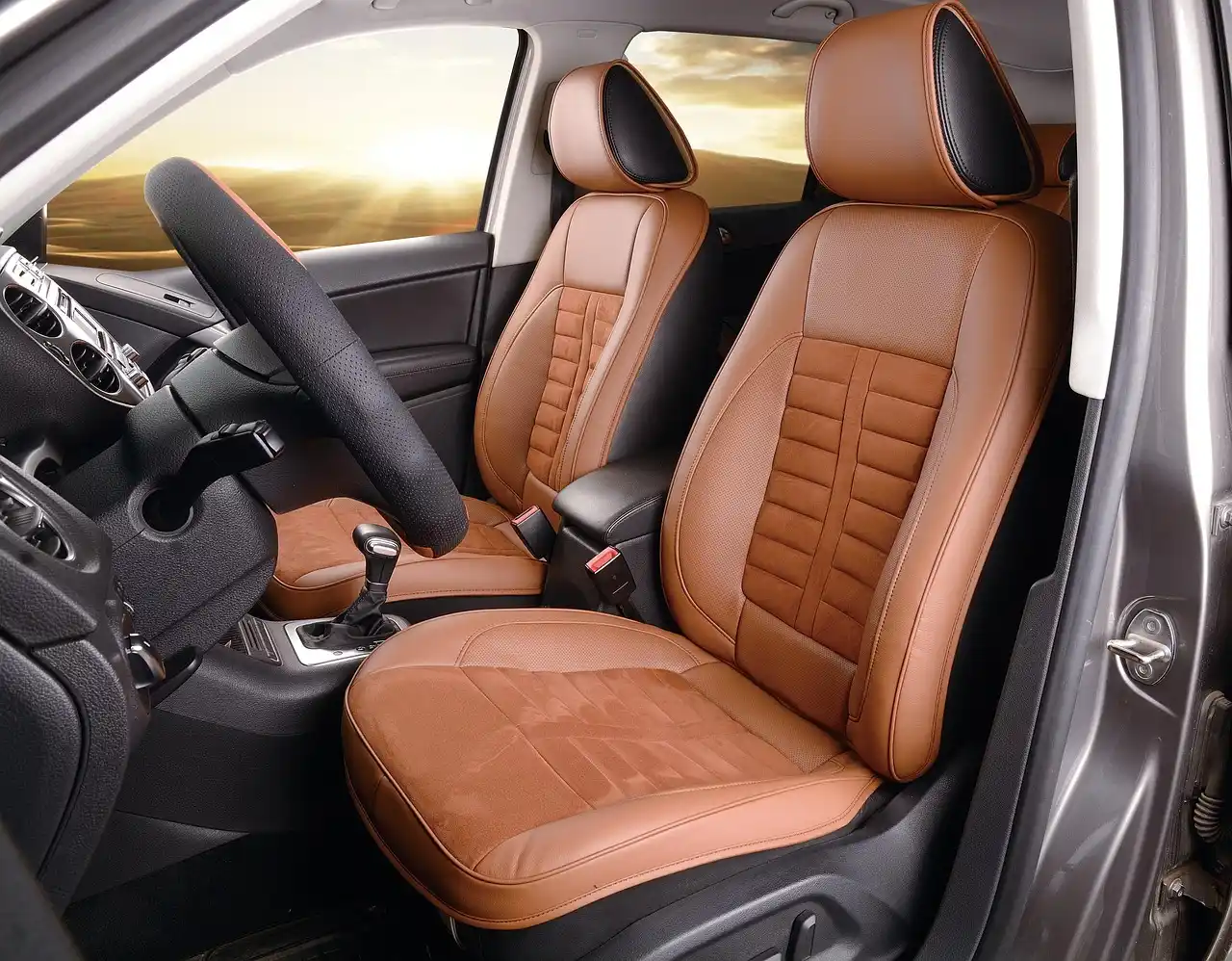
Choose this one if your biggest problem is a front-seat mess from a dog, gym clothes, muddy shoes, or daily wear on a bucket seat. Based on the manufacturer’s details, it uses heavy-duty 900D Oxford fabric, dual-layer waterproofing, and a five-point grip, which points to better scratch resistance and less shifting than a basic universal cover.
The main strength is containment. The side flaps add coverage where claws, dirt, and wet fur usually reach first, and the multi-layer bonded seams are the detail that matters most when you are trying to stop seepage at the seams.
The drawback is fit scope. It is a front seat cover, so it is not the right answer for a rear bench or a child-seat setup, and any side-airbag or seatbelt clearance issue has to be checked against the vehicle manual before use.
If your biggest failure mode is a protector that slides every time you brake, this is the stronger of the two picks here. If your biggest issue is rear-seat kid mess, it is the wrong shape for the job.
Waterproofing and retention
The waterproof claim is supported by the 900D Oxford shell and dual-layer construction. The grip system matters just as much, because a cover that moves can open seams and expose upholstery.
Cleaning and day-to-day use
For mud, sweat, or pet hair, a wipe-clean surface is the quickest path back to usable. Quick removal also matters for drivers who switch between work, errands, and pet transport on the same day.
Munchkin Elite Seat Guardian: best for commuters
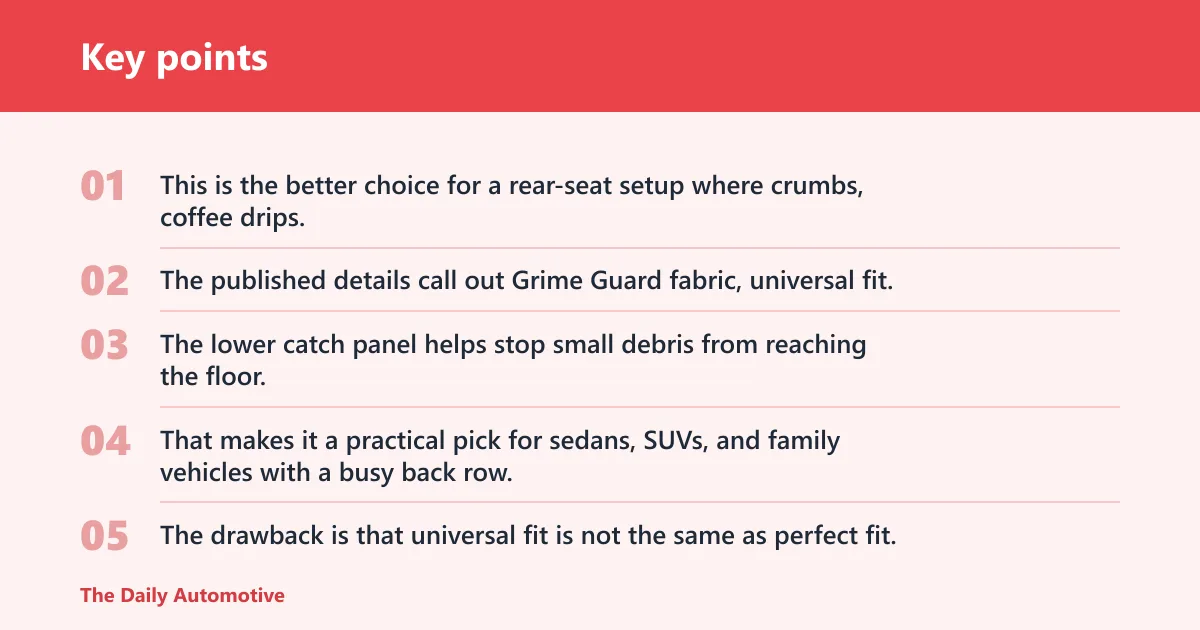
This is the better choice for a rear-seat setup where crumbs, coffee drips, and everyday wear matter more than claw damage. The published details call out Grime Guard fabric, universal fit, a built-in lower catch panel, and an extra tall back panel, which is useful when debris tends to fall between the seat base and backrest.
Its strongest point is coverage. The lower catch panel helps stop small debris from reaching the floor, and the tall back panel gives more surface protection than a thin seat mat. That makes it a practical pick for sedans, SUVs, and family vehicles with a busy back row.
The drawback is that universal fit is not the same as perfect fit. If you have a highly contoured seat, special trim, or a child-seat installation, you still need to check the car-seat and vehicle maker’s rules before using any aftermarket protector underneath or around the child seat.
For everyday commuting, this is the more sensible choice when your failure mode is mess spreading behind the seat rather than clawing and front-seat shifting.
Waterproofing and access
The Grime Guard material is designed for dirt and spills, but the more important question is whether the protector leaves seatbelt buckles, latch points, and adjustment hardware easy to reach. That is where rear-seat products win or lose usability.
Cleaning and day-to-day use: this kind of rear-seat protector
This kind of rear-seat protector is best when quick cleanup matters more than heavy-duty abrasion resistance. A damp cloth is usually the first line of cleanup for coffee, snack residue, and general commuter mess.
Are waterproof seat protectors safe for leather seats?
They can be, but only if the protector stays put and does not trap moisture or rub the leather finish. Leather needs a cover that avoids abrasive backing, excessive heat buildup, and sliding contact, because motion can mark the surface even when the cover is technically waterproof.
What leather needs from a cover
Leather benefits from even pressure and limited friction. A protector with non-slip backing or seat anchors helps, but it should not create grit or a sticky surface that can scuff the seat during daily entry and exit.
Where friction and trapped moisture matter
Moisture trapped against leather can cause a damp spot to linger under the cover, especially in hot weather or with heated seats. That is why a breathable fit, regular removal, and complete drying matter more than a simple waterproof label.
When to skip a protector
Skip it if the vehicle manual or leather-care guidance says not to use aftermarket covers, or if the protector interferes with seat sensors, side airbags, or seat adjustment controls. If the seat is already delicate, a bad-fit cover can do more harm than a small spill.
Which one should you buy?
Start with the seat position, then match the failure mode. If the problem is a dog, wet gear, or repeated front-seat abuse, the ALLANSING cover is the stronger pick because its 900D build and five-point grip are aimed at holding position and resisting wear.
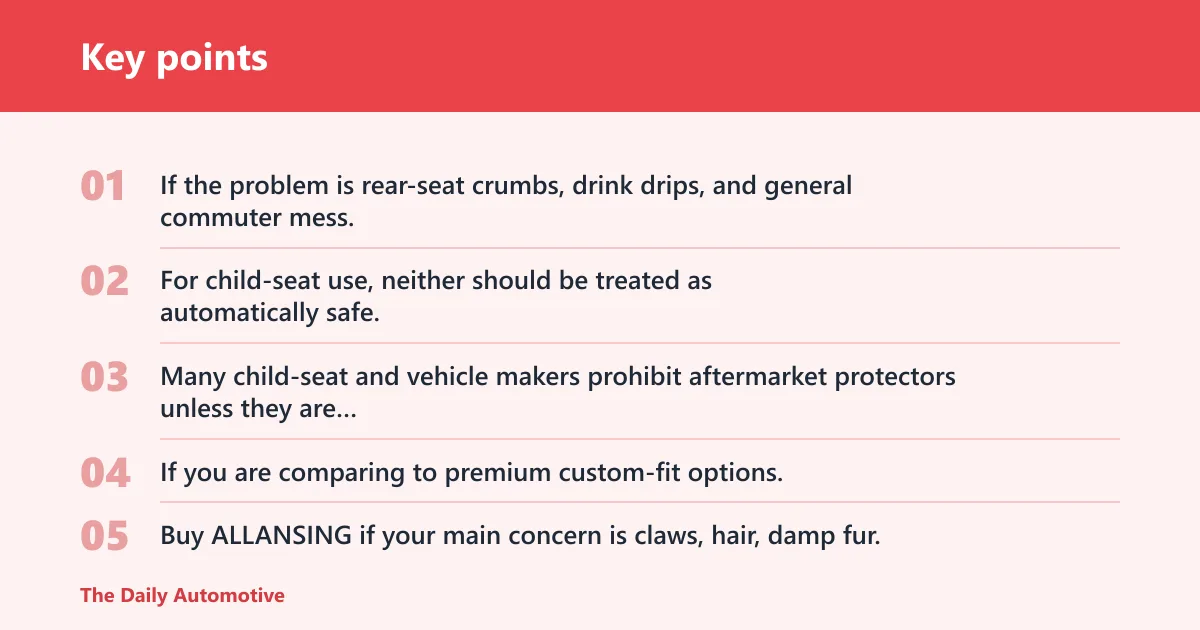
If the problem is rear-seat crumbs, drink drips, and general commuter mess, the Munchkin protector is the better fit because its tall back panel and lower catch panel are built around back-row containment.
For child-seat use, neither should be treated as automatically safe. Many child-seat and vehicle makers prohibit aftermarket protectors unless they are specifically approved, so check the manuals first and skip any cover that blocks seatbelt routing, latch access, or the child seat’s stability.
If you are comparing to premium custom-fit options, that kind of fit is a different purchase decision than a universal cover. This guide sticks to the two listings above.
Best pick for pets
Buy ALLANSING if your main concern is claws, hair, damp fur, and a front-seat bucket that shifts under load. Its bonded seams and five-point grip make it the more convincing option for pet travel.
Best pick for sweat and spills
Buy Munchkin if you need rear-seat spill control for coffee, sports drinks, or the after-work commute. Its tall back panel and lower catch panel are a better match for everyday liquid and crumb control than a front-seat pet cover.
Best pick for child-seat use with approval
Use the Munchkin only if your child-seat manufacturer and vehicle maker allow a protector in that position. The safer buying rule is approval first, then fit, then belt access; never reverse that order.
What features should you look for in a waterproof seat protector?
Look for waterproof fabric plus a waterproof backing or membrane, then check how the seams are built. After that, focus on fit hardware: adjustable straps, seat anchors, non-slip backing, anti-slip dots, or a five-point grip all matter more than a generic universal-fit claim.
Fit and retention
Retention is what stops pooling and slippage. A cover that stays centered under braking keeps seams flat and reduces the chance of liquid finding an opening.
Coverage and seat type
Choose a front-seat cover for pets or solo commuting, and a rear-bench cover for kids, family mess, or back-seat passenger wear. Bucket seats, sedans, SUVs, and trucks all fit differently, so the seat shape should drive the choice.
Safety and access
Check seatbelt access, heated-seat warnings, and side-airbag compatibility before installing anything. If the protector interferes with belts, sensors, or child-seat stability, it is the wrong product for that vehicle.
Cleaning and maintenance
Wipe-clean surfaces are fastest after coffee or sweat. Machine-washable options help when pet hair or mud builds up, but quick removal matters almost as much as washability because a cover you never remove often gets neglected.
Say your dog jumps into a truck after a rainy walk and shakes once in the cab. A loose cover can pool water in the seat fold and slide toward the door, while a snug, front-seat protector with a better grip keeps the mess contained.
Suppose a child seat stays in place, but the cover underneath blocks the buckle stalk or adds too much padding. The child-seat setup can become less stable, which is why approval and access checks come before any claim of convenience.
Frequently asked questions
What is the best waterproof seat protector for cars?
The best choice depends on the seat and the mess. ALLANSING is the stronger pick for pets and front-seat wear, while Munchkin is better for rear-seat commuter mess. The right answer is the one that seals seams, stays fixed, and does not block safety hardware.
Are waterproof car seat protectors safe for leather seats?
They can be safe if they do not scuff the surface, trap moisture, or interfere with seat functions. Leather needs a stable fit and a clean underside, and you should avoid any protector that slides or holds heat against the seat for long periods.
Do waterproof seat protectors work for child car seats?
Only if the child-seat maker and vehicle maker specifically allow it. Many do not approve aftermarket protectors unless they are designed for that use, because added material can affect stability, seatbelt routing, or latch contact. Check the manuals first.
Which car seat protector stays in place the best?
Based on the listed features, ALLANSING has the strongest retention claim here because it uses a five-point grip. For most protectors, seat anchors, non-slip backing, and a seat shape that matches the cover matter more than marketing language.
What is the difference between waterproof and water-resistant seat covers?
Waterproof covers are built to block liquid from passing through the material and, ideally, the backing or membrane. Water-resistant covers may shed liquid briefly but can still seep at seams, stitching, or open edges once the spill sits there.
How do I clean a waterproof car seat protector?
Start with a damp cloth for fresh spills, then remove the cover if the mess reached seams, pockets, or folds. If the maker allows it, machine washing helps with pet hair or heavy grime, but quick drying before reinstalling matters just as much.
Products related to this article
Sponsored / affiliate links. As an Amazon Associate I earn from qualifying purchases. I may earn additional commission from eligible campaigns.