When Did Personal Cars Become Popular in the US?
Personal cars became widely popular in the United States in the 1920s, but they did not become common in most households until the late 1940s and 1950s. Treating those phases as the same blurs how fast ownership spread, and why. This guide traces that shift decade by decade, from the Model T era to postwar household ubiquity.
When did cars become popular in America?
Cars became broadly popular in the United States in the 1920s. The Model T and assembly-line production made ownership realistic for far more families, while better roads, installment buying, and rising middle-class demand pushed cars beyond early adopters. Even so, broad popularity was not the same as household saturation.
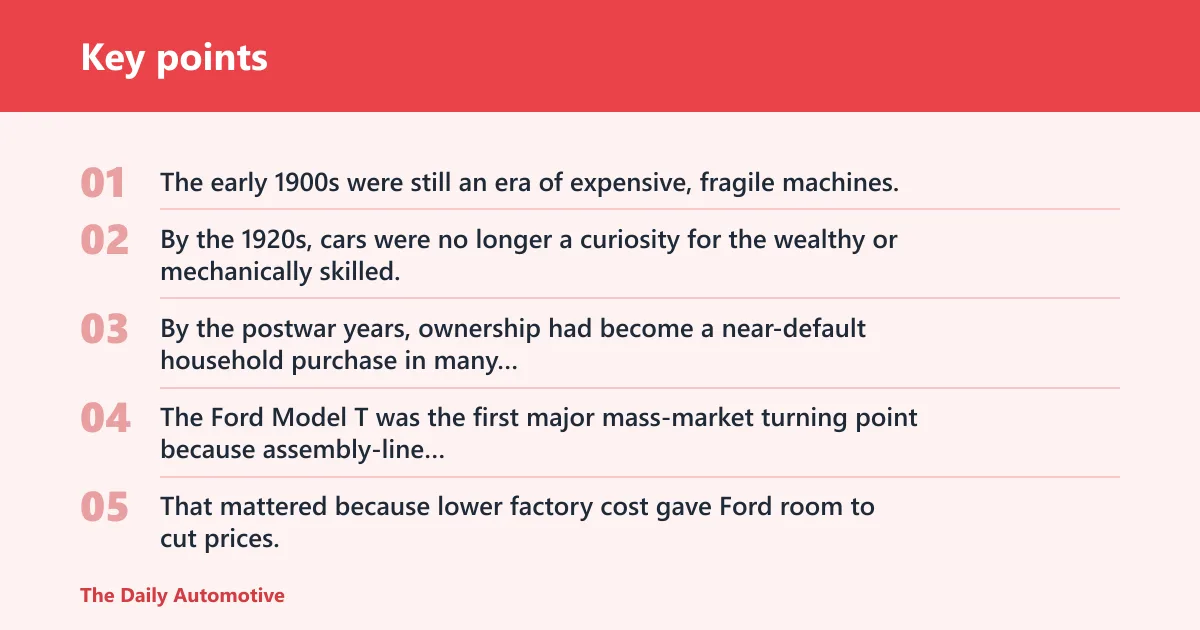
The early 1900s were still an era of expensive, fragile machines. By the 1920s, cars were no longer a curiosity for the wealthy or mechanically skilled. By the postwar years, ownership had become a near-default household purchase in many parts of the country.
Car popularity timeline
| Decade | Main adoption driver | What limited ownership | Why it moved popularity forward |
|---|---|---|---|
| 1900s | Early gasoline cars appeared for wealthy buyers and enthusiasts. | High prices, poor roads, and limited service support. | Introduced personal motor travel, but only for a small elite. |
| 1910s | Ford Model T production scaled up through assembly-line methods. | Prices still mattered, and many roads were unpaved. | Made the car a realistic purchase for more middle-class buyers. |
| 1920s | Mass production, financing, and improving roads aligned. | Cost, maintenance, and uneven rural road access still held some buyers back. | Turned car ownership into a broad middle-class purchase and a visible part of daily life. |
| 1940s-1950s | Postwar demand, suburban growth, and highway building. | World War II had delayed civilian car buying and production. | Moved ownership from broad popularity to near-normal household dependence. |
Why the Ford Model T changed everything
The Ford Model T was the first major mass-market turning point because assembly-line production lowered manufacturing costs and raised output. That mattered because lower factory cost gave Ford room to cut prices, and lower prices widened the pool of buyers far beyond the wealthy.
The Model T did not make cars popular by itself. It worked because it was part of a larger shift: standardized parts, faster assembly, and a manufacturing system that could produce cars in volumes earlier automakers could not match. That is why the Model T is a turning point, not the finish line.
A common first-timer mistake is to treat a lower sticker price as the whole story. A $500-or-so car still depended on roads, fuel, repair shops, and a buyer who could handle the running costs after purchase. The car had to be practical, not merely cheaper.
What kept early car ownership limited?
Early car ownership stayed limited because cars were expensive, roads were poor, and the support network was thin. Even with a cheaper Model T, many families still faced a large upfront cost, uneven road quality, fuel access gaps, and repair bills that could wipe out the appeal of ownership.
High prices before mass production
Before assembly-line production, cars were hand-built or made in small numbers. That kept prices high. In the first years of the automobile, a personal car was more likely to be a luxury good than a practical household tool.
Poor roads and weak service networks
Road infrastructure lagged behind demand. Paved roads were limited in many areas, especially outside major cities, and state highway systems were still taking shape. If a car could not reliably reach a destination, ownership made less sense.
Suppose a farm family in 1912 could afford a car but lived on dirt roads that turned muddy after rain. The car might start every morning and still fail the family’s real test: dependable travel to town, school, or market. That is why infrastructure mattered as much as factory price.
Maintenance, fuel access, and repair costs
Early cars also needed more attention than later models. Drivers had to deal with frequent maintenance, scattered gas stations, and local mechanics who were not yet common in every town. Those hidden costs slowed adoption even when the headline price fell.
- Make the purchase price affordable enough for middle-class buyers.
- Expand roads so the car can be used regularly, not only occasionally.
- Build repair and fuel networks that make ownership practical.
- Offer financing so buyers can spread the cost over time.
- Use the car for commuting, shopping, and travel so it becomes part of household routine.
How did the 1920s make cars common?
The 1920s made cars common because mass production, consumer credit, and better roads moved ownership from novelty to normal purchase. This was the breakthrough decade. By then, the car had become a middle-class purchase, not a rich person’s toy or a rural curiosity. (Wikipedia)
Assembly line output and falling prices
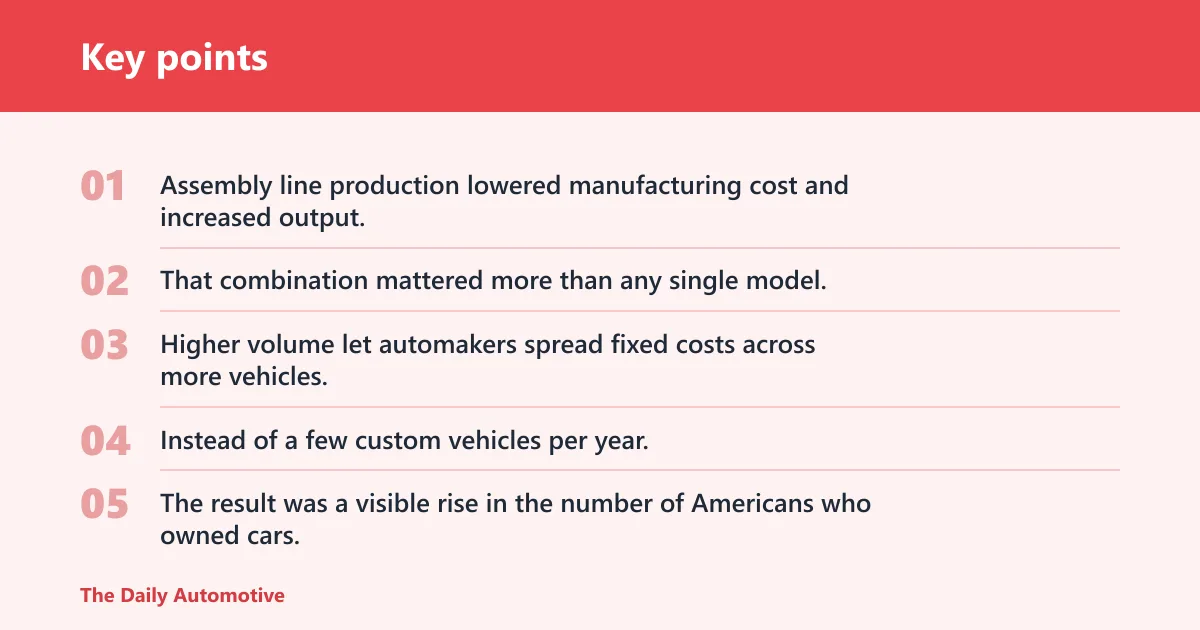
Assembly line production lowered manufacturing cost and increased output. That combination mattered more than any single model. Higher volume let automakers spread fixed costs across more vehicles, and those savings helped push prices down enough for many ordinary families to consider buying.
That shift changed the market. Instead of a few custom vehicles per year, manufacturers could build cars at scale and keep selling them at prices more households could reach. The result was a visible rise in the number of Americans who owned cars, especially in urban and suburban middle-income households.
Installment buying and consumer credit
Credit and financing were a major reason car ownership spread in the 1920s. Installment buying let families pay over time instead of producing the full amount upfront. That did not make cars cheap, but it made them accessible to buyers with steady income and limited savings.
What made personal cars affordable for the middle class was the mix of lower factory prices and easier payment plans. One without the other would have moved adoption more slowly. Together, they turned car buying into a regular household financial decision.
Middle-class adoption and the first broad ownership surge
The 1920s were when the car became part of middle-class life in a way it had not been before. Families used cars for commuting, errands, visiting relatives, and road trips. That daily usefulness helped normalize ownership and made the car feel less like a luxury and more like a tool.
Road trips and leisure travel also mattered. Once families could drive to beaches, parks, and nearby towns, the car’s value went beyond work and shopping. It became a family use case, which helped car ownership spread in both culture and practice.
What changed after World War II?
World War II disrupted civilian car buying because factories shifted to war production and civilian availability dropped. After the war, pent-up demand met a revived consumer market, and car ownership surged again. The postwar years did not start the car boom, but they finished the move toward near-normal household ownership.
Production shifts during the war
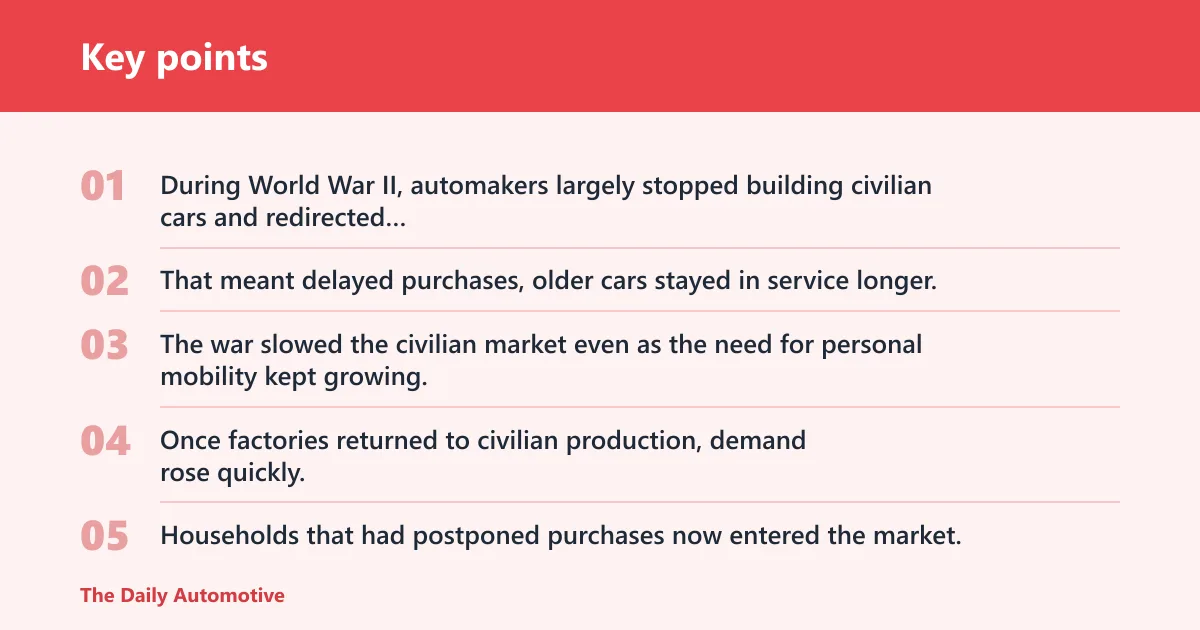
During World War II, automakers largely stopped building civilian cars and redirected plants to military needs. That meant delayed purchases, older cars stayed in service longer, and many households waited to buy. The war slowed the civilian market even as the need for personal mobility kept growing.
Postwar demand surge
Once factories returned to civilian production, demand rose quickly. Households that had postponed purchases now entered the market, and new buyers joined them. That surge helped push car ownership beyond broad popularity and into everyday expectation.
Suburbanization, commuting, and family-car demand
Suburbanization after the war increased family-car demand because housing spread farther from city centers and commuting became more car dependent. As more households moved into subdivisions with longer drives to work, school, and stores, owning a car became less optional and more practical.
Road infrastructure also improved after the war. State highways expanded, road paving spread, and later interstate highways made long-distance driving easier and more predictable. Those changes did not create car ownership by themselves, but they made ownership more useful for more Americans.
Road trips and highway culture
Postwar road travel helped turn the car into a normal household purchase. Vacation driving, weekend visits, and cross-state travel fit the growing highway system. The car was no longer only a way to reach work or town; it became the default way to move a family around the country.
Picture a family in 1956 planning a summer trip with two children, a trunk full of luggage, and a route built around new highways. That kind of trip made the car feel ordinary, even necessary. The more households used cars that way, the more normal ownership became.
When did cars replace horses in the United States?
Cars replaced horses gradually, not in a single year or even a single decade. In cities, the shift happened earlier because cars fit paved streets, commercial delivery, and longer commutes. In rural areas, horses lasted longer because dirt roads, farm use, and cost kept animal power useful well into the first half of the 20th century.
By the 1920s and 1930s, the balance had clearly shifted in many places. By the postwar years, cars were the dominant personal transport choice for most households. Horses did not disappear overnight, but their central role in daily travel ended as car ownership spread and roads improved.
Frequently asked questions
When did personal cars become popular in the US?
Personal cars became popular in the United States in the 1920s. That was the first decade when mass production, falling prices, better roads, and financing made ownership realistic for a broad middle class. Popularity came before universal ownership, so the 1920s mark the breakthrough, not the finish.
What decade did car ownership become common in America?
Car ownership became common in America in the 1920s, but it became truly normal in most households after World War II. Those are different milestones, and they should not be merged.
Did the Model T make cars popular?
Yes, the Ford Model T was a major reason cars became popular. Its assembly-line production lowered manufacturing costs and let Ford sell at much lower prices than earlier automakers could manage. Even so, roads, financing, and postwar demand also mattered. The Model T started the shift; it did not finish it.
How did the Great Depression affect car ownership?
The Great Depression slowed car ownership because incomes fell, credit tightened, and many households delayed big purchases. Some families kept older cars longer, while others went without. The decade did not reverse the long-term trend, but it interrupted the pace of expansion that had built during the 1920s.
When did suburbs and highways boost car ownership?
Suburbs and highways boosted car ownership after World War II, especially in the late 1940s and 1950s. Suburban housing spread farther from city centers, so families depended more on cars for commuting and errands. Highway expansion made driving easier and more useful, which reinforced household ownership.
How many Americans owned cars in the 1920s?
Ownership rose sharply in the 1920s, but the exact share varied by year and source. What matters is the trend: the decade saw the first broad middle-class surge in ownership. The car moved from elite purchase to common household item, even though it was not yet universal.
What made personal cars affordable for the middle class?
Two forces made cars affordable for the middle class: lower production costs and easier payment plans. Assembly-line production cut manufacturing cost, and installment buying spread the expense over time. Better roads, more repair support, and rising practical value then made the purchase easier to justify.
Products related to this article
Sponsored / affiliate links. As an Amazon Associate I earn from qualifying purchases. I may earn additional commission from eligible campaigns.