Which Way Should I Face My Subwoofer In My Car: Best Pro Tips
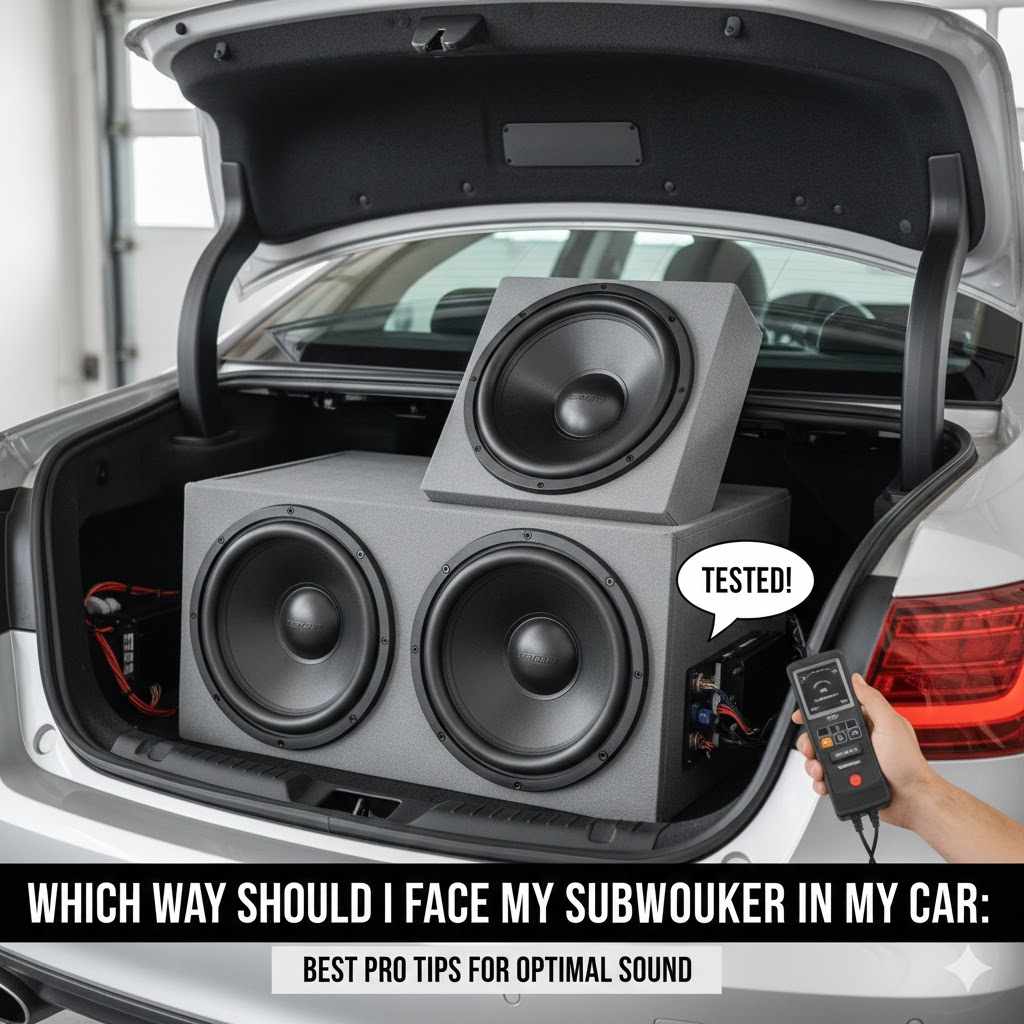
For most vehicles, especially sedans, the best direction to face your subwoofer is toward the rear of the car. This allows the sound waves to load off the back of the trunk and reflect into the cabin, creating a deeper, fuller bass sound. For SUVs and hatchbacks, facing the subwoofer upward often yields the best results.
You just installed a new subwoofer in your car. You’re excited for that deep, rich bass to bring your music to life. But then you hit a snag. Which way should you point it? Forward? Backward? Up? It seems like a simple question, but the answer can completely change how your system sounds. It can be the difference between muddy, weak bass and clean, powerful thumps.
Many people get frustrated by this. They spend good money on equipment, only to be disappointed by the results. Don’t worry, you’re not alone, and it’s an easy fix! This isn’t some complex secret only audio pros know. It’s all about understanding how sound works inside your car.
In this guide, I’ll walk you through everything you need to know. We’ll explore the best positions for your specific vehicle type, and I’ll give you a simple, step-by-step process to find the perfect spot. Let’s get that subwoofer sounding exactly how you imagined.
Why Does Subwoofer Placement Even Matter?
You might think a speaker is a speaker. You point it at your ears, and that’s that. But subwoofers are different. They produce very low-frequency sound waves, which behave in a unique way. Think of them less like a spotlight and more like ripples in a pond. They spread out in all directions.
These long, powerful waves travel around your car and bounce off surfaces like the windows, seats, and trunk lid. This bouncing is where the magic—or the trouble—happens.
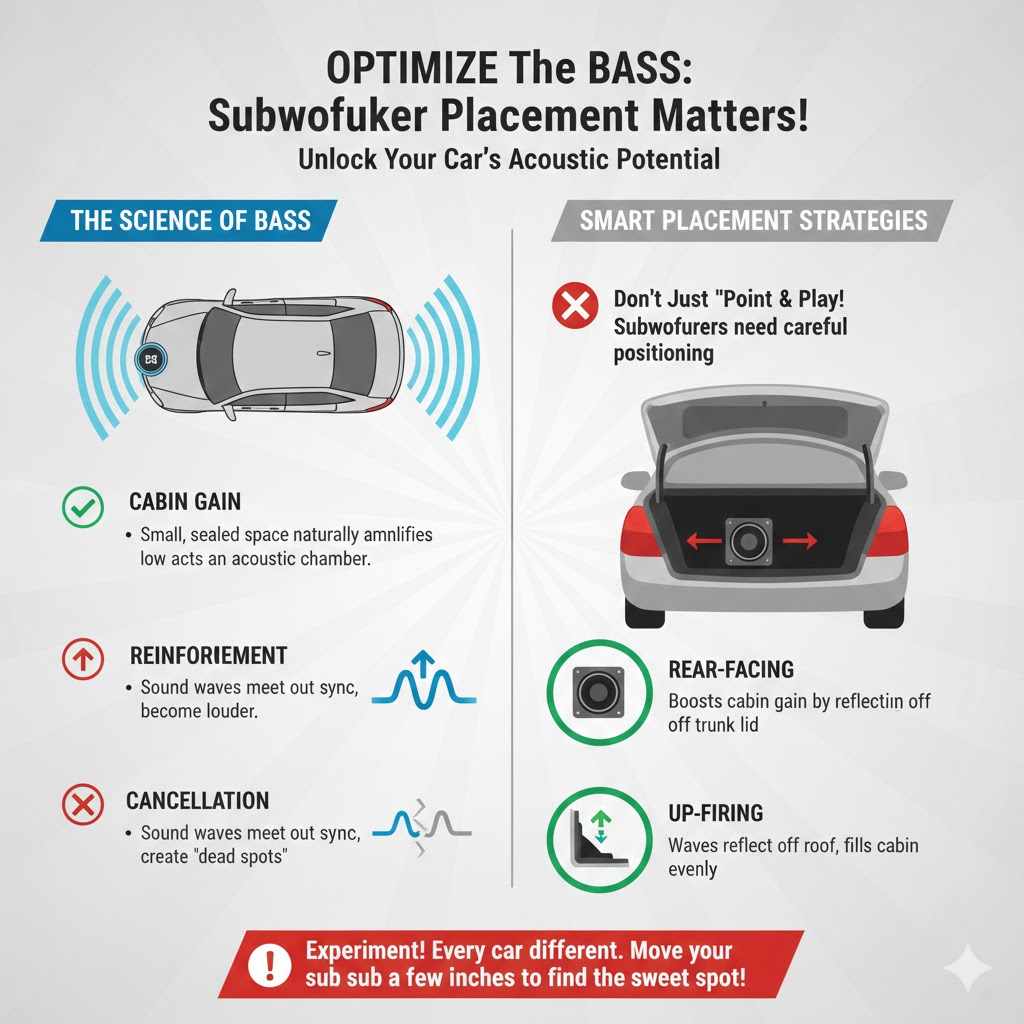
- Cabin Gain: This is a good thing! The small, sealed space of a car naturally amplifies low bass frequencies. The car itself acts like a small acoustic chamber, making your subwoofer sound more powerful than it would in a large room. Proper placement takes advantage of this free boost.
- Reinforcement: When sound waves bounce and meet each other in sync, they get louder. This is what we want. Facing the sub toward a solid surface, like the back of your trunk, helps create strong, reinforced waves that travel into the main cabin.
- Cancellation: This is the enemy of good bass. If sound waves bounce and meet each other out of sync, they can cancel each other out. This creates “dead spots” where the bass sounds weak or disappears entirely, even if the sub is working hard. Moving the subwoofer just a few inches can fix this.
So, choosing which way to face your subwoofer isn’t just about pointing it. It’s about using your car’s unique shape to make those bass waves work for you, not against you.
Understanding Your Vehicle Type Is Key
Every car has a different shape inside, and that shape dramatically affects how bass sounds. What works perfectly in a sedan might sound terrible in an SUV. Let’s break down the three most common vehicle types.
For Sedans (with a Trunk)
Sedans have a separate, sealed trunk. This is a huge advantage for bass. By facing the subwoofer toward the rear of the car (away from the cabin), you allow the sound waves to fully develop in the trunk before entering the cabin through the rear deck and seats. This “loading” effect makes the bass feel deeper and more powerful.
Best Bet: Face the subwoofer toward the rear bumper, about 6-12 inches away from the back of the trunk.
For SUVs, Hatchbacks, and Wagons
These vehicles have an open cargo area that is part of the main cabin. There’s no separate trunk to load the bass into. Because of this, the rules change. Facing the sub toward the rear hatch can sometimes work, but it can also sound “boomy” or create rattles.
Best Bet: Try facing the subwoofer straight up, toward the roof. This allows the sound waves to radiate more evenly throughout the large, open space. If that doesn’t work well, facing it toward the rear is your next best option.
For Pickup Trucks
Trucks have the most challenging cabins. The space is often small and irregular, especially in single-cab or extended-cab models. You’re usually working with a slim-profile subwoofer box that fits under or behind the seat.
Best Bet: Firing the subwoofer downward (if it’s a down-firing box) or directly forward into the back of the seat is often the most effective. This directly transfers the bass energy into the seats and cabin, giving you that tactile punch you can feel.
The Three Main Subwoofer Positions: Pros and Cons
Let’s dive deeper into the most common placement options. Remember, these are starting points. Your ears will be the final judge.
Position 1: Firing Toward the Rear (The Classic)
This is the most popular and often most effective method, especially for sedans. You place the subwoofer box in your trunk with the speaker cone pointing toward the tail lights.
- Pros:
- Excellent low-frequency extension (deep bass).
- Takes full advantage of cabin gain in a trunk.
- Often produces the loudest and most impactful bass.
- Protects the speaker cone from loose items in the trunk.
- Cons:
- Can sometimes cause trunk rattles.
- May not be as effective in SUVs or hatchbacks.
Position 2: Firing Upward
Here, the subwoofer box sits flat with the speaker cone pointing toward the roof. This is a go-to for open-cabin vehicles like SUVs and hatchbacks.
- Pros:
- Distributes bass more evenly in a large, open cabin.
- Can reduce localized rattles from the rear hatch.
- Good for achieving a balanced sound that fills the whole vehicle.
- Cons:
- The speaker cone is exposed and can be easily damaged.
- May not feel as “punchy” as a rear-firing setup.
- Takes up flat floor space in your cargo area.
Position 3: Firing Forward (Toward the Seats)
In this setup, you place the box against the back wall of the trunk or cargo area, with the speaker cone pointing toward the back of the rear seats.
- Pros:
- Can produce a “tighter” and more accurate bass response.
- Often works well in pickup trucks or when the sub is very close to the listener.
- Can reduce trunk rattle by directing energy away from the trunk lid.
- Cons:
- Often sounds quieter and less powerful than firing to the rear.
- The rear seats can muffle the sound, especially if they are thick.
A Comparison Table: Which Position is Best for You?
To make it even simpler, here’s a table to help you decide on a starting position based on your car and what kind of sound you like.
| Vehicle Type | For a Loud, Boomy Sound | For a Tight, Accurate Sound | Best All-Around Starting Point |
|---|---|---|---|
| Sedan | Firing Rear | Firing Forward | Firing Rear |
| SUV / Hatchback | Firing Rear | Firing Forward | Firing Upward |
| Pickup Truck | Firing Forward | Down-Firing | Firing Forward or Downward |
Step-by-Step Guide: How to Find Your Car’s Sweet Spot
Now for the fun part: testing! This is the only way to know for sure what sounds best in your car. It’s not hard, and you don’t need any fancy tools. Just trust your ears.
Step 1: Gather Your Tools (and Your Ears!)
You only need a few things for this experiment:
- Your Car and Subwoofer: Make sure it’s installed and playing safely.
- Your Favorite Music: Pick a few songs you know very well, preferably with a good variety of bass notes (some deep, some punchy).
- A Friend (Optional but helpful): One person can listen from the driver’s seat while the other moves the subwoofer box.
- About 30 Minutes: Don’t rush the process.
Step 2: Set Your System to “Flat”
Before you start, turn off any bass boost, “Loudness,” or special EQ settings on your head unit (car stereo). Set the bass, mid, and treble controls to zero, or “flat.” This ensures you’re hearing what the subwoofer is actually doing, not what the stereo is artificially adding.
Step 3: Start with the Recommended Position
Using the guide and table above, place your subwoofer box in the recommended starting position for your vehicle type. For a sedan, that’s in the trunk, facing the rear. For an SUV, try facing it up.
Step 4: Listen from the Driver’s Seat
This is the most important rule. It doesn’t matter how the bass sounds standing outside the car or in the back seat. All that matters is how it sounds where you sit! Play your test song at a normal listening volume.
Ask yourself these questions:
- Is the bass clear or is it muddy?
- Is it loud and full, or does it sound weak?
- Can you hear all the different bass notes, or just one boomy tone?
- Do you hear any annoying rattles or vibrations from the trunk or panels?
Step 5: Experiment! Try Different Angles and Spots
Now it’s time to move things around. Try each of the three main positions: rear-firing, forward-firing, and upward-firing (if possible in your vehicle). Each time you move it, go back to the driver’s seat and listen to the same part of the song.
Don’t just try the main directions. Try small changes too:
- Slide the box from the left side to the right side of the trunk.
- Move it closer to or further from the back of the trunk.
- In an SUV, try placing it in a corner.
You will be shocked at how much difference a few inches can make. You’re listening for that “sweet spot” where the bass suddenly sounds louder, cleaner, and deeper.
Step 6: Lock It In
Once you find the position that sounds best to you, you’re done! The final step is to make sure your subwoofer box is secured. A loose box can slide around, which is not only bad for the sound but also a major safety hazard in a sudden stop. Use straps or brackets to hold it firmly in place.
Pro Tips for Even Better Bass
Finding the right position is the biggest step, but here are a few extra things you can do to take your bass to the next level.
Sound Deadening is Your Best Friend
That rattling sound you hear? It’s often the metal of your trunk, license plate, or plastic panels vibrating. You can fix this by applying sound deadening material. It’s a simple peel-and-stick mat that absorbs vibrations and makes your car quieter, allowing you to hear more bass and less noise.
Check Your Amplifier’s Phase Switch
Many car audio amplifiers have a “Phase” switch, usually with 0° and 180° settings. This switch changes the timing of the subwoofer’s movement. Sometimes, your sub and your main speakers can be slightly out of sync, causing some bass frequencies to cancel out right at the driver’s seat.
While listening to a bass-heavy track, have a friend flip this switch back and forth. Pick the setting that sounds louder and fuller from your listening position. It’s a quick and easy tune-up that can make a noticeable difference.
Set Your Crossover and Gain Correctly
Your amplifier has two other critical settings: the Low-Pass Filter (LPF) and the Gain.
- LPF Crossover: This tells the subwoofer which notes to play. A good starting point is around 80 Hz. This means the sub will only handle the deep bass notes below 80 Hz, while your main speakers handle the rest. This prevents muddy, overlapping sound.
- Gain: This is NOT a volume knob. It matches the output of your stereo to the input of your amp. Setting it too high will cause distortion and can damage your sub. It’s best to look up a guide on how to set your amp’s gain properly using your ears or a multimeter.
A Word on Safety: Protecting Your Hearing
We all love loud, powerful bass, but it’s crucial to be safe. Loud music, especially deep bass, can permanently damage your hearing over time. According to the Centers for Disease Control and Prevention (CDC), exposure to sounds above 85 decibels (about the level of a lawnmower) can lead to hearing loss.
A powerful car audio system can easily exceed 120 decibels. Enjoy your music, but be smart about it. Listen at reasonable volumes, and give your ears a break on long drives. Your hearing will thank you for it in the long run.

Frequently Asked Questions (FAQ)
What if I have two subwoofers in my car?
The same principles apply. Usually, facing both subwoofers in the same direction works best. The most common setup is to have both subs in one box, facing the rear. Avoid facing them toward each other, as this can cause the sound waves to cancel each other out.
Does the type of subwoofer box (sealed vs. ported) matter for placement?
Yes, it can. Ported boxes are often louder and produce deeper bass, but they can be more sensitive to placement. Sealed boxes tend to offer tighter, more accurate bass and are generally more forgiving with placement. Regardless of the box type, you should still experiment with different positions to find what sounds best.
Why does my bass sound great outside the car but weak inside?
This is a classic sign of sound wave cancellation inside the cabin. The sound waves are bouncing around and canceling each other out before they reach your ears. Experimenting with different subwoofer positions and checking your amplifier’s phase switch are the best ways to fix this.
Should my subwoofer be “broken in”?
Yes, most manufacturers recommend a break-in period for new subwoofers. The speaker’s suspension is stiff from the factory. Playing it at a low to moderate volume for several hours helps loosen it up, allowing it to move more freely and produce better sound. Avoid pushing it to its maximum volume for the first 10-20 hours of playtime.
Is it bad to put things in my trunk with my subwoofer?
It’s fine to use your trunk, but be careful. Don’t place hard or heavy objects where they can slide into the speaker cone and damage it. This is another reason why rear-firing positions are popular—they naturally protect the cone. Also, make sure nothing is blocking the port on a ported box, as this will ruin the sound.
Can I just put the subwoofer in the back seat?
While you can, it’s generally not recommended. First, it’s a major safety hazard, as the heavy box can become a projectile in an accident. Second, the sound is often overwhelming and poorly balanced when it’s that close to your ears. Subwoofers need some space for the long bass waves to develop properly.
Conclusion: Your Ears Are the Ultimate Judge
So, which way should you face your subwoofer in your car? As you’ve seen, there’s no single magic answer. While facing it to the rear is a fantastic starting point for most sedans, and facing it up works well for SUVs, the perfect placement is unique to your vehicle, your equipment, and your ears.
Don’t be afraid to spend a little time moving that box around. The process of testing different positions is the key to unlocking your system’s true potential. By following the steps and trusting what you hear from the driver’s seat, you can dial in that deep, clean, and powerful bass you’ve been looking for.
Now, go put on your favorite track, do some experimenting, and enjoy the ride. Happy listening!