How to Transfer a Financed Car: Payoff Options Guide
Choose the payoff path first: if you owe more than the car is worth, you usually need lender-approved payoff steps or a buyer who can cover the shortfall. If you have equity, a sale or private transfer is simpler. Skip that check and you can miss lien-release steps, delay title transfer, or keep paying a loan tied to a car you no longer control. This guide covers payoff options, lender rules, equity math, and the safest way to sell, swap, or exit a financed car loan.
Start with three numbers
Before you list the car or talk to a buyer, get three figures in writing: the lender’s payoff amount, the car’s private-party or trade-in value, and the difference between them. That difference tells you whether you have equity, break-even value, or negative equity, and each path has different paperwork and risk.
- Payoff amount: the amount the lender needs to close the loan
- Vehicle value: what the car could bring in a private sale or trade-in
- Gap: the amount that must be covered if value is below payoff
A financed car is generally tied to a lender lien until the loan is paid off and the lien is released. That is why the online balance is not enough. The payoff amount usually differs from the remaining balance shown online, and you need the lender’s current figure before any transfer. (caranddriver.com)
Can you transfer a financed car to someone else?
Usually, not by simple handoff. A financed car still belongs to the lienholder on paper until the loan is paid off or the lender approves another arrangement. If someone else is taking over the vehicle, that transfer is usually treated as a sale, a refinance, or a formal loan assumption rather than a casual swap of keys.
Why the lender still controls the title
The lender’s lien stays attached to the title until payoff and release. That means the current owner usually cannot give a clean title to a buyer or new driver without lender involvement. If the loan is still open, the lender decides when and how the title can be released.
When a transfer is really a sale, refinance, or loan assumption
If another person wants the car, one of three things normally has to happen: the car is sold and the loan is paid off, the loan is refinanced into new terms, or the lender allows a loan assumption. Most contracts do not permit a simple transfer of liability without approval, and the original borrower can remain responsible if the new driver stops paying.
How do I get the payoff amount for my car loan?
Contact the lender directly and ask for the exact payoff amount, the payoff deadline, and the method of payment they accept. Do not rely on the online balance. The payoff figure is the amount needed to clear the lien, and it may change with interest accrual and processing timing.
What to ask the lender for before you list or transfer the car
Ask for a payoff quote in writing, the expiration date, wiring or cashier’s-check instructions, and the name and address where funds must go. Also ask how long lien release usually takes after payment clears. If the lender needs a dealer packet, title release form, or odometer statement, get that now.
How payoff timing affects a buyer handoff
Payoff timing matters because the buyer should not be told the deal is finished until the lender confirms the loan is satisfied. In a private sale, the buyer’s funds often go to the lender first, then any leftover money goes to the seller. If the lender’s quote expires before funds arrive, the shortfall is on the seller unless the contract says otherwise.
Choose the right payoff path first

The safest path depends on equity. Positive equity usually points to a private sale or trade-in. Break-even usually means the sale price can clear the loan if timing is managed carefully. Negative equity means you need a plan for the shortfall before the vehicle changes hands.
| Scenario | Example numbers | Documents to request | Who covers any shortfall? | Safest next step |
|---|---|---|---|---|
| Positive equity | Payoff $14,000; sale value $16,200; equity $2,200 | Payoff quote, lien release instructions, bill of sale | Not needed | Sell privately or trade in, then pay lender in full |
| Break-even | Payoff $15,000; sale value $15,000; gap $0 | Payoff quote, closing instructions, receipt of payment | None, if funds clear on time | Coordinate payment timing carefully before handoff |
| Negative equity | Payoff $18,000; sale value $15,500; gap $2,500 | Payoff quote, lender payoff instructions, sale agreement | Seller, buyer only if contract says so | Bring cash, use a personal loan, or choose another plan |
Positive equity: sell, pay off the loan, release the lien
If the sale price is higher than the payoff amount, the deal is usually straightforward. The lender is paid in full, the lien is released, and the remaining money goes to the seller. Selling the vehicle privately is one way to get out of a car loan, and it works best when the sale price covers the payoff amount.
Break-even: coordinate payment timing and paperwork carefully
If the sale price and payoff amount are nearly equal, timing matters more than price. The buyer’s payment must reach the lender in the correct amount and before the quote expires. One missed business day can leave a small balance, and that balance still belongs to the borrower until the lender receives full payoff.
Negative equity: cover the gap with cash, a personal loan, or a different plan
When the car is worth less than what is owed, the shortfall has to come from somewhere. That gap is called negative equity, also called an upside-down car loan. If you sell, either the seller covers the difference, a dealer rolls it into the next loan, or a third-party loan is used to bridge the gap.
Can you sell a financed car privately?
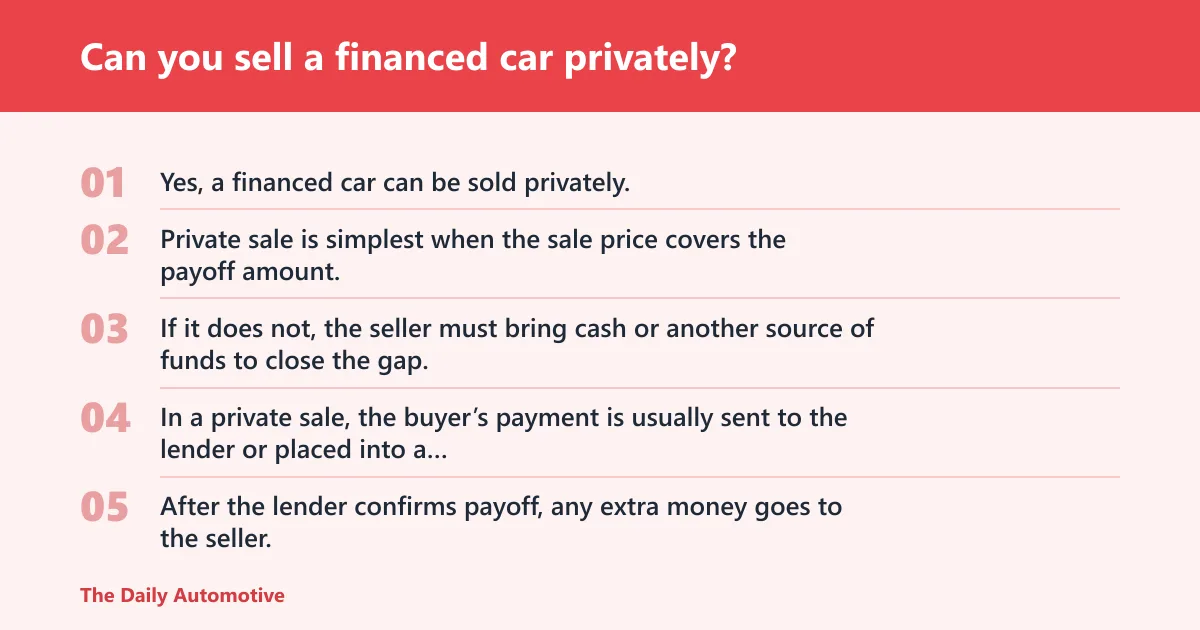
Yes, a financed car can be sold privately, but the lender has to be paid in full before the title is cleanly released. Private sale is simplest when the sale price covers the payoff amount. If it does not, the seller must bring cash or another source of funds to close the gap.
How the buyer’s money goes to the lender
In a private sale, the buyer’s payment is usually sent to the lender or placed into a closing process that satisfies the loan first. After the lender confirms payoff, any extra money goes to the seller. That sequence protects the buyer from paying for a car with an unreleased lien.
What to do if the sale price does not cover the payoff
If the sale price falls short, the deal cannot be treated as complete unless the shortfall is covered. You can pay the difference in cash, use a personal loan, or negotiate a different sale structure. Without that, the lien remains and the lender can still pursue the remaining loan balance.
Documents to confirm before handing over the car
Get the payoff quote, buyer’s full legal name, bill of sale, lien release instructions, and a record of how funds will be transmitted. If the lender uses electronic title release, confirm the timing in writing. A common first-timer mistake is giving away the car before the payoff clears.
Should you refinance before transferring a financed car?
Refinancing can make sense if you need a lower payment, want a new borrower on the loan, or need to replace the old loan before transfer. Refinancing creates a new loan agreement, and the new loan pays off the previous loan. It does not automatically fix negative equity.
How refinancing changes the loan and the lien
Once the new loan funds, the old loan is paid off and the lien moves with the new lender. That can lower the monthly payment if the interest rate drops. Some lenders restrict auto loan refinancing by balance, mileage, or age, so approval is not guaranteed.
When a lower rate or lower payment makes sense
Refinancing helps most when the new rate is meaningfully lower, the payment needs to drop, or the current loan needs to be moved into a different name. If the borrower is current and the car has enough value, refinancing may be a cleaner exit than selling under pressure.
Why bad credit can limit refinancing options
Credit impact matters before renegotiation. Missed payments may be reported unless the lender agrees otherwise, and damaged credit can make refinancing harder or more expensive. If the credit file is already weakened, lenders may ask for stronger income, lower mileage, or a more conservative loan amount.
What happens if the car is worth less than what I owe?
That means negative equity, or an upside-down car loan. The car’s value does not cover the payoff amount, so a transfer or sale only works if someone covers the gap. In a private sale, that is usually the seller. In a trade-in, the dealer may absorb or roll it into the next loan.
Who pays the shortfall in a sale or transfer
Unless the sale contract says otherwise, the borrower is usually responsible for the shortfall. A buyer is not required to pay more than the agreed sale price. If the lender is not paid in full, the lien stays in place and the title does not move cleanly.
When to use extra principal payments to narrow the gap
Extra principal payments can reduce the loan balance faster, may shorten the loan term, and may reduce total interest paid. That helps narrow negative equity over time. Paying extra each month goes directly toward principal, which can move the loan toward break-even sooner.
Suppose the payoff is $20,000 and the car is worth $17,500. A $2,500 gap does not disappear at sale time. If the borrower adds extra principal payments over several months, the balance can move closer to the car’s value before listing or trading.
Lender-first decision checklist

Use this checklist before you sell, trade, or transfer the vehicle. It keeps the sequence straight: confirm equity, request the payoff, match the transfer path to the lender’s rules, and decide who covers any gap before the car changes hands.
- Request the payoff amount directly from the lender.
- Compare it with the car’s current sale value.
- Classify the situation as positive equity, break-even, or negative equity.
- Ask for lien release timing and payoff delivery instructions.
- Choose the path: private sale, dealer trade-in, refinance, or another plan.
- Confirm who pays any shortfall before funds move.
- Keep proof of payment and lien release until the title is clear.
Scenario 1: positive equity
Request the payoff quote, a lien release timeline, and the exact payment method the lender accepts. The safest next step is a private sale or trade-in where the proceeds pay the lender in full and the remaining funds go to you.
Scenario 2: break-even
Request the same payoff paperwork, then lock down the closing date before the quote expires. The safest next step is to coordinate payment so the lender receives the exact payoff amount and releases the lien without leaving a balance behind.
Scenario 3: negative equity
Request the payoff quote and a written estimate of the gap. The safest next step is to decide who covers the shortfall before the vehicle leaves your control, whether that is cash, a personal loan, or a different strategy such as refinancing or waiting for more equity.
Failure cases: payoff delays, dealer processing, and private buyer paperwork
If a lender processes slowly, the title may not release on the day of sale. If a dealer sends the wrong payoff amount, the remaining balance can stay open. If a private buyer pays before paperwork is complete, the seller can end up with neither the car nor a clean title. Do not hand over keys until the payoff path is confirmed.
What are your options if you cannot afford the payment?
If you cannot keep up with the payment, contact the lender before you miss more time. Lender hardship options may include a temporary pause on payments or renegotiated terms, and they often require you to explain the hardship. If you can still pay something extra, use it to reduce principal and pressure on the balance.
Lender hardship options and how to ask for them
Ask the lender whether it offers temporary payment relief, modified terms, or another hardship plan. Be ready to explain the reason, the timeline, and what you can realistically afford. Missed payments may be reported unless the lender agrees to a different arrangement in writing.
Extra principal payments if you can still stay current
If the loan is still manageable, extra principal payments can help you get ahead of the balance. That can shorten the term and reduce total interest paid. It also helps if you need to refinance later, because a smaller balance can improve your options.
Voluntary repossession as a last resort
Voluntary repossession should be the last resort when payments are no longer sustainable. It can have major credit consequences, and the lender may still pursue a remaining deficiency balance. If you can avoid it through sale, refinance, or hardship terms, that is usually the safer path.
Frequently asked questions
Can you transfer a financed car to someone else?
Usually not by simple handoff. A financed car still has a lender lien attached, so a real transfer normally needs lender approval, a refinance, a formal loan assumption, or a sale that pays off the loan. If the lender is not involved, the original borrower can stay liable.
How do I get the payoff amount for my car loan?
Ask the lender directly for a payoff quote, not just the online balance. The payoff amount is the exact figure needed to clear the lien, and it can differ from the remaining balance because of interest and timing. Also ask when the quote expires and how to send payment.
What happens if the car is worth less than what I owe?
That is negative equity, also called an upside-down car loan. If you sell or transfer the vehicle, someone has to cover the gap between the sale price and the payoff amount. That person is often the seller, unless a dealer or new lender agrees to another structure.
Can I sell a financed car privately?
Yes, but the lender must be paid in full before the title is cleanly released. Private sale works best when the sale price covers the payoff amount. If it does not, you need cash or another source to cover the shortfall before the buyer takes the car.
Should I refinance before transferring a financed car?
Refinancing can help if the goal is to lower the payment, remove a borrower, or replace the old loan with a new one. It is not automatic, though. Some lenders restrict refinancing by balance, mileage, or age, and damaged credit can make approval harder or more expensive.
Can I pay off a car loan early without penalties?
Many auto loans allow early payoff, but you should verify your contract before sending extra money. Ask whether any prepayment penalty applies and whether extra principal payments are credited immediately. Paying extra each month can reduce principal faster, shorten the term, and lower total interest paid.
Products related to this article
Sponsored / affiliate links. As an Amazon Associate I earn from qualifying purchases. I may earn additional commission from eligible campaigns.