Why Is The Brake Light On In My Car? Top Reasons
Seeing that red brake light pop up on your dashboard can be a bit startling, especially if you’re new to cars. It’s one of those warnings that feels important, and you want to know what’s going on right away. The good news is that figuring out Why Is the Brake Light On in My Car?
Top Reasons doesn’t have to be a big mystery. We’re going to break it down simply so you can understand what might be happening and what to do next.
Understanding Your Car’s Brake Light Warning
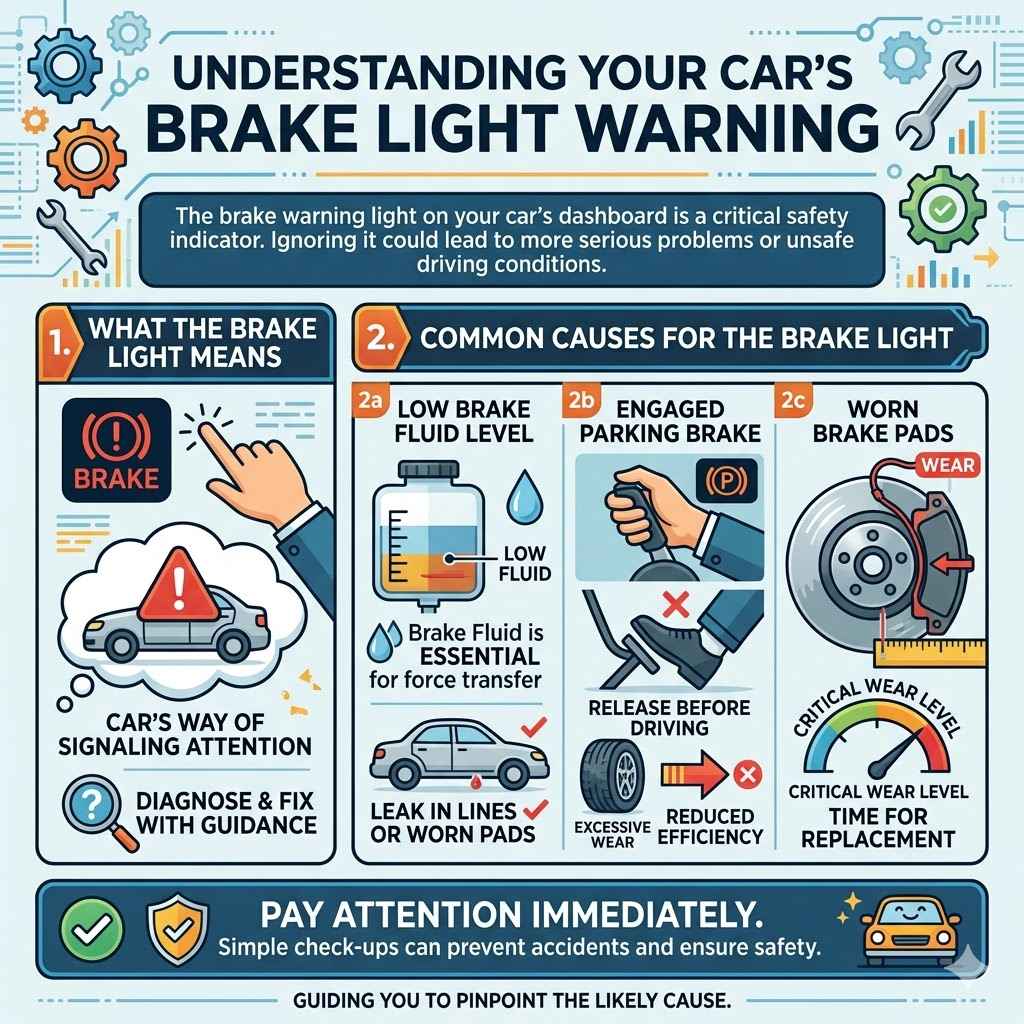
The brake warning light on your car’s dashboard is a critical safety indicator. It’s designed to alert you to potential issues with your braking system or other related components. While it can sometimes be a simple fix, it’s always best to pay attention to it immediately.
Ignoring this light could lead to more serious problems or unsafe driving conditions. This section will explore the common reasons behind this warning light, helping you pinpoint the likely cause.
What the Brake Light Means
The brake light, often a circle with an exclamation mark inside or the letters “BRAKE,” is a signal from your car’s computer that something needs your attention regarding your brakes. It’s not always an immediate emergency, but it’s never a sign to ignore. It could mean a variety of things, from a low fluid level to a more significant mechanical issue.
Understanding its purpose is the first step in addressing it correctly.
Think of it as your car’s way of whispering, and sometimes shouting, that it needs a quick check-up. While you might panic, most of the time, it’s an issue you can diagnose and potentially fix with a bit of guidance. We’ll go through the most frequent culprits so you can get a clear picture.
Common Causes for the Brake Light
Several factors can trigger the brake light. The most frequent causes include low brake fluid, an engaged parking brake, worn brake pads, or issues with the anti-lock braking system (ABS). Each of these conditions has specific implications for your car’s safety and performance.
Low Brake Fluid Level: This is one of the most common reasons the brake light illuminates. Brake fluid is essential for transferring the force from your foot on the pedal to the brakes themselves. If the fluid level drops too low, it can indicate a leak in the brake lines or that your brake pads are significantly worn, using up more fluid.
Engaged Parking Brake: Sometimes, the brake light is simply letting you know that your parking brake is still on. This is usually a straightforward oversight, but it’s important to release it before driving. Driving with the parking brake engaged can cause excessive wear and tear on your braking components and reduce your car’s efficiency.
Worn Brake Pads: As brake pads wear down over time, they get thinner. Many cars have sensors that detect when the brake pads have reached a critical wear level. When this happens, the brake light may come on to alert you that it’s time for replacement.
These are the primary reasons you might see the brake light. Let’s explore each of these in more detail to help you understand the specific signs and what to look for.
Troubleshooting the Brake Light Warning Indicator
When your brake light comes on, it’s time to do some detective work. This section focuses on how to investigate the common causes we just discussed. We’ll guide you through simple checks you can perform yourself, and when it’s time to seek professional help.
Checking Your Brake Fluid Level
The brake fluid reservoir is usually a translucent plastic container located under the hood of your car, often near the driver’s side firewall. It typically has “MIN” and “MAX” markings on its side. To check the fluid, ensure your car is on a level surface and the engine is off and cool.
Open the hood and locate the reservoir.
If the fluid level is below the MIN line, this is likely the cause of your illuminated brake light. However, if the level is low, it’s crucial to also look for signs of leaks. Check the brake lines, hoses, and around the wheels for any reddish or brownish fluid.
A significant drop without obvious leaks could mean worn brake pads are pulling the caliper pistons out further, or there might be a more serious leak in the system.
Technical Term: Brake Fluid
Brake fluid is a hydraulic fluid used in brake systems to convert force into pressure. When you press the brake pedal, you are pushing a piston into the master cylinder, which forces the brake fluid through the brake lines. This fluid pressure then activates the brake calipers at the wheels, squeezing the brake pads against the rotors to slow or stop the vehicle.
Brake fluid is designed to be incompressible, meaning it doesn’t compress under pressure, which allows for efficient force transfer. It also has a high boiling point to prevent it from boiling and creating vapor bubbles under the heat generated by braking. Regular checks and
Scenario: The Fluid Is Low
Imagine you check your brake fluid and see it’s well below the minimum mark. You don’t see any obvious puddles under your car. What should you do?
- First, carefully add the correct type of brake fluid to the MAX line. The type of fluid needed is usually specified in your car’s owner’s manual.
- Then, drive your car cautiously and see if the brake light goes off. If it does and stays off, it might have been a temporary low due to pad wear, and you should still have your brakes inspected soon.
- If the light stays on or comes back soon, or if you notice any sponginess in the brake pedal, this indicates a leak, and you must have your car inspected by a mechanic immediately.
Verifying the Parking Brake
The parking brake, also known as the handbrake or emergency brake, is a secondary braking system. It’s often a lever between the front seats or a pedal to the left of the driver’s footrest. In many modern cars, it’s an electronic button or switch, typically located on the center console.
When you engage the parking brake, a separate set of cables or an electronic actuator applies the brakes to the rear wheels. The brake warning light will illuminate to let you know it’s active. The simplest solution here is to ensure the parking brake is fully disengaged.
You might hear a click or feel resistance release as you lower the lever or press the button.
Sometimes, the parking brake mechanism can become stuck or not fully release. If you disengage it completely and the light remains on, there might be an issue with the switch that detects its position or a problem with the brake cables themselves. This would require a mechanic’s attention.
Sample Scenario: The Parking Brake Light Stays On
You’ve driven for a few miles and realize the brake warning light is still on. You pull over, double-check, and are absolutely sure the parking brake lever is all the way down. What’s the next step?
- Confirm that there isn’t any debris caught in the parking brake mechanism preventing it from fully disengaging.
- Check your car’s owner’s manual to see if there’s a specific procedure for resetting the parking brake system or if there’s a separate parking brake warning light.
- If the light persists, it’s wise to have the parking brake system and its associated sensors checked by a professional.
Inspecting Brake Pads and Rotors
Worn brake pads are a very common reason for the brake light. As pads wear down, they become thinner, and the brake fluid level might drop slightly. More importantly, many brake systems have a wear indicator.
This is a small metal tab attached to the brake pad that squeals against the rotor when the pad is nearing its end of life. Some systems also have an electronic sensor.
If your car has an electronic wear sensor, it will send a signal to the car’s computer, triggering the brake warning light. This is a proactive warning, giving you time to schedule a replacement before the pads are completely gone, which could damage the rotors.
Technical Term: Brake Pads
Brake pads are the friction material that presses against the brake rotors to slow down your vehicle. They are part of the braking system, located within the brake caliper. When you apply the brakes, the caliper squeezes the pads onto the rotating rotor.
This friction converts the kinetic energy of the moving vehicle into heat energy, thus slowing the car. Brake pads are designed to wear down over time because they are made of softer materials than the rotors to protect the rotors from premature wear. The lifespan of brake pads varies greatly depending on driving habits, the type of pads, and the vehicle, but typically range from 25,000 to 70,000 miles.
Regular inspection of brake pads is crucial for maintaining safe braking performance.
Technical Term: Brake Rotors
Brake rotors, also known as brake discs, are the flat, circular metal plates that spin with your car’s wheels. The brake pads clamp onto these rotors to create friction and slow the vehicle. They are typically made of cast iron or sometimes advanced composites for performance vehicles.
Rotors are exposed to significant heat and pressure during braking. Over time, they can develop grooves, become warped, or wear thin, which can affect braking performance and lead to vibrations. If brake pads are not
Signs of Worn Brake Pads
- A persistent squealing or grinding noise when you brake.
- A vibrating or pulsing sensation in the brake pedal.
- A longer stopping distance than usual.
- The brake light illuminating on your dashboard.
If you notice any of these signs along with the brake light, it’s a strong indication that your brake pads need immediate attention.
Anti-Lock Braking System (ABS) Issues
Your car is likely equipped with an Anti-Lock Braking System (ABS). This system prevents your wheels from locking up during hard braking, allowing you to maintain steering control. The ABS has its own warning light, which is often a circle with “ABS” inside.
However, sometimes, a problem within the ABS can also trigger the general brake warning light.
How ABS Works
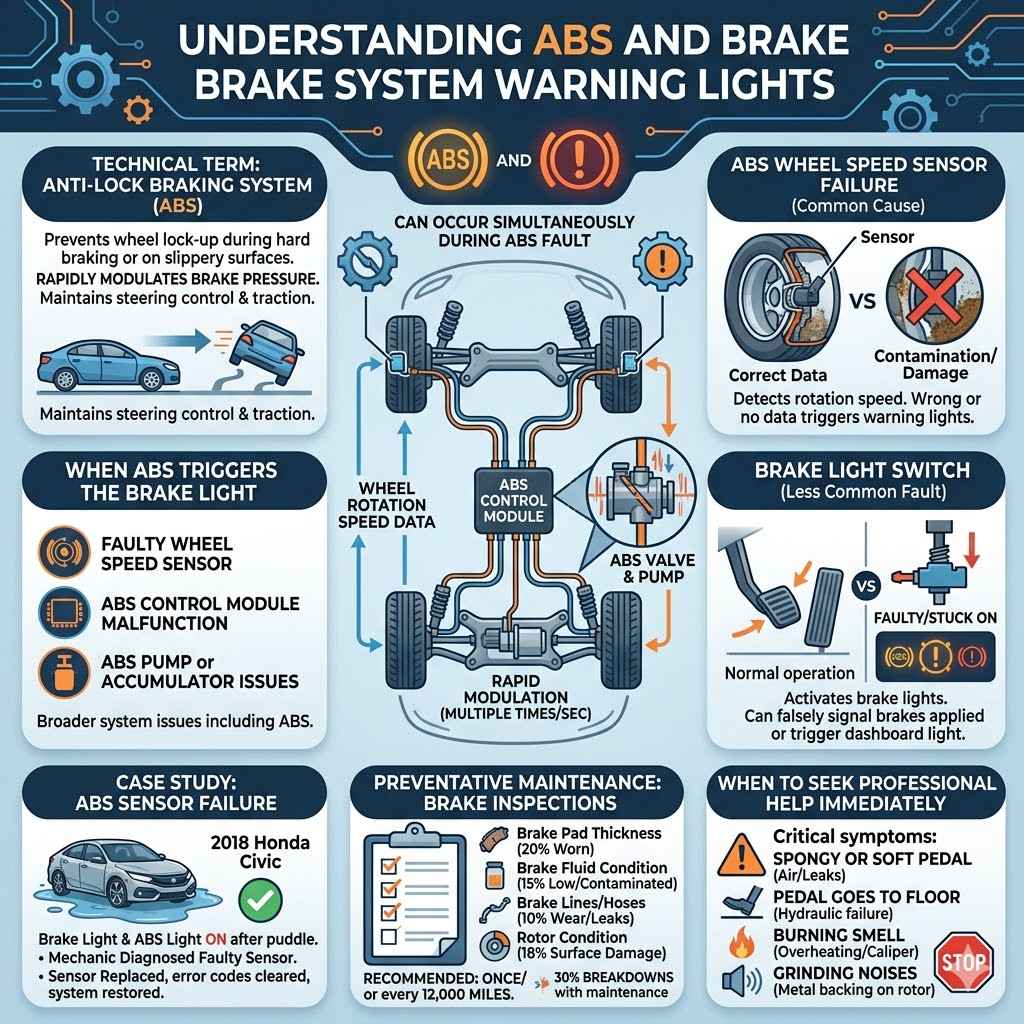
The ABS works by using sensors on each wheel to monitor their rotation speed. During braking, if a wheel starts to rotate significantly slower than the others, indicating it’s about to lock up, the ABS module rapidly pulses the brake pressure to that wheel. This pulsing action prevents the wheel from locking and skidding, allowing the driver to steer around obstacles.
Technical Term: Anti-Lock Braking System (ABS)
The Anti-Lock Braking System (ABS) is a safety feature that prevents the wheels from locking up during hard braking or on slippery surfaces. It operates using sensors at each wheel that detect if a wheel is about to stop rotating while the vehicle is still moving. If a lock-up is imminent, the ABS control module rapidly modulates the brake pressure to that wheel, releasing and reapplying it multiple times per second.
This allows the wheel to continue rotating, maintaining traction and enabling the driver to steer the vehicle while braking. The ABS significantly improves vehicle control and reduces stopping distances on many surfaces, especially when compared to locked wheels which tend to skid.
Technical Term: ABS Wheel Speed Sensor
An ABS wheel speed sensor is a crucial component of the Anti-Lock Braking System. It is typically located near the wheel hub and is responsible for detecting the rotational speed of the wheel. These sensors send this data to the ABS control module, which uses the information to determine if a wheel is about to lock up.
If a sensor fails or becomes contaminated with road debris or rust, it can send incorrect information or no information at all to the control module. This can lead to the ABS warning light illuminating, or in some cases, it might cause the main brake warning light to come on as a general fault indicator for the braking system.
When ABS Triggers the Brake Light
While the ABS has its own warning light, some vehicle systems are designed so that a fault within the ABS module or its sensors can also illuminate the general brake warning light. This indicates a broader issue within the braking system that includes the ABS. Common ABS-related causes for the brake light include faulty wheel speed sensors, a malfunctioning ABS control module, or issues with the ABS pump or accumulator.
If both the brake warning light and the ABS warning light are illuminated, it strongly suggests an issue with the ABS system. In such cases, it is essential to have the vehicle inspected by a qualified technician. They have specialized diagnostic tools to read error codes from the ABS module and pinpoint the exact component causing the problem.
Case Study: ABS Sensor Failure
A 2018 Honda Civic owner noticed their brake light and ABS light illuminated simultaneously after driving through a large puddle. The car still braked, but the owner felt less confident in its stopping ability. A mechanic diagnosed a faulty front-left ABS wheel speed sensor.
After replacing the sensor and clearing the error codes, both warning lights turned off, and the braking system returned to normal operation, restoring the owner’s confidence in the vehicle’s safety features.
Other Less Common Causes
While less frequent, other issues can trigger the brake light. These can include problems with the brake light switch itself, which might be stuck in the ‘on’ position, or issues with the vehicle’s hydraulic system beyond just the fluid level. In rare cases, a malfunctioning brake master cylinder could also be the culprit.
Technical Term: Brake Light Switch
The brake light switch is a simple electrical switch that activates your car’s brake lights when you press the brake pedal. It is typically located near the brake pedal arm. When you press the pedal, it compresses a plunger on the switch, closing the electrical circuit and turning on the brake lights.
If this switch malfunctions or gets stuck in the “activated” position, it can falsely signal that the brakes are being applied, or in some vehicle systems, it can trigger the brake warning light on the dashboard. Conversely, if the switch fails completely, your brake lights won’t illuminate when you press the pedal, which is a safety hazard.
Real-Life Example: Faulty Brake Light Switch
A driver noticed that their brake lights were always on, even when the car was parked and the brake pedal was not pressed. This caused concern for other drivers behind them. Upon inspection, it was found that the brake light switch had become dislodged and was continually activating the brake lights.
Replacing the switch resolved the issue, and the brake warning light on the dashboard also turned off.
When to Seek Professional Help
While some brake light issues can be addressed by a vehicle owner, many require the expertise of a professional mechanic. Knowing when to hand over the reins is crucial for your safety and the longevity of your vehicle.
Recognizing Serious Brake System Problems
If you experience any of the following, it’s imperative to stop driving and have your car towed to a repair shop immediately. These symptoms suggest a serious brake system failure that could compromise your ability to stop safely.
- Spongy or Soft Brake Pedal: This indicates air in the brake lines or a significant leak. Your brakes may not work effectively.
- Brake Pedal Goes to the Floor: This is a critical failure. It means your braking system has lost hydraulic pressure, and your car may not stop at all.
- Burning Smell: A strong burning smell, especially when braking, can indicate overheating brakes, seized calipers, or fluid leaks.
- Grinding Noises: While sometimes associated with worn pads, a loud, metallic grinding noise can mean the pads are completely gone, and the metal backing is grinding on the rotor, causing severe damage.
The Importance of Regular Brake Inspections
Preventative maintenance is key to avoiding most brake-related issues. Many manufacturers recommend a brake inspection at least once a year or every 12,000 miles. These inspections allow technicians to identify potential problems before they become serious and trigger warning lights.
During a brake inspection, a mechanic will check:
- Brake Pad Thickness: Ensuring they have plenty of life left.
- Brake Fluid Level and Condition: Checking for contamination and topping up if needed.
- Brake Lines and Hoses: Looking for any signs of leaks or damage.
- Rotor Condition: Checking for wear, warping, or damage.
- Parking Brake Function: Ensuring it engages and disengages properly.
- ABS System Components: Running diagnostics to check sensors and modules.
Statistics show that routine maintenance can prevent many roadside breakdowns. For example, a survey by AAA found that over 30% of vehicle breakdowns are preventable with regular maintenance, and braking system issues are a significant contributor.
Statistics on Brake Maintenance
| Area Checked | Common Issues Found During Inspection | Approximate Percentage of Vehicles Affected |
|---|---|---|
| Brake Pads | Worn below minimum thickness | 20% |
| Brake Fluid | Low level or contaminated | 15% |
| Brake Lines/Hoses | Signs of wear or minor leaks | 10% |
| Rotors | Surface damage or light wear | 18% |
These numbers highlight that brake issues are quite common, making regular checks highly valuable.
Frequently Asked Questions
Question: Can I drive with the brake light on?
Answer: It depends on the cause. If it’s just the parking brake not fully released, you can drive cautiously after disengaging it. However, if the light is on for other reasons, especially if you notice any change in braking performance (like a soft pedal), it’s safer not to drive and to have it checked immediately.
Question: How much does it cost to fix the brake light issue?
Answer: The cost varies greatly. A simple fix like topping up brake fluid might be minimal. Replacing brake pads can range from $200 to $400 per axle.
More complex issues with ABS sensors or modules can cost anywhere from $300 to $800 or more, depending on the car and the part.
Question: How often should I check my brake fluid?
Answer: It’s a good idea to check your brake fluid level every few months as part of your routine car checks. You can usually do this visually through the translucent reservoir under the hood.
Question: Will my car fail inspection if the brake light is on?
Answer: Yes, in most places, a persistently illuminated brake warning light would cause your car to fail a safety inspection. It indicates a potential safety issue that needs to be resolved.
Question: Is it safe to add brake fluid if I don’t know the type?
Answer: No, it’s not safe to guess the type of brake fluid. Using the wrong type can damage your brake system. Always check your car’s owner’s manual for the correct DOT (Department of Transportation) classification, such as DOT 3, DOT 4, or DOT 5.
Conclusion
Seeing the brake light on your car’s dashboard means it’s time for a check. Most often, it’s low brake fluid or the parking brake. Worn brake pads or ABS issues are also common.
Simple checks can help you identify the problem. If you suspect a serious issue or aren’t comfortable doing the checks, get it to a mechanic right away. Your safety and your car’s health depend on it.