
Why You Shouldn’t Date a Caribbean Man: Myths Exposed
You should not avoid a Caribbean man by default; the rule is simpler: judge the person in front of you, not the passport in his pocket. Walk away when behavior, not origin, gives you a reason. Bad advice turns culture into a punchline and real compatibility into static. This guide sorts lazy dating myths from actual red flags, so you can separate a cheap joke from a real warning sign.
Why this joke works and where it stops being funny
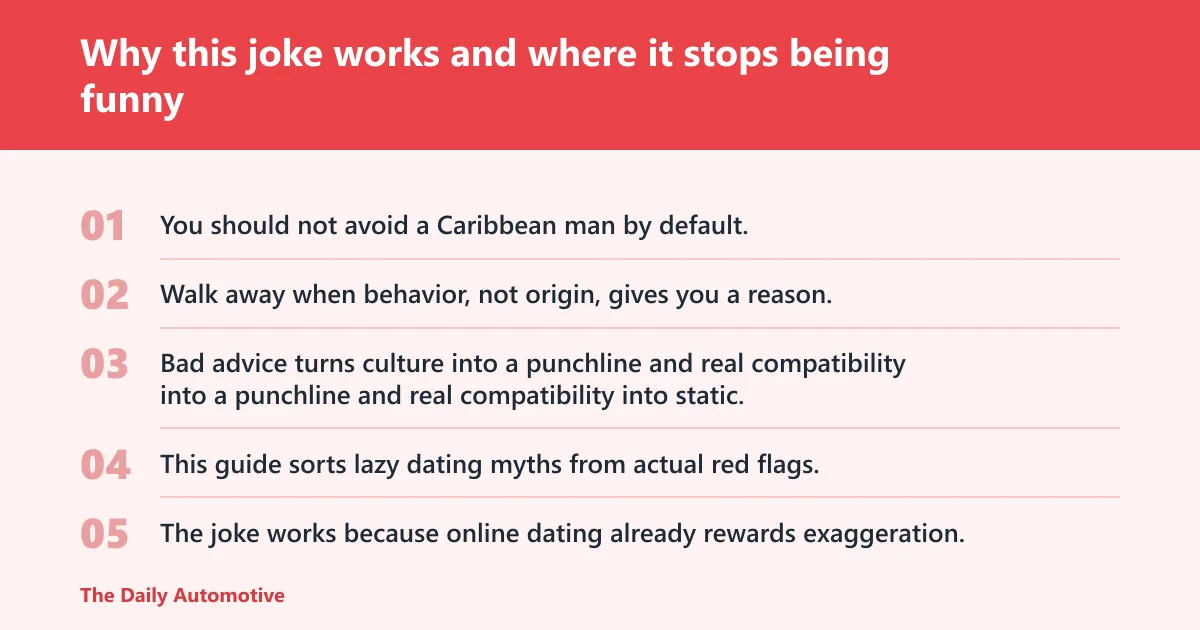
The joke works because online dating already rewards exaggeration. A humorous Tinder match can turn into a cartoon of red flags: he has climbed Everest twice, does not clean up after himself, carries a lot of baggage, is obsessed with being on top, spends money on impulse purchases, has terrible tan lines, and acts like he is used to long lines in bad weather. That is satire about behavior, not evidence about a region.
The line is simple. A stereotype says “all Caribbean men are like this.” A pattern says “this person keeps showing the same behavior again and again.” A red flag says “this behavior threatens respect, safety, or trust.” Only the last one belongs in dating advice.
What does “Caribbean man” even mean?
It means very different things depending on the person. Caribbean identity can include nationality, ethnicity, language, religion, migration history, or diaspora life, and those layers do not fit neatly into one dating script. A man from one Caribbean place may share a region with others, but not a single social code.
That difference matters because Caribbean culture is multi-ethnic, shaped by colonial history, migration, music, food, hospitality traditions, and family-centered values. Some communities are English-speaking, while others use Spanish, French, Dutch, or Creole. Religious influences can also vary widely, from Christian traditions to Hindu, Muslim, Rastafarian, and mixed spiritual practice.
How Caribbean culture actually shapes dating
Dating norms often reflect family expectations, community visibility, and the local idea of what counts as respectful courtship. In some places, a partner may meet family early; in others, privacy matters more. Public affection can be normal in one setting and read as disrespectful in another. Class background, island size, and diaspora experience can change all of it.
Music and social life matter too. Caribbean dating can be more social, more group-based, or more event-driven than an outsider expects. Food and hospitality traditions may also shape the pace of a relationship. A person who insists on hosting, feeding, or checking in through family channels may be following culture, not controlling behavior.
What are the stereotypes about Caribbean men in dating?

The stereotype problem starts when people treat Caribbean men as one personality type. That is lazy and usually inaccurate. Some jokes land because they target a behavior, like being flaky, cheap, dramatic, or chronically late. Others fail because they recycle assumptions about masculinity, race, nationality, or immigration status.
Humor gets safer when it mocks recognizable dating habits instead of identity. A joke about a guy who says “I’m spiritual” but texts like a ghost is fair game. A joke that treats an entire region as cheating, loud, controlling, or unavailable is not comedy; it is prejudice wearing a smirk.
Streotypes versus the real question to ask
| Stereotype | Why it is too broad | The real dating question to ask instead |
|---|---|---|
| “Caribbean men are all overly flirtatious.” | Flirting style varies by island, class, religion, and personality. | Does he respect boundaries once interest is clear? |
| “He will want family involved in everything.” | Some families are highly involved; others are private or distant. | How quickly does he expect family introductions, and why? |
| “He is automatically macho.” | Gender roles differ across home countries and diaspora communities. | Does he share decisions, or does he demand control? |
| “He does not do serious commitment.” | Commitment style depends on maturity, not passport. | Is he consistent, clear, and willing to define the relationship? |
| “He will hide things from you.” | Secrecy is a personal trait, not a regional trait. | Does his story match his actions, schedule, and availability? |
| “He is always loud and dramatic.” | Some people are quiet, reserved, or formal in private settings. | Can he communicate without turning every disagreement into theater? |
| “He will expect traditional gender roles.” | Views on work, care, and domestic labor differ across households. | How does he split chores, money, and emotional labor? |
| “He is bad with money.” | Financial habits depend on income, values, and discipline. | Does he budget, save, and avoid hiding debts or impulse spending? |
| “Long-distance with him will be impossible.” | Some diaspora relationships are stable; others fail for ordinary reasons. | Can he communicate across time zones and follow through reliably? |
| “Faith will always control the relationship.” | Religious influence varies from very strong to barely present. | Are your values on sex, marriage, and family actually compatible? |
What are the real red flags when dating a Caribbean man?
The real red flags are the same ones that sink any relationship: control, disrespect, weak communication, financial irresponsibility, and shaky consent. If a man uses culture to excuse jealousy, secrecy, or pressure, the problem is not Caribbean identity. The problem is a partner who wants immunity from accountability.
Watch for inconsistency first. If he says one thing and does another, keeps changing the story, or disappears after making plans, that is not “island energy.” It is unreliability. Also watch for a person who makes everything about dominance, whether that means sex, money, decisions, or who gets the last word.
Three practical red-flag checks
- Ask whether he respects a clear no without sulking, pressure, or punishment.
- Notice whether money talk stays honest, including debt, spending, and shared plans.
- Check whether disagreements stay specific, or turn into blame, intimidation, and control.
Say a match keeps pressing to know your location, your passwords, and your outfit choices early on. That is not cultural curiosity. Suppose another person is warm in public but evasive about a hidden partner, a child, or a separate household. That is not mysterious either; it is a commitment problem.
Is dating a Caribbean man different from dating anyone else?
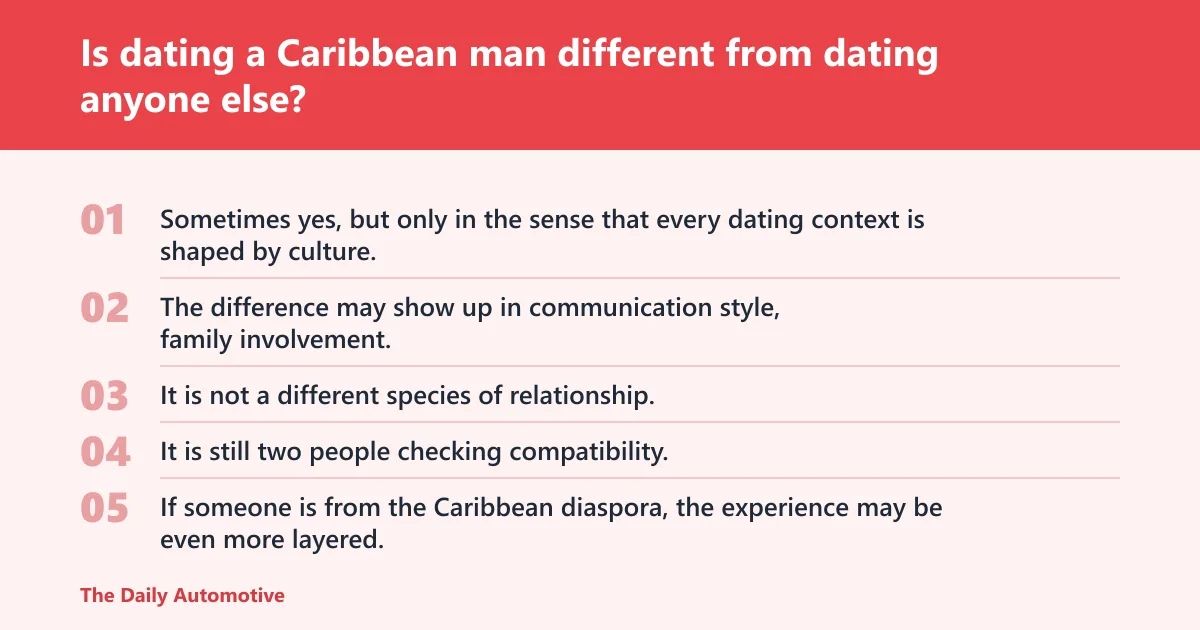
Sometimes yes, but only in the sense that every dating context is shaped by culture. The difference may show up in communication style, family involvement, religious expectations, or how much public affection feels appropriate. It is not a different species of relationship. It is still two people checking compatibility.
If someone is from the Caribbean diaspora, the experience may be even more layered. A man raised in Toronto, London, Miami, or New York may mix Caribbean family expectations with local dating norms. That can mean broader cultural fluency, or it can mean mixed signals if he uses one identity at home and another in public.
What to know before you date someone from the Caribbean
Start with questions, not assumptions. Ask how he defines family involvement, how he handles conflict, what religious or cultural practices matter to him, and what kind of affection feels normal. Then listen for specifics. Vague answers usually mean vague expectations.
Also pay attention to how he talks about women, exes, and relatives. If the language is dismissive, controlling, or loaded with resentment, that matters more than his accent, island, or cuisine preferences. Respect is not hidden in a playlist. It shows up in daily conduct.
What are the common relationship expectations in Caribbean culture?
Common expectations often include strong family ties, visible respect, and some degree of courtship formality, but none of that is universal. In many Caribbean communities, the relationship may be judged by how well it fits family values, religion, and social standing. That can be supportive, or it can become pressure if nobody names the limits.
Public versus private affection can also vary. Some people are comfortable with hand-holding and open affection. Others prefer discretion until trust is established. Gender roles can be more traditional in some households and far more flexible in others, so assuming one script can create avoidable conflict.
How to tell tradition from a problem
Tradition sounds like “my family is involved, and here is why.” A problem sounds like “you must do what I say, and disagreement is disrespect.” Tradition leaves room for negotiation. A problem demands obedience.
That same test applies to religion. A partner may want prayer, church attendance, fasting, or modesty norms. Those are compatibility questions. They become red flags only when they are used to shame, isolate, or control you.
How do you write a funny dating article without being offensive?
Write upward at the bad behavior, not sideways at nationality. The cleanest satire mocks the dating app lie, the lazy excuse, the inflated ego, the ghosting, and the red-flag parade. It does not turn a region into a shortcut for punchlines, and it does not confuse cultural difference with moral failure.
Specificity matters. “He texts at 2 a.m. and calls it romance” is a joke about bad timing. “Caribbean men are all like this” is lazy, because it erases language, religion, class, island differences, and diaspora identity in one swipe.
Keep the satire honest
Use self-aware wording that leaves room for exception. Make the joke about a behavior a reader can recognize, not about someone’s origin. Keep the tone light, but do not blur the line between playful and cruel.
A common first-timer mistake is aiming at the loudest stereotype in the room. That is the easiest target and the weakest writing. Better satire sounds like a person calling out bad dating logic while leaving human variation intact.
What are the pros and cons of dating a Caribbean man?
The pros can include strong family values, expressive communication, warmth, social confidence, and a clear sense of identity. The cons appear when those same traits are mixed with rigidity, family pressure, mismatched expectations, or an unwillingness to treat you as an equal. The person matters more than the label.
If the relationship is cross-cultural or long-distance, clarity matters even more. Differences in religion, money habits, affection style, and public behavior can either deepen the relationship or expose incompatibility fast. The upside is real. So is the need for honest screening.
Frequently asked questions
Why shouldn’t you date a Caribbean man?
You should not avoid a Caribbean man as a category. The useful question is whether the specific person is respectful, honest, and emotionally available. Treating nationality as a warning sign turns culture into a joke and can hide the real issues: control, inconsistency, disrespect, or weak consent boundaries.
What are the red flags when dating a Caribbean man?
The red flags are ordinary but serious: possessiveness, manipulation, poor communication, hidden commitments, money problems, and pressure around sex or attention. None of those belong to Caribbean identity. If someone blames culture for bad behavior, that excuse deserves even more scrutiny, not less.
Is dating a Caribbean man different from dating anyone else?
It can be, because family expectations, religion, language, and public affection norms may differ from what you are used to. But the core relationship questions are still the same: respect, consistency, shared values, and consent. Culture changes the style. It does not replace the need for compatibility.
What should I know before dating someone from the Caribbean?
You should know that Caribbean identity is not one thing. Island, mainland, and diaspora backgrounds can shape communication, courtship, family involvement, and gender expectations in very different ways. Ask direct questions early, especially about religion, privacy, family roles, and long-distance habits.
What are the stereotypes about Caribbean men in dating?
Common stereotypes portray Caribbean men as flirtatious, controlling, dramatic, or commitment-averse. Those claims are too broad to guide real dating decisions. A better filter is behavior: does he communicate clearly, respect boundaries, and handle conflict like an adult, or does he lean on stereotypes to dodge accountability?
How do you write a funny dating article without being offensive?
Make the joke about the dating behavior, not the ethnicity or nationality. Aim at dishonesty, ego, ghosting, and immaturity. Keep the wording specific enough to be recognizable, but broad enough to leave room for individual difference. Comedy works best when it punctures bad habits, not whole communities.
Products related to this article
Sponsored / affiliate links. As an Amazon Associate I earn from qualifying purchases. I may earn additional commission from eligible campaigns.