
Finding Meaning: Definition, Uses, and Examples
“Finding” usually means one discovery, one decision, or the act of locating something; “findings” is the plural noun for multiple results, and context decides which sense fits. Using the wrong form can blur a repair estimate, a research summary, or a legal conclusion, which costs time and credibility. This guide breaks down everyday, academic, and legal usage so you can choose the right form fast.
What does finding mean?
“Finding” commonly means something discovered or determined. It can also name the act of researching, checking, or locating something. In speech and writing, the surrounding sentence usually tells you whether the word points to a result, a process, or a legal decision.
Pronunciation and first-use example
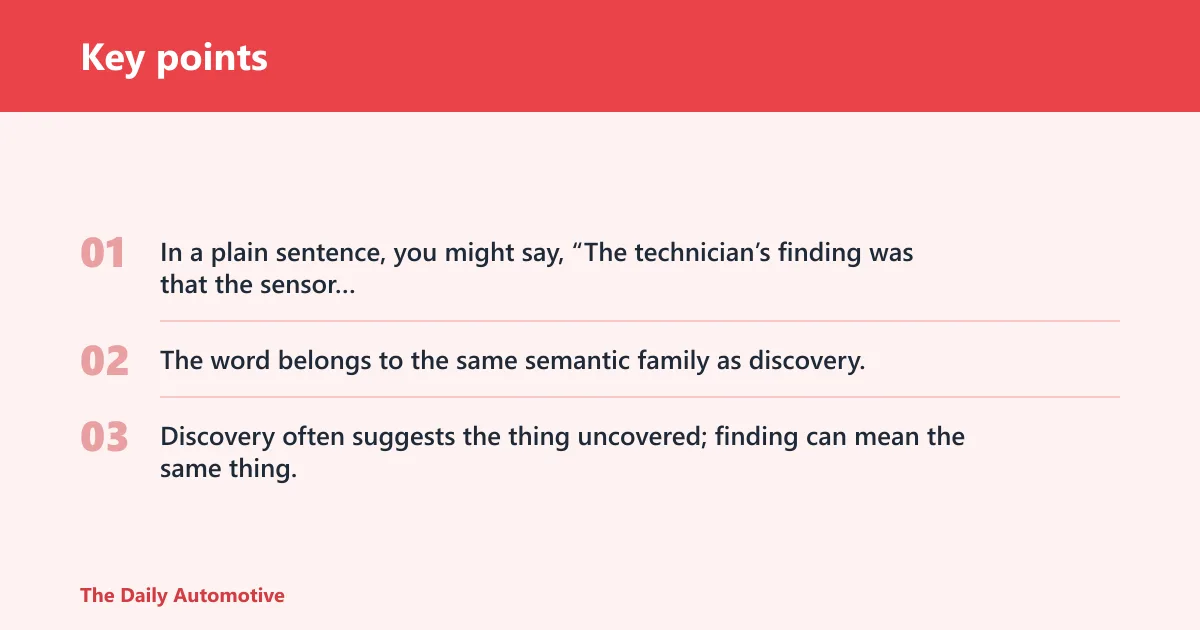
The pronunciation is /ˈfaɪndɪŋ/. In a plain sentence, you might say, “The technician’s finding was that the sensor failed.” Here, the word means the result of a check, not the act of searching.
The word belongs to the same semantic family as discovery, but it is narrower in some settings. Discovery often suggests the thing uncovered; finding can mean the same thing, or the conclusion reached after review, calculation, or inquiry.
Finding meaning table
This table shows how the same word shifts by context. Read the sentence context first, then match it to the correct sense and number.
| Sentence context | Correct sense of “finding/findings” | Singular, plural, or legal usage |
|---|---|---|
| “The inspector’s finding was a clogged filter.” | One discovered result or conclusion | Singular |
| “The report lists several findings from the survey.” | Multiple results or facts discovered | Plural |
| “Researchers reported a finding after analyzing the data.” | A result reached through research or analysis | Singular |
| “The court entered a finding of fact.” | A judicial determination on what the facts show | Legal usage |
| “The tribunal issued findings of law.” | A legal decision on the law that applies | Legal usage, plural |
Is finding singular or plural?
Finding is singular. Findings is plural. Use the singular when you mean one discovery, one conclusion, or one legal determination. Use the plural when you mean several results, several facts, or a report containing multiple conclusions.
Modern writing is strict about this distinction. A report with one major conclusion should usually use finding. A summary with multiple outcomes should use findings. That difference matters in research, journalism, and legal writing, where number signals scope.
When to use finding
Use finding when the sentence points to one outcome or one act of determining something. A common first-timer mistake is writing “The findings was…” when only one result is meant. The singular pair is one finding, one result.
When to use findings
Use findings when the sentence points to several results, several observations, or the conclusions of a study or case. Academic writing uses the plural often because papers usually report more than one result, even if the results are closely related.
What is the difference between finding and findings?
The difference is simple: finding usually points to one discovery or one conclusion, while findings points to more than one. In practice, singular language often sounds like a final result; plural language often sounds like a summary of outcomes or evidence.
Single discovery versus multiple discoveries
If a sentence reports one cause, one fault, or one conclusion, use the singular. If it reports several causes, several observations, or a list of evidence, use the plural. That rule holds in everyday writing and in formal reports.
Result versus process
Finding can also name the act of determining something through research, analysis, or checking. In that use, it leans toward process. Findings more often point to the finished results of that process. The difference is subtle, but it matters in scholarly prose.
Common writing mistakes to avoid
- Do not pair singular verbs with plural findings.
- Do not use findings when only one conclusion is meant.
- Do not force finding into a legal sentence where finding of fact or finding of law is more accurate.
- Do not use the word as a catch-all when the sentence really needs discovery, result, or conclusion.
How is finding used in law?
In law, finding is a formal conclusion reached after a judicial inquiry. It may refer to a finding of fact, which answers what happened, or a finding of law, which answers what legal rule applies. The term belongs to court and tribunal language, not casual speech.
Finding of fact
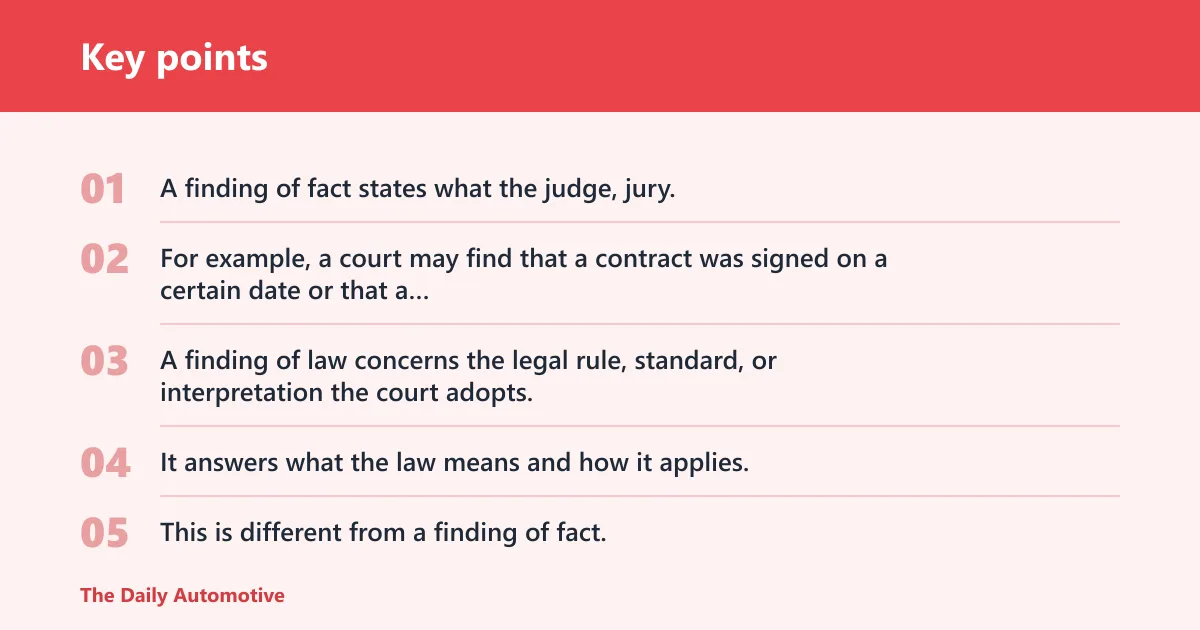
A finding of fact states what the judge, jury, or tribunal decides happened based on the evidence. For example, a court may find that a contract was signed on a certain date or that a warning was never given. Those are factual determinations.
Finding of law
A finding of law concerns the legal rule, standard, or interpretation the court adopts. It answers what the law means and how it applies. This is different from a finding of fact, which deals with evidence and events rather than legal interpretation.
Judicial inquiry and final decision language
In a judicial inquiry, findings often appear near the end of an opinion, order, or decision. They summarize the court’s conclusions after reviewing testimony, documents, and argument. If a document says “the findings,” it may refer to several separate legal conclusions.
Picture a hearing over a disputed invoice. The judge may make one finding of fact about who approved the work and one finding of law about whether the contract clause controls. The language changes because the issue changes.
Examples of finding in sentences
Examples help separate ordinary speech from academic and legal usage. The same spelling can mean a discovery in one sentence and a court conclusion in another. Context does the heavy lifting.
Everyday examples
“Her finding was a loose wire behind the panel.”
“The finding helped explain the noise.”
“Finding the missing key took ten minutes.”
Academic and scientific examples
“The study’s findings showed a clear pattern in the samples.”
“After analyzing the results, the team reported one finding.”
“The researchers’ finding came from a comparison of two data sets.”
Legal examples
“The court’s finding of fact supported the verdict.”
“The panel issued findings of law on the disputed clause.”
“The written decision sets out each finding separately.”
Finding origin and related words
The word family links finding to find, and the broader sense connects to discovery, result, and conclusion. That family helps explain why the word can name both what is discovered and the act of determining it through review or inquiry.
In modern usage, context controls the meaning. A newspaper paragraph, a lab report, and a court order can all use the same word, yet the intended sense changes. That is why reading the surrounding nouns and verbs is often enough to choose the right form.
A quick way to choose the right form
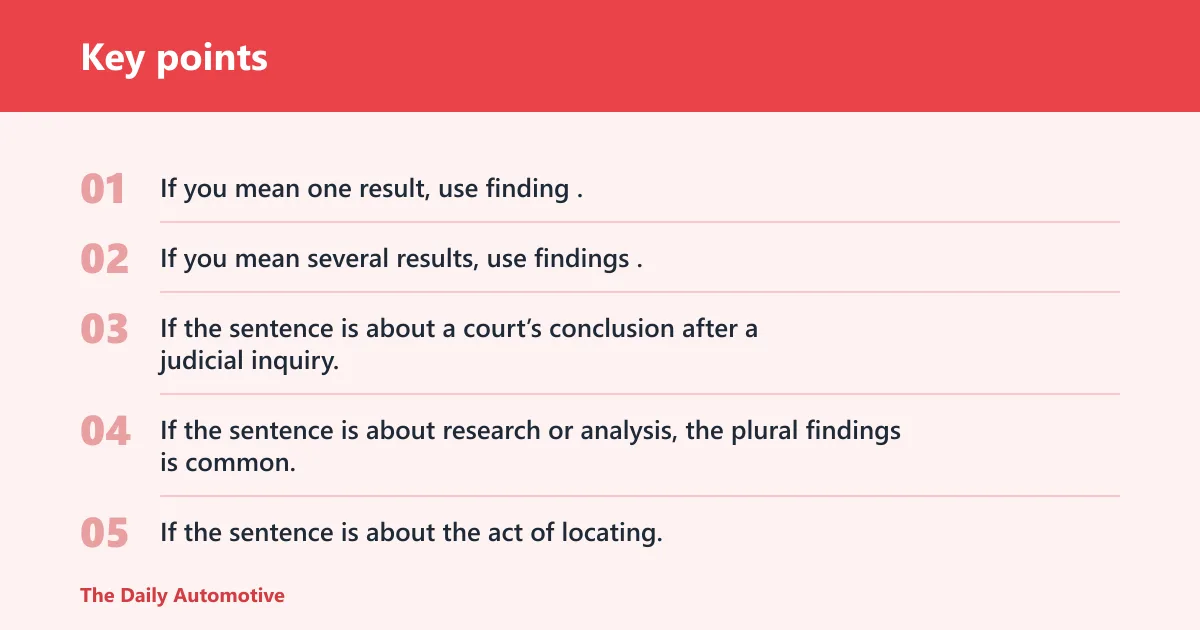
- If you mean one result, use finding.
- If you mean several results, use findings.
- If the sentence is about a court’s conclusion after a judicial inquiry, look for finding of fact or finding of law.
- If the sentence is about research or analysis, the plural findings is common.
- If the sentence is about the act of locating, consider whether finding is really part of a verb phrase such as “finding the issue.”
Frequently asked questions
What does finding mean?: finding usually means something discovered?
Finding usually means something discovered, a conclusion reached, or the act of determining something through checking or research. The surrounding sentence decides which sense fits. In law, the word can also mean a formal decision after judicial inquiry, especially when paired with fact or law.
What is the difference between finding and findings?: finding usually points?
Finding usually points to one discovery or one conclusion, while findings points to several. In research, findings often summarizes the results section. In legal writing, findings may refer to multiple determinations made by a court or tribunal after reviewing evidence and argument.
Is finding a noun or a verb?
Finding is a noun, and it is also the present participle of find. As a noun, it can mean a discovery or conclusion. As part of a verb phrase, it can describe the act of locating or determining something, as in “is finding.”
What is the etymology of finding?
Finding comes from the verb find and shares its core sense of locating or discovering. The modern noun developed from that verb family and later took on specialized uses in research and law. Its word history helps explain why it can mean both a result and a process.
Products related to this article
Sponsored / affiliate links. As an Amazon Associate I earn from qualifying purchases. I may earn additional commission from eligible campaigns.