Pros and Cons of Car Subscription Services Explained
Car subscription services can make sense if you need month-to-month flexibility and are willing to pay more for it; for around six months or longer, leasing or buying often costs less. Skip the math and you can pay hundreds more each month for convenience you may not need. This guide compares subscriptions with leasing, buying, and renting by total cost, mileage caps, extra fees, and contract terms.
What is a car subscription service?

A car subscription service is a monthly, all-in access plan for a vehicle. You typically pay one recurring fee for the car, insurance, maintenance, and sometimes roadside help, then accept mileage caps, driver rules, and a minimum term. It is closer to a service contract than to ownership.
How the monthly fee is structured
The headline price is only part of the bill. Many providers add a start-up fee, a refundable or nonrefundable deposit, delivery charges, taxes, registration, and overage fees if you exceed the mileage cap. Some plans also charge extra for premium models, additional drivers, or young-driver eligibility.
That means a $699 monthly quote may not be the true monthly cost. If insurance is bundled, compare the deductible, permitted driver ages, and any location-based restrictions. If insurance is excluded, the subscription can end up costing more than it first appears.
What is usually included and excluded
Most car subscription plans include routine maintenance, scheduled service, and wear items in ordinary use. Many also include insurance and roadside assistance. What is excluded varies: fuel, tolls, parking, tickets, excess damage, smoking cleanup, and abuse-related wear are usually on the driver.
Tires, brakes, and windshields are contract points to read carefully. Some providers cover normal wear; others limit coverage or charge for anything beyond a narrow wear-and-tear policy. Deductibles matter too. A plan with a low monthly fee but a high deductible can be a poor deal for a multi-driver household.
Common contract terms to check before you sign
- Minimum term and notice period for cancellation.
- Early termination penalty or remaining-balance charge.
- Mileage allowance and overage fee per mile.
- Insurance coverage, deductible, and eligible drivers.
- Maintenance coverage, wear-item limits, and damage charges.
- Delivery, pickup, swap rules, and timing.
- Upfront fees, deposits, and whether they are refundable.
Say your commute is 18 miles each way and you drive about 22 workdays a month. That is roughly 800 miles before errands. A plan with a 750-mile cap can look fine on paper and still trigger overage charges in many months.
What are the pros of car subscription services?
Car subscriptions are strongest when you want lower commitment and predictable billing. They can reduce setup work, bundle insurance and maintenance, and give you access to a newer vehicle without a long lease or an ownership down payment. Where swap programs exist, they can also fit changing needs.
Lower commitment than leasing or buying
Subscriptions often run month to month or on a short fixed term, which lowers exit friction compared with a lease or financed purchase. That matters if your job, city, family size, or parking situation may change soon. You are not locked into a three- to seven-year ownership decision.
Bundled services that simplify monthly budgeting
Insurance, routine maintenance, and registration may be folded into one bill. That is useful if you want to avoid separate renewal dates and surprise service bills. It is also easier to compare against a lease if the lease quote omits insurance, which many shoppers forget to add.
Flexibility to switch vehicles when the provider allows it
Some providers allow swaps within their fleet, which can help if you need an SUV for a weekend move, a sedan for commuting, or a different setup after a life change. The catch is inventory. Swap availability depends on city, trim, and timing, so flexibility is not guaranteed.
What are the cons of car subscription services?
The main drawbacks are cost, mileage limits, and limited availability. A subscription often costs more than a long-term lease or a used-car purchase once you add insurance, taxes, fees, and depreciation. If you drive a lot, overage charges can erase the appeal quickly.
Higher monthly cost than many long-term options
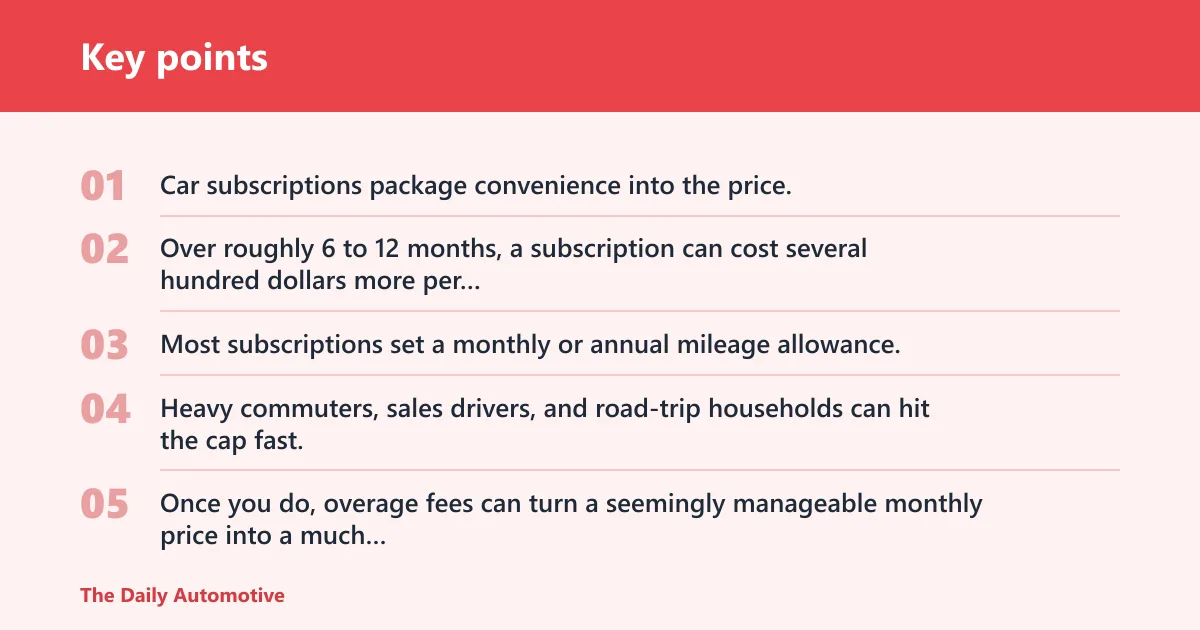
Car subscriptions package convenience into the price. That premium is real. Over roughly 6 to 12 months, a subscription can cost several hundred dollars more per month than a lease or financed used car once you factor in ownership equity or a lower lease payment.
Mileage caps and overage fees
Most subscriptions set a monthly or annual mileage allowance. Heavy commuters, sales drivers, and road-trip households can hit the cap fast. Once you do, overage fees can turn a seemingly manageable monthly price into a much higher total cost than planned.
Inventory limits, swap delays, and cancellation friction
Subscriptions are not a universal menu of cars. Provider inventory, local regulations, and delivery logistics limit choice. If you need a specific vehicle quickly, you may wait. Early termination penalties, notice periods, and nonrefundable fees can also make “flexible” less flexible than advertised.
Suppose a family in a suburb needs two child seats, a weekend cargo hauler, and an occasional second driver. A subscription may work only if the provider allows multi-driver coverage and has an SUV available at the right time. If not, the plan can stall on practical details.
How do subscriptions compare with leasing, buying, and renting?
Subscriptions sit between rental cars and long-term car ownership. They are usually cheaper than daily rental for extended use, but they are usually more expensive than leasing or buying if you keep the vehicle for many months. The tradeoff is exit friction versus total cost.
Subscription versus leasing
Leasing usually wins on price for drivers who can predict mileage and keep the car for a full term. It often requires credit qualification, has mileage caps, and includes wear-and-tear rules at lease end. Subscription can beat leasing on simplicity if insurance and maintenance are bundled, but rarely on raw cost.
Subscription versus used-car purchase
Used-car buying often has the lowest long-run monthly cost because depreciation has already hit the vehicle. The downside is maintenance uncertainty, older warranty coverage, and the burden of resale. Subscription avoids repair surprises, but you pay for that protection in the monthly fee.
Subscription versus new-car purchase
New-car purchase means the highest upfront price and the fastest early depreciation, but it also gives you full ownership, factory warranty coverage, and the option to sell later. Subscription avoids depreciation risk and resale hassle, yet gives you no equity at the end of the term.
Which option is cheapest for your driving pattern?
The cheapest choice depends on mileage, time horizon, and how much risk you are willing to carry. Low-mileage drivers may find a lease competitive. Commuters with high annual mileage often do better with ownership. Subscription is most defensible when your use period is short and uncertain.
Low-mileage drivers
If you drive well under a lease cap and want a newer vehicle without owning it, leasing can beat subscription on monthly cost. Subscription only makes sense if the bundled insurance, maintenance, and short commitment are worth the premium and the mileage allowance fits your use.
Commuters and variable-mileage drivers
Commuters should calculate annual miles before signing anything. A subscription can look attractive for a 500-mile month and turn expensive at 1,200 miles. Variable-mileage drivers need a buffer, because overage fees can exceed the cost of choosing a less flexible but more forgiving lease or used car.
Short-term and temporary use cases
Short assignments, relocation gaps, and waiting for a replacement vehicle are the strongest use cases for subscription. It can also work if you need a car for a few months and want insurance and maintenance folded in. Renting usually wins for very short periods; buying rarely does.
Use this side-by-side decision table before you choose
Read the table by separating sticker price from true all-in cost. The monthly-cost column should include insurance, maintenance, overage fees, and likely depreciation or resale value where relevant. Exit friction matters too: a low monthly payment can be a bad deal if ending the contract is costly.
| Option | Typical total monthly cost | Mileage flexibility | Included services | Exit friction | Best-fit driver profile |
|---|---|---|---|---|---|
| Car subscription | High; often $600-$1,500+ before overages | Low to medium; caps often apply | Often insurance, maintenance, roadside help | Medium to high; notice periods and early fees common | Short-term drivers, variable needs, convenience-first shoppers |
| Lease | Medium; often lower than subscription for comparable cars | Low; mileage caps and wear rules apply | Warranty coverage on new vehicles; insurance separate | Medium to high; contract end charges possible | Predictable drivers with stable mileage and credit qualification |
| Used-car purchase | Low to medium after down payment; depends on repair risk | High; no contractual mileage cap | Owner pays maintenance; warranty may be limited | Low to medium; selling takes time | Budget-focused buyers who can handle repairs and resale |
| New-car purchase | High upfront, medium monthly if financed; depreciation is significant | High; no mileage cap | Factory warranty, owner pays insurance and maintenance | Low to medium; selling or trading later is optional | Long-term owners who want warranty coverage and equity potential |
How to read the monthly cost and exit-friction columns
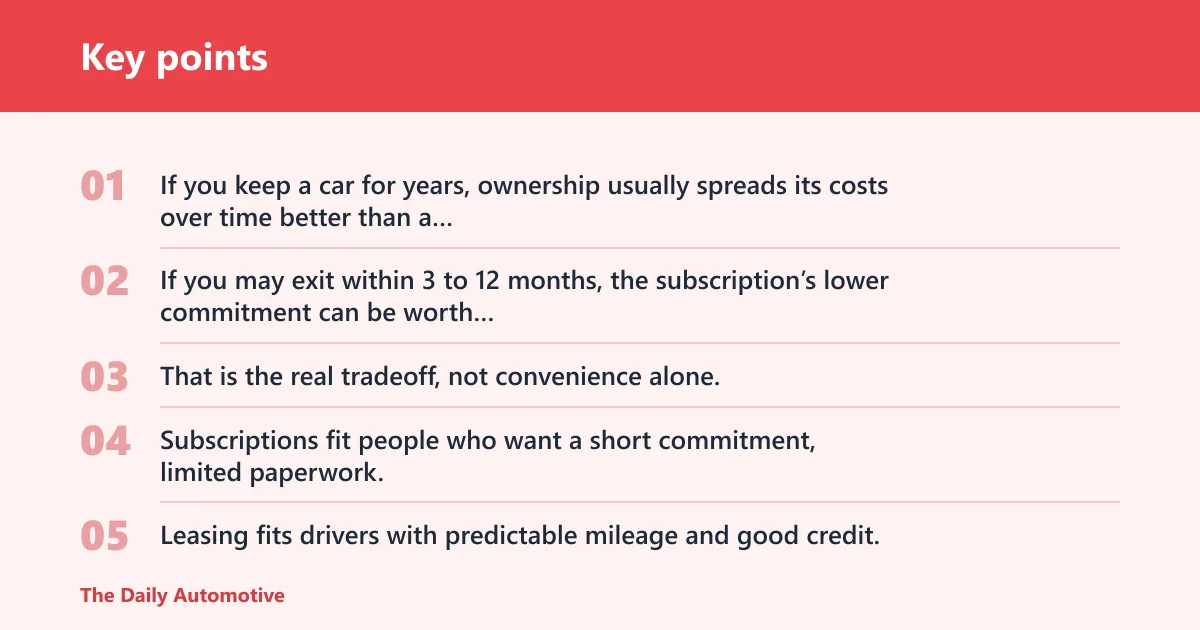
If you keep a car for years, ownership usually spreads its costs over time better than a subscription. If you may exit within 3 to 12 months, the subscription’s lower commitment can be worth paying extra for. That is the real tradeoff, not convenience alone.
Best-fit driver profiles for each option
Subscriptions fit people who want a short commitment, limited paperwork, and a newer vehicle. Leasing fits drivers with predictable mileage and good credit. Used-car buying fits value-focused shoppers who can handle repairs. New-car buying fits long-term owners who want warranty coverage and eventual resale value.
What are the pros and cons of car subscription services?
Pros include lower commitment, bundled monthly costs, and occasional vehicle swapping. Cons include a higher all-in price, mileage caps, limited inventory, and cancellation friction. The service is best judged as a total-cost choice, not as a convenience upgrade for every driver.
Are car subscription services cheaper than leasing or buying?
Usually no, not over six months or longer. Leasing often costs less for predictable drivers, and buying usually beats subscription once depreciation is spread over time. A subscription can still make sense if insurance, maintenance, and short-term flexibility replace costs you would otherwise pay separately.
Who is a car subscription service best for?
It is best for short-term drivers, people between cars, households with changing transportation needs, and drivers who value bundled billing more than ownership equity. It can also work for people with variable mileage, but only if the contract allows enough room without steep overage charges.
What fees are included in a car subscription?
Usually the fee includes the vehicle, insurance, maintenance, and sometimes roadside assistance. Common exclusions are fuel, tolls, parking, tickets, excess wear, smoking cleanup, and damage beyond normal use. Always check deductibles, driver eligibility, deposit rules, and any fees for delivery or pickup.
Can you switch cars in a subscription service?
Sometimes, but not always. Some providers allow swaps within their fleet, while others only let you change at renewal or after a notice period. Availability depends on inventory, location, and timing, so a swap feature should be treated as a possibility, not a promise.
Do new cars require subscription services?
No. New cars do not require subscriptions. You can buy, finance, or lease a new car directly from a dealer or lender. A subscription is only one access model, and it usually makes sense when you want short-term use, bundled costs, or easy exit terms.
What are the pros and cons of used cars vs new cars?
Used cars usually cost less upfront and depreciate more slowly, which helps value-focused buyers. The downside is more maintenance uncertainty and shorter remaining warranty coverage. New cars cost more, lose value faster at first, and usually bring fuller warranty protection and fewer surprise repairs early on.
Is a car subscription worth it for short-term driving?
Often yes, if you need a car for a few months and want insurance and maintenance wrapped into one bill. It is less compelling for very short use, where rental may be cheaper, or for longer use, where leasing or buying usually reduces the monthly cost.
Products related to this article
Sponsored / affiliate links. As an Amazon Associate I earn from qualifying purchases. I may earn additional commission from eligible campaigns.