Lowest Car Rental Drop Off Fees Explained
The lowest car rental drop-off fee is the one-way surcharge, stripped out of the base rate. Compare the full trip total, then compare the same pickup and drop-off pair across suppliers, along with airport or off-airport branches and economy-to-midsize cars, which usually keep that surcharge lower. Skip that split, and a cheap daily rate can turn into a much pricier one-way trip. This guide shows how to read rental quotes, spot the hidden fee, and compare the route and vehicle choices that most often reduce it.
What is a drop fee?
A drop fee, also called a one-way fee, is the amount a rental supplier charges when you return the car to a different location from where you picked it up. It can appear inside the quoted price or show up as a separate line item, so you need to check the full booking screen before you pay.
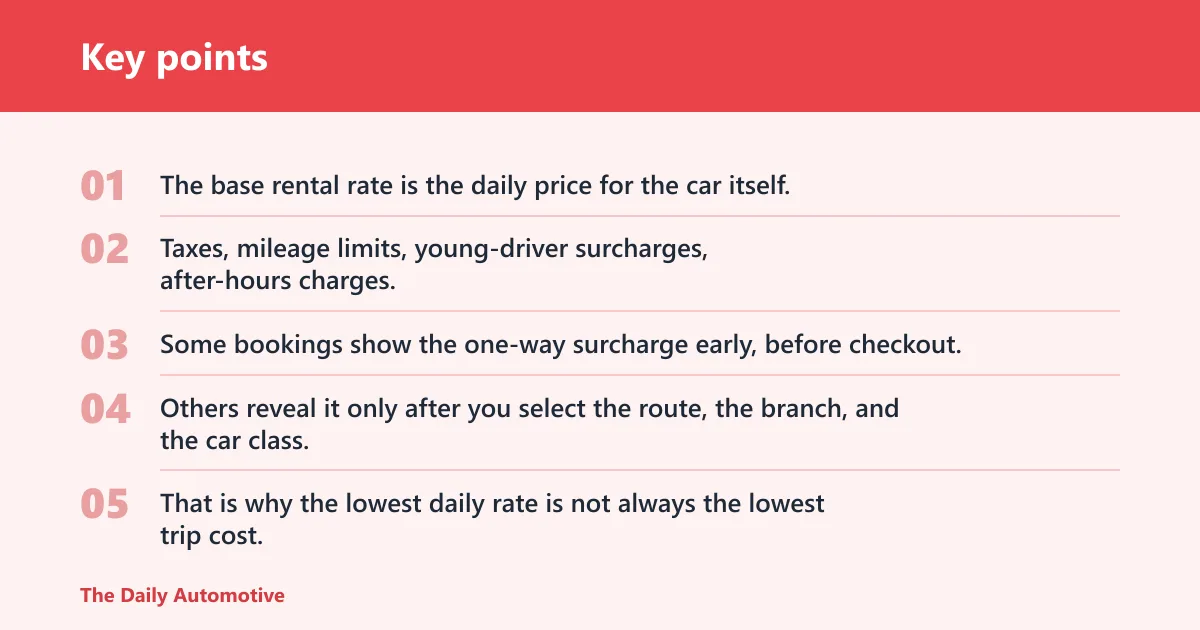
The base rental rate is the daily price for the car itself. The drop fee is different. Taxes, mileage limits, young-driver surcharges, after-hours charges, and optional extras belong in their own buckets, because each one can change the total in a different way.
When the fee appears in the quote
Some bookings show the one-way surcharge early, before checkout. Others reveal it only after you select the route, the branch, and the car class. That is why the lowest daily rate is not always the lowest trip cost. A quote that looks cheap can become expensive once the drop fee is added.
One-way rental pricing is common for road trips and relocations, but it depends on the supplier’s branch network. A company with more locations on your route may have more flexible drop-off options than a supplier with sparse coverage.
Why do one-way fees change?
One-way fees change because the supplier has to move the vehicle back into its network, and that cost depends on route demand, branch coverage, and car class. A short route on a busy corridor may price very differently from a long route with limited return demand. The same booking type can also be priced differently at airport and downtown branches.
Route length and branch network
Routes between large cities usually have more one-way inventory than routes into smaller markets. A branch network with many locations gives the supplier more chances to rebalance vehicles, which can keep the surcharge lower on some city-to-city routes. Thin coverage tends to do the opposite.
Vehicle class sensitivity
Vehicle class matters because the supplier’s rebalancing cost is not the same for every car. Economy and compact cars often carry lower one-way surcharges than larger SUVs or specialty vehicles. Automatic transmission can also change the available pool, because not every branch stocks the same mix.
Say your trip is from Toronto downtown to Ottawa downtown for two days. An economy car may carry a modest one-way surcharge, while an SUV on the same route can cost more because the supplier has fewer easy replacement options for that class. The route is the same. The vehicle class is not.
Airport and downtown inventory differences
Airport branches and downtown branches do not price the same way on every route. Airports often have larger inventories and more supplier coverage, but that does not mean they are always cheaper. On some routes, downtown branches price lower because the supplier has better return demand or fewer airport fees to recover.
How do you find the lowest drop-off fee?
Start with the total trip cost, not the daily rate. Then compare the same pickup and drop-off pair across suppliers, because the one-way surcharge can vary even when the headline price looks similar. If free cancellation is available, use it to re-shop the route when a better quote appears.
Read the quote in layers
Break the booking into four parts: daily rate, one-way surcharge, taxes and fees, and any mileage or country restrictions. If a quote does not show all four clearly, treat it as unfinished. The cheapest-looking daily rate may be the most expensive total once the surcharge and taxes are added.
Use cancellation to re-shop the route
Free cancellation gives you flexibility, but it does not make the one-way fee disappear. It simply lets you compare again if the first quote is weak. That matters on busy travel dates, on holiday weekends, and on routes where branch inventory changes quickly.
Suppose a compact car shows a lower daily rate on one supplier’s site, but the one-way surcharge is higher than a rival’s quote for the same pickup and drop-off cities. The cheaper daily rate is a trap if you stop reading at that line. Compare the total, not the teaser.
Lowest car rental drop table
The figures below are illustrative comparison values, not a live quote. They show how the same route can produce very different totals once you separate the base rate from the one-way surcharge, then add the cost together.
| Route type | Pickup and drop-off city | Airport vs downtown | Car class | Quoted daily rate | Estimated one-way surcharge | Total estimated trip cost |
|---|---|---|---|---|---|---|
| Domestic city-to-city | Toronto to Ottawa | Downtown to downtown | Economy | €18.28 per day | €34 | €70.56 for 2 days |
| Domestic city-to-city | Toronto to Ottawa | Airport to airport | Compact | €21.00 per day | €22 | €64.00 for 2 days |
| Domestic city-to-city | Los Angeles to San Francisco | Airport to downtown | Automatic compact | €51.40 per day | €15 | €117.80 for 2 days |
| Cross-border one-way | Vancouver to Seattle | Airport to airport | SUV | €39.00 per day | €95 | €173.00 for 2 days |
Decision rule: if the lower daily rate comes with a surcharge that pushes the total above a rival quote, the “cheap” car is not cheap. Choose the quote with the lowest full trip total, even when the daily rate looks higher.
How do airport and downtown drop-offs affect price?
Airport and downtown returns can price differently because they sit in different parts of the supplier network. Airports may offer more branches and more inventory, while downtown branches may fit the route better on some city trips. The right answer depends on the city pair, not on a one-size-fits-all rule.
Why airport branches can price differently
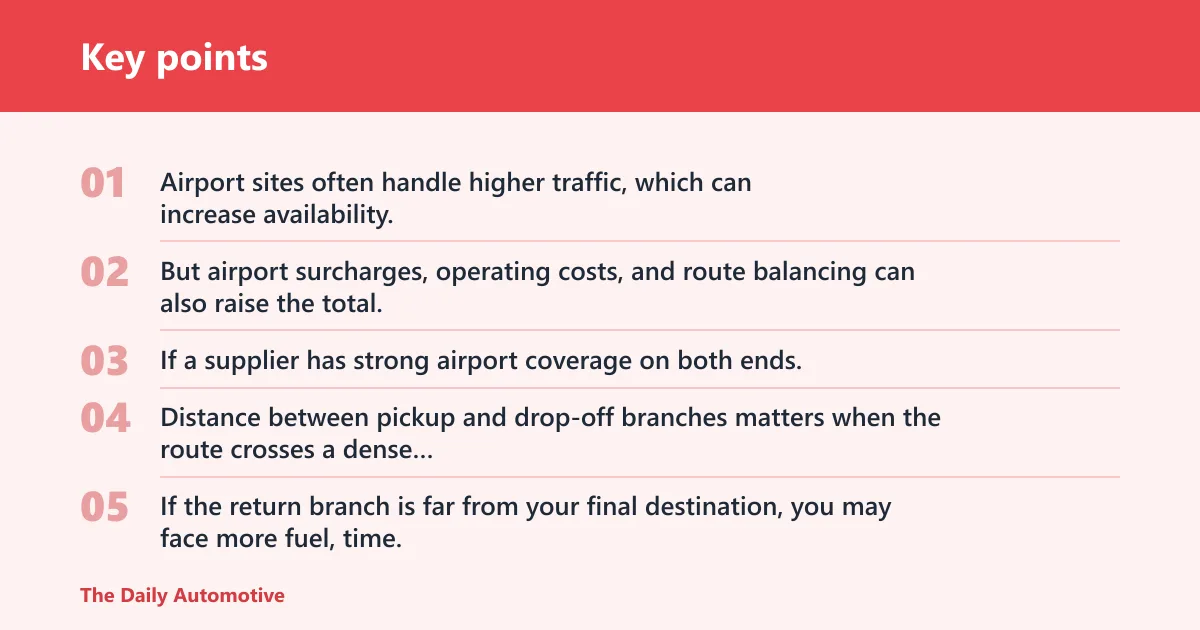
Airport sites often handle higher traffic, which can increase availability. That can help on some routes. But airport surcharges, operating costs, and route balancing can also raise the total. If a supplier has strong airport coverage on both ends, the one-way fee may be lower than expected. If not, the quote can rise fast.
When distance between branches matters
Distance between pickup and drop-off branches matters when the route crosses a dense city, a toll zone, or a border. If the return branch is far from your final destination, you may face more fuel, time, and transit costs even if the rental quote looks acceptable. That is part of the real trip cost.
A common first-timer mistake is choosing a downtown pickup and an airport drop-off because the daily rate looks lower, then discovering that the airport branch is far from the hotel and the return instructions require extra time. The cheapest quote is only helpful when the branch choice fits your route.
What should you check before booking?
Check the booking terms before you pay. The quote should tell you the mileage limit, any country restrictions, the approved drop-off location, the cancellation terms, and how to contact support if your plans change. For one-way travel, those details matter as much as the price.
Mileage limits and country restrictions
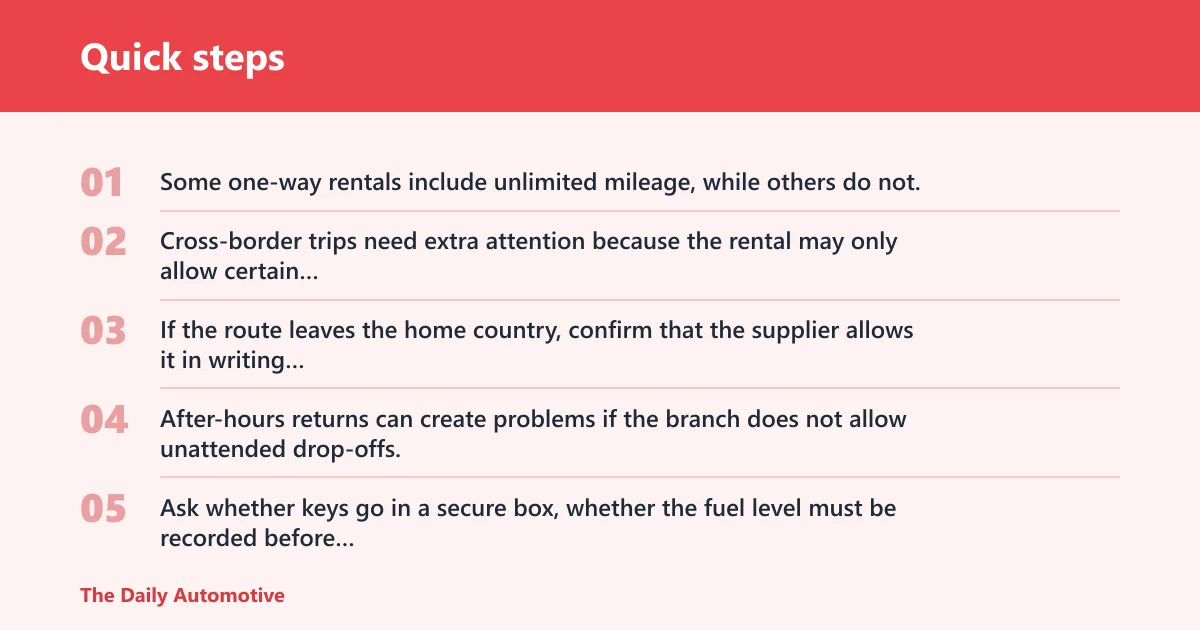
Some one-way rentals include unlimited mileage, while others do not. Cross-border trips need extra attention because the rental may only allow certain countries or certain border crossings. If the route leaves the home country, confirm that the supplier allows it in writing before you book.
After-hours return rules
After-hours returns can create problems if the branch does not allow unattended drop-offs. Ask whether keys go in a secure box, whether the fuel level must be recorded before closing, and whether the branch accepts returns after its posted hours. A late arrival without approval can create avoidable charges.
Drop-off approval and support contact
Confirm that the exact drop-off branch is approved. Do not assume a nearby branch counts as the same location. If the supplier offers 24/7 Support, save the number or chat channel before pickup. That helps if weather, traffic, or schedule changes affect your route.
DiscoverCars says it is the “#1 World’s Most Visited Car Rental Comparison and Booking Website,” and its Canada page lists “Save up to 70%,” “Free Cancellation,” “Trusted by 7M travelers,” “24/7 Support,” and “1,000+ brands.” Its Canada page also shows a sample rate of “€18.28 per day” for a “Kia Rio or similar.” Those platform claims are useful only as booking features; they do not remove the need to inspect the one-way surcharge in the quote.
Can you avoid a drop-off fee?
The safest way to avoid a drop fee is to return the car to the same location. Some routes and promotions can reduce the surcharge, especially when the supplier wants the vehicle moved in a useful direction. Cross-border one-way rentals need extra approval, and some routes simply will not allow a different drop-off location at all.
Same-location return
If your travel plan allows it, a same-location return is the cleanest way to avoid the one-way surcharge. You still need to compare taxes, mileage, and cancellation terms, but the biggest location-based fee is removed from the booking.
Special routes and promotions
Some suppliers discount one-way rentals on routes that help move vehicles where they are needed. Those deals are route-specific and time-sensitive. A quote that looks expensive on one day may drop when inventory changes or when a promotion applies to that city pair.
Cross-border approvals
Cross-border one-way rentals need the most care. The supplier may allow the route, restrict the vehicle class, or require advance approval. Without that approval, you can end up with a denied pickup, an unexpected fee, or a return location that does not match the booking.
Frequently asked questions
What is a rental car drop fee?
A rental car drop fee is the one-way surcharge charged when you return the vehicle to a different location from the pickup branch. It is separate from the base daily rate, though some quotes bundle it into the total. Always check whether the fee is already included before you compare prices.
Why do rental car companies charge different drop-off fees?
They charge different fees because route demand, branch network size, airport versus downtown inventory, and vehicle class all change the supplier’s cost to move the car back into its system. A route with strong return demand can price lower than a route with limited network coverage.
How can I find the cheapest car rental with a different drop-off location?
Compare the full trip total for the same pickup and drop-off pair across several suppliers. Then check whether the daily rate, one-way surcharge, taxes, mileage, and cancellation terms are all visible. If free cancellation is available, use it to re-shop the route when a better total appears.
Are one-way car rentals always more expensive?
No. One-way rentals often cost more because of the surcharge, but some routes are priced competitively, especially when the supplier wants the vehicle moved in that direction. The key is to compare the total cost, not assume every different drop-off booking will be overpriced.
Can I avoid a drop-off fee when renting a car?
Yes, sometimes. The most reliable way is to return the car to the same location. Some special routes or promotions can lower the surcharge, but they do not remove the need to check the booking terms. Cross-border routes usually need the strictest approval.
What should I check before booking a rental car for one-way travel?
Check the approved drop-off branch, mileage limits, country restrictions, after-hours return rules, cancellation terms, and support contact. Then confirm whether the one-way surcharge is included in the quoted total or added later. If any part is unclear, ask before you pay.
Products related to this article
Sponsored / affiliate links. As an Amazon Associate I earn from qualifying purchases. I may earn additional commission from eligible campaigns.