1800s Cars: Proven & Essential Machines
1800s cars were the very first automobiles, marking a giant leap in personal transportation and innovation. These early machines, while vastly different from today’s vehicles, were crucial in paving the way for modern automotive technology and proving the concept of self-propelled travel.
The idea of a car in the 1800s might seem strange, right? We think of cars from the 1900s and beyond. But actually, the very first “cars” were born in the late 1800s! These were amazing inventions that changed the world. They weren’t fancy like today’s rides, but they were powerful proof that people could travel on their own without horses. If you’ve ever wondered about these incredible early machines, you’re in the right place. We’re going to explore what these 1800s cars were really like and why they were so important.
Where There Cars in the 1800s? The Dawn of the Automobile
Yes, absolutely! While we often associate cars with the 20th century, the very beginnings of automotive technology stretch back into the late 1800s. These weren’t cars as we know them today – no sleek designs, air conditioning, or GPS. Instead, they were revolutionary, often steam-powered or powered by early internal combustion engines, fundamentally changing the concept of personal travel. These pioneering vehicles proved that self-propelled machines could replace horse-drawn carriages, laying the groundwork for the automotive industry we know today.
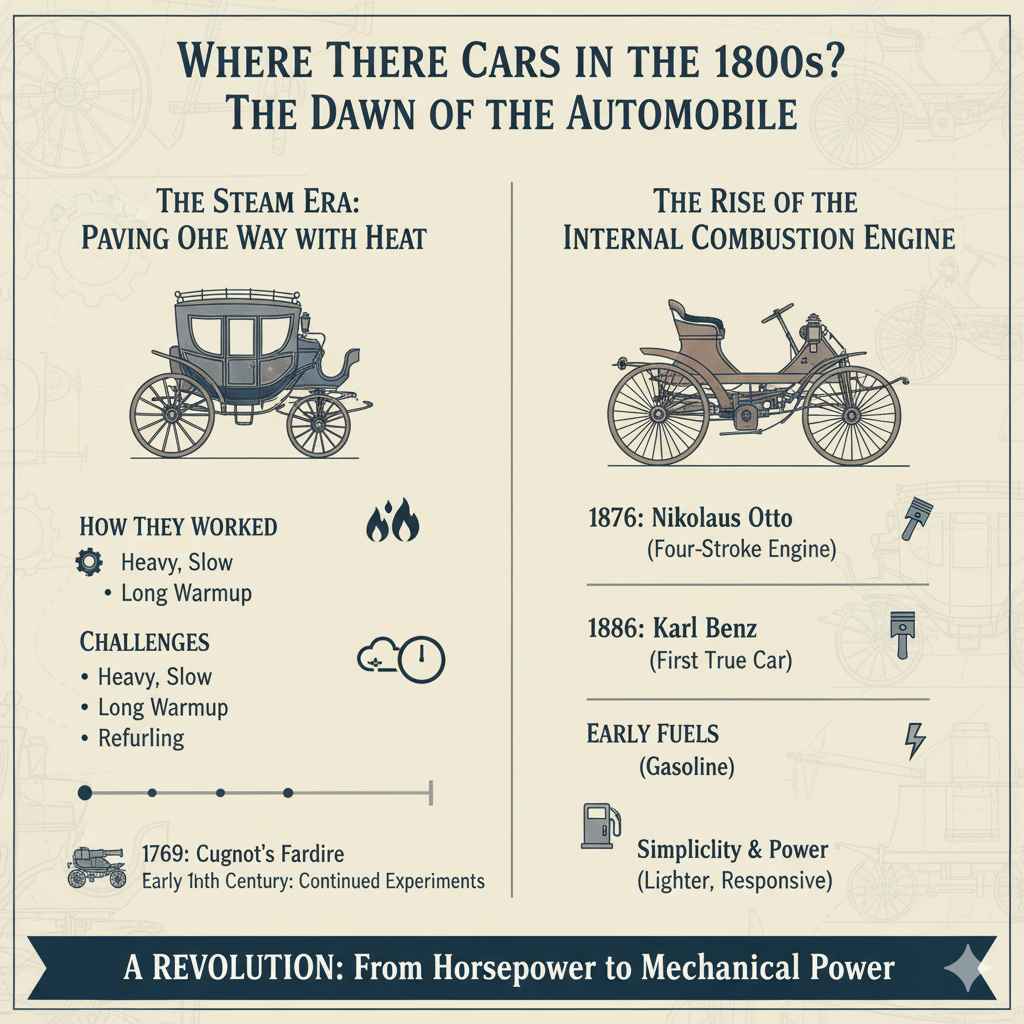
The Steam Era: Paving the Way with Heat
Before gasoline engines became dominant, steam power was the leading contender for making machines move on their own. Inventors in the 1800s tinkered with steam engines, trying to adapt them for locomotion. These early steam carriages were essentially steam engines on wheels.
Early Pioneers: Nicolas-Joseph Cugnot is often credited with building the first self-propelled mechanical vehicle in 1769. While this was technically before the 1800s, it laid a crucial foundation. Early 19th-century inventors continued to experiment with steam.
How They Worked: A steam carriage required water and fuel (like coal or wood) to heat the water and create steam. This steam then powered pistons, which in turn drove the wheels. It was a bit like an early train engine, but designed for roads.
Challenges: These machines were often heavy, slow, and required a great deal of time to build up steam before they could move. Refueling and maintaining the steam pressure on the go was also a significant challenge. Despite their limitations, they demonstrated the possibility of self-powered road travel.
The Rise of the Internal Combustion Engine
The real game-changer for cars came with the development of the internal combustion engine (ICE). Instead of using external heat to create steam, ICEs burn fuel inside the engine to generate power. This was a more compact and efficient way to create motive force.
Key Inventors & Dates:
Nikolaus Otto patented the four-stroke engine in 1876. This design became the standard for most gasoline engines.
Karl Benz is widely credited with building the first practical automobile powered by an internal combustion engine in 1886. His “Motorwagen” is often considered the first true car. Learn more about Karl Benz and his invention’s legacy.
Gottlieb Daimler and Wilhelm Maybach were also instrumental, developing their own high-speed gasoline engines and fitting them to a motorcycle and then a four-wheeled vehicle around the same time.
Early Fuels: These early engines primarily ran on gasoline, though the fuel itself was quite different from what we use today. It was often less refined and more volatile.
Simplicity and Power: Compared to steam engines, internal combustion engines were lighter, more responsive, and didn’t require extensive warmup times. This made them far more suitable for personal vehicles.
The First “Cars”: What Were They Like?
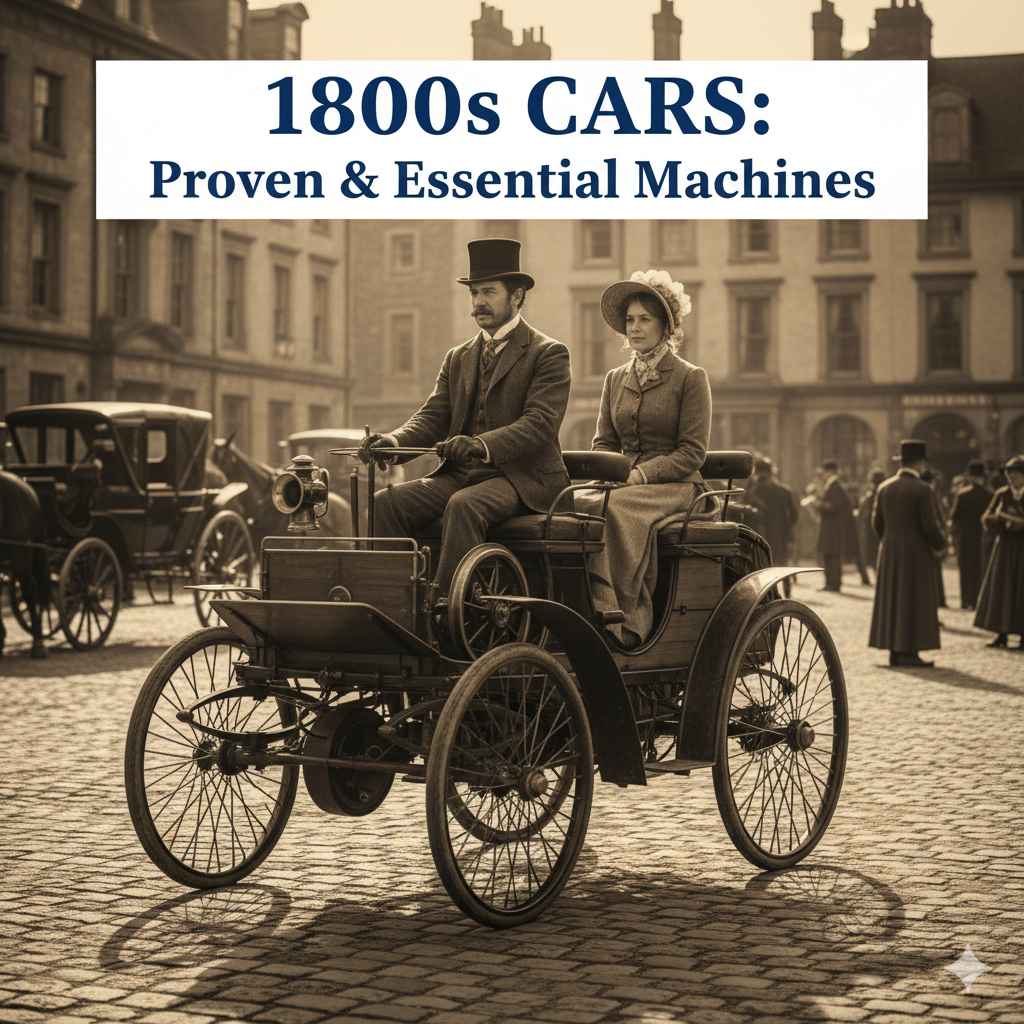
The cars of the late 1800s were a far cry from the sleek, comfortable vehicles of the 21st century. They were more like motorized carriages, often with three or four wheels, and a distinct lack of creature comforts.
Design and Structure
Imagine a horse-drawn carriage, and then picture its horse being replaced by an engine. That’s a good starting point for visualizing early automobiles.
Chassis: Many early cars used a frame derived from carriage construction, often made of wood or simple metal tubing.
Wheels: They typically featured spoked wheels, similar to those on bicycles or carriages, often with solid rubber tires rather than inflatable pneumatic tires.
Steering: Steering was achieved through a tiller or a steering wheel, which directly controlled the front wheels.
Bodywork: Open-top designs were the norm, offering minimal protection from the elements. There were no roofs, doors, or windows in the modern sense. Some vehicles might have had a dashboard for controls and levers.
Engines and Performance
The engines were the heart of these early machines, and their performance was limited by the technology of the time.
Engine Placement: Engines were often mounted at the rear of the vehicle or between the driver and passenger seats.
Speeds: Top speeds were very low by today’s standards, often not exceeding 10-15 miles per hour. Even reaching 20 mph was considered quite fast.
Noise and Vibration: These early engines were incredibly noisy and vibrated heavily. The experience of riding in one would have been quite rough and loud.
Starting the Engine: Starting required manual effort, often involving a hand crank, which could be difficult and even dangerous if not done correctly.
Key Models from the 1800s: A Glimpse of Innovation
While hundreds of inventors experimented, a few models stand out as defining the era:
Benz Patent-Motorwagen (1886): Considered the first true automobile. It had three wheels and was powered by a single-cylinder, four-stroke gasoline engine. Karl Benz’s vision was to create a practical, horseless carriage.
Daimler Motorkutsche (1886): Gottlieb Daimler and Wilhelm Maybach fitted a lightweight, high-speed engine to a stagecoach. This four-wheeled vehicle demonstrated the potential for a more car-like vehicle.
Panhard et Levassor cars (from 1890s): This French company was one of the first to produce cars in series. They adopted the “Système Panhard,” which established the layout for most subsequent cars: engine at the front, behind the radiator, driving the rear wheels.
Table 1: Comparison of Early Automotive Power Sources
| Feature | Steam Power (Late 1800s) | Internal Combustion Engine (Late 1800s) |
|---|---|---|
| Power Generation | External combustion (burning fuel to heat water) | Internal combustion (burning fuel inside engine) |
| Weight | Heavy, due to boiler and water | Relatively lighter |
| Startup Time | Long (needs to build steam) | Relatively quick |
| Fuel | Coal, wood, or other combustibles | Gasoline, early forms of petroleum |
| Complexity | High maintenance, pressure risks | Simpler mechanics, evolving technology |
| Efficiency | Lower | Higher, especially with Otto cycle |
| Typical Vehicle | Heavy road locomotives, carriages | Lighter, more maneuverable vehicles |
| Key Inventors | Richard Trevithick, Walter Hancock | Nikolaus Otto, Karl Benz, Gottlieb Daimler |
Why Were These “Cars” Essential Machines?
These early automobiles weren’t just novelties; they were “essential machines” in a profound sense. They represented a paradigm shift in human mobility and technological progress.
1. Revolutionizing Travel and Commerce
For millennia, travel was dictated by the speed of walking, horseback riding, or sailing. The ability to self-propel a vehicle meant overcoming these limitations.
Increased Range and Speed: Suddenly, journeys that took days could be accomplished in hours. This dramatically expanded the possibilities for personal travel, commuting, and transporting goods.
Economic Impact: Though slow to start, the potential for rapid goods transport hinted at future economic growth. Businesses could reach wider markets and deliver goods more efficiently.
Personal Freedom: The concept of “going anywhere, anytime” began to take shape. It offered a level of independence previously unimaginable for most people.
2. Driving Technological Innovation
The challenges and requirements of building functional automobiles spurred incredible innovation across multiple fields.
Engine Development: The need for lightweight, powerful, and reliable engines drove advancements in metallurgy, thermodynamics, and fuel research. The history of engine development is a fascinating journey.
Materials Science: Engineers had to find new metals and materials that could withstand the stresses and heat generated by engines.
Infrastructure Demands: The emergence of cars highlighted the need for better roads, fueling stations, and mechanical repair services, foreshadowing the infrastructure development of the 20th century.
Manufacturing Techniques: Early car makers experimented with new ways to produce parts, laying the groundwork for mass production.
3. Inspiring the Future of Transportation
The very existence of these early cars proved that powered, personal transport was possible. This inspired countless inventors, engineers, and entrepreneurs.
A Vision for the Future: Even these rudimentary machines painted a picture of a world less reliant on animal power. They were a tangible promise of what could be achieved.
The Foundation for Modern Cars: Every car on the road today owes a debt to the Benz Motorwagen, Daimler’s innovations, and the countless other pioneers of the 1800s. They solved fundamental problems of propulsion, steering, and chassis design.
Cultural Impact: The idea of the automobile captured the public imagination, representing progress, speed, and a new era of mechanical marvels.
Challenges and Limitations of 1800s Cars
It’s important to remember that these early cars were far from perfect. They faced numerous hurdles that limited their widespread adoption and immediate practicality.
Reliability: Breakdowns were extremely common. Engines were temperamental, and parts were often handmade and prone to failure.
Road Conditions: Roads were generally poor, unpaved, and unsuitable for anything but slow, cautious travel. Driving over rough terrain was a significant challenge.
Cost: These were extremely expensive machines, accessible only to the very wealthy. They were far from being practical for the average person.
Maintenance Complexity: While simpler in concept than modern cars, their experimental nature meant constant tinkering and repair were a necessity. Finding mechanics who understood them was also difficult.
Safety: With no seatbelts, airbags, or advanced braking systems, riding in these cars was inherently risky. Collisions, even at low speeds, could be very dangerous.
Fuel Availability: Gasoline was not readily available as it is today. It was often purchased from apothecaries or in small quantities.
Table 2: Early Car vs. Modern Car Features
| Feature | 1800s Cars (Late) | Modern Cars (21st Century) |
|---|---|---|
| Engine Type | Primarily gasoline ICE, some steam | Advanced gasoline ICE, hybrid, electric |
| Top Speed | 10–20 mph | 100+ mph |
| Comfort | Minimal; open-air, rough ride | Climate control, ergonomic seating, quiet |
| Safety Features | None | Airbags, ABS, traction control, seatbelts |
| Steering | Tiller or basic wheel | Power steering, rack-and-pinion |
| Transmission | Simple gears, direct drive | Automatic, manual, CVT, complex gears |
| Braking | Basic drum or band brakes | Disc brakes, ABS, regenerative braking |
| Cost (Relative) | Extremely high (luxury item) | Relatively accessible (various price points) |
| Fuel Availability | Scarce | Abundant; gas, diesel, EV charging |
| Reliability | Poor, frequent breakdowns | High, with planned maintenance |
The Legacy of the 1800s Automobile
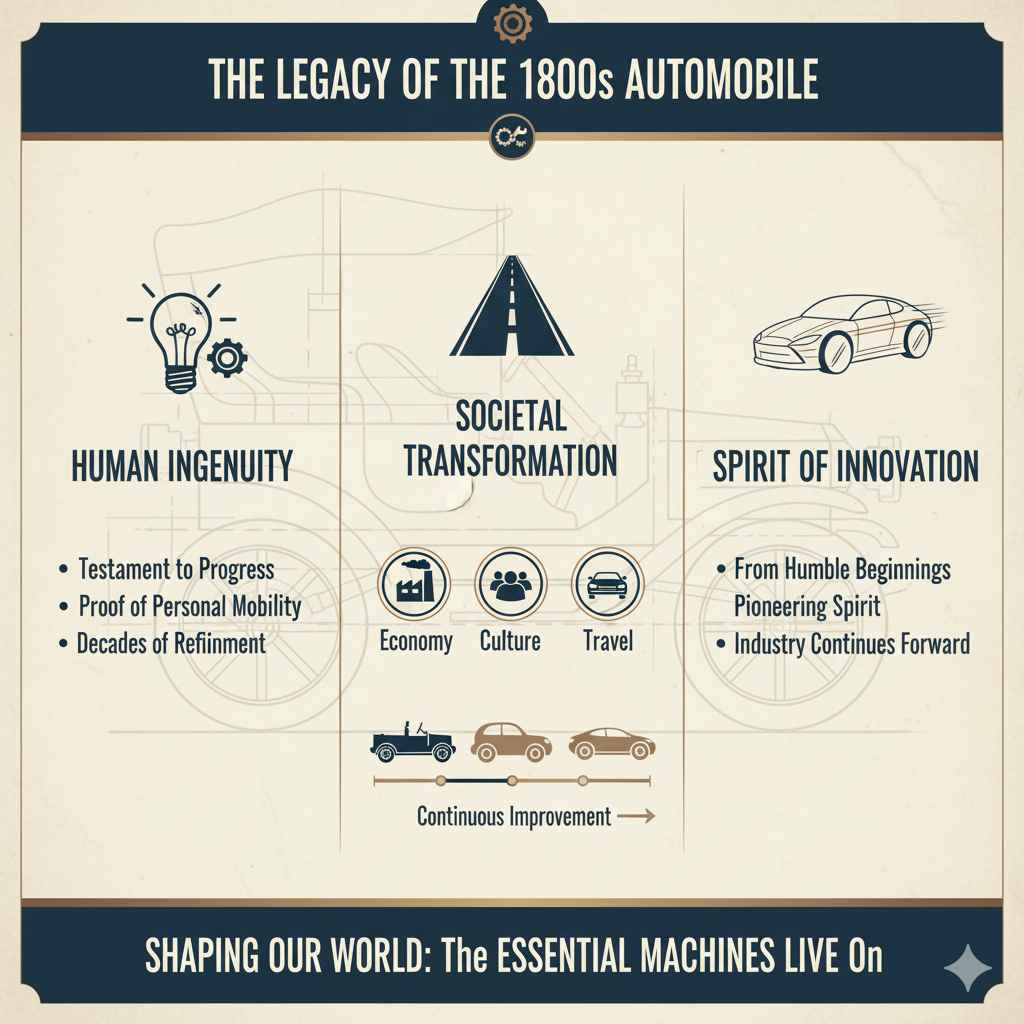
The cars of the 1800s were not just machines; they were a testament to human ingenuity and the relentless pursuit of progress. They proved that a world of personal, powered mobility was not a fantasy but an achievable reality, albeit one that required decades of refinement.
They represent the absolute beginning of a journey that transformed society, economy, and culture. From humble beginnings with sputtering engines and wooden wheels, the automobile embarked on a path of continuous improvement, leading to the sophisticated, efficient, and indispensable vehicles we rely on today. The spirit of exploration and innovation that defined the 1800s automotive pioneers continues to drive the industry forward, ensuring that the legacy of these essential machines lives on.
Frequently Asked Questions About 1800s Cars
Q1: Were there cars in the 1800s, or is that a myth?
A1: No, it’s not a myth! The very first automobiles were invented and built in the late 1800s. While they looked very different from today’s cars, they were the original self-propelled vehicles that started it all.
Q2: What powered the first cars?
A2: The earliest self-propelled vehicles often used steam engines. Later in the 1800s, the development of the gasoline-powered internal combustion engine became the key, leading to cars like the Benz Patent-Motorwagen.
Q3: How fast could the cars in the 1800s go?
A3: They were quite slow! Most cars in the late 1800s could only reach speeds of about 10 to 15 miles per hour. Reaching 20 mph was considered very fast and impressive for the time.
Q4: Did the first cars have steering wheels?
A4: Some did, but many early cars used a tiller (a stick-like lever) for steering. The steering wheel as we know it was still being developed and standardized during this period.
Q5: Were cars in the 1800s expensive?
A5: Yes, very! They were rare, difficult to build, and seen as luxury items or rich people’s toys. They were certainly not affordable for the average person back then.
Q6: How did you start a car in the 1800s?
A6: Most cars were started by manually cranking a handle attached to the engine. This process, called hand-cranking, required physical effort and could sometimes be dangerous if the engine backfired.
Q7: Where did people drive these early cars?
A7: Driving was limited to the roads that existed, which were often unpaved, rough, and designed for horse-drawn carriages. Navigating these conditions was a major challenge for the early automobiles.
The late 1800s marked a seismic shift in human history, and at the heart of this revolution were the proven and essential machines” we now call early cars. These weren’t just experiments; they were the crucial first steps that demonstrated the feasibility of personal, powered transport. They overcame the ingrained limitations of relying on animal power, proving that human innovation could forge new paths of mobility.
While they seem primitive by today’s standards, their impact was immense. They spurred incredible advancements in engine technology, materials science, and manufacturing, laying the essential groundwork for the automotive industry that would define the 20th century and beyond. The legacy of these pioneering vehicles is undeniable; they didn’t just move people and goods; they moved society forward, forever changing how we live, work, and explore our world.