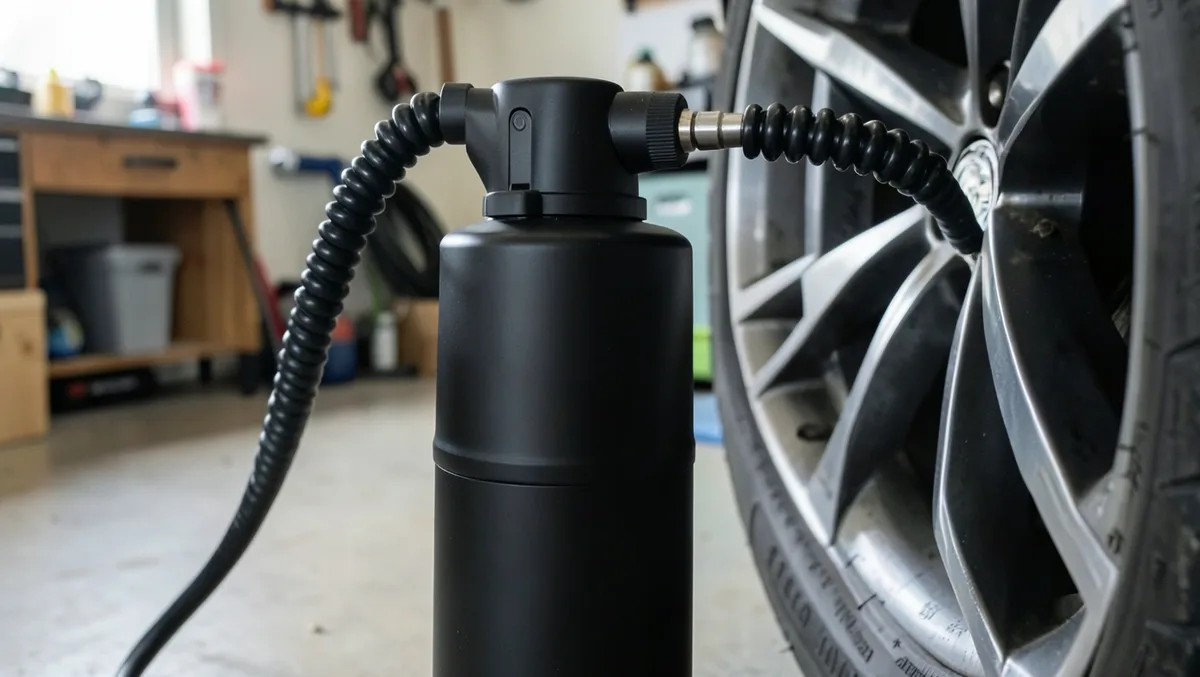
Air Inflator for Car Tires: 3 Portable Picks + Buying Guide
A good air inflator for car tires plugs into a 12V outlet or runs on battery, reads pressure to within about 1 PSI, and shuts off automatically once the tire hits your target pressure.
The three inflators below cover the setups most drivers actually choose between: a budget corded pump, a faster corded model with a bigger display, and a battery-plus-12V dual-power unit that also works away from the car. Each section breaks down the real specs rather than just the marketing bullet points, so you can match the inflator to how you will actually use it. Shopping in a store instead of online? Our guide to what Lowes actually stocks for tire inflators covers the corded and cordless models sold on the shelf.
AstroAI AIRUN H Tire Inflator Portable Air Compressor
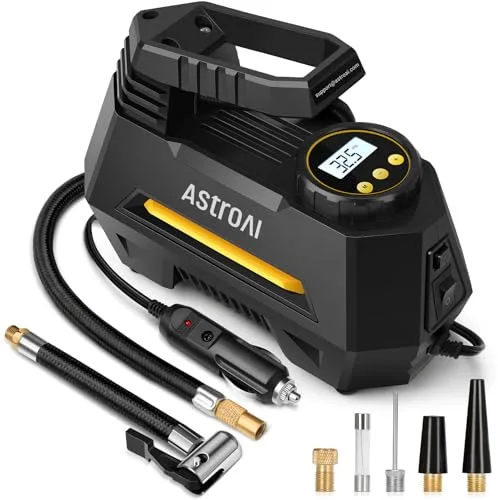
The AstroAI AIRUN H is a straightforward 12V corded inflator built for anyone who wants one pump that lives in the trunk and never needs charging. It plugs into the car’s power outlet, so there is no battery to remember to top off, and a built-in digital gauge shows the running PSI as it fills so you can watch it approach your target instead of guessing. An auto shut-off cuts the pump once it reaches the pressure you set, which lowers the odds of overinflating a tire compared with an inflator that has no cutoff at all.
The 9.8-foot cord reaches all four tires from a single outlet on most sedans and compact SUVs without repositioning the car, and a rubber-coated hose gives a bit more reach right at the wheel. A small LED light built into the housing is meant for finding a valve stem or reading the gauge in a dark parking lot rather than for general work lighting.
Pros:
- Plugs into any 12V outlet, no battery to charge or replace
- Digital gauge with auto shut-off at your target PSI
- 9.8-foot cord reaches around most cars from one outlet
- Doubles as a bike pump or ball inflator with the included nozzles
Cons:
- Needs a live 12V outlet to run, so it is not usable with the car fully off on every vehicle
- Corded design ties it to the outlet, unlike a battery-powered unit
You can check current pricing and buy this one by clicking here.
ROCGORLD R8 Tire Inflator Portable Air Compressor
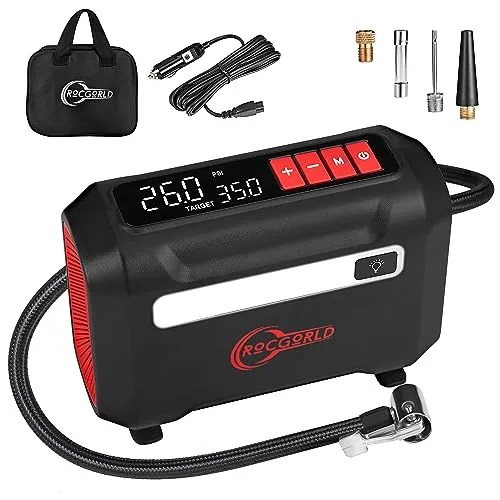
The ROCGORLD R8 is aimed at drivers who want a corded inflator with a clearer readout than a basic single-number gauge. It runs on the same 12V DC setup as most plug-in inflators, but its large dual digital screen shows the live pressure and your target side by side, so you are not switching between modes to see the number climbing. ROCGORLD lists it as roughly 3 times faster than a typical 12V inflator, which matters more when you are refilling all four tires than when you are just topping off one after a slow leak.
Like the AstroAI above, it needs a working 12V outlet to run rather than a built-in battery, and the included nozzle set extends its use to bikes, sports balls, and motorcycle tires in addition to car tires.
Pros:
- Dual digital screen shows current PSI and target PSI at once
- Rated about 3 times faster than a standard 12V inflator
- Works on cars, bikes, balls, and motorcycles with the included nozzles
- Compact enough to store in a glovebox or trunk pocket
Cons:
- Corded 12V design only, with no battery-powered option
- Bright red housing stands out more than a plain black pump if that matters to you
You can check current pricing and buy this one by clicking here.
OlarHike Tire Inflator Portable Air Compressor (Dual Power)
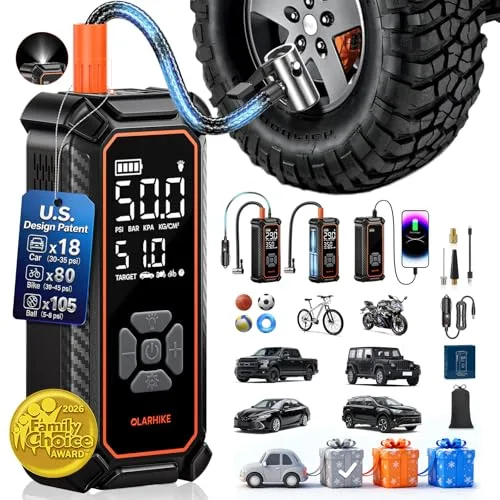
The OlarHike is the dual-power option on this list: it runs on a set of three built-in 2000 mAh battery cells or plugs straight into a 12V outlet, so a drained battery does not leave you without a working pump. That flexibility is useful for topping off a tire away from the car, like a bike tire in the garage, without running a cord to it.
A digital display shows live PSI (and other pressure units) as the tire fills, and preset modes for car, bike, ball, and motorcycle tires cut out the guesswork of picking a target pressure. Because it is battery-based, actual runtime and how many tires you can fill on one charge depend on how depleted the tires are before you start and how cold it is outside, so treat the manufacturer’s per-charge estimate as a best case rather than a guarantee.
Pros:
- Dual power: built-in rechargeable battery or 12V DC outlet
- Digital display with preset inflation modes for car, bike, ball, and motorcycle
- Usable away from the vehicle since it does not have to stay plugged in
- Priced in line with the corded options above
Cons:
- Battery runtime drops in cold weather and with repeated use between charges
- Slightly bulkier than a basic corded pump because of the internal battery pack
You can check current pricing and buy this one by clicking here.
How to Choose the Right Tire Inflator for Your Car
Most passenger car tires need somewhere between 30 and 35 PSI, and light trucks and SUVs can run higher, so look for an inflator rated to at least 100 PSI even though you will rarely fill past 40. A gauge that reads in 1 PSI increments is accurate enough for daily use; you do not need shop-grade precision for a home pump.
Corded 12V inflators like the AstroAI and ROCGORLD above only run while connected to a live power outlet, which is fine if you always inflate at the car but not useful for a bike tire in the garage or a pool toy in the backyard. A dual-power or battery-only model like the OlarHike trades that limitation for a battery you have to remember to recharge.
Nearly every car uses a standard Schrader valve, the same type found on most bike tires and sports balls, so any inflator with the stock nozzle threads on without an adapter. If you also inflate a road bike with Presta valves or a low-pressure item like a paddleboard, check that the included nozzle kit covers that valve type before you buy.
Do not use the number molded into the tire’s sidewall as your target pressure; that figure is the tire’s maximum rating, not the recommended pressure for your vehicle. The correct number is on a sticker inside the driver’s door jamb, and it is usually lower than the sidewall max. If a tire keeps drifting low between fills, a slow leak rather than temperature swings may be the real cause; our guide on fixing a leaking tire air valve covers the most common source, and a tire patch kit can handle a small puncture without a shop visit.
Frequently Asked Questions
How Do Tire Inflators Work?
A tire inflator draws in ambient air and forces it through a hose and nozzle into the tire, using either a small electric motor and piston running off a 12V outlet or the same mechanism powered by an internal battery. A digital or analog gauge tracks the pressure inside the tire as it fills, and models with auto shut-off stop the motor once the reading matches your target PSI.
Are Portable Tire Inflators Reliable for Everyday Use?
Yes. For routine top-offs and seasonal pressure checks, a portable inflator is reliable and accurate enough for daily use, since most digital gauges read within about 1 PSI of a shop gauge. For a serious leak or a tire that will not hold air at all, a portable inflator only buys you time; get the tire inspected rather than relying on repeated top-offs.
Can a Car Tire Inflator Be Used on Bike Tires and Sports Balls?
Most car tire inflators ship with extra nozzles for Presta valves, needle-style ball nozzles, and cone adapters, so the same pump that handles your car tires can usually inflate a bike tire, a basketball, or a pool toy. Just confirm the pump’s maximum PSI is high enough for a road bike tire, since some run well above 80 PSI, and that it can also dial down low enough that you will not overinflate a ball or a soft-sided item.
How Fast Do These Inflators Fill a Tire?
Fill time depends more on how low the tire started than on the inflator’s rated speed, but a corded 12V pump typically brings a passenger tire from around 20 PSI to 35 PSI in two to four minutes. Manufacturer claims like 3 times faster describe a comparison against a slower inflator in the same lineup rather than an absolute time, so treat the exact minutes on the box as a rough estimate.
Do These Inflators Have an Emergency LED Light?
Many portable tire inflators, including two of the three reviewed above, include a small built-in LED light meant for finding the valve stem or reading the gauge in the dark. It is a convenience feature rather than a true worklight, so keep a separate flashlight in the car for anything beyond illuminating the wheel you are working on.
What PSI Should I Inflate My Car Tires To?
Inflate to the number on the sticker inside your driver’s door jamb or in the owner’s manual, not the number stamped on the tire’s sidewall; the sidewall figure is the tire’s maximum pressure rating, not the recommended setting for your vehicle. Most passenger cars call for somewhere between 30 and 35 PSI, and this can differ between the front and rear axles on some vehicles, so check both if your placard lists two numbers.
Conclusion
All three inflators here handle the same basic job, getting a tire back to the right pressure without a trip to a gas station, but they fit different situations. The AstroAI AIRUN H is the simplest corded option for a driver who wants one pump in the trunk. The ROCGORLD R8 adds a clearer dual display and faster fill times on the same 12V setup. The OlarHike trades the cord for a rechargeable battery, so it also works away from the car. Pick based on how and where you will actually use it, and inflate to the pressure on your door jamb sticker, not the tire’s sidewall maximum.
Products related to this article
Sponsored / affiliate links. As an Amazon Associate I earn from qualifying purchases. I may earn additional commission from eligible campaigns.