Car HVAC Diagnostic Scanner Review: Worth Buying for Home Use?
A car HVAC diagnostic scanner is worth buying only if your vehicle supports HVAC module access and you need to diagnose recurring electronic climate faults; for simple refrigerant leaks or bad blend doors, it usually is not. Guessing wrong can send you toward the wrong repair, waste money on parts, and leave the cabin problem untouched. This guide explains which HVAC codes, live data, and actuator commands these scanners can read, which DIY drivers actually benefit, and when to skip the purchase.
Verdict
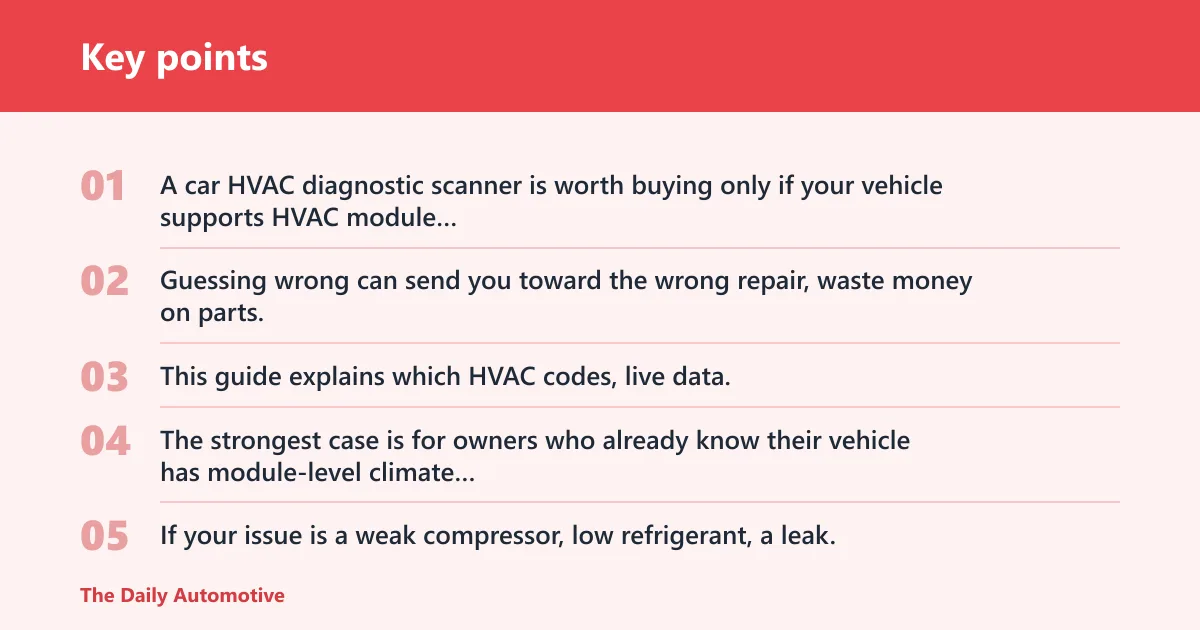


The strongest case is for owners who already know their vehicle has module-level climate control coverage and who expect to use bidirectional tests, live data, or reset functions more than once. If your issue is a weak compressor, low refrigerant, a leak, or a sticking door on a simple system, a scanner alone is the wrong first buy.
Specs at a glance
| Product | Type | Price | Notable listing detail | Honest drawback |
|---|---|---|---|---|
| Autel MaxiCOM MK808BT PRO | Wireless, bidirectional, full-system scanner | $519.00 | Bluetooth VCI, active testing, all-system diagnosis | High price for buyers who only need basic code reading |
| LAUNCH X431 CRP919XBT | Wireless, bidirectional, ECU coding scanner | $475.15 | All-system scans, component tests, ECU coding | More tool than many home users need for one-off HVAC faults |
| TOPDON X800BT | Wireless, bidirectional, full-system diagnostic tool | $349.99 | Active tests, full-system diagnostics, lifetime free updates | Still expensive compared with basic OBD2 readers |
Who it
This purchase makes sense for DIY owners chasing recurring electronic climate faults on 1996 and newer OBD2 vehicles, especially when the HVAC control module is accessible and the symptom points to code storage, sensor data, or actuator control. It is a poor fit when the problem is obviously mechanical or sealed-system related.
Vehicles with accessible HVAC modules
Some vehicles allow module-level HVAC data through enhanced software, while others hide climate faults behind manufacturer-specific coverage. A generic OBD2 tool may still read engine codes, but that does not mean it can see the climate control module. Coverage varies by make, model, trim, and software level.
When a basic code reader is enough
If the only job is reading a check-engine light, a budget OBD2 reader is usually enough. Hyper Tough HT100 is for 1996 and newer OBD2 vehicles and is listed at $24.18, which fits that narrow use case better than a more expensive scanner. A scanner only starts paying for itself when you need deeper system access, live data, or actuator control.
What works
These tools work best when the fault is electronic and the vehicle exposes the right module data. They can read climate control trouble codes, show live data on some models, and run bidirectional tests on higher-end units. That is useful for narrowing down a faulty sensor, actuator, or command issue before you buy parts.
Reading climate control trouble codes
A true car HVAC diagnostic scanner may read HVAC-module codes that a generic code reader cannot see. That matters when the cabin temperature is wrong, airflow is inconsistent, or the control head sets its own fault code without triggering the check-engine light. On supported vehicles, the scan result can point you toward the correct branch of diagnosis.
Live data and actuator commands
Bidirectional scan tools can send active commands to actuators and sometimes request compressor operation. That is the step that separates simple code reading from real component diagnosis. Higher-end tools cost more because they do more than show text on a screen; they can sometimes command a blend door actuator to move and help confirm whether the response matches the command.
Say your driver-side vents stay hot while the passenger side blows cold after a battery disconnect. A bidirectional command test can help determine whether the blend door motor responds at all, or whether the fault is in the control side rather than the refrigerant side.
RepairSolutions2 app pairing
Some consumer scanners pair with phone apps for code explanations and repair guidance. Hyper Tough HT300 works with RepairSolutions2 app support, and FIXD OBD-II Gen II is listed as a wireless vehicle health monitor at $39.99. That app-based workflow is convenient for home use, but convenience is not the same as module depth.
What does not?
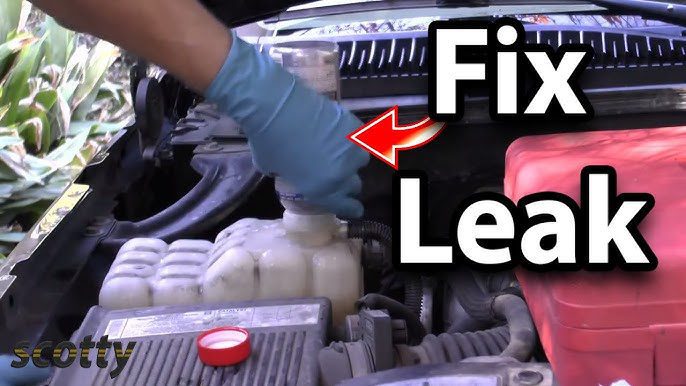
These scanners do not replace leak detection or physical HVAC inspection. Low refrigerant, leaking seals, failed compressors, clogged condensers, and broken doors can all create cabin complaints that a scanner cannot fix on its own. If the system is empty or leaking, the correct next step is a pressure check and leak finding, not more code hunting.
Low refrigerant and leak diagnosis
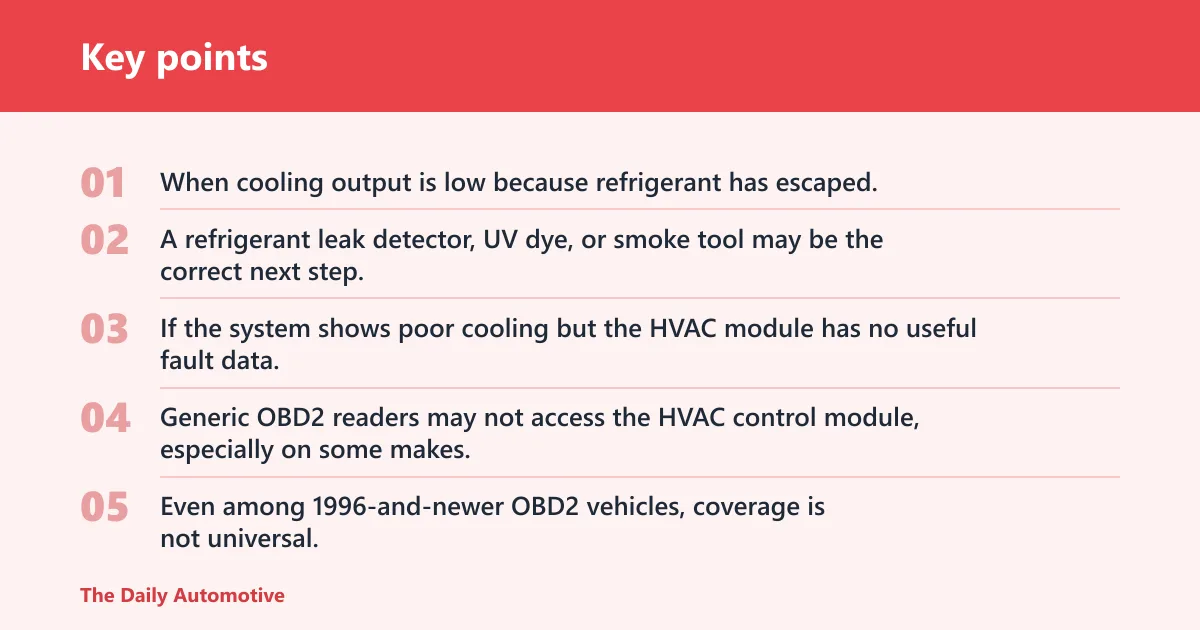
When cooling output is low because refrigerant has escaped, the scanner is only a side tool at best. A refrigerant leak detector, UV dye, or smoke tool may be the correct next step. If the system shows poor cooling but the HVAC module has no useful fault data, a scanner-only approach can waste time.
Vehicles with limited module coverage
Generic OBD2 readers may not access the HVAC control module, especially on some makes, trims, and older vehicles. Even among 1996-and-newer OBD2 vehicles, coverage is not universal. That means the buyer risk is not whether the tool turns on; it is whether it can actually reach the system that matters.
Mechanical faults a scanner will not fix
A scanner cannot repair a stripped blend door, a seized actuator gear, or a blocked refrigerant path. Blend door actuators are common failure points because they can cause temperature mixing or airflow problems, but the fix still comes down to inspection and repair. Code data can point you there; it cannot move the door for good.
HVAC decision matrix
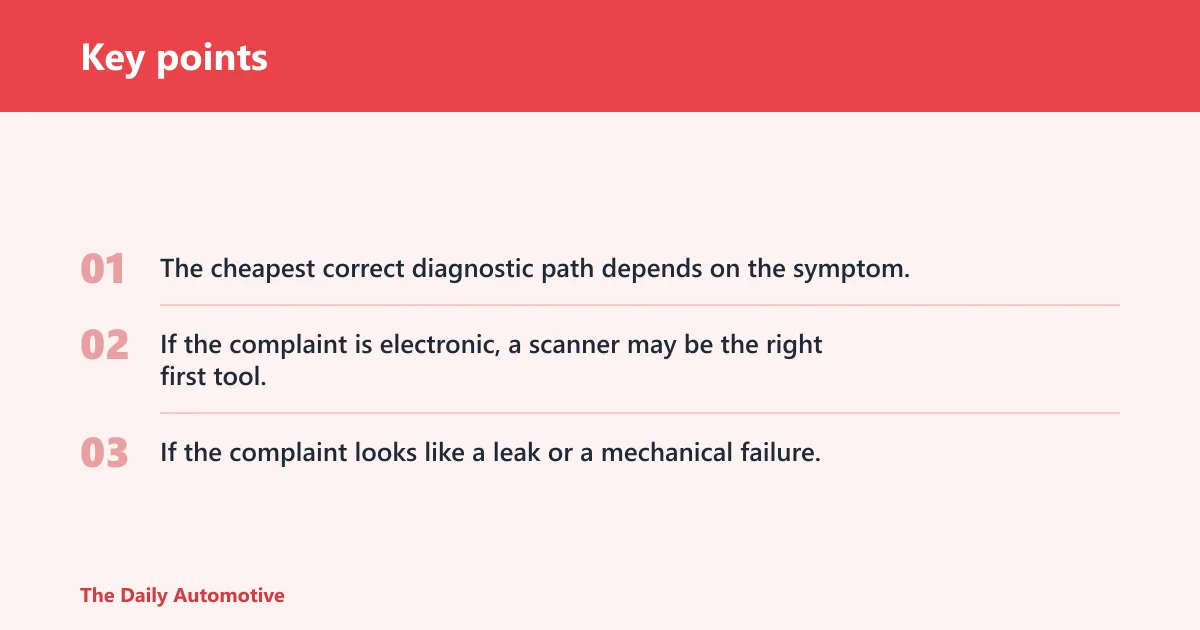
The cheapest correct diagnostic path depends on the symptom. If the complaint is electronic, a scanner may be the right first tool. If the complaint looks like a leak or a mechanical failure, stop paying for diagnostics you do not need.
| Symptom | Likely cause | Scanner usefulness | Other tool needed | When to stop DIY and pay a shop |
|---|---|---|---|---|
| Air blows warm on all vents | Low refrigerant, compressor issue, or leak | Low unless the module stores a related code | Manifold gauges, leak detector, UV or smoke tool | If pressure readings are abnormal or the system needs evacuation and recharge |
| Driver side hot, passenger side cold | Blend door actuator or calibration fault | High on supported vehicles with actuator commands | Trim tools, access to the actuator area | If the actuator is buried, seized, or the door is broken inside the box |
| Fan works, temperature will not change | Blend door, temperature sensor, or control module fault | Medium to high with live data and codes | Basic hand tools, service information | If the module is not readable or calibration is required after repair |
| Air only comes from one vent mode | Mode door actuator fault | High if the tool can command mode doors | Access tools, possibly a scan tool with bidirectional tests | If the HVAC case must be opened to repair the door |
| AC light comes on, cooling is weak | Low refrigerant, pressure switch issue, compressor control issue | Medium for codes, low for leak location | Pressure gauges, leak detection tools | If the leak is not visible or the system needs professional recovery equipment |
| No blower on any speed | Blower motor, resistor, relay, or fuse fault | Low unless the module logs electrical faults | Multimeter, wiring checks | If the wiring is damaged or the dash must come apart deeply |
| Intermittent hot and cold cycling | Sensor fault, actuator miscalibration, control logic problem | High with live data and commands | Service data, possibly calibration procedure | If the scan tool cannot access the module or calibration fails |
| No fault codes, but cabin comfort is poor | Mechanical restriction, low charge, blocked airflow, or calibration issue | Low unless live data shows a clear mismatch | Inspection, gauges, leak tools, cabin filter check | If the symptom persists after basic checks and you lack HVAC service tools |
Can a regular OBD2 scanner read HVAC faults?
Sometimes, but not reliably. A regular OBD2 scanner is built around generic emissions and powertrain access, while HVAC faults often live in a separate module. If the vehicle exposes that module through the tool’s software coverage, you may see climate codes; if not, the scanner will miss the problem entirely.
Generic code reading versus module access
Generic code readers are a good starting point on 1996-and-newer OBD2 vehicles, but they usually stop at engine and emissions data. HVAC control modules often store module-specific fault codes that need enhanced software or manufacturer-level coverage. That is the core divide most product pages gloss over.
Why some cars need enhanced software
Coverage depends on how the vehicle manufacturer published the module data and how the tool’s software supports it. A low-cost reader can still be useful, but it may be blind to the climate system. That is why a tool can be fine for one car and nearly useless for another from the same driveway.
Where blend door actuators fit
Blend door actuators sit in the middle of many HVAC complaints because they directly control temperature mixing. A scanner with bidirectional tests can command the actuator and confirm movement. Without that function, diagnosis becomes more of a guess-and-check process, especially when the dash symptoms look similar across several faults.
A common first-timer mistake is buying a scanner for a cabin that only has a refrigerant leak. The display may show nothing useful, because the real problem is in the sealed system, not the control module. In that case, leak detection gear or a shop diagnosis is the cheaper path.
Should you buy it?
Buy an HVAC-capable scanner when the vehicle supports it and the problem is likely to return. Skip it when you only need one check-engine read, when the car has obvious low-refrigerant symptoms, or when your model’s HVAC module is not supported by the tool. The value comes from repeated use, not from owning one more gadget.
Budget versus midrange price tiers
For basic code reading, budget tools are enough. Hyper Tough HT500 is a Bluetooth OBD2 scan tool listed at $55.12, which is the sort of price that makes sense for occasional home diagnostics. At the next level, OTOFIX D1 Lite is a 7-inch automotive diagnostic scanner priced at $399.00 and includes 38+ reset services, which places it in the heavier-duty home-user tier.
Midrange tools are for owners who want more than stored codes. FOXWELL NT650 PRO offers 25+ maintenance services and lifetime free updates via Wi-Fi, while the OTOFIX D1 Lite and the two bidirectional launch-style tools move further into module access and active testing. That added capability is what you pay for.
When the purchase pays for itself
The math changes if you expect recurring HVAC faults. One dealer or specialty-shop diagnosis can approach the cost of a stronger consumer scanner, especially when the vehicle needs repeated module reads or actuator commands over time. If the fault is a one-time leak or a single mechanical repair, paying a shop once is usually cheaper.
Best fit for home use
Home use fits best when the scanner supplements normal DIY work instead of replacing it. The right buyer is already comfortable checking fuses, inspecting connectors, and reading service data, and wants module access for a specific vehicle. For that owner, the scanner can save time and reduce parts guessing.
Choose Autel MaxiCOM MK808BT PRO if… / Choose TOPDON X800BT if… / Choose LAUNCH X431 CRP919XBT if…
| Model | Best for | Key detail from the listing | Price | Honest drawback |
|---|---|---|---|---|
| Autel MaxiCOM MK808BT PRO | Buyers who want a full-system wireless tool with strong active-test capability | Bidirectional control, all-system diagnosis, Bluetooth VCI | $519.00 | Cost is hard to justify if you only need basic HVAC or engine code reading |
| TOPDON X800BT | DIY owners who want bidirectional testing and a lower entry price than the top tier here | Bidirectional scan tool, 34 reset service, full-system diagnostic, lifetime free update | $349.99 | Still a significant spend for a problem that might turn out to be a leak or a mechanical fault |
| LAUNCH X431 CRP919XBT | Users who want all-system scans plus ECU coding and broader service support | Wireless bidirectional scan tool, ECU coding, 35+ services, all systems diagnostic | $475.15 | More capability than many DIY climate jobs require |
Choose the Autel if you want the most complete wireless, full-system route of the three and expect to use active testing often. Choose the TOPDON if you want bidirectional coverage at the lowest listed price in this comparison. Choose the LAUNCH if ECU coding and broad all-system coverage matter alongside HVAC diagnosis.
Frequently asked questions
Do I need a special scanner to diagnose car HVAC problems?
Only if you need HVAC-module access or bidirectional tests. A basic OBD2 reader can handle engine codes, but many climate faults live in a separate module. If the vehicle hides that data, you will need an enhanced scanner with broader software coverage or another diagnostic path.
Will an OBD2 scanner read climate control trouble codes?
Sometimes. On some vehicles, an OBD2-compatible scan tool can access climate codes through enhanced software. On others, the same tool will only see generic powertrain data. The deciding factor is vehicle-specific support, not the plug shape or the fact that the car is 1996-and-newer.
Is a car HVAC diagnostic scanner worth buying for home use?
It is worth buying for home use when you expect repeated electronic climate faults and your vehicle supports the needed module access. If the likely problem is low refrigerant, a leak, or a broken door in the HVAC box, the scanner is usually the wrong first purchase.
What HVAC problems can a scanner actually diagnose?
It can help with stored HVAC codes, sensor faults, actuator problems, and command-response checks on supported vehicles. It cannot directly find every leak or repair a mechanical failure. The more the symptom depends on electronics, the more useful the scanner becomes.
How much should I spend on a scanner for AC and heater issues?
Spend as little as possible if you only need basic code reading. Move into midrange or higher-end tools only when you need module access, live data, or bidirectional control. Hyper Tough HT100 and HT500 sit in the budget tier, while the Autel, LAUNCH, and TOPDON tools are for deeper diagnosis.
Which HVAC scanner features matter for DIY repairs?
Prioritize module access, live data, bidirectional actuator tests, and clear code descriptions. App support can help if you prefer a phone-connected workflow, as with some consumer scanners. Maintenance resets are useful, but only after you confirm the tool can actually reach the climate module on your vehicle.
Can these scanners do more than read check engine codes?
Yes. Better tools can scan multiple vehicle systems, run service resets, and execute active tests. That broader coverage is why they cost more than a simple code reader. For HVAC work, the useful feature is not the display itself; it is whether the tool can reach the module you need.
Products related to this article
Sponsored / affiliate links. As an Amazon Associate I earn from qualifying purchases. I may earn additional commission from eligible campaigns.