USB Cooler for Car: True USB Coolers vs 12V Fridges
A true USB cooler for car use is usually a small thermoelectric box for drinks and lunch, while a 12V compressor fridge is the better pick for stronger cooling, longer trips, and food safety. Pick the wrong type and you pay twice, once at purchase and again in ice, battery strain, or spoiled food. This guide sorts USB-style coolers from 12V fridges and matches each to trip length, cabin heat, and overnight battery risk.
| Factor | True USB Coolers | 12V Fridges | Winner |
|---|---|---|---|
| Cooling method | Thermoelectric cooling; usually chills, not freezes | Active refrigeration with compressor control; can reach fridge or freezer temperatures | 12V Fridges |
| Hot-weather performance | Output drops as ambient temperature rises; ΔT becomes the limiter | Holds setpoint far better in heat | 12V Fridges |
| Food-safety use | Okay for drinks and short-stay snacks if the load starts cold | Better for perishables that need to stay below 40°F (4°C) | 12V Fridges |
| Power and battery risk | Lower draw, but still depends on socket quality and run time | Needs battery protection and a sound 12/24V DC setup for overnight use | Tie |
| Upfront and total cost | Cheaper at purchase, but limited cooling can push you back to ice | Higher upfront cost, lower ice spend, lower spoilage risk | Depends on use case |
USB cooler vs 12V fridge: the core trade-off
True USB Coolers are for short, simple cooling jobs. 12V Fridges are for holding temperature, not guessing at it. That difference matters most when the cabin gets hot, the trip runs long, or the food needs to stay out of the danger zone.
What a thermoelectric cooler can realistically do
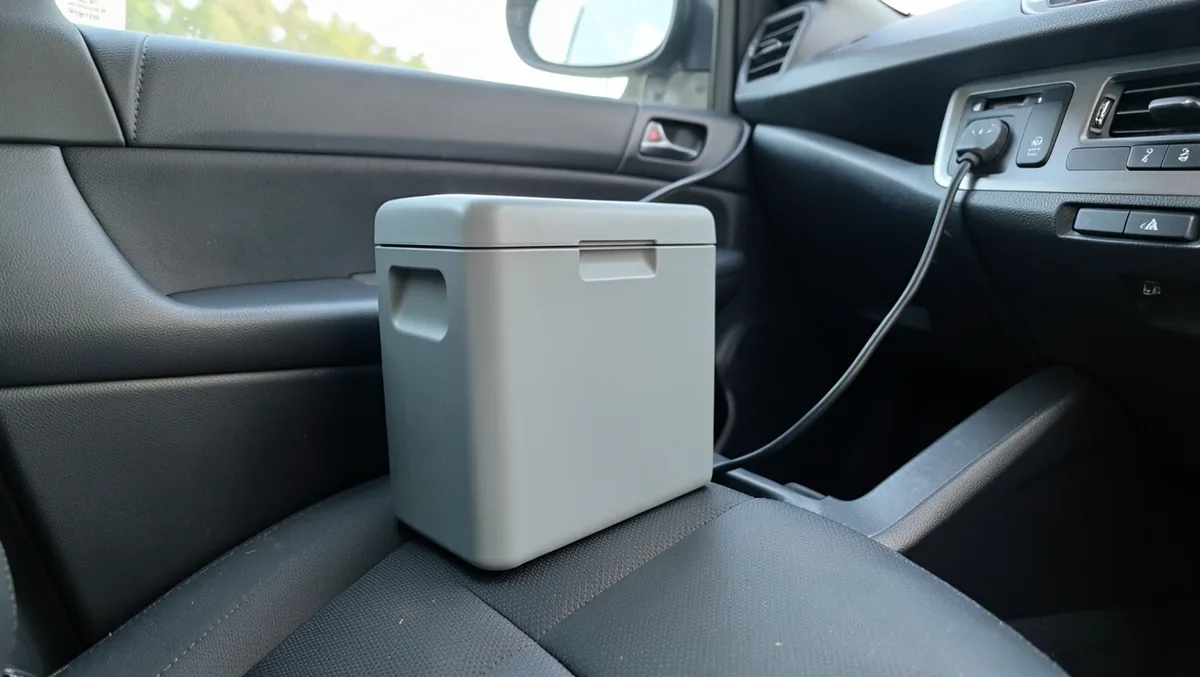
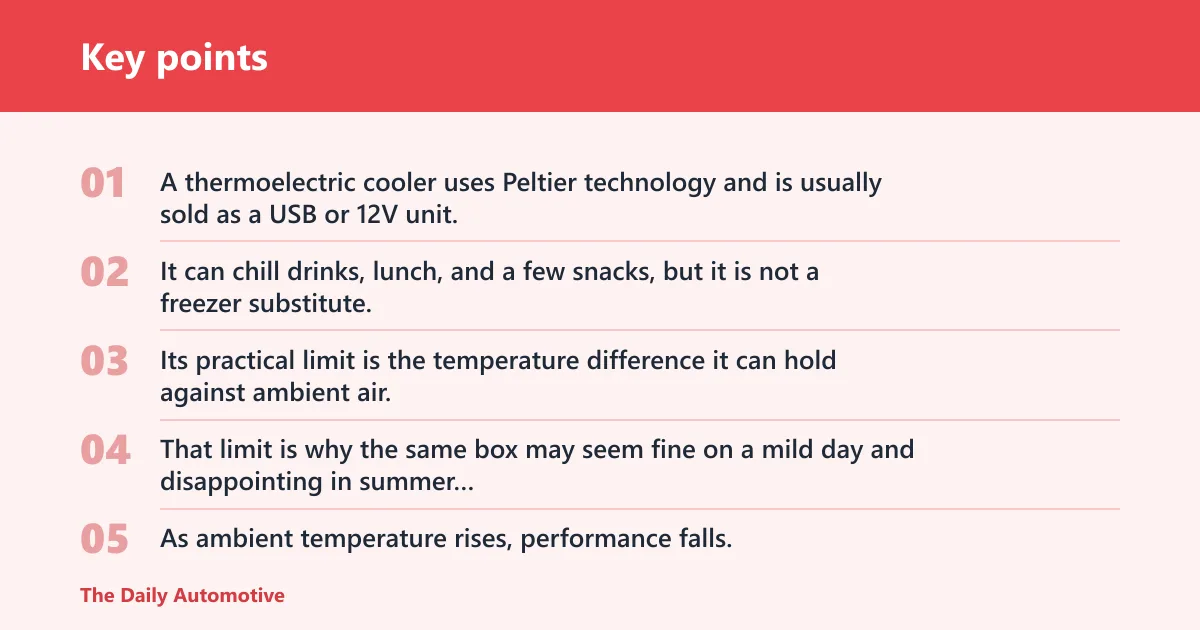
A thermoelectric cooler uses Peltier technology and is usually sold as a USB or 12V unit. It can chill drinks, lunch, and a few snacks, but it is not a freezer substitute. Its practical limit is the temperature difference it can hold against ambient air.
That limit is why the same box may seem fine on a mild day and disappointing in summer traffic. As ambient temperature rises, performance falls. If the cabin starts hot, the cooler has to fight that heat before it can chill the contents.
What a compressor fridge can realistically do
A 12V portable fridge uses a compressor or thermoelectric system to actively refrigerate contents, but the compressor version is the one that gives you setpoint control and real fridge or freezer temperatures. Some dual-zone models can run one compartment at 0°F while keeping the other side at fridge temperatures.
That is the key buyer difference. A compressor fridge does not depend on ice packs to stay cold, so it is the better tool for food that must hold a narrow temperature range over hours or days.
Why ambient heat changes the answer
Ambient temperature is not a side note. It changes whether a thermoelectric cooler is a convenience item or a weak link in food storage. Hot weather hurts thermoelectric performance far more than compressor performance.
Picture a compact hatchback parked in full sun with lunch, yogurt, and a few drinks inside. A thermoelectric box may still cool the drinks some, but a compressor fridge is the safer choice if the goal is to keep perishables below 40°F (4°C).
Cooler decision matrix
| Device type | Realistic use case | Failure mode |
|---|---|---|
| True USB Coolers | Commuters, short errands, lunch, drinks, and short parked stops | Cabin heat overwhelms cooling; contents stay cool-ish instead of safe |
| True USB Coolers | Compact cars where footprint matters more than long runtime | Capacity feels too small once you add drinks, snacks, and ice packs |
| 12V Fridges | Road trips, camping, overnights, EV owners, and frequent travelers | Poor wiring or no battery protection can drain the vehicle battery |
| 12V Fridges | Perishables, meal prep, and trips where 40°F (4°C) matters | Bad fitment or undersized capacity makes loading awkward |
A common first-timer mistake is buying by plug type instead of cooling method. A unit labeled USB can still be thermoelectric, and a 12V socket unit can still be weak if it is not a compressor fridge. The label tells you about power input, not performance class.
How the two cooling systems work
Thermoelectric and compressor systems solve different problems. One is a low-complexity chiller. The other is active refrigeration with a controlled setpoint, and that difference shows up in heat, runtime, and food safety.
Thermoelectric cooling and ΔT limits
Thermoelectric coolers typically use the temperature differential, or ΔT, between the inside of the box and the surrounding air. The higher the ambient temperature, the harder it is to maintain a useful delta. That is why these units often chill, but do not freeze, and why their performance fades in summer heat.
They are often fine for drinks and short trips. They are not the right answer when you need steady refrigeration in a parked car, a hot cabin, or a multi-day road trip.
Compressor refrigeration and setpoint control
A compressor fridge cycles refrigerant to hold a chosen temperature. That active control is what lets it reach fridge temperatures reliably, and on many models freezer temperatures too. It is the only option of the two that can credibly serve as a mobile fridge/freezer for long trips.
Capacity matters here too. Portable models are commonly sold in liters or quarts, and the right size depends on the vehicle you are fitting. Too small wastes the advantage; too large wastes space and power.
Why the power source matters
Both categories may claim 12V compatibility, but vehicle power is not unlimited. A 12/24V DC input has to fit the socket, the fused circuit, and the vehicle’s battery protection strategy. Some portable fridges also add AC input, which helps when you want pre-cooling at home.
USB-style coolers usually look simpler here, but that simplicity cuts both ways. If the unit is being fed from a weak outlet or a long thin cable, voltage drop becomes part of the real-world limit.
Can a USB car cooler keep food safe?
Only under narrow conditions. A USB car cooler can hold drinks and short-stay snacks at a serviceable temperature, but it should not be treated as guaranteed safe storage for perishables unless it can keep the load below 40°F (4°C). In hot weather, that is harder than many buyers expect.
The 40°F / 4°C threshold
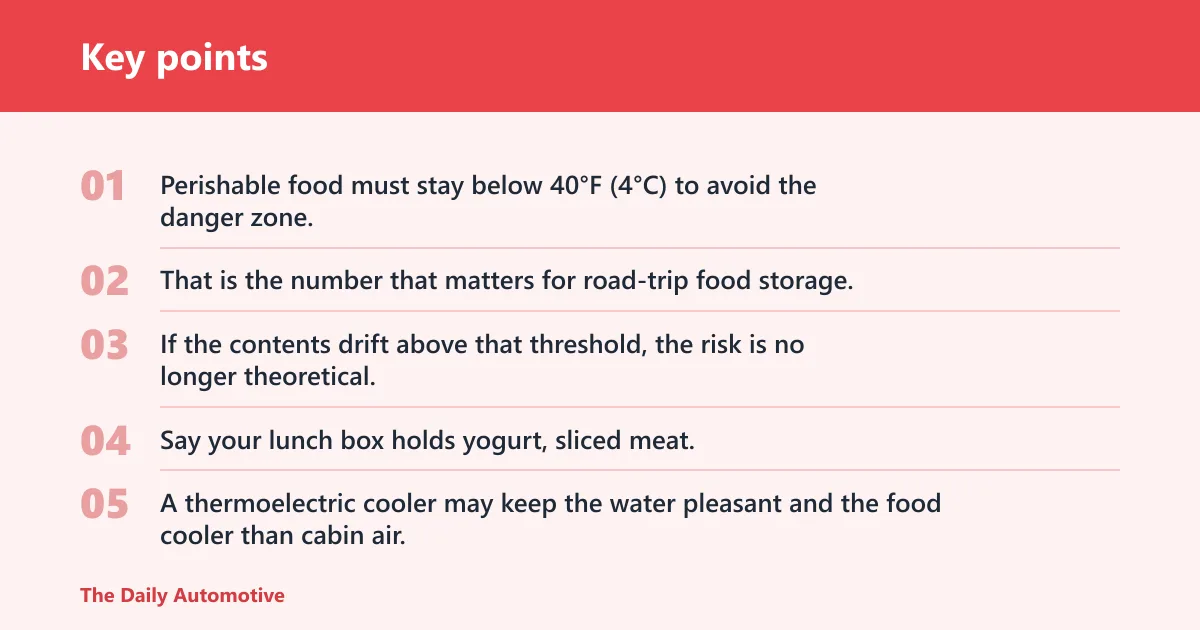
Perishable food must stay below 40°F (4°C) to avoid the danger zone. That is the number that matters for road-trip food storage, not the marketing term on the box. If the contents drift above that threshold, the risk is no longer theoretical.
Say your lunch box holds yogurt, sliced meat, and a bottle of water for a two-hour commute. A thermoelectric cooler may keep the water pleasant and the food cooler than cabin air, but it is not the same as a compressor fridge that can hold a set temperature through a hot afternoon.
Drinks, snacks, and short stops versus perishables
For drinks, fruit, and sealed snacks, True USB Coolers can be enough. For eggs, dairy, cooked proteins, or anything you plan to carry through a long workday, a 12V Fridges setup is the safer category. The difference is plain once the car sits in the sun.
Capacity also changes the answer. A small box that barely fits a lunch and two bottles is useful for commuting, but it is not a road-trip pantry. Check the manufacturer’s listed liters or quarts before you buy.
What happens in hot weather
Hot weather is where thermoelectric units expose their limits. Their cooling falls as ambient temperature rises, so the same cooler that seems acceptable in mild weather may struggle to stay below the food-safe threshold on a summer day.
That is why ambient temperature belongs in the buying decision, not just the weather forecast. If the car will sit parked or the trip will happen in heat, the safer option is the compressor fridge.
Will a car cooler drain my battery overnight?
It can, especially if you run a 12V fridge from a parked vehicle without battery protection. A compressor fridge typically draws 40-50 watts while the compressor runs, and real-world daily consumption averages 30-45 amp-hours from a 12V battery. The risk rises with poor wiring, voltage drop, and weak batteries.
12/24V DC input and fused circuits
Check the vehicle socket rating before you buy. A portable fridge needs a fused circuit that can handle the load, and 12/24V DC compatibility matters if you switch between vehicles. A loose or undersized socket can become the weak point long before the fridge itself is the problem.
Battery protection features to look
Battery protection is not a luxury feature. It is the control that helps prevent the fridge from draining the vehicle battery too far overnight. If you plan to sleep in the vehicle, leave the cooler running for hours, or park for a long stretch, this feature deserves attention.
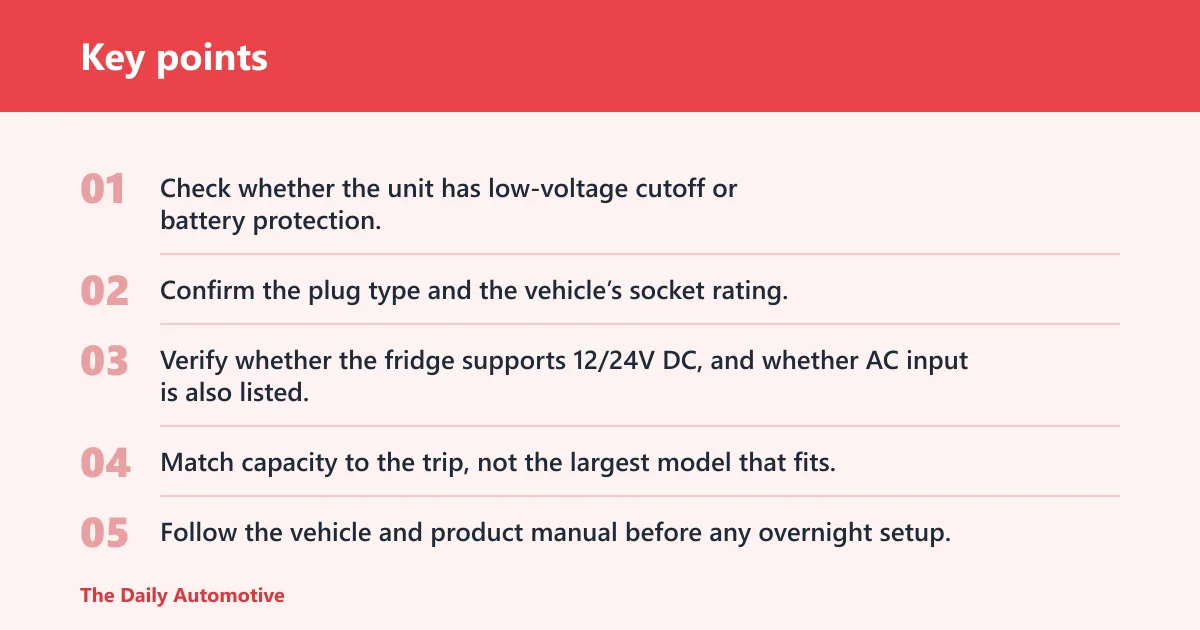
- Check whether the unit has low-voltage cutoff or battery protection.
- Confirm the plug type and the vehicle’s socket rating.
- Verify whether the fridge supports 12/24V DC, and whether AC input is also listed.
- Match capacity to the trip, not the largest model that fits.
- Follow the vehicle and product manual before any overnight setup.
Voltage drop and parked-car use
Voltage drop matters because the fridge only sees what reaches the socket. Long cable runs, weak connectors, and poor vehicle charging conditions can change how the unit behaves when parked. That is why overnight use needs more than a plug that fits.
If the fridge is for an EV, a hybrid, or a vehicle that sits long enough for accessory draw to matter, assume the battery-protection feature is part of the purchase decision. Do not treat it as optional trim.
Cost of ownership over 12 months
Upfront price is only part of the bill. Ice spend, battery accessories, and food-spoilage risk can change which option is cheaper over a year. In this category, the first purchase price can be misleading.
| Cost item | True USB Coolers | 12V Fridges | Winner |
|---|---|---|---|
| Upfront price | Lower purchase price | Quality models start around $300; premium units can reach $600-$1,200 | True USB Coolers |
| Ice spend | Usually low if you rely on passive packs, but cooling is limited | Little or no ice spend once the fridge is in use | 12V Fridges |
| Likely battery accessories | Usually fewer extras | Often benefits from battery protection or a dedicated power setup | True USB Coolers |
| Food-spoilage risk over 12 months | Higher if used for perishables in heat or on long trips | Lower for food that needs stable refrigeration | 12V Fridges |
Some buyers focus on the sticker price and stop there. That is where the cheaper cooler can become the more expensive choice. The article’s example math puts a fridge ahead in roughly 16 months when frequent use replaces repeated ice purchases and spoiled food losses.
For a weekend-only driver, that calculation may not matter. For someone who uses chilled storage more than 15 nights per year, the fridge is the smarter buy.
Choose True USB Coolers if… / Choose 12V Fridges if…
Choose True USB Coolers if… you want a small box for drinks, lunch, and short stops; you drive in mild weather more often than extreme heat; you care more about compact size and lower upfront cost than about precise temperature control; and you do not need to hold perishables below 40°F (4°C) for hours.
Choose 12V Fridges if… you take road trips, camp, sleep in the vehicle, or haul food for a full day; you need consistent cooling in hot ambient temperatures; you want a unit that can reach fridge or freezer temperatures; or you need battery protection for overnight use.
For commuters and very short trips, True USB Coolers are the practical pick. For road trips, overnight stays, and food safety, 12V Fridges win on the factors that matter most.


Frequently asked questions
Are USB coolers for cars actually worth it?
Yes, but only for the right job. A USB cooler is worth buying if you want a compact chiller for drinks, lunches, and short errands. It is not worth expecting freezer performance, strong hot-weather control, or safe long-duration storage for perishables.
What is the difference between a USB cooler and a 12V fridge?
A USB cooler is often a thermoelectric unit that chills contents and can be affected by ambient temperature. A 12V fridge uses active refrigeration with setpoint control, can run from 12/24V DC, and can reach fridge or freezer temperatures. They solve different problems.
Can a USB car cooler keep food cold enough for safe storage?
Sometimes for a short window, but not as a default assumption. Perishable food needs to stay below 40°F (4°C), and thermoelectric coolers lose effectiveness as the cabin heats up. For dairy, meat, or cooked leftovers, a compressor fridge is the safer choice.
How much power does a 12V portable fridge use?
A typical 12V compressor fridge draws 40-50 watts while the compressor runs. Real-world daily consumption averages 30-45 amp-hours from a 12V battery, though actual use varies with ambient temperature, set temperature, box size, and how often you open the lid.
Do USB car coolers freeze food or only cool drinks?
Most true USB coolers only cool drinks and lightly chilled food. They use thermoelectric cooling, not compressor refrigeration, so they usually do not freeze. If freezing or real fridge temperatures matter, a 12V compressor fridge is the correct category.
Products related to this article
Sponsored / affiliate links. As an Amazon Associate I earn from qualifying purchases. I may earn additional commission from eligible campaigns.