Are Car Sales Up or Down Right Now? U.S. Market Update
In 2026, car sales are moving in different directions. New-car demand is holding up, but discounts are clustered in slower gas models and some EVs, while used trucks, hybrids, and low-mileage cars stay expensive. Miss that split, and you can overpay or miss a short-lived incentive window. This guide explains which segments are getting cheaper, which are still stretched, and when waiting helps versus hurts.
Are car sales up or down right now in 2026?
The short answer for shoppers
Overall U.S. sales look mixed rather than cleanly up or down. June 2026 new-vehicle volume was projected between 1.35 million and 1.4 million units, with a projected annualized selling pace in the mid-16-million range. That is not a collapse. It is a market where some buyers keep moving, while others pause over monthly payment pressure.
Why the market is moving in different directions at once
The sales mix matters more than the headline. Hybrids are pulling buyers in, EV demand is softer, and some carryover gas models are getting heavier discounts as dealers make room for new arrivals. One showroom can feel hot while another needs price cuts to move inventory.
📊 J.D. Power and GlobalData projected first-half retail sales at 6.42 million. Source: Mid-Year 2026 U.S. Auto Sales Results.
How are U.S. car sales trending this year?
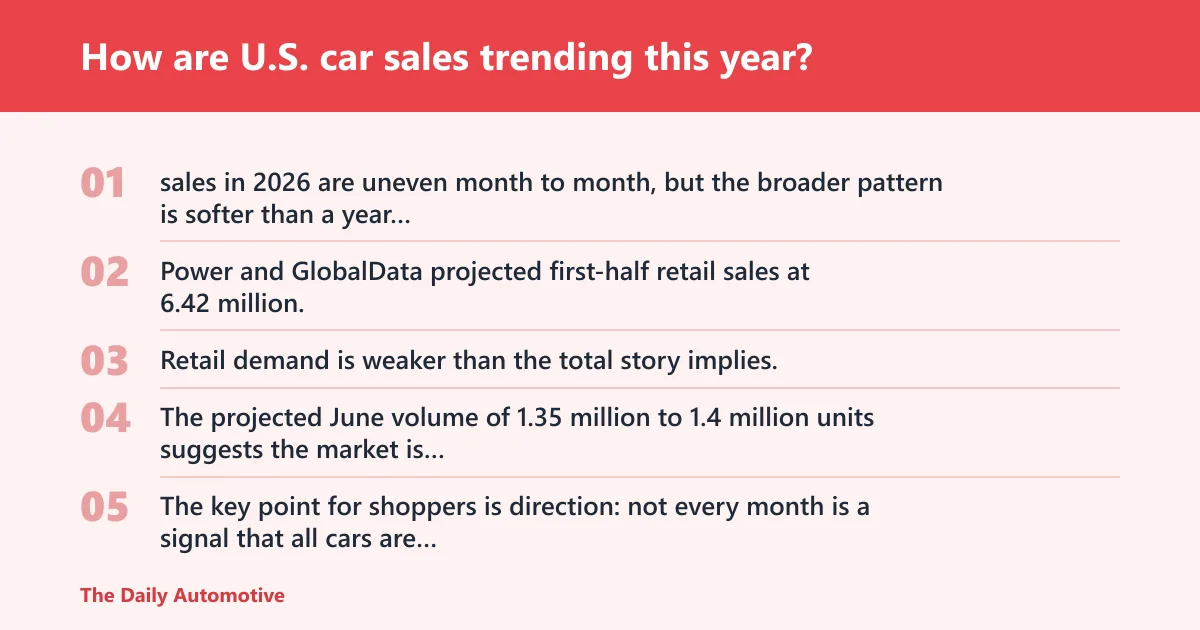
U.S. sales in 2026 are uneven month to month, but the broader pattern is softer than a year ago. J.D. Power and GlobalData projected first-half retail sales at 6.42 million, down 4.1 percent from the first half of 2025. Retail demand is weaker than the total story implies, and fleet or channel noise can blur the read.
Monthly unit totals and year-over-year direction
The projected June volume of 1.35 million to 1.4 million units suggests the market is still active, but not running hot across every segment. The key point for shoppers is direction: not every month is a signal that all cars are cheaper or that demand has evaporated.
What SAAR says about demand
The projected June selling pace landed in the mid-16-million range. That matters because SAAR strips out some seasonal noise and gives a cleaner view of demand than one weak or strong month. A mid-16-million pace points to a market that is steady enough to support inventories, but not strong enough to erase incentives.
Retail demand versus fleet or channel noise
Retail demand is the part shoppers feel most directly. Fleet sales, end-of-quarter pushes, and local dealer stock swings can make a monthly headline look stronger than the showroom floor feels. For buyers, the retail side sets transaction price pressure, lease support, and negotiation room.

Why affordability is still shaping the market
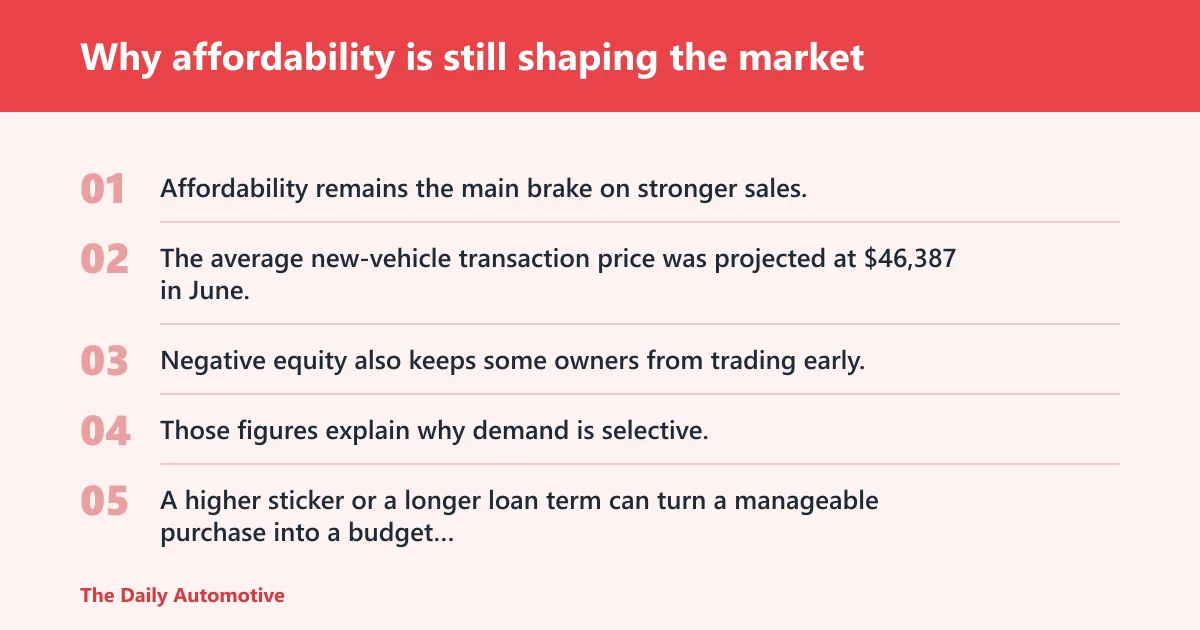
Affordability remains the main brake on stronger sales. The average new-vehicle transaction price was projected at $46,387 in June, the average monthly finance payment at $813, and the average new-vehicle loan rate at 6.66 percent. Negative equity also keeps some owners from trading early, which limits both new and used demand.
Average transaction prices and monthly payments
Those figures explain why demand is selective. A higher sticker or a longer loan term can turn a manageable purchase into a budget strain. Even when the vehicle price barely moves, the monthly payment can shift enough to change a buyer’s choice of trim, drivetrain, or model class.
Loan rates and negative equity
At 6.66 percent, financing remains expensive enough to matter. Buyers rolling negative equity into a new loan face an even steeper payment hit, because the old balance is added on top of the new loan. That is one reason some shoppers are staying put longer, especially if their current vehicle still works.
What payment shock changes in buying behavior
Payment shock pushes shoppers toward shorter feature lists and slower decision-making. It also makes incentive targeting more effective. A cash rebate or low-rate offer can matter more than a small sticker drop, because the monthly number is what many buyers are tracking first.
Which vehicles are selling better in 2026?
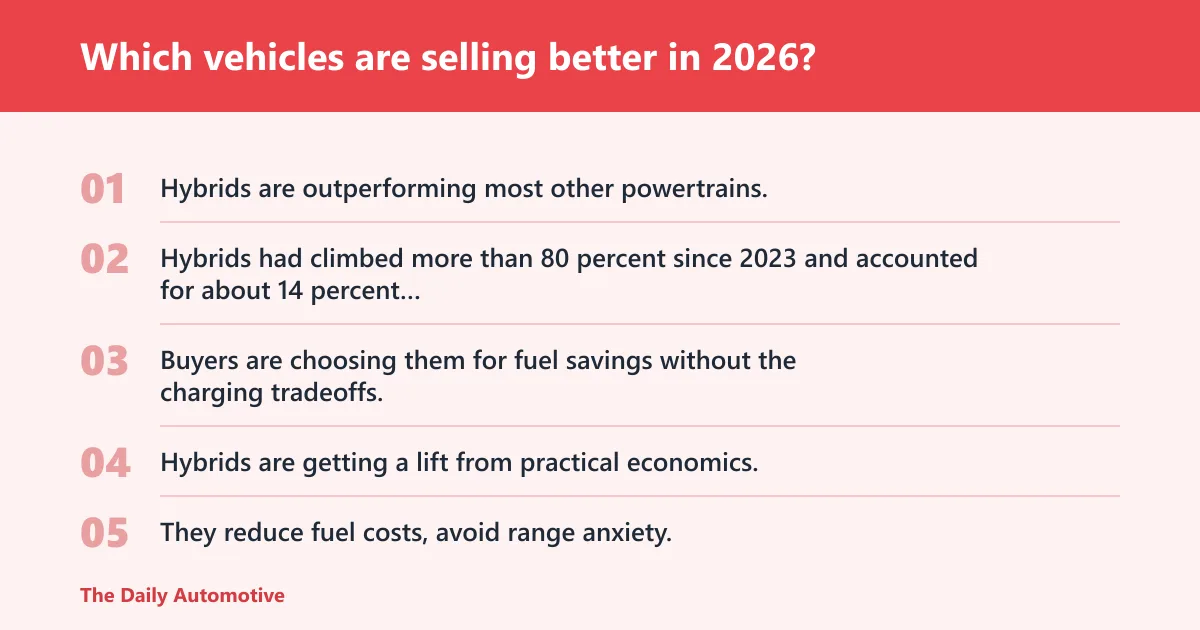
Hybrids are outperforming most other powertrains, while EVs are softer and more incentive dependent. Hybrids had climbed more than 80 percent since 2023 and accounted for about 14 percent of light-vehicle sales earlier in 2026. Buyers are choosing them for fuel savings without the charging tradeoffs.
Hybrids and the reasons demand keeps rising
Hybrids are getting a lift from practical economics. They reduce fuel costs, avoid range anxiety, and often cost less to own month to month than a similarly equipped EV or thirsty gas model once charging, insurance, and financing are considered. That is why hybrid-heavy lineups are holding up better.
Why EV sales are softer
EV demand is softer than hybrid demand, and that softness makes incentives more important. Tax credits and manufacturer discounts can move sales, but the market is more sensitive to subsidy changes than the hybrid market is. When credits shift or trim availability changes, EV transaction prices can swing fast.
Sedans, trucks, and other segment splits buyers should watch
Segment strength is not uniform. Trucks and some popular sedans remain resilient, while slower movers often need more clearance support. That is why two shoppers can see opposite answers to the same question: one model gets a discount, another stays firm because stock is tight or demand is steadier.
Say your local dealer has a carryover gas crossover in a color nobody asked for and six units on the lot. That is the kind of vehicle where a buyer may find a larger discount, especially near month end or during a model-year turnover. A hybrid in the same row may not budge much.
What are brands and model lines telling us?
Brand and model strength is separating by portfolio mix. Toyota Motor North America reported June U.S. sales of 212,793 vehicles, and its electrified sales totaled 122,063 for the month, equal to 57.4 percent of total volume. Hybrid-heavy portfolios are holding up better because they match current buyer demand.
Winner and loser brands
Brands with stronger hybrid and electrified lineups have had more pull with shoppers. Brands leaning harder on slower gas inventory or weaker EV demand face more pricing pressure. That does not mean every model in a winning brand is strong, only that the lineup mix gives it a better base of demand.
Model-level strength versus weakness
Through September 2026, the Ford F-Series remained the best-selling vehicle line at 561,508 sales, and the Toyota Camry was the best-selling car at 260,684. Those results show that trucks and enduring mainstream cars can still post strong volume even while the broader market looks mixed.
Why hybrid-heavy portfolios are holding up better
Hybrid-heavy portfolios fit current buyer priorities: lower fuel use, fewer charging concerns, and payments that can be easier to justify than a full EV. That makes them less dependent on short-term rebates and more likely to keep selling even if the rest of the market cools.
Will car prices come down in 2026?
Some new-car prices are already under pressure, but not evenly. Dealer stock, model-year changeover timing, and factory incentives are creating real discounts on slower movers, while used inventory stays tighter in popular segments. Buyers should expect price relief in pockets, not across the whole market.
New-car discounts, dealer stock, and clearance timing
Dealer clearance activity tends to rise when lots are full and the next model year is arriving. That is where the strongest buyer room shows up. The biggest discounts usually appear on carryover gas models, aging trims, and vehicles that are not pulling enough showroom traffic.
Used-car price trends and inventory tightness
Used-car prices are not falling evenly either. Low-mileage cars, fuel-efficient pickups, and popular hybrid models can still command firm pricing if inventory is tight. Older, higher-mileage, or less desirable trims are more likely to see softer pricing, especially when dealers need faster turnover.
Where incentives are doing the most work
Incentives are doing the heaviest lifting where demand is weakest, especially on some EVs and slower gas models. The best offers are often tied to financing support, lease subvention, or cash on the hood. Buyers should compare the monthly payment, not only the sticker discount.
What this means for buyers now
Waiting helps if you are shopping a soft segment, a carryover model, or a brand with visible stock sitting too long. Waiting usually does not help if you want a hot hybrid, a tight used truck, or a model with limited trims on the lot. The right move depends on segment pressure, not the headline market.
When waiting helps
Waiting 60 to 90 days can help if a vehicle is likely to face model-year clearance, if inventory is already heavy, or if competing brands are stacking incentives. That window can also help shoppers who can keep improving their credit profile before applying for a loan.
When waiting probably does not help
Waiting usually does not help when demand is already strong and inventory is thin. That is common with in-demand hybrids, certain trucks, and used vehicles with low miles. In those cases, a delay can mean a smaller selection and a less favorable deal.
What a shopper should do next
- Check whether the vehicle is a strong-seller or a slow mover.
- Compare the payment, not only the sticker price.
- Ask whether the quoted deal depends on financing or lease support.
- Look for model-year clearance if the outgoing version is still on the lot.
- Compare new and used options in the same class before committing.
Suppose a family is shopping a midsize SUV and finds one hybrid with a short wait and one gas model with a larger discount. The hybrid may still cost less over time if fuel and resale matter, but the gas model can win if the monthly payment is the main constraint. The better deal depends on the buyer’s use case.
| new-car buyer | used-car buyer | can wait 60-90 days |
|---|---|---|
| Focus on carryover gas models, year-end clearance, and trim combinations with visible stock. Use financing offers and cash rebates together, because the payment matters more than the sticker alone. | Look hardest at softer segments, higher-mileage units, and models with slower turnover. Avoid paying a premium for low-mileage hybrids or trucks if a similar vehicle is coming back to market. | Best room is likely to come from outgoing model-year units, EVs with heavy incentives, and brands with growing inventory. Waiting can help if you are not fixed on a hot hybrid or scarce used truck. |
Frequently asked questions
how are car sales in 2026
Car sales in 2026 are mixed rather than uniformly strong or weak. New-vehicle volume has held up better than some shoppers expected, but retail demand is softer than the market average suggests. Hybrids are strong, EVs are less steady, and used-vehicle pricing remains uneven by segment.
are car sales down america december 2026
By late 2026, the better question is which segment is down, not whether everything is down. Some gas models and certain EVs are under pressure, while hybrids and best-selling trucks can still post solid volume. The market is splitting by model, so a single national answer can hide the real shopping conditions.
will used car prices drop in 2026
Used-car prices may soften in some segments, but not all at once. Inventory remains tighter in popular classes, which supports pricing for low-mileage and fuel-efficient vehicles. Older, higher-mileage, or less desirable trims are more likely to see discounts first.
are car prices coming down 2026
Yes, in some pockets. The clearest pressure is on carryover new inventory, slower gas models, and some EVs where incentives are doing the work. Prices are still stubborn in hybrids and certain used segments, so shoppers need to compare by model, not by market headline.
will car rates go down in 2026
Loan rates can move, but buyers should not plan around a sharp drop. The average new-vehicle loan rate was projected at 6.66 percent in June 2026, which keeps monthly payments elevated. If you find a good vehicle at the right price now, waiting only for rates may not save much.
Products related to this article
Sponsored / affiliate links. As an Amazon Associate I earn from qualifying purchases. I may earn additional commission from eligible campaigns.
 Portable Car Heater Car Heater, Portable Electronic Auto Heater Fan Fast Heating Defrost 12V 120W Car Defrost Defogger, 2 in 1 Heating/Cooling Function 3-Outlet, Plug Adjustable
 for Ford F-Series Truck Short Antenna 2009-2025 2026 Fit for Ford F150 F250 F350-F550 Raptor | 7" Spiril Flexible Rubber Antenna, Optimized AM/FM Radio Reception | for F-150 Radio Accessories