Can You Use E85 Gas In A Regular Vehicle? Read This First
It’s a question many drivers have, especially when they see those “flex fuel” pumps at the gas station. You might wonder if you can just go ahead and fill up with E85 gas, thinking it’s a better option. It seems simple enough, right?
More ethanol might mean less gasoline, and sometimes it’s even cheaper. But before you grab that pump handle, there’s something really important you need to know.
Using the wrong type of fuel can cause serious problems for your car. It’s not just about wasting money; it can lead to expensive repairs. This guide will walk you through everything you need to know about E85 and regular cars.
We’ll cover what E85 is, how it works, and why it’s not a simple swap for most vehicles.
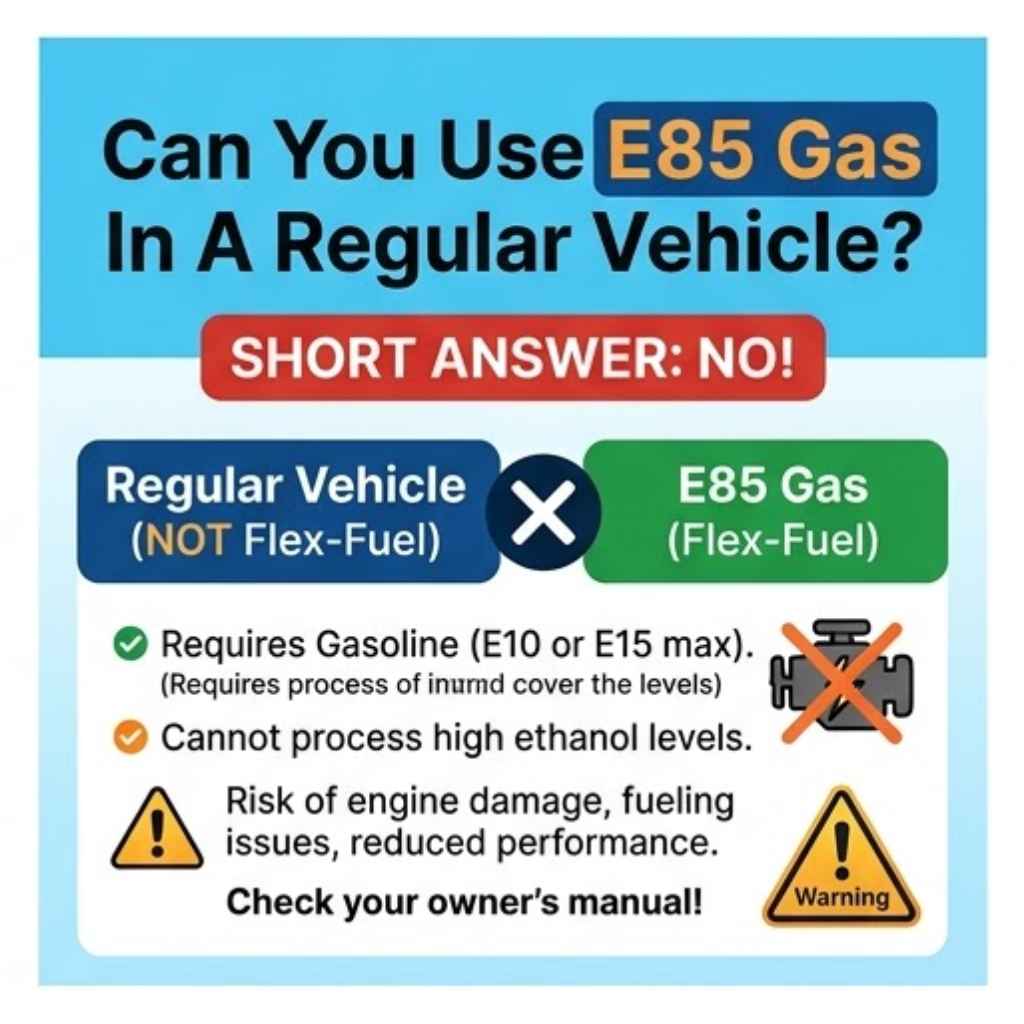
You can only use E85 gas in vehicles specifically designed to run on it, known as flex-fuel vehicles (FFVs). Putting E85 in a regular gasoline car can damage its fuel system, engine components, and emissions controls, leading to costly repairs. Always check your vehicle’s owner’s manual or look for a “flex fuel” badge.
What Exactly Is E85 Gas?
E85 is a blend of fuel. It contains 85% ethanol and 15% gasoline. Ethanol is an alcohol.
It can be made from many things, like corn or grains. This is why it’s often called a biofuel. The 15% gasoline is there to help the fuel burn better and to make it easier to start your engine in cold weather.
Regular gasoline in the U.S. typically has a small amount of ethanol mixed in. This is usually called E10.
It contains up to 10% ethanol. You see E10 at most gas stations. E85 is a much higher concentration.
It’s a significant difference for your car’s engine.
Ethanol is a renewable fuel. This is one of the main reasons it’s promoted. It can help reduce our reliance on fossil fuels.
However, the energy content of ethanol is lower than gasoline. This means you’ll likely get fewer miles per gallon when using E85.
Why Can’t All Cars Use E85?
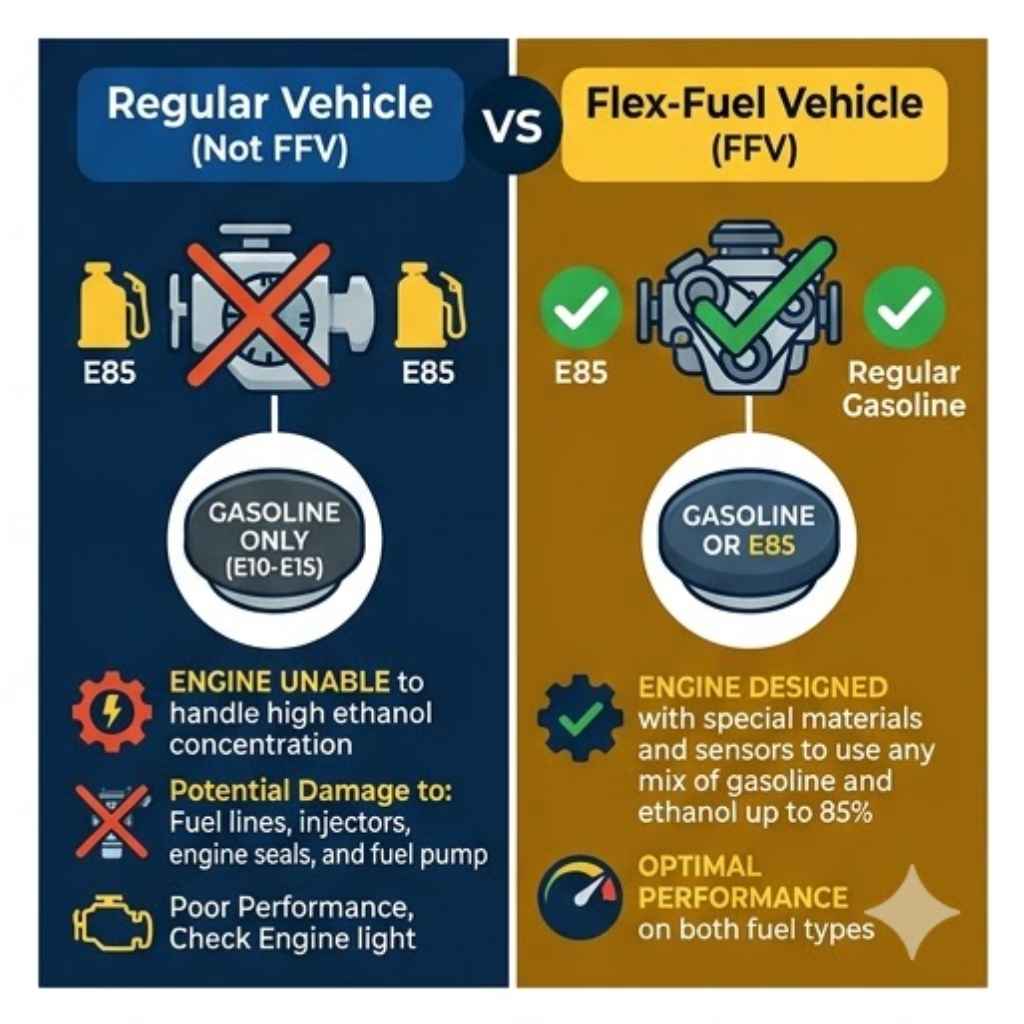
The biggest reason is how the fuel system and engine are built. Cars designed for E85 have special parts. These parts can handle the high ethanol content.
Regular cars do not have these parts. Ethanol is corrosive. It can eat away at certain materials.
It can also absorb water. This can cause problems in the fuel lines and tank.
Ethanol also burns differently than gasoline. The engine’s computer needs to know what fuel it’s using. It adjusts how the fuel is injected and when the spark plugs fire.
A car designed for E85 has sensors. These sensors tell the computer the ethanol level in the fuel. Then, the computer makes the right adjustments.
Materials used in regular car fuel systems include rubber and plastic. These might not be resistant to ethanol. Over time, ethanol can degrade them.
This can lead to leaks. Leaks are dangerous. They can cause fires.
They also let fuel vapor escape into the air.
What Is a Flex-Fuel Vehicle (FFV)?
A flex-fuel vehicle, or FFV, is a car designed to run on different fuel blends. This includes regular gasoline, E85, or any mix in between. These vehicles have special fuel system components.
They also have a special engine control unit (ECU). This ECU can sense the ethanol content.
You can usually spot an FFV easily. Look for a yellow gas cap. Many FFVs also have a sticker on the fuel door.
It will say something like “Flex Fuel Vehicle” or “E85 Compatible.” Also, check your owner’s manual. It will clearly state if your car is an FFV.
These vehicles are designed for flexibility. You can fill up with E85 one day. The next day, you can fill up with E10.
The car’s computer will automatically adjust. It knows how to manage the different fuel blends. This makes them very convenient for drivers.
The development of FFVs has been a way to promote biofuels. They offer a choice to consumers. However, owning an FFV doesn’t mean you have to use E85.
You can use regular gasoline just fine. The FFV technology is there to support the use of higher ethanol blends when you choose to use them.
E85 vs. Regular Gas: The Key Differences
Ethanol Content: E85 has 85% ethanol. Regular gas (E10) has up to 10% ethanol.
Material Compatibility: E85 needs fuel systems made of ethanol-resistant materials. Regular gas is fine for most standard materials.
Energy Density: Gasoline has more energy per gallon than ethanol. You get fewer miles per gallon with E85.
Engine Tuning: FFVs have computers that adjust for E85. Regular cars do not.
What Happens If You Put E85 in a Regular Car?
This is where things get serious. Putting E85 in a car not designed for it can cause immediate and long-term damage. Your car’s fuel system is not equipped to handle that much ethanol.
The effects can range from minor issues to major engine failure.
One of the first things you might notice is a check engine light. This is the car’s way of telling you something is wrong. The car’s computer is not programmed to read or correctly use E85.
It might cause misfires. The engine could run rough. It might even stall.
Beyond the immediate performance issues, the real damage happens over time. The ethanol in E85 can eat away at rubber and plastic parts in the fuel lines. It can also attack seals and gaskets.
These parts can swell, crack, or become brittle. This leads to fuel leaks.
The fuel injectors are also at risk. Ethanol can cause them to clog or become damaged. This affects how fuel is sprayed into the engine.
It can lead to poor performance and decreased fuel efficiency. Even worse, ethanol can attract water. This water can get into the fuel system.
It can cause corrosion.
The car’s catalytic converter and oxygen sensors can also be affected. These are important for controlling emissions. Damage to these parts can lead to even more expensive repairs.
And it will make your car pollute more.
My Own “Oops” Moment with Fuel
I remember one time, years ago, I was helping a friend move. We were on a road trip, and his car was low on gas. We pulled into a station, and I was in a hurry.
I just saw the “Flex Fuel” sign and thought, “Oh, that must mean it’s super gas.” I didn’t really check the details. I just filled it up with E85.
For the first hour, the car seemed fine. Then, it started sputtering. The check engine light came on.
It was a Sunday, late afternoon. We were miles from anywhere. The car was running really poorly.
It felt sluggish and hesitant. My friend started to panic.
We managed to limp to the next town. We had to get the car towed to a mechanic. Turns out, it wasn’t just a minor issue.
The ethanol had started to mess with the fuel lines. The mechanic had to flush the entire fuel system. He also had to replace some hoses.
It was an expensive lesson for both of us. I felt terrible, knowing I caused the problem. It taught me to always double-check what kind of fuel you’re putting in.
Never assume.
Signs Your Car Is Not Happy with E85
- Check engine light comes on
- Engine runs rough or sputters
- Loss of power or acceleration
- Hesitation when you press the gas pedal
- Stalling
- Unusual smells (like rotten eggs or gas)
Can You Use E85 If Your Car Isn’t a Flex-Fuel Vehicle? The Risks
So, to be crystal clear: No, you should not use E85 if your car is not a flex-fuel vehicle. The risks are too high. We’ve talked about the damage it can do to the fuel system.
Let’s break down the specific components that are most at risk.
Fuel Lines and Hoses: These are often made of rubber or synthetic materials that aren’t resistant to high ethanol concentrations. Ethanol can cause them to swell, crack, or become brittle. This leads to leaks.
Leaks are dangerous because fuel is flammable.
Fuel Pump and Filter: Ethanol can cause the seals in the fuel pump to break down. It can also clog the fuel filter faster. A failing fuel pump can leave you stranded.
A clogged filter means the engine won’t get enough fuel.
Fuel Injectors: These spray fuel into the engine. Ethanol can cause them to clog up. It can also damage the seals.
This affects the spray pattern and amount of fuel. This leads to poor engine performance.
Engine Seals and Gaskets: Many seals and gaskets in the engine and fuel system are not made to withstand E85. Ethanol can cause them to degrade. This can lead to internal fuel leaks or the entry of water into the system.
Computer System: The car’s computer (ECU) is not programmed for E85. It will try to manage the fuel mixture based on regular gasoline. This leads to incorrect timing and fuel delivery.
This can cause engine damage over time.
Emissions Controls: Damage to oxygen sensors, catalytic converters, and other emission control parts can occur. This means your car will pollute more. It can also lead to failed emissions tests.
Real-World Scenarios and What to Look For
Imagine you’re at a gas station. You see pumps with different labels. Some say “Regular,” “Mid-Grade,” “Premium.” Some have “E10” or “E15.” Then there are the pumps with “E85.” It’s crucial to know the difference.
If your car is a regular gasoline vehicle, you should only use fuel labeled E10 or E15 (if your car is rated for it, check the manual!). The E number tells you the percentage of ethanol. So E10 means 10% ethanol.
E85 means 85% ethanol. That’s a huge jump.
Scenario 1: The Unmarked Pump
If you’re unsure about a pump, don’t use it. Most gas stations in the U.S. are clearly marked.
But if you’re in a remote area or a new place, it’s good to be cautious. Always look for clear labeling.
Scenario 2: The “Flex Fuel” Badge
You see a small badge on the back of a car. It says “Flex Fuel.” This means the car can use E85. But it also means it can use regular gasoline.
You can fill it up with whatever is available. This is the key difference.
Scenario 3: Rental Cars
If you rent a car, it’s almost certainly not a flex-fuel vehicle unless explicitly stated. Stick to regular gasoline. Most rental agreements have clauses about using the wrong fuel, and the repair costs can be astronomical.
Scenario 4: Older Cars
Older cars, especially those made before the widespread adoption of E10, might have fuel systems that are even more sensitive to ethanol. While most cars today are built to handle E10, E85 is a completely different beast. If you have a classic car, consult with a specialist.
Quick-Scan Fuel Guide
| Fuel Type | Ethanol % | Who Can Use It? | What to Look For |
|---|---|---|---|
| E10 | Up to 10% | Most gasoline cars | “Regular,” “Mid-Grade,” “Premium” |
| E15 | Up to 15% | Most cars made after 2001 (check manual) | Often labeled “E15” |
| E85 | Up to 85% | Flex-Fuel Vehicles (FFVs) ONLY | Labeled “E85” or “Flex Fuel” pump |
What This Means for You: Normal vs. Concerning
Knowing whether your car can use E85 is crucial for its health. Here’s what’s normal and when you should be concerned.
Normal:
Using E10 (or E15 if your car is approved) in a regular gasoline vehicle is perfectly normal. Your car is designed for it. The small amount of ethanol is accounted for in the fuel system materials and engine tuning.
Using E85 in a flex-fuel vehicle (FFV) is also normal. The car’s systems are designed to handle it. You might notice slightly lower gas mileage, but that’s expected.
Filling up with regular gasoline in an FFV is also normal. You don’t have to use E85 if you don’t want to.
Concerning:
Using E85 in any vehicle that is not a certified Flex-Fuel Vehicle (FFV) is highly concerning. This is the situation that leads to damage.
Seeing a check engine light after fueling up is concerning. If it happens after using E85 in a regular car, it’s a clear warning sign.
Any unusual engine performance – sputtering, loss of power, rough idling – after refueling is concerning. This is especially true if you might have accidentally used E85.
A strong fuel smell around your car is concerning. It could indicate a fuel leak, which E85 can cause.
If you suspect you’ve accidentally put E85 in a non-FFV, don’t drive the car. Turn it off immediately. The longer you drive it, the more damage you can do.
Your best bet is to get the fuel system drained and flushed by a professional mechanic.
Quick Checks and Tips for Fueling
Here are some simple things you can do to make sure you’re always using the right fuel:
Check Your Owner’s Manual: This is the most important step. It will tell you exactly what fuel types your car can use. It will specify if it’s a Flex-Fuel Vehicle.
Look for Fuel Door Stickers: Many cars have a sticker inside the fuel door that indicates the approved fuel types. This is often a quick and easy reminder.
Know Your Gas Cap: If your car is an FFV, your gas cap might be yellow. This is a visual cue. However, not all FFVs have yellow caps, so don’t rely on this alone.
Be Aware at the Pump: Pay attention to the labels on the pumps. E85 is usually clearly marked and often has a different color handle or hose. If you’re unsure, ask the station attendant or choose a different pump.
When in Doubt, Stick to E10: If you cannot confirm your car is an FFV, always assume it’s a regular gasoline car. Stick to E10. It’s the safest option for the vast majority of vehicles on the road.
What if you filled up by mistake? Don’t panic, but act fast. If you realize your mistake right after pumping, don’t start the engine. Call a tow truck.
You’ll need to have the tank drained and flushed. If you’ve already driven a bit, the damage might be more significant. A mechanic will need to assess the situation.
Never try to “dilute” E85 by adding regular gasoline if you’ve made a mistake. This won’t fix the problem and can sometimes make it worse. The best approach is professional service.
When to Worry Most About Fuel Choice
Using E85 in a Non-Flex Fuel Vehicle: This is the highest risk scenario.
Driving After Accidental E85 Use: Each mile driven increases potential damage.
Ignoring the Check Engine Light: This light is a warning you shouldn’t ignore.
Smelling Strong Gasoline Odors: This could mean a dangerous leak.
Frequently Asked Questions about E85
Can I mix E85 with regular gasoline in my regular car?
No, you should not mix E85 with regular gasoline in a car that is not a Flex-Fuel Vehicle (FFV). Even a small amount of E85 can start to damage the fuel system components not designed for high ethanol content. It’s always best to stick to the fuel type your car’s manufacturer recommends.
How do I know if my car is a Flex-Fuel Vehicle (FFV)?
You can usually tell if your car is an FFV by checking for a specific badge on the vehicle, often on the gas cap or fuel door, that says “Flex Fuel Vehicle” or “E85 Compatible.” Your car’s owner’s manual will also clearly state if it’s an FFV and can run on E85. Many FFVs also have a yellow gas cap.
Will E85 harm my car’s engine if it’s not a flex-fuel vehicle?
Yes, E85 can cause significant harm to the engine and fuel system of a regular car. The high ethanol content is corrosive and can degrade rubber and plastic components, clog fuel injectors, damage seals, and even affect the catalytic converter. This can lead to poor performance and very expensive repairs.
What happens if I accidentally put E85 in my regular car?
If you accidentally put E85 in a non-flex-fuel vehicle, stop driving it as soon as possible. Do not start the engine if you realize before starting. You should have the fuel tank drained and the fuel system flushed by a qualified mechanic to prevent long-term damage.
Is E85 cheaper than regular gas?
E85 is often cheaper per gallon than regular gasoline. However, because ethanol has less energy than gasoline, you will get fewer miles per gallon when using E85. This means that in many cases, the cost savings per mile might be minimal or nonexistent, depending on the price difference and your car’s fuel economy.
Can I use E85 in a car that is rated for E15?
No. While a car rated for E15 can handle a higher ethanol blend than typical E10 gasoline, it is not designed for the 85% ethanol content of E85. E85 requires specific materials and engine tuning found only in Flex-Fuel Vehicles (FFVs).
Using E85 in a car rated for E15 will cause damage.
Understanding Your Fuel Choices
It’s really important to understand your car and its fuel needs. Using the right fuel is one of the simplest ways to keep your vehicle running smoothly. It saves you money in the long run by preventing costly repairs.
Always take a moment to check the pump and your car’s requirements before you fill up.
The world of biofuels is growing, but flexibility comes with specific engineering. Flex-fuel vehicles are marvels of engineering that offer choice. Regular cars are built for the fuels they are designed for.
Respecting these differences is key to a healthy car and a happy wallet. Your car will thank you for it.
Products related to this article
Sponsored / affiliate links. As an Amazon Associate I earn from qualifying purchases. I may earn additional commission from eligible campaigns.