Creative Automotive Service Ideas That Build Loyalty
Build loyalty by pairing one convenience offer, one trust signal, and one follow-up loop, then track repeat visits and referrals on a regular basis. Skip that system and you get one-off tickets, thin word-of-mouth, and wasted marketing spend. This guide gives practical service ideas for shops, mobile service, and hybrid operators, plus the metrics to judge what pays back.
What automotive service ideas build customer loyalty?
Loyalty grows when a customer can come back without friction, see what was done, and get a timely reason to return. The best ideas work as a loop: easy access, visible trust cues, and a follow-up message matched to the maintenance interval, not a random discount blast.
The loyalty loop: convenience, trust, follow-up
Start with one convenience offer, such as mobile maintenance or online booking. Add one trust signal, such as photo-backed repair notes or a clean waiting area. Finish with one follow-up loop, such as a text reminder at the right mileage or time interval. That mix beats a one-time coupon.
Why repeat visits matter more than one-time traffic
Repeat RO count tells you whether a service idea is building habit, not just traffic. A shop can buy a burst of first visits with promotions, but retention by interval and referral rate show whether the work built confidence and convenience. That is the operating result that matters.
Which ideas work best for independent shops, dealers, and mobile operators
Independent shops usually benefit most from low-cost trust and follow-up systems. Dealers can use reminder automation and inspection events to pull customers back into the service lane. Mobile-only operators should lean on booking convenience, routing discipline, and narrow service menus, because travel time and insurance exposure can erase margin fast.
Suppose a small independent shop adds same-day text approvals, an oil-change reminder based on mileage, and a clean pickup counter. The work changes little. The return changes a lot, because the customer has a clear reason to come back and a simple way to do it.
Mobile services that make repeat visits easier
Mobile maintenance can work as a loyalty play when the shop sells time savings without pretending it can serve everyone. Keep the menu tight: oil changes, quick checks, battery testing, fluid top-offs, and light inspections. The service area, staffing, equipment, and insurance all need to match the route plan.
Mobile maintenance for oil changes and quick checks
Creative says mobile car wash startups can serve customers at home or work, and the same convenience logic applies to maintenance visits. Use booking windows that fit local traffic patterns, limit service radius, and bring only the tools needed for the quoted job. If the truck lacks the right lift, spill control, or parts inventory, the promise turns into a callback.
On-demand repair and diagnostics at home or work
Creative says on-demand repair brings the mechanic to the customer, and it can include diagnostics and regular maintenance. That is useful when the repair is light, the vehicle is immobilized, or the customer cannot lose a workday. App-based scheduling helps, but dispatch accuracy matters more than the app itself.
Mobile car wash and detailing as a repeatable add-on
Creative says mobile car wash services can use a waterless method, which fits apartment complexes, office parks, and tight service areas. Detailing supports retention because it is naturally repeatable, and add-on waxing can raise ticket value. Keep the offer easy to book online and easy to repeat on a fixed cadence.
Operational limits: routing, equipment, insurance, and service area
Mobile service can fail when routing gets sloppy, the van carries too little equipment, or the insurance policy excludes the work being sold. A wide service radius also hurts punctuality. For that reason, mobile operators should publish clear limits and price for them, rather than accept every call.
How should a service reminder program work?
A reminder program should be opt-in, interval-based, and tied to the work the customer actually had done. Send messages about oil changes, tire rotations, inspections, or follow-up items at the right time, not on a generic monthly blast. Good timing brings customers back; bad timing creates opt-outs.
Opt-in consent and message cadence
Text message reminders should require consent, with a clear explanation of what the customer will receive. A practical cadence is one reminder near the due interval, one follow-up if there is no response, and then a pause. Too many messages feel like marketing spam, not service.
Timing for oil changes, tire rotations, and inspections
Creative says maintenance reminder apps can send notifications for oil changes and track tire rotations. Use the vehicle’s maintenance interval, the last RO date, or both. For example, a shop can trigger a reminder by mileage estimate, then use a second message when the due date approaches if the customer has not booked.
What to send after the visit to bring the customer back
The post-visit message should include the completed work, the next due service, and an easy way to schedule it. Keep the language plain. If the shop found worn brakes but no immediate safety issue, the note should say that directly and explain the next check point without pressure.
- Get written or digital opt-in before sending texts.
- Tag each RO by service interval: oil, tires, inspection, brakes, or seasonal work.
- Send one reminder near the due date or mileage.
- Follow with one short confirmation if the customer does not book.
- Stop or pause after no response, unsubscribe, or completed booking.
How can an auto repair shop get repeat customers?
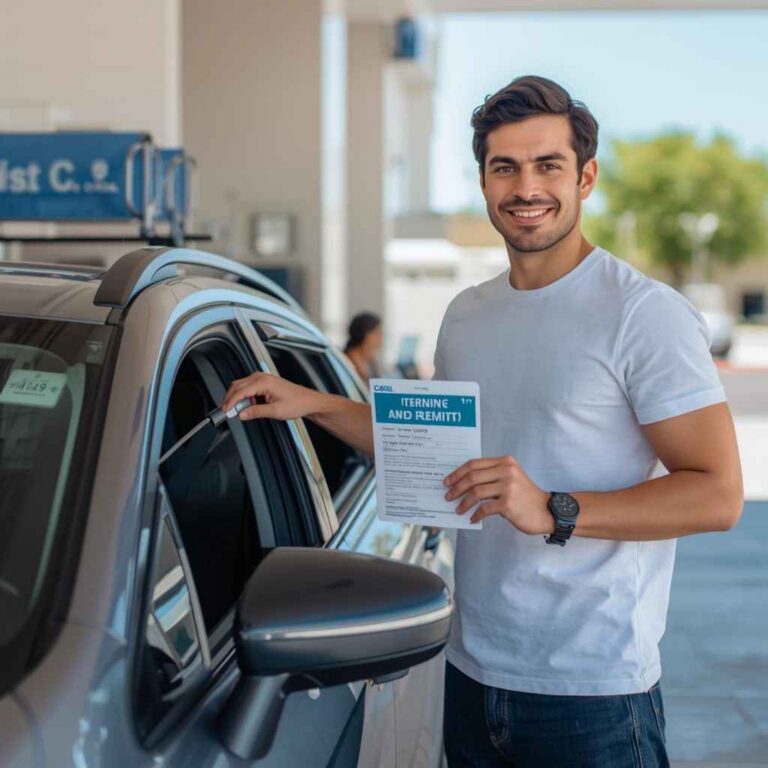
Repeat customers come back when the shop cuts uncertainty. That means clear estimates, status updates, photos or notes, and a clean handoff at pickup. Convenience brings the first return; trust keeps the customer from shopping around next time.
Status updates that reduce anxiety
Customers want to know whether the vehicle is waiting, in diagnosis, or nearly done. A brief update prevents callbacks and front-counter friction. It also gives service advisors a chance to mention discovered issues before the customer feels surprised at pickup.
Repair photos, notes, and estimate transparency
Photos and notes help explain why a repair matters. If a brake hose is cracked or a filter is clogged, show the condition and state the consequence in plain language. Then separate what is urgent from what is recommended, so the customer can make a clean decision.
How to explain necessary work without creating pressure
Use the job order to explain the symptom, the test result, and the next step. Avoid vague urgency. Customers remember whether the estimate felt honest, especially if the price was not the lowest in town. Pressure tactics can win today and lose the next RO.
Picture a family sedan that comes in for an oil change and needs a battery test. A concise text says the car is in bay two, a photo shows the weak battery date code, and the advisor explains the replacement is recommended before winter. That kind of clarity supports return business.
What low-cost loyalty ideas give the best return?
Low-cost loyalty ideas work when they signal professionalism without cutting price too far. Shop cleanliness, free inspection events, and referral partnerships are strong examples because they shape trust, lead capture, and return intent. Cheap promotions that train customers to wait for a deal do the opposite.
Shop cleanliness and organization as a credibility signal
A tidy waiting area and organized workbay tell customers the shop handles vehicles the same way it handles invoices. This is not decoration. It is a visible trust signal that affects how customers judge safety, care, and competence before they approve work.
Free inspection events with OBD-II scans and multi-point checks
A free inspection event can work if it is scoped tightly: basic OBD-II scan, multi-point check, and a clear lead-capture process. Treat it as a customer appreciation event, then convert only the findings that justify paid repair. A bloated free event creates queueing, no-shows, and low conversion.
Referral partnerships with local businesses and offer terms
Referral partnerships work best with local businesses that share the same customer base, such as tire stores, detailers, or nearby offices. Offer terms should be simple: who gets the incentive, what counts as a valid referral, and when credit is issued. Track each referral source, not just total sales.
Small incentives that do not erode margin
Good incentives are specific and bounded. A modest service credit, a wash voucher, or a future discount on labor can work if the margin math still holds. Avoid open-ended promises, because incentive abuse and discount creep can turn a loyalty idea into a profit leak.
What automotive service ideas build customer loyalty?
The strongest ideas are the ones that can be repeated without wrecking margin or operations. Customer convenience, visible trust, and a disciplined follow-up system create loyalty more reliably than trendy add-ons. The matrix below ranks a set of service ideas by cost, launch speed, repeat-visit impact, and operational risk.
Loyalty idea matrix: 10 service ideas ranked by effort and payoff
| Service idea | Implementation cost | Time to launch | Likely repeat-visit impact | Operational risk |
|---|---|---|---|---|
| Text reminder system | Low | Fast | High | Low if consent is clean |
| Photo-backed repair updates | Low | Fast | High | Low |
| Shop cleanup and organization standard | Low | Fast | Medium | Low |
| Referral partnership program | Low | Medium | Medium | Medium if terms are vague |
| Free inspection event | Low to medium | Medium | Medium | Medium to high if traffic is unmanaged |
| Mobile car wash and detailing | Medium | Medium | Medium | Medium |
| Mobile maintenance visits | Medium to high | Medium | High | High due to routing and insurance |
| On-demand repair at home or work | High | Medium to long | High | High |
| App-based scheduling portal | Medium | Medium | Medium | Medium |
| AI-assisted quick assessment | Medium to high | Medium to long | Medium | Medium to high if not checked by staff |
How to read the matrix
Low-cost, fast-launch ideas are best for shops that need immediate retention gains. Medium-cost ideas need a workflow change and usually a staff owner. High-risk ideas belong in businesses that can control routing, tooling, and dispatch. That matters more than the marketing appeal of the idea itself.
Which ideas to start with if you need quick wins
Start with reminders, photos, and clearer communication. Those three ideas are cheap, visible, and easy to track. Next, add one convenience play that fits the business model, such as mobile maintenance for a limited area or a periodic inspection event that feeds the service lane.
How do you measure loyalty instead of guessing?
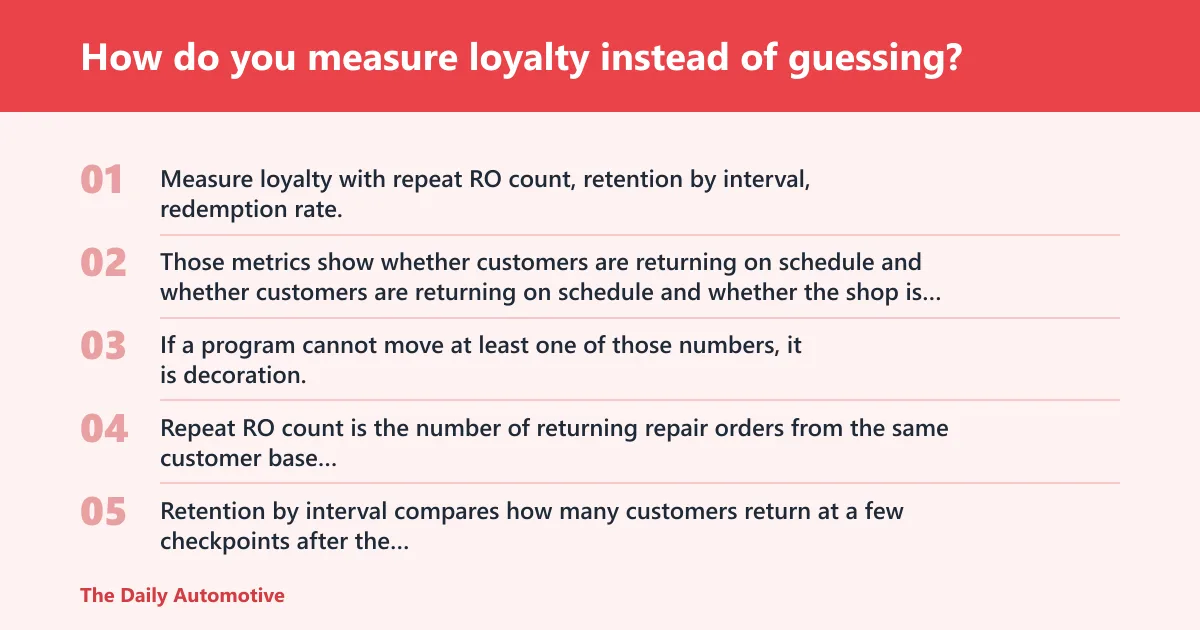
Measure loyalty with repeat RO count, retention by interval, redemption rate, and referral rate. Those metrics show whether customers are returning on schedule and whether the shop is earning word-of-mouth. If a program cannot move at least one of those numbers, it is decoration.
Repeat RO count and retention by interval
Repeat RO count is the number of returning repair orders from the same customer base over a set period. Retention by interval compares how many customers return at a few checkpoints after the first visit, such as around 3, 6, or 12 months. That tells you whether the idea creates a habit or only a sale.
Referral rate, redemption rate, and return frequency
Referral rate measures how many new customers came from existing customers or partners. Redemption rate measures how many people used the offer you sent, such as a reminder booking link or a referral credit. Return frequency shows how often the same household comes back in a year.
A simple KPI tracker for testing one idea at a time
Use one tracker per campaign, not a pile of loose notes. A basic sheet can hold the customer name, last RO date, offer sent, date opened or redeemed, return date, and referral source. That is enough to compare ideas without guessing.
| KPI | Definition | How often to review | What a weak result can mean |
|---|---|---|---|
| Repeat RO count | Returning repair orders from prior customers | Monthly | The offer did not create a reason to return |
| Retention by interval | Returns at 3, 6, or 12 months | Monthly and quarterly | The reminder timing is off |
| Referral rate | New customers from existing customers or partners | Monthly | The offer is unclear or the experience is not worth talking about |
| Redemption rate | Offers used after being sent | Weekly and monthly | The incentive is weak or the message arrived at the wrong time |
What should be included in a service reminder program?

A reminder program should include consent, service history, interval logic, and a clear next step. For oil changes and tire rotations, the message should reference the last service, the due window, and the booking method. The goal is to make the next visit obvious and easy.
Frequently asked questions
How can an auto repair shop get repeat customers?
Repeat customers come back when the shop lowers uncertainty and makes rebooking simple. Status updates, estimate transparency, repair photos, and reminder messages all help. A clean front counter and consistent pickup process matter too, because customers often judge future trust by the last handoff.
What are low-cost loyalty ideas for auto shops?
Low-cost ideas include text reminders, repair photos, better front-office communication, cleaner bays, and referral partnerships with local businesses. Free inspection events can work if they are tightly controlled. The key is to choose ideas that build trust and repeat visits without training customers to chase discounts.
How do mobile car services increase customer retention?
Mobile car services increase retention when they save time and fit a clear service area. Creative says mobile car wash startups can serve customers at home or work, and on-demand repair brings the mechanic to the customer. Those offers work best with strict scheduling, limited menus, and reliable routing.
What should be included in a service reminder program?
Include opt-in consent, a message cadence, interval-based triggers, and a direct booking path. Creative says reminder apps can notify customers about oil changes and track tire rotations, which makes the timing practical. After the visit, send one short note with the next due service and a clear call to book.
How do referral partnerships help an auto repair business?
Referral partnerships help by turning other local businesses into repeat customer sources. The offer should spell out who qualifies, what incentive is paid, and how the referral is tracked. Without those terms, the program creates confusion, weak redemption, and arguments about credit.
What customer experience improvements matter most in a repair shop?
The biggest wins are plain-language communication, consistent status updates, transparent estimates, and visible organization. Customers want to know what is wrong, what it costs, and when the car will be ready. A clean waiting area and orderly bays strengthen the message that the work will be handled carefully.
Products related to this article
Sponsored / affiliate links. As an Amazon Associate I earn from qualifying purchases. I may earn additional commission from eligible campaigns.
 OCESTORE Adjustable For R134A Quick Coupler Connector, 1/4" SAE HVAC High Low AC Freon Manifold Gauge Hose Conversion kit
 Brake Bleeder Kit Automotive,Brake Fluid Bleeder Exchanger Machines,Brake Oil Fluid Extractor Pump,Professional Pulsating Brake Oil Fluid Bleeding Tool,Automatic Vacuum Brake Bleeder One Person