Automotive Technician Summary: Skills and Requirements
Many entry-level automotive technician jobs ask for a high school diploma or GED, basic mechanical and diagnostic skills, and some employer-backed or ASE-aligned training; candidates who can speak to safety, tools, and scan data are often better prepared. Missing those basics slows hiring, leads to unsafe work, and can turn a first job into a probation problem. This guide breaks down must-have skills, training signals, and shop-floor expectations for first-time technician candidates.
What an automotive technician does



An automotive service technician inspects, maintains, and repairs cars and light trucks. The work centers on finding faults, doing routine service, replacing worn parts, and checking that systems work correctly after repair. Many modern shops expect comfort with computerized diagnostic equipment and a steady approach to safety.
Core repair and maintenance duties
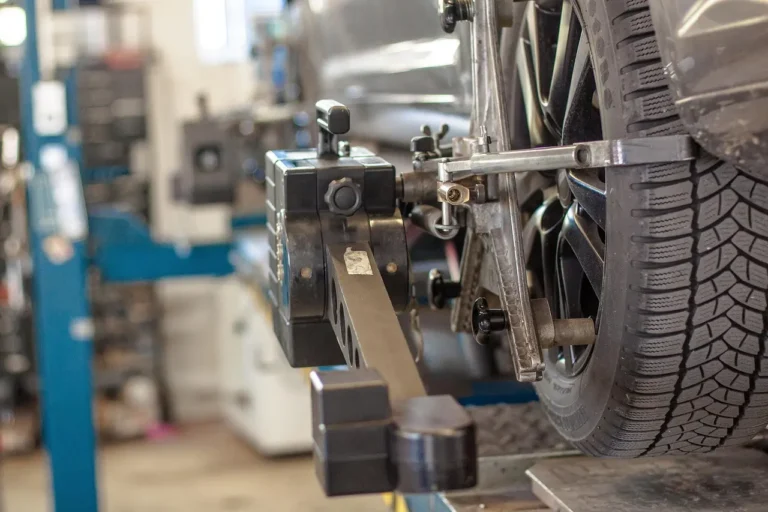
Day-to-day work often includes changing oil, checking fluid levels, rotating tires, and replacing brake pads, wheel bearings, or sensors. Many employers also expect technicians to inspect vehicles with diagnostic equipment and perform routine maintenance. A common first-timer mistake is treating maintenance as “easy work”; it still demands accuracy, clean documentation, and good judgment.
Where computerized diagnostics fit in
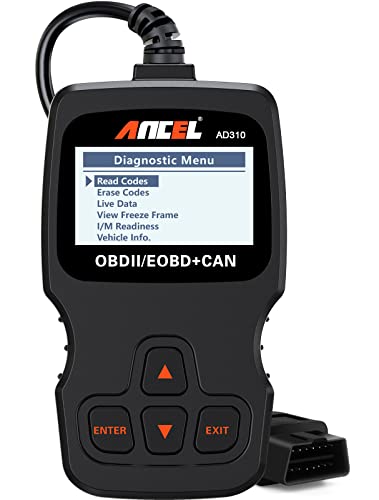
Computers are part of the job now. Technicians often identify problems with computerized diagnostic equipment, read fault codes, review live data, and help narrow down whether a problem is electrical, mechanical, or software-related. That matters when a warning light turns on but the real issue is a loose connector, weak battery, or failed sensor.
Common vehicle systems worked on
Automotive service technicians work on engines, transmissions, brakes, and electronic systems. Some shops keep technicians broad, while others push specialization early. Either way, the job is not only wrench work; it also includes interpreting symptoms, isolating the cause, and checking the fix.
What skills do automotive technicians need?
Technicians need mechanical reasoning, careful inspection habits, basic diagnostic literacy, and clear communication. Employers usually separate must-have day-one skills from skills they can train after hire. Reliability, accuracy, and safety awareness are the first filters; speed comes later.
Day-one skills versus trainable skills
Day one, a candidate should understand basic hand tools, follow directions, recognize hazards, and explain what a fault code or service note means in plain English. Skills such as advanced drivability diagnosis, brand-specific procedures, and specialty repairs are often trainable after hire. Employers value candidates who can learn without cutting corners.
Technical, diagnostic, and communication skills
Technical skill means more than turning bolts. It includes reading service information, using scan data, and knowing when to stop and ask before damaging a fastener, connector, or trim piece. Customer communication matters too, because technicians help explain repair needs and timelines to clients, which supports trust and service quality.
How employers weigh reliability and accuracy
In hiring, a clean work habit often matters as much as raw mechanical interest. A technician who labels parts correctly, keeps tools organized, and follows torque specs reduces rework. A fast mistake can cost more than a careful repair.
What are the requirements to become an automotive technician?
Typical entry requirements include a high school diploma or GED, some basic mechanical aptitude, and some form of automotive service technology training. Many employers hire candidates with a postsecondary nondegree award, while others accept high school graduates who learn through short-term on-the-job training. ASE certification is often preferred and, in some settings, may be required.
Typical education paths
Automotive service technology programs usually cover engines, drivetrains, brakes, electrical systems, and related shop skills. Algonquin’s apprenticeship outline also lists air conditioning systems, fuel systems, drivelines, engine mechanicals, power trains, steering and suspensions, brakes, options and accessories. That mix matters because entry-level work rarely stays in one system for long.
When on-the-job training is enough
Some shops hire with only a diploma or GED and then train on the floor. That path works best for candidates who already understand tool use, safety, and basic diagnosis. Short-term on-the-job training can cover shop process, vehicle inspection routines, and the employer’s repair standards.
Where ASE certification fits
ASE certification is a common industry credential. Employers often list it as required or preferred because it signals readiness and credibility. It is not mandatory for every entry-level role, but it can help when applying to dealerships, independent shops, and employers that want a proven baseline.
Do automotive technicians need ASE certification?
No, ASE certification is not always mandatory, but it often improves job prospects. Some employers treat it as required, others as preferred, and some use it as a promotion benchmark after hire. For first-time candidates, it is best viewed as a strong credential, not the only route into the trade.
What ASE signals to employers
ASE tells a hiring manager that the candidate has studied common service categories and can speak the trade’s language. It does not replace shop experience, but it can shorten the trust-building phase. That matters when a shop needs a new technician who can move from inspection to supervised work quickly.
When it matters most
ASE matters most when a posting asks for experience, when the role includes more diagnostics than basic maintenance, or when a shop wants technicians to work with less direct oversight. It is especially useful for candidates aiming at faster advancement or a specialty track.
What education is required for automotive service technicians?
The typical entry-level education is a postsecondary nondegree award. Some technicians enter with a high school diploma or GED and build skills through short-term on-the-job training. Program content usually covers engines, brakes, drivetrains, electrical systems, and other core service areas needed for modern shop work.
How school and shop training differ
School provides the structure: terminology, systems knowledge, safety basics, and repeatable process. Shop training teaches speed, workflow, customer-facing habits, and how to work on vehicles that are already in service. Both matter, but neither alone makes a technician job-ready.
How to judge whether the training is enough
A useful test is simple: can the candidate identify common tools, explain a fault code in plain language, and describe basic safety rules around fluids, lifts, and high-voltage systems? If not, more preparation is needed before a first independent assignment.
What tools do automotive technicians use?
Technicians use hand tools, power tools, pneumatic tools, jacks, hoists, scan tools, and computerized diagnostic equipment. Hand tools may be personally owned, while larger shop equipment is usually employer-owned. New candidates should budget for a starter set, but not assume they must buy every major tool themselves.
Hand tools and power tools
Common hand tools include wrenches, pliers, sockets, and ratchets. Power tools and pneumatic wrenches help with repetitive fastening tasks and wheel service. Jacks and hoists are essential for access, but they are typically provided by the shop because of cost and safety requirements.
Scan tools and computerized diagnostic equipment
Scan tools read fault codes and live data. Computerized diagnostic equipment helps technicians confirm whether a complaint is sensor-related, wiring-related, or tied to a broader system issue. That is a core modern workshop tool, not an optional extra.
What new technicians often need to buy
First-time technicians often need a personal hand-tool set, work boots, a flashlight, and basic storage. A complete professional box can be expensive, so candidates should ask employers which tools are required, which are supplied, and which can be purchased gradually. That avoids overspending before the job starts.
Job-readiness checklist: skills mapped to real shop tasks
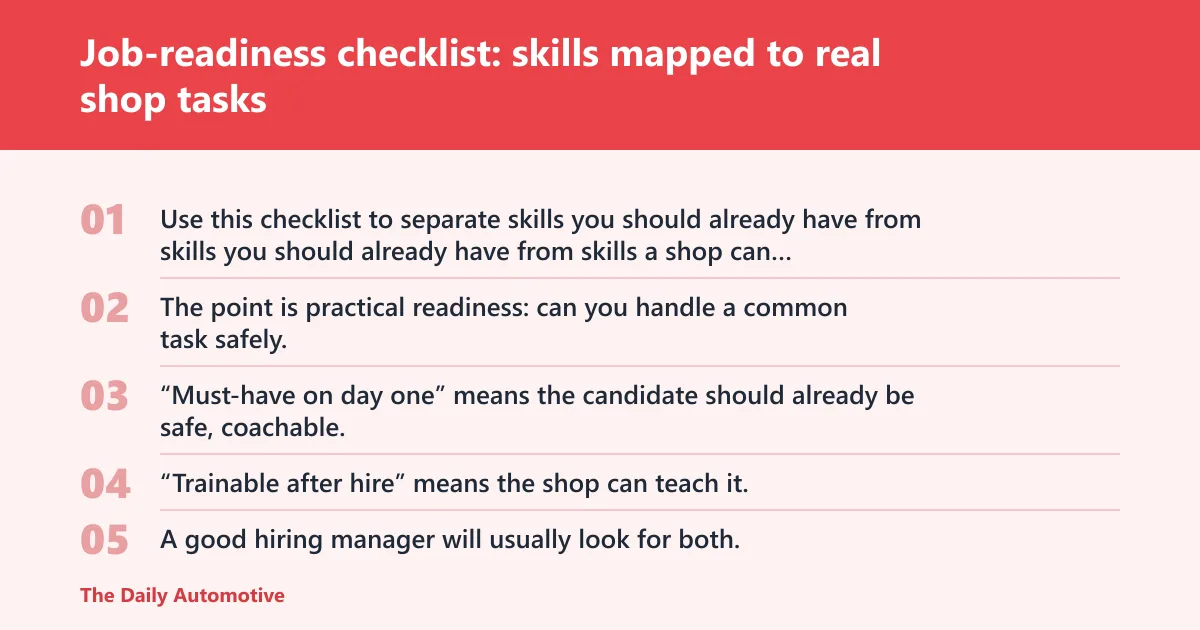
Use this checklist to separate skills you should already have from skills a shop can teach after hire. The point is practical readiness: can you handle a common task safely, use the right tool, and communicate the result without guesswork?
| Skill | Real shop task | Day one or trainable? |
|---|---|---|
| Basic hand-tool use | Remove a wheel, loosen brackets, and reinstall fasteners correctly | Must-have on day one |
| Safety awareness | Lock out a lift, support a vehicle, and avoid pinch points | Must-have on day one |
| Reading fault codes | Pull diagnostic trouble codes from a scan tool and record them | Must-have on day one |
| Basic fluid service | Change oil and check fluid levels | Must-have on day one |
| Tire service basics | Rotate tires and inspect tread or wear patterns | Must-have on day one |
| Brake inspection | Measure pad wear and inspect rotors and hardware | Trainable after hire |
| Electrical troubleshooting | Trace a failed sensor circuit or weak connector | Trainable after hire |
| Customer communication | Explain repair needs and timelines in plain language | Must-have on day one |
| Documentation | Write accurate work notes and parts lists | Must-have on day one |
| EV service awareness | Follow high-voltage safety steps before battery or cable work | Trainable after hire |
How to read the checklist
“Must-have on day one” means the candidate should already be safe, coachable, and able to contribute without creating extra risk. “Trainable after hire” means the shop can teach it, but the candidate should show the right foundation. A good hiring manager will usually look for both.
Two common readiness scenarios
Say your scan tool shows a code for a wheel-speed sensor, but the problem is actually a damaged harness near the strut. A ready candidate does not start replacing random parts; they inspect wiring, confirm the fault, and document the finding clearly.
Suppose a 12-volt complaint appears on an EV, and the vehicle will not enter ready mode. The correct next step is not guesswork. The technician should follow high-voltage and low-voltage safety procedures, use the proper diagnostic process, and avoid touching orange cables without training.
Can automotive technicians work on electric vehicles?
Yes, but EV work has extra requirements. Technicians must follow safety procedures and environmental regulations when dealing with high-voltage EV systems. They also need to understand battery performance, regenerative braking systems, and electric motor efficiency, which change the diagnostic process compared with gas vehicles.
High-voltage safety basics
High-voltage systems can injure an untrained worker, so EV service depends on correct shutdown steps, insulated tools where required, and strict procedure. This is not an area for casual troubleshooting. Shops usually expect formal training before a technician touches high-voltage components.
Battery, regenerative braking, and motor diagnostics
EV diagnosis often focuses on battery state, charging behavior, regen braking complaints, and motor performance data. A noise complaint may point to a bearing or reduction gear, while a range complaint may involve battery health, software, or driving conditions. The same scanner habits still matter, but the system logic is different.
What changes in EV service compared with gas vehicles
There is less emphasis on oil changes and more emphasis on electrical diagnosis, software awareness, and safety discipline. Hazardous materials disposal still matters, and brake work can be affected by regenerative braking patterns. Candidates who want EV work should plan on extra training, not a quick add-on.
Which specialization paths make sense first?
Early specialization works best when it matches a candidate’s strongest tasks. Diagnostics, brakes, A/C, dealership work, fleet service, and EV-focused roles all exist, but each asks for different habits and training depth. The right path is the one tied to actual shop work, not just a job title.
Diagnostics track
Diagnostic technicians spend more time with scan data, testing, and fault isolation. This path suits candidates who like pattern recognition and careful troubleshooting. It often leads to more advanced pay bands, but it also raises the bar on accuracy.
Brakes, A/C, dealership, fleet, and EV-focused roles
Brake specialists handle inspections, pad and rotor replacement, hydraulic checks, and related wear items. A/C work adds refrigerant handling and system diagnosis. Dealership technicians usually follow brand-specific procedures, while fleet roles prioritize repeatable maintenance and turnaround speed. EV-focused roles add high-voltage rules and battery-related diagnostics.
What does an automotive technician do every day?
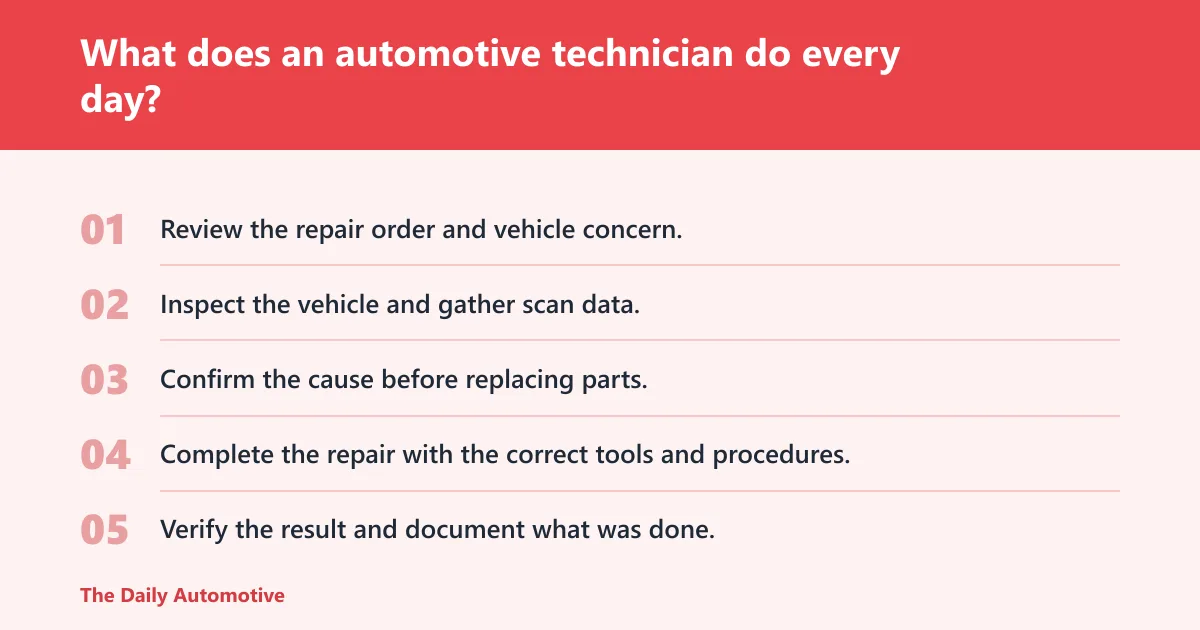
Every day can include inspections, maintenance, diagnostics, parts replacement, road-test follow-up, and customer updates. The mix changes by shop type, but the pattern stays the same: identify the problem, perform the repair, verify the fix, and document the result clearly and safely.
Typical workflow in a busy shop
- Review the repair order and vehicle concern.
- Inspect the vehicle and gather scan data.
- Confirm the cause before replacing parts.
- Complete the repair with the correct tools and procedures.
- Verify the result and document what was done.
How much do automotive service technicians make?
The 2025 median pay is $50,620 per year. Pay varies by shop type, region, experience, and specialization, so this number is a midpoint rather than a ceiling. Technicians with strong diagnostic ability, ASE credentials, or EV training can often move into better-paying roles over time. (bls.gov)
What affects pay early on
Entry-level pay is usually shaped by the employer’s training investment, local labor market, and how much work the candidate can handle with supervision. A technician who can safely perform routine maintenance and communicate clearly will usually be more valuable than one who only knows tools by name.
Products related to this article
Sponsored / affiliate links. As an Amazon Associate I earn from qualifying purchases. I may earn additional commission from eligible campaigns.