Automotive Technology Degree Near Me: How to Find One
Find an automotive technology degree near you by narrowing programs to a practical commute, then compare lab hours, accreditation, cost, and job placement before you apply. Pick poorly and you can waste time, miss hands-on training, or pay more for a weaker credential. This guide shows how to compare nearby schools by schedule, shop access, tuition, transfer value, and outcomes.
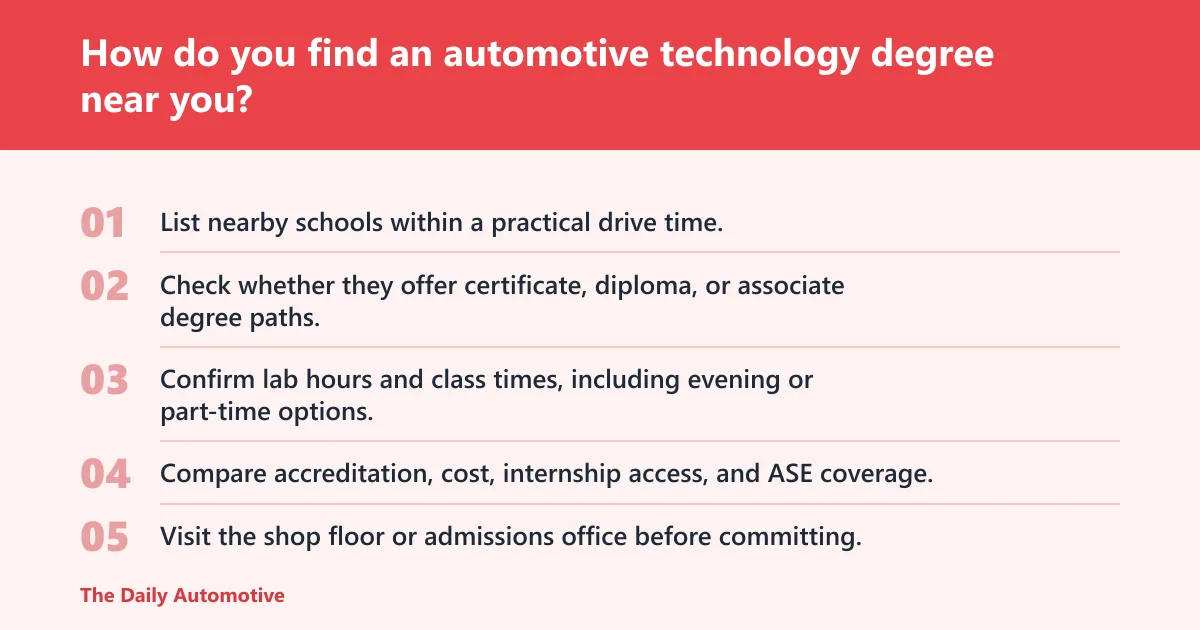
How do you find an automotive technology degree near you?


Start with program type, not school name. Search community colleges, technical schools, and colleges that offer an automotive technology degree, then filter by commute time, class times, and whether the program is built for certificate or associate degree students.
Search by program type, not only by school name
A nearby campus is not always the right fit. Look for automotive technology degree pages that mention hands-on lab training, engine diagnostics and drivability, electrical and electronic systems, and brake, suspension, and drivetrain service. Those topics tell you more about the curriculum than a generic “auto” label.
Search terms such as “automotive technology degree,” “automotive service technology,” and “automotive repair training” can return different results. Compare them carefully. A certificate may get you into the field sooner, while an associate degree may give you broader coursework and more transfer value.
Use commute time as a filter, not a finish line
Distance matters because an automotive program usually includes lab blocks that are harder to skip than lecture-only courses. A 12-mile trip can be easy at 7 a.m. and much harder at 5 p.m. Check traffic, parking, and whether the campus is reachable by bus if you do not drive every day.
Picture a student who can reach campus in 20 minutes on a map, but 45 minutes during evening rush. That extra time may turn a twice-a-week class into a real burden. Commute burden matters as much as mileage.
Check evening, weekend, and part-time options early
If you work, care for family members, or need a staggered schedule, check class timing before you apply. Some community college programs offer part-time pacing, evening theory classes, or mixed schedules.
- List nearby schools within a practical drive time.
- Check whether they offer certificate, diploma, or associate degree paths.
- Confirm lab hours and class times, including evening or part-time options.
- Compare accreditation, cost, internship access, and ASE coverage.
- Visit the shop floor or admissions office before committing.
📊 The global automotive market was about $2.75 trillion in 2025. Source: Automotive industry.
What should you look for in a nearby program?
Look for current lab equipment, clear ASE-aligned coursework, and student support that helps with placement and scheduling. A strong nearby program should also show how it prepares you for work on gasoline, hybrid, and electric vehicles, not only older mechanical systems.
Hands-on lab space and current shop equipment
An automotive service technology lab should give you access to diagnostic scanners, lift equipment, brake and alignment tools, and supervised work on real components. Those tools matter because modern repair work depends on diagnostics, measurement, and safe service procedures, not guesswork.
Ask how much lab time is built into the program. A school can call a course “hands-on” and still schedule most hours in lecture rooms. If the lab is crowded or outdated, you may not get enough practice with scan tools, electrical testing, or drivability work.
ASE-aligned coursework and modern diagnostic coverage
ASE, commonly expanded as Automotive Service Excellence, is an industry certification benchmark many employers recognize. Ask whether the curriculum covers ASE exam areas such as engine repair, automatic transmission and transaxle, manual drivetrain and axles, brakes, steering and suspension, electrical systems, heating and air conditioning, and engine performance.
That alignment matters because it helps your coursework match what employers expect on the shop floor. It also makes it easier to prepare for certification exams later, instead of studying separate material from scratch.
Community college support services and employer links
Community college programs often offer commuter access, in-state tuition, part-time scheduling, and career services. Those supports can reduce the friction of getting through the program, especially if you are balancing work or family responsibilities.
Employer links matter too. Local shop partnerships, dealership connections, and internship or apprenticeship pathways can open the door to work-based learning. Ask whether placements are paid or unpaid, how many hours are required, and whether the school helps place students or only lists names.
Some programs are tightly connected to local employers; others are not.
What is the difference between a certificate and an associate degree?
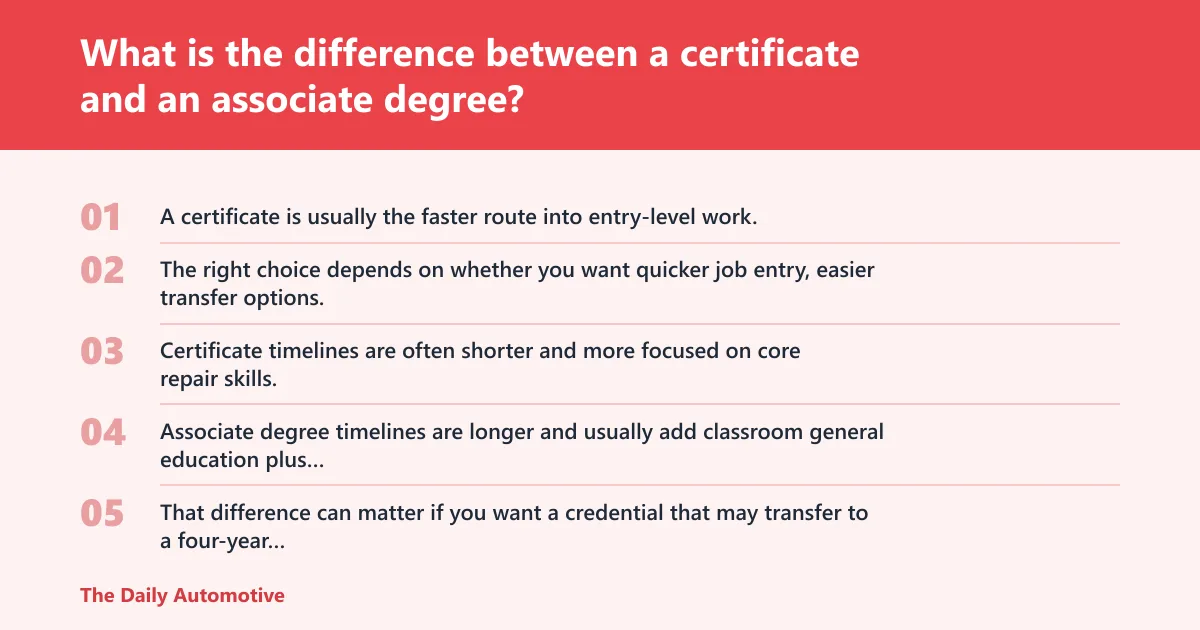
A certificate is usually the faster route into entry-level work, while an associate degree usually takes longer and includes more general education and technical depth. The right choice depends on whether you want quicker job entry, easier transfer options, or a broader academic base.
Program length and course depth
Certificate timelines are often shorter and more focused on core repair skills. Associate degree timelines are longer and usually add classroom general education plus deeper technical study. That difference can matter if you want a credential that may transfer to a four-year program later.
Do not treat the two paths as interchangeable. A short program may fit a student who wants to enter a shop faster. An associate degree may fit someone who wants more complete training in diagnostics, electronics, and management basics.
General education credits and transfer value
Regional accreditation matters if you want credits to transfer more easily to another college. Programmatic accreditation can matter for the technical side, but regional accreditation speaks to the school’s broader academic standing and transferability of credits.
Employer recognition also matters. A school’s name may carry weight with local dealers or fleet employers, even if the program is not the longest one on the list. Ask graduates’ employers, if possible, whether they respect the credential.
Which path fits a faster entry or broader study plan
If you want to start working quickly, a certificate may be enough for some entry-level roles. If you want more room for advancement, an associate degree can provide a wider foundation in diagnosis, electrical systems, and modern service procedures.
| Path | Typical focus | Best fit | Tradeoff |
|---|---|---|---|
| Certificate | Core hands-on repair skills | Faster entry into the field | Less general education and transfer breadth |
| Associate degree | Technical training plus general education | Broader study plan and transfer value | More time and often higher total cost |
How do accreditation and ASE alignment affect your choice?
Accreditation and ASE alignment do different jobs. Accreditation helps you judge school quality and transferability, while ASE alignment helps you judge whether the curriculum matches industry certification expectations. A good program often has both, but one does not replace the other.
Programmatic accreditation versus regional accreditation
Programmatic accreditation focuses on the specific technical program. Regional accreditation applies to the institution as a whole. If a school has regional accreditation, your general education credits may transfer more easily. If it has programmatic accreditation, the technical curriculum may be reviewed against industry standards.
Neither type guarantees a job. They do, however, give you a cleaner way to compare schools and ask sharper questions before you enroll.
Why employer recognition and credit transfer matter
Employer recognition affects how a shop or dealer views your training on day one. Credit transfer matters if you later want to continue school. A program can be nearby and affordable, yet still be a poor fit if credits will not move or if local employers ignore the credential.
How ASE exam areas map to curriculum
Look for course titles and lab descriptions that match ASE exam areas. You want engine diagnostics and drivability, electrical/electronic systems, brakes, suspension, drivetrain service, and heating and air conditioning. That map tells you whether the school is preparing you for certification work or just general shop exposure.
Hybrid and electric vehicle systems should also appear in the curriculum. Search for high-voltage safety, battery service basics, regenerative braking, and diagnostic procedures. Those topics matter because modern technicians increasingly work on electrified systems.
Use this checklist to compare nearby schools
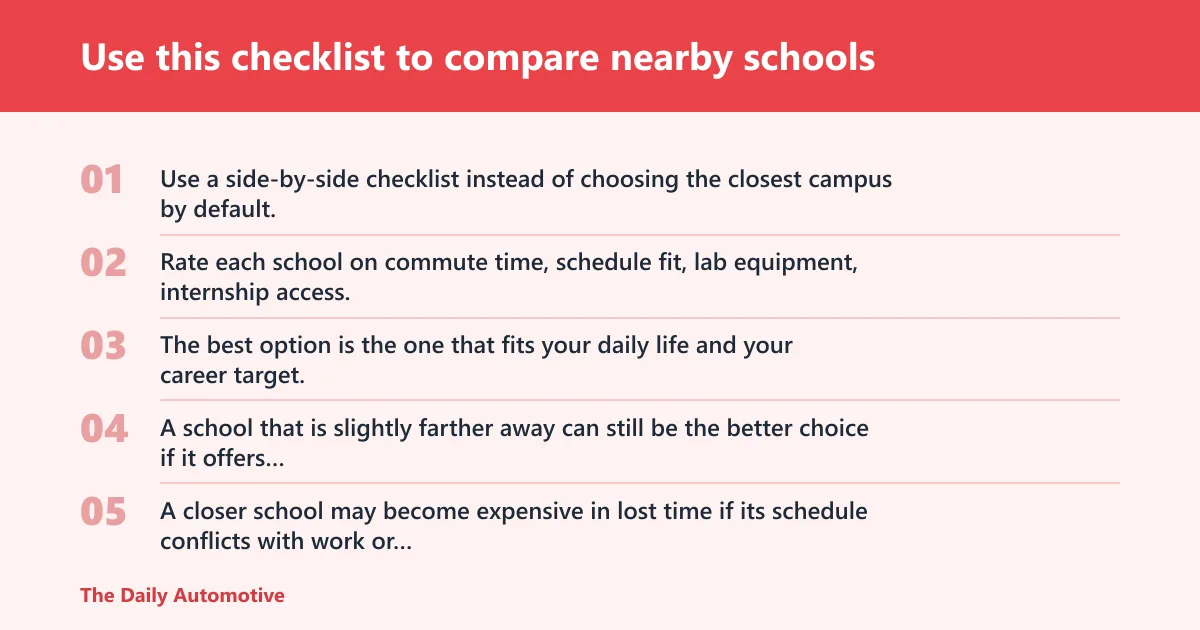
Use a side-by-side checklist instead of choosing the closest campus by default. Rate each school on commute time, schedule fit, lab equipment, internship access, first-year cost, and ASE or EV coverage. The best option is the one that fits your daily life and your career target.
| Criteria | School A | School B | School C |
|---|---|---|---|
| Commute time | 25 minutes | 45 minutes | 15 minutes |
| Class schedule | Day and evening | Day only | Part-time evenings |
| Lab equipment | Scanners, lifts, alignment tools | Basic tools only | Scanners, lifts, EV bay |
| Accreditation | Regional + program review | Regional only | Program review only |
| Internship access | Dealer and independent shop ties | Limited local contacts | Paid apprenticeship track |
| Total first-year cost | $8,900 | $11,400 | $7,600 |
| ASE/EV coverage | ASE-aligned, hybrid basics | ASE-aligned only | Limited EV coverage |
Commute time and class schedule
A school that is slightly farther away can still be the better choice if it offers evening labs, part-time pacing, or better parking. A closer school may become expensive in lost time if its schedule conflicts with work or family obligations.
Lab equipment and hybrid/EV coverage
Check whether the shop area includes diagnostic scanners, lift equipment, brake and alignment tools, and supervised exposure to hybrid or electric vehicle systems. Ask specifically about high-voltage safety instruction and whether students get any battery service basics, not only theory.
Internship access and shop partnerships
Ask how the school connects students to local shops, dealerships, or fleet employers. Work-based learning can build experience and contacts, but the details matter. Paid placements are not the same as unpaid ones, and required hours can vary widely by program.
Suppose a program has a strong lab but no local employer partners. You may still get technical training, but you could lose the bridge to a first job. Another school with a smaller lab but better shop ties may be more practical for employment.
Total first-year cost and expected fees
Do not stop at tuition. Add per-credit cost, lab fees, tool and equipment costs, books, and uniforms. Some programs also require specific safety gear or a starter tool set. Ask for an itemized estimate before you apply.
For example, a school with lower tuition can still cost more if its lab fees and tool requirements are high. The right comparison is total first-year cost, not just the posted tuition rate.
How much do automotive technology programs cost?
Automotive technology program cost includes tuition, lab fees, tools, books, uniforms, and certification prep. A school with lower tuition may still cost more once required gear is added. Compare the total first-year bill so you do not mistake a cheap headline price for a cheap program.
Tuition and fees
Ask for per-credit cost if the school charges by credit hour. Also ask whether there are separate lab fees for automotive service technology, diagnostics, or consumables. Those charges can change your real cost more than you expect.
Tools, books, uniforms, and certification prep
Some programs expect you to buy your own hand tools or basic starter kit. Others include them in the package or let you rent them. Books and uniforms are easy to miss, but they add up quickly. Certification prep materials may also be extra.
Community college options can lower the bill
Community colleges often cost less than private technical schools, especially for in-state students. They may also offer part-time scheduling and stronger commuter access. That combination can lower the total financial burden without cutting you off from hands-on training.
Can you visit local shops or dealerships before choosing a school?
Yes. Visiting local shops or dealerships before enrolling can help you see what employers expect from new technicians. A campus tour matters, but so does hearing from the people who might hire graduates. That can tell you whether a school’s training matches real shop work.
What to ask local employers
Ask which schools they recognize, whether they hire from nearby programs, and what skills new hires lack most often. Ask whether they value ASE-aligned coursework, hybrid and EV exposure, or formal internship experience. Keep the questions practical and specific.
What to look for during a campus visit
Check the condition of the lab, the number of lifts, scanner availability, and whether students are working on current platforms or only older vehicles. Ask how often equipment is updated and whether the school has access to modern drivability and electrical training resources.
Craven Tire & Automotive Repair serves New Bern, NC, and the business lists service specials including oil changes starting at $39.95, tire alignments at $89.99, and state inspections at $13.60. It also says it has more than 40 years of experience and provides a secure key box for after-hours car drop-offs. Details like these show why local employer relationships can matter when you compare schools and shops.
What jobs can you get after graduation?
Graduates can often pursue entry-level technician roles in dealer, independent shop, and fleet settings. An automotive technology degree can support work in diagnostics, maintenance, and light repair, while internships and employer contacts can improve the odds of a first placement.
Entry-level technician roles
Common starting roles include lube or general service technician, maintenance technician, and apprentice-level diagnostic helper. Some graduates move directly into brake, suspension, or electrical work if their program gave them enough lab time and employer-facing experience.
Dealer, independent shop, and fleet paths
Dealers often want strong brand-specific learning and formal service habits. Independent shops may value flexibility and broad repair exposure. Fleet employers may prioritize reliability, preventative maintenance, and safe diagnostics across a mixed vehicle inventory.
How internships can help with the first job
Internships or apprenticeships can make the first job search easier because they create a direct record of attendance, attitude, and hands-on work. Ask whether the placement is paid or unpaid, whether hours are required for graduation, and whether the employer routinely hires trainees after completion.
Automotive work is part of a large industry that includes design, development, manufacturing, marketing, selling, repairing, and modification of motor vehicles. The word automotive first came into use in 1898. Those facts do not choose a school for you, but they help explain why modern programs now need both mechanical and electronic coverage.
Frequently asked questions
How do I find an automotive technology degree near me?
Search nearby community colleges, technical schools, and career programs that offer an automotive technology degree, then compare commute time, schedule, accreditation, lab access, and total first-year cost. A nearby school is only a good choice if the timetable, training, and employer connections fit your life and goals.
What should I look for in an automotive technology program?
Look for hands-on lab training, current diagnostic scanners, lifts, brake and alignment tools, ASE-aligned coursework, and coverage of hybrid and electric vehicle systems. Also check for internship access, part-time or evening classes, and support services that help commuter students stay enrolled and on track.
Is an automotive technology degree different from automotive repair training?
Yes. Automotive technology degree programs usually combine repair skills with diagnostics, electrical systems, and sometimes general education, while repair training may be shorter and more task-focused. A certificate can help you enter the field sooner, but an associate degree may offer broader study and transfer value.
How close does the school need to be for a commuting student?
Close enough to make regular attendance realistic. That depends on traffic, parking, class timing, and whether the program requires long lab blocks. A school 15 to 30 minutes away may work well, but a farther campus can still be practical if it offers evening or part-time scheduling.
What accreditation should I check before applying?
Check both programmatic accreditation and regional accreditation. Programmatic accreditation helps you judge the technical program itself, while regional accreditation matters for credit transfer and broader institutional recognition. Neither one guarantees a job, but both can make your degree more useful after graduation.
Products related to this article
Sponsored / affiliate links. As an Amazon Associate I earn from qualifying purchases. I may earn additional commission from eligible campaigns.
 RVS Technology G6 Engine oil Treatment; For Gasoline Engines with a Motor oil capacity up to 6 quarts; Save fuel, Boost Power and Safely Restore and protect your Car, Truck, and all other engines
 Automatic Transmission Shifter Cable Bracket Lever Kit 35498, Replacement for Turbo TH400 TH350 TH250 200 4R 700R4 4L60, Metal Bracket and Lever Kit with