Balancing Family Life With a Passion for Cars Guide
Keep the hobby alive with three guardrails: a fixed monthly car budget, one protected hobby block each week, and a family calendar check before any parts order or event commitment. Without those limits, car spending steals time, cash, and trust fast. This guide shows how to protect family time, cap costs, and stay active in cars without pushing home life aside.
Why a car hobby needs household rules
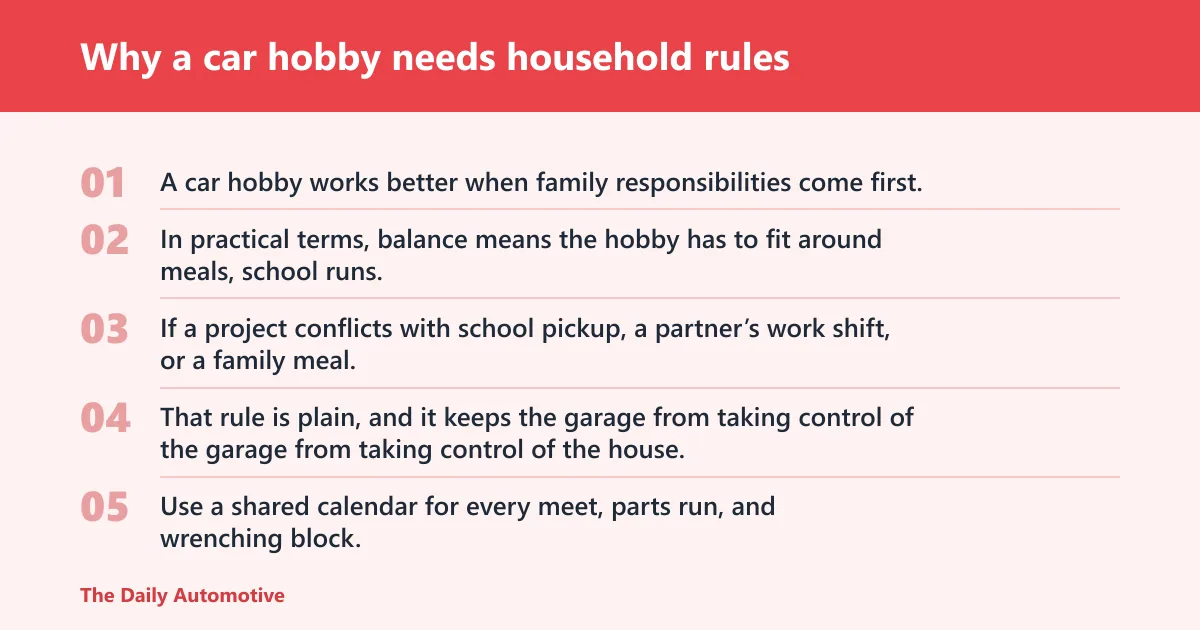
A car hobby works better when family responsibilities come first, because time and money are limited. In practical terms, balance means the hobby has to fit around meals, school runs, work shifts, chores, and rest.
Set the household order first
Start with the nonnegotiables. If a project conflicts with school pickup, a partner’s work shift, or a family meal, the family need wins. That rule is plain, and it keeps the garage from taking control of the house.
Use a shared calendar for every meet, parts run, and wrenching block. That keeps hobby time visible instead of assumed. A hidden Saturday in the garage often becomes the reason resentment builds.
Define hobby time before the hobby defines it
Set what counts as car time. That can include wrenching, parts runs, online listing searches, detailing, meets, and even long phone calls about parts. If it keeps spilling into family time, it needs a limit.
Small checks work better than waiting until the schedule is already broken. A family calendar check does the same job for home life that regular balance practice does for movement, it catches problems early.
How do you split time between family and cars?

Use a weekly time budget so garage time does not crowd out meals, school events, chores, or rest. The goal is not equal time. The goal is predictable time, so everyone knows when the hobby happens and when family needs come first.
Build a weekly time budget
Pick a fixed number of hobby hours, then place them after family duties. A practical structure is one weeknight block for planning or ordering parts, plus one weekend block for hands-on work. Leave the rest of the weekend open unless the family calendar says otherwise.
Here is a simple model:
| Weekly block | Allowed use | What it prevents |
|---|---|---|
| 1 weeknight, 60–90 minutes | Parts research, inventory, small prep tasks | Late-night garage drift |
| 1 weekend block, 2–4 hours | Maintenance, cleaning, minor installs | All-day projects that cut into family plans |
| Shared family car time | Drive, wash, trunk cleanup, quick errands | Hobby time that excludes everyone else |
Use recurring car blocks instead of open-ended projects
Open-ended work expands. A “quick brake job” becomes a missing-caliper weekend, then another trip for hardware, then a second weekend lost. Recurring blocks keep the project moving without letting it swallow the house.
Suppose a parent has a 7-year-old’s soccer game, a grocery run, and a hanging bumper cover. The right move is not to force the bumper job into the same day. Move the repair block to a day with real margin.
Plan for school nights, weekends, and shared events
School nights should stay light. Keep hobby work to quick tasks that stop on time. Weekends need the most protection, because that is where meets, family outings, and overdue chores all compete.
If an event conflicts with a family commitment, skip the event. Missing one meet costs less than teaching the family to expect the car hobby to outrank everything else.

How do you budget for car projects without strain?
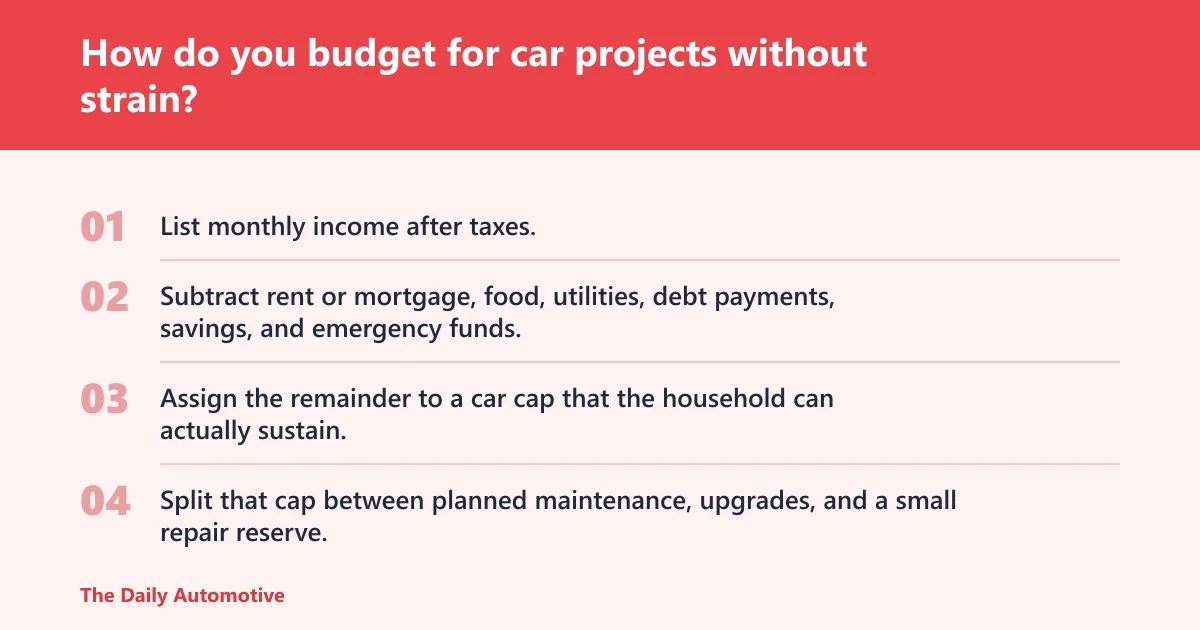
Create a separate car budget category, and treat it as its own fixed expense alongside rent, food, savings, and utilities. Car hobbies can be expensive, especially when repairs, upgrades, and collecting start mixing together without a ceiling.
Create a separate car budget category
Keep car money in its own line in the household budget. That category should cover maintenance, parts, fluids, detailing supplies, and event fees. If there is no category, the money tends to come out of savings or everyday spending.
A simple method:
- List monthly income after taxes.
- Subtract rent or mortgage, food, utilities, debt payments, savings, and emergency funds.
- Assign the remainder to a car cap that the household can actually sustain.
- Split that cap between planned maintenance, upgrades, and a small repair reserve.
Cap repairs, upgrades, and restoration costs
Car projects, restoration, and collecting create financial strain when limits are vague. A parts list without a ceiling can turn into a rolling debt problem. Set a monthly cap and an annual ceiling, then stop when you reach those limits.
For example, a modest hobby might use one bucket for wear items such as oil and filters, one for upgrades such as a dash cam or phone mount, and one for surprise repair reserve. That structure keeps the hobby from raiding the household budget.
Know the difference between planned spending and surprise bills
Planned spending is a chosen expense. Surprise bills can include a breakdown, a failed battery, or a tire issue that cannot wait. The reserve fund should cover the surprises first. If there is no reserve, the hobby is too fragile to grow.
Older adults especially need balance training to help prevent falls, and the same logic applies to family finances: a small reserve helps prevent a sudden problem from becoming a larger one. The risk of falling goes up after age 65; the risk of financial wobble goes up when every repair is treated as optional until it is urgent.
What should you do when a project starts to crowd out home life?
Use red-flag triggers to pause the work. If the project is causing repeated conflict, missed obligations, or borrowing from essentials, it is time to slow down or stop. A project should fit the household, not pull the household around it.
Watch for conflict around time, money, or stress levels
A pause is warranted when garage time keeps displacing dinners, school events, chores, sleep, or direct family time. It also matters when surprise expenses start landing on credit cards or when the project becomes a source of constant tension.
A common first-timer mistake is treating every delay as a reason to push harder. That often leads to missed deadlines, unfinished work, and more stress at home. If the car is parked apart in pieces and the family is already stretched thin, the pause is the responsible choice.
Decide whether to finish, sell, or slow the project
Not every project deserves the same ending. If the work is near completion and the budget is still intact, finish it slowly. If the car has become a long-term drain with no clear path, consider selling the project or stripping it back to a simpler goal.
Picture a restoration that needs bodywork, tires, trim pieces, and paint. If the household has a new baby, rising rent, and no repair reserve, the smart move may be to park the project and revisit it later. That is not failure. It is prioritization.
Make the car part of family life
Balance improves when the car is useful to the household, not only to the hobby. Scenic drives, road trips, errands, and trunk organization can turn the vehicle into shared infrastructure instead of a private escape hatch.
Turn road trips into shared outings
Family bonding can happen in the car without turning every trip into a formal event. Choose low-stress drives, scenic loops, or a weekend route with one stop that everyone wants. The point is shared time, not mileage for its own sake.
The NPR story about the family making a five-hour drive from Los Angeles to Tijuana shows how repeated trips can become part of family connection, and the teen says they have been making the border trip for six years. The family used daily calls to stay in touch. That kind of routine matters more than the road itself.
Use the car for everyday logistics
Family car organization should make daily life easier. Trunk storage boxes, cargo nets, and seat-back organizers reduce clutter and keep groceries, sports gear, and emergency items from rolling around. A clean trunk is not a luxury. It is practical family use.
Low-cost accessories can help too. A dash cam supports incident recording. A phone mount keeps navigation visible without hand-holding a device. Sunshades help reduce rear-seat heat on hot days. These are small purchases, but they should still fit the budget.
How can I involve my kids in car-related activities safely?
Match tasks to age and attention span, and keep children away from tools, chemicals, jacks, and moving vehicles unless the activity is tightly supervised and age-appropriate. Kids can learn a lot from cars, but safety has to set the limits.
Use supervised maintenance and simple tools only
Young children can help with basic cleanup, handing over a microfiber towel, or sorting sealed hardware on a table. Older kids can learn tire-pressure checks, fluid identification, or how to read a service schedule, but only with direct adult oversight.
Keep children away from jacks, jack stands, rotating parts, hot exhaust parts, solvents, and batteries unless the task is specifically planned for them and fully controlled. No child should be under a raised vehicle as a casual helper.
Try model cars, cleanup tasks, and STEM learning
Model cars can teach sequencing and patience. Simple STEM tasks can teach why gears move, how torque works, or why a battery dies after lights are left on. Cleanup tasks also matter because they build responsibility without exposure to tools.
For teens, the right level is often measuring tread depth, changing a cabin air filter with guidance, or helping compare repair estimates. That keeps the hobby educational instead of risky.
Adjust by family stage
Parents of young kids need short, predictable car time and a clear stop point. Parents of teens can add more teaching and more shared driving. Child-free enthusiasts still need household duties, sleep, and relationship time, so the same budget-and-calendar rules apply.
Standing on one leg is a common balance exercise, and balance holds are suggested for up to 30 seconds. The car hobby works the same way: brief, regular limits are safer than long bursts that throw the rest of life off center.
One-page family-hobby balance checklist
Use this as a weekly and monthly check. It turns “I’ll be careful” into a visible system.
Weekly time budget
- Family calendar checked before any hobby plan.
- One protected hobby block on the calendar.
- No hobby work during meals, school events, chores, or rest time.
- One shared car task scheduled with the family, such as washing, organizing, or a drive.
Monthly car-spend cap
- Separate category for repairs, upgrades, and parts.
- Repair reserve funded before cosmetic upgrades.
- No parts order that pushes food, savings, or emergency funds short.
- One review date to compare planned spending with actual spending.
Red-flag triggers that mean the project needs to pause
- Missed family events or repeated schedule conflicts.
- Spending that requires dipping into rent, food, savings, or emergency funds.
- Growing stress, tension, or arguments tied to the car.
- Project parts piling up with no realistic finish path.
- Family members saying the hobby is crowding out home life.
Frequently asked questions
How can I balance family life with a car hobby?
Set a weekly hobby block, protect family commitments first, and use a shared calendar for every event or parts run. Balance means getting two things to correspond, so the hobby has to fit around meals, school, chores, and rest instead of overriding them.
How do I budget for car projects when I have a family?
Create a separate household category for car spending, then cap repairs, upgrades, and parts at a fixed amount each month. Keep a reserve for surprise repair bills so the project does not raid savings, groceries, or other essentials.
How can I involve my kids in car-related activities safely?
Use age-appropriate tasks and keep children away from moving vehicles, jacks, chemicals, and sharp tools unless the activity is tightly supervised. Model cars, cleanup work, tire-pressure lessons, and simple STEM explanations are safer ways to include them.
What should I prioritize: family responsibilities or car projects?
Family responsibilities should come first. If a project conflicts with school pickup, work schedules, meals, rest, or urgent household tasks, the project pauses. That rule protects trust and prevents the hobby from becoming a source of constant friction.
How do I keep my car hobby from causing financial strain?
Use a hard monthly cap, separate planned maintenance from wish-list upgrades, and keep an emergency fund for repairs. Car collecting and restoration are where budgets often break, so vague spending rules should be replaced with a clear ceiling and a pause point.
What are affordable ways to enjoy cars with my family?
Choose scenic drives, casual road trips, family washes, trunk organization days, and low-cost accessories that make the car easier to use. A dash cam, phone mount, and sunshades can support family life without turning every purchase into a major expense.
Products related to this article
Sponsored / affiliate links. As an Amazon Associate I earn from qualifying purchases. I may earn additional commission from eligible campaigns.