Car Customization Trends: OEM-Plus, Reversible Mods
The strongest car customization trend now is OEM-plus, reversible mods, and camera-safe styling: if a change hurts daily usability, resale, or service access, it is fading. Ignore that shift and you risk a car that looks loud online but feels annoying, expensive, or impractical every day. This guide covers what is gaining traction, what is dropping out, and which upgrades fit daily drivers, show builds, weekend cars, and EVs.
What are the biggest car customization trends in 2026?
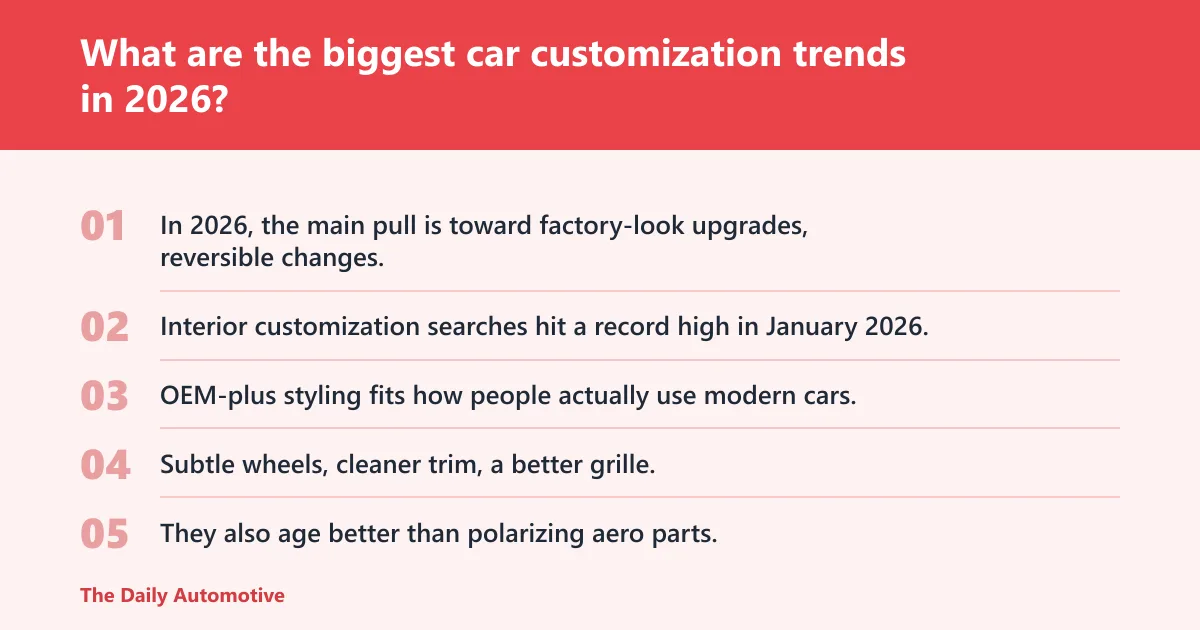


In 2026, the main pull is toward factory-look upgrades, reversible changes, and practical personalization. Interior customization searches hit a record high in January 2026, wraps are described as the default way to change a car’s look, and OEM-plus styling is being framed as the modern move for enthusiasts who want a premium result without a full teardown.
Why OEM-plus is moving ahead
OEM-plus styling fits how people actually use modern cars. Subtle wheels, cleaner trim, a better grille, and restrained lighting changes read as planned, not improvised. They also age better than polarizing aero parts, and they tend to survive software updates, dealer visits, and resale inspections with fewer headaches.
Where wraps, lighting, and smart interior mods fit in
Vinyl wraps remain the standard non-permanent exterior change because they offer color and finish variety without committing the owner to paint. Inside the cabin, app-controlled RGB lighting is now a common reversible customization, and the Massapequa article also calls out AI-powered interior customization as part of the current trend mix. That pushes the category toward personalization with less permanence.
What still counts as a high-impact custom change
High-impact changes are no longer limited to loud body kits or extreme camber. A clean wrap, better wheel fitment, a revised steering feel from suspension parts, or a carefully chosen lighting package can transform the car’s presence. The key difference is whether the change improves the car’s look without blocking visibility, access, or daily comfort.
📊 Interior customization searches hit a record high in January 2026. Source: The Art of Car Customization: A 2026 Lifestyle Trend.
Is OEM-plus styling replacing aggressive aftermarket builds?
OEM-plus styling is not erasing aggressive builds, but it is becoming the broader default for owners who want a modern result. Factory-look body kits, subtle trim, and wheel packages are winning because they look planned in photos, suit daily driving, and avoid the maintenance and compatibility problems that often come with extreme custom parts.
Factory-look body kits, wheels, and trim
Factory-inspired body pieces are popular because they blend in with the original design language. That matters on newer cars with sharp factory lines, where a modest lip, cleaner side skirt, or restrained spoiler can look more expensive than a heavily styled aftermarket kit. Matching wheel design to the car’s original proportions has the same effect.
Why subtle changes photograph well and age better
Subtle builds photograph well because the eye reads them as complete rather than busy. They age better because they are less likely to clash with future model-year styling changes. Loud one-off cars still matter, but mainly as dedicated show projects where downtime, tire wear, and attention are part of the point.
Which owners are choosing restraint over flash
Daily drivers, lease holders, and owners who care about resale are leaning hardest into restraint. They want changes that look premium at a glance, do not trigger fitment problems, and do not make service work harder. That preference is also common among EV owners, where the car’s software, sensors, and aero balance matter more than ever.
What exterior mods are most popular right now?
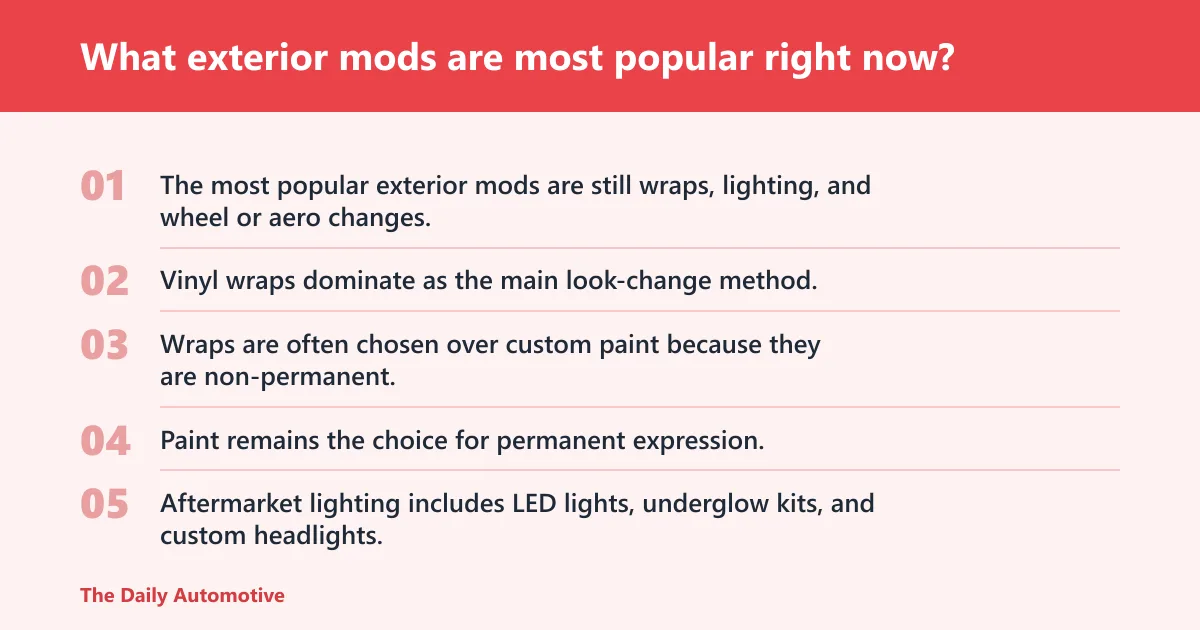
The most popular exterior mods are still wraps, lighting, and wheel or aero changes, but the direction has shifted toward cleaner execution. Vinyl wraps dominate as the main look-change method, aftermarket lighting remains popular when it is tasteful and compliant, and EV-friendly body kits are rising because they can alter the profile without major mechanical changes.
Vinyl wraps versus custom paint jobs
Wraps are often chosen over custom paint because they are non-permanent, widely available, and offer broad color and finish options. Paint remains the choice for permanent expression, especially matte and metallic finishes, but it carries higher labor cost, more downtime, and fewer easy reversals if the owner changes direction.
Aftermarket lighting, including headlights and underglow
Aftermarket lighting includes LED lights, underglow kits, and custom headlights. LED headlights and carefully executed accent lighting can modernize a car quickly, while underglow is more polarizing and usually belongs on show builds rather than daily commuters. Cheap kits are a common failure point because they can flicker, drain power, or cause fitment and waterproofing issues.
Aerodynamic body kits and wheel packages for EVs
EV-compatible modifications often focus on aerodynamic body kits and wheel packages first, because range and thermal management matter. The Massapequa article includes EV modifications as a trend, and the best examples are usually restrained: wheels with suitable weight and offset, aero add-ons that do not block sensors, and upgrades that preserve charging access and ride quality.
Scenario examples
Say your sedan gets a satin wrap, a light OEM-style lip, and 18-inch wheels with factory-like spoke patterns. The car reads as current and premium without forcing attention at every stoplight. The same car with a bright underglow kit and an oversized wing would move into show-only territory fast.
A common first-timer mistake is buying a universal headlight kit that looks fine in photos but throws warning lights on a newer crossover with front sensors. Once the wiring, seal, and beam pattern create problems, the “upgrade” becomes a repair project.
What interior customization trends are popular right now?
Interior customization is leaning toward ambient lighting, smarter control, and custom-fit details that do not interfere with airbags, switches, or sensors. App-controlled RGB lighting is common because it is reversible and cosmetic, while 3D-printed trims and accent pieces are gaining ground for owners who want a more tailored cabin without replacing major components.
Interior LED lighting kits and app control
App-controlled RGB interior lighting is a simple, removable interior mod that fits a modern look. A featured interior LED product is priced at $16.98, which shows how accessible this category has become. The best installs keep brightness controlled, avoid glare in the windshield, and do not interfere with night vision.
Custom trims, switchgear accents, and 3D-printed parts
3D-printed components are now part of the customization conversation because they can create bespoke trims, rapid prototypes, and custom-fit parts. The Massapequa article includes 3D-printed components as a trend, and that makes sense for small cabin pieces such as bezels, knobs, phone mounts, or switch surrounds. These parts work best when they match factory texture and fit.
What stays reversible for leased or daily-driven cars
Reversible changes matter most in leased cars and daily commuters. Stick-on trim, plug-in lighting, removable accent panels, and non-invasive mounts are the safest path. Anything that requires cutting wires, drilling into visible surfaces, or blocking access to switches should be treated as a permanent decision, not a casual add-on.
How much do common cosmetic customization upgrades cost?
Cosmetic upgrades span a wide price range, but the realistic budget bands are easy to separate: simple trim and lighting can stay low, wraps and quality wheel changes sit in the middle, and custom paint or major interior work can move into premium territory fast. Labor often rises quickest on anything that needs panel removal, prep, or precise alignment.
Budget, mid-tier, and premium pricing
Budget cosmetic changes often include stick-on trim, basic LED kits, and touch-up work. A featured touch-up paint product is priced at $9.99, and a featured funnel accessory is priced at $15.99, which gives a sense of how low-cost supporting parts can be. Mid-tier wraps, better lights, and trim pieces usually cost more because installation time matters.
Where labor costs rise fast
Labor climbs quickly on wraps, custom headlights, and paint because these jobs depend on prep and precision. Wheel-and-tire changes may look simple, but alignment, sensors, and tire sizing can add cost. Interior work can also get expensive if the installation touches dash panels, switchgear, or airbag-adjacent areas.
Which mods give the best visual change per dollar
Wraps often deliver the biggest visual shift per dollar, especially when the goal is a full color change without permanent paint. Lighting can also be efficient when it is restrained and well integrated. A cheap part only stays cheap if it does not create follow-up labor, warning lights, or rework.
How do performance and suspension mods fit a lifestyle build?
Performance and suspension mods still matter, but they are now more selective in lifestyle-focused builds. Engine remapping, intake, exhaust, turbocharger, and supercharger paths remain relevant, yet owners are balancing power against noise, warranty, emissions compliance, and drivability. Suspension changes are often chosen as much for stance and control as for speed.
Engine remapping, intake, exhaust, turbocharger, and supercharger paths
Engine remapping can sharpen throttle response and change the power delivery, while intake and exhaust upgrades usually target sound, response, and modest gains. Turbochargers and superchargers are more serious projects because they affect heat, fueling, and long-term reliability. These paths fit best when the owner accepts the extra maintenance and complexity.
Suspension upgrades for stance and handling
Suspension upgrades can include shock absorbers and springs, sway bars, and control arms. These parts can tighten body control and improve turn-in, but they can also reduce comfort if the setup is too stiff or too low. A well-chosen package should improve handling without making speed bumps, driveway angles, and wet roads miserable.
Where daily comfort and reliability can suffer
Daily comfort suffers when the build chases appearance over function. Too much drop can sometimes cause tire rub and exhaust contact. Aggressive exhaust systems can become tiring on commutes. Power adders can create extra heat and service needs that do not suit a car parked outside and driven year-round.
What are the risks of adding digital or smart-car upgrades?
Digital and smart-car upgrades can add convenience, but the risk profile is higher than with simple cosmetic parts. Anything tied to sensors, cameras, software menus, or vehicle networks can create compatibility issues. The main hazards are warning lights, misaligned sensors, failed modules, and features that stop working after a software update or accessory install.
ADAS compatibility and sensor clearance
ADAS matters because modern cars depend on sensors and cameras for features such as parking assist, lane support, and automatic braking. The Massapequa article includes ADAS integration as a customization consideration, and that warning is important. Bumper and grille clearance must stay clear, or a body kit, badge change, or lighting retrofit can disrupt camera or radar function.
OBD-II tools, app-based features, and hidden failure points
A featured OBD-II scanner is priced at $23.99, which shows how accessible diagnostics have become. That accessibility matters because smart upgrades often fail quietly before they fail visibly. The warning signs are simple: odd alerts, delayed module wake-up, or features that only work until the next software refresh.
How to reduce risk before you buy
Start by checking whether the mod touches a sensor, a camera view, an airbag zone, or a wiring run. Then confirm that the part is made for the exact platform and trim level. If the seller cannot explain clearance, beam pattern, or module compatibility in plain terms, treat that as a warning sign.
How do EV customization trends differ from gas car mods?
EV customization trends differ because range, weight, aero, and software integration matter more than engine hardware. The Massapequa article includes EV modifications as a trend, but the smartest changes usually focus on aerodynamic body kits, wheel packages, and carefully chosen performance upgrades that do not hurt efficiency or sensor function.
What EV owners change first
Most EV owners start with wheels, trim, and aero rather than power parts. That makes sense because wheel weight, tire choice, and drag can affect efficiency. Exterior changes also need to preserve charging access and camera visibility, which makes restraint more important than on many gas cars.
Why EV builds punish bad fitment
Bad fitment can cause more than rubbing. It can affect range, efficiency, and the behavior of driver-assist systems. Large wheels, aggressive offsets, or body parts that interrupt airflow may look dramatic, but they can conflict with the very advantages that make EVs attractive in the first place.
Where EV performance upgrades still make sense
Performance upgrades still have a place on EVs, but they are usually software, cooling, tire, or chassis related rather than classic engine mods. A clean wheel setup, better tires, and aero pieces that keep drag in check tend to fit the modern EV approach better than loud visual changes.
What trends make a car build look modern without overdoing it?
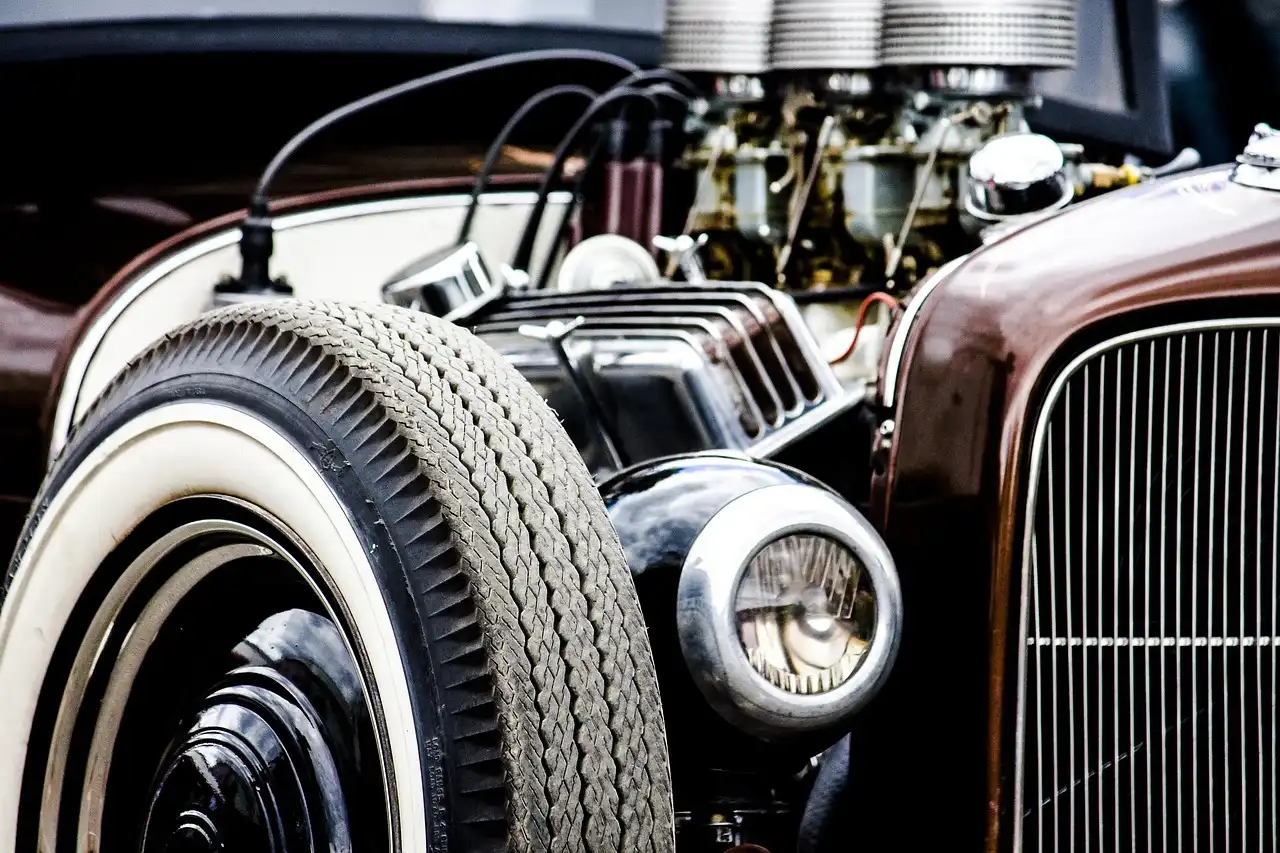
The builds that look modern in 2026 are usually the ones that keep the original design readable. OEM-plus styling, wrap-based color changes, tasteful lighting, and subtle cabin upgrades create a finished look without turning the car into a parts catalog. The goal is coherence, not volume.
Use restraint in three places
- Keep exterior colors and finishes clean, with wraps or paint that suit the body lines.
- Match wheel size and offset to the chassis instead of forcing extreme fitment.
- Avoid lighting, aero, or trim that blocks cameras, sensors, or service access.
Choose one visual focal point
A modern build usually needs one clear focal point, not five competing ones. That could be a premium wrap finish, a well-fitted wheel setup, or a clean interior lighting theme. When every panel tries to get attention, the car starts to look dated faster.
Which trends are fading unless the car is a show project
Loud one-off bodywork, unsupported smart accessories, and overdone underglow are losing ground as default choices. They still belong on dedicated show cars, but they are less attractive for daily use. The trend is moving toward changes that look good in a parking lot, work on a commute, and survive the next service visit.
| Trend | Cost tier | Reversible? | Installation risk | Best-fit owner type |
|---|---|---|---|---|
| OEM-plus styling | Mid | Mostly | Low to medium | Daily driver, weekend enthusiast |
| Vinyl wrap | Mid to premium | Yes | Medium | Daily driver, show car, EV owner |
| Interior LED lighting kits | Low | Yes | Low | Daily driver, commuter-friendly build |
| Custom paint jobs | Premium | No | High | Show car, committed enthusiast |
| Aftermarket lighting | Low to premium | Usually | Medium to high | Weekend enthusiast, show car |
| Performance tuning | Mid to premium | Sometimes | High | Weekend enthusiast, dedicated enthusiast |
| Suspension upgrades | Mid to premium | Sometimes | Medium to high | Weekend enthusiast, performance-minded driver |
| ADAS-aware body kits | Mid to premium | Mostly | High | Daily driver, EV owner |
| 3D-printed components | Low to mid | Yes | Low to medium | Daily driver, DIY-focused owner |
Frequently asked questions
What are the biggest car customization trends in 2026?
The biggest trends are OEM-plus styling, wraps, app-controlled interior lighting, and smarter use of wheels and trim. Interior customization searches hit a record high in January 2026, and the overall direction is toward reversible, camera-safe changes that keep daily drivability intact.
Is OEM-plus styling replacing aggressive aftermarket builds?
OEM-plus is becoming the default for many owners because it looks premium, photographs well, and ages better than extreme builds. Aggressive aftermarket styling still exists, but it is increasingly a choice for dedicated show projects rather than the mainstream daily-driver path.
What interior customization trends are popular right now?
App-controlled RGB lighting, custom trims, switchgear accents, and 3D-printed cabin parts are leading the way. The strongest interior trend is reversible personalization: changes that alter the mood of the cabin without cutting wires, blocking controls, or creating permanent damage.
What exterior mods are most popular in car culture?
Wraps, tasteful lighting, cleaner wheel packages, and restrained aero are the most visible exterior changes. Custom paint still matters for permanent expression, but wraps are more popular because they are easier to change, easier to remove, and available in more finishes.
How much do common cosmetic customization upgrades cost?
Simple cosmetic parts can be inexpensive, while wraps and paint move into higher tiers fast. A featured interior LED product is priced at $16.98, a featured touch-up paint product is $9.99, and a featured OBD-II scanner is $23.99, but labor and fitment often cost more than the part itself.
Are wraps still more popular than custom paint jobs?
Yes. Wraps are described as the default way to change a car’s look because they are non-permanent and offer broad color and finish choice. Paint remains the better answer for a permanent finish, especially matte or metallic looks, but it is a bigger commitment.
Products related to this article
Sponsored / affiliate links. As an Amazon Associate I earn from qualifying purchases. I may earn additional commission from eligible campaigns.