Car Audio System Innovations: What Matters First Now
For 2026 car audio, spend first on speakers, factory tuning, and cabin noise control. If the base system is weak, those three usually beat amps, screens, and app features for audible gain. Skip that order and you can pay for convenience while the sound stays thin, harsh, or muddy. This guide ranks the upgrades that actually move sound quality forward, flags the features that are mostly marketing, and shows what to do first.
What matters most in 2026 car audio?
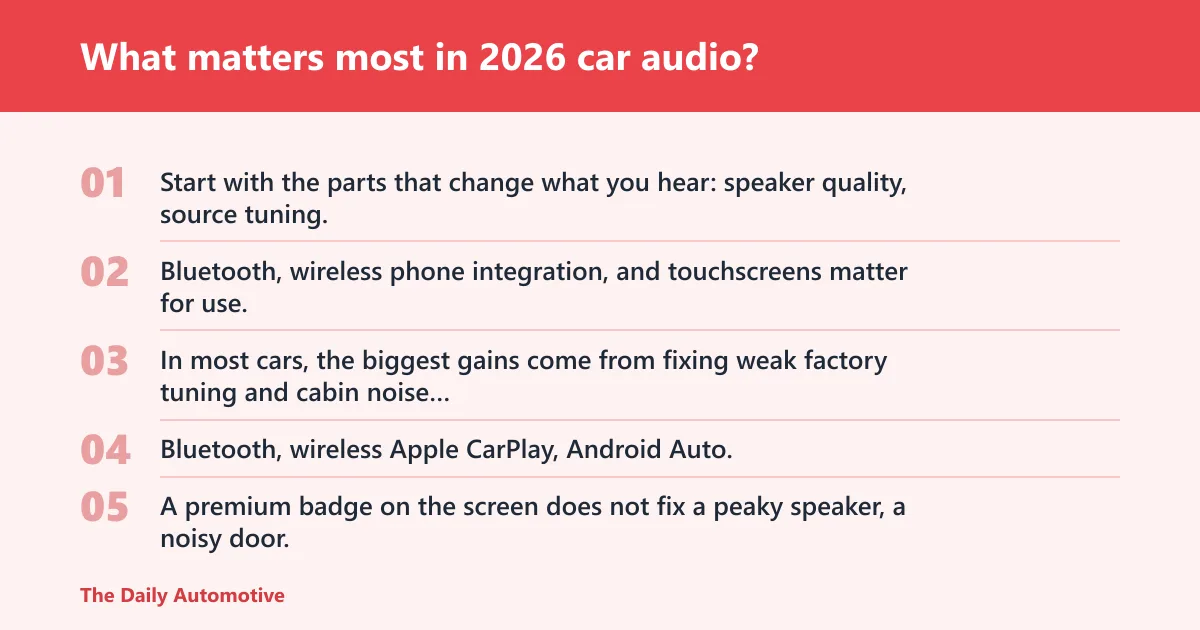


Start with the parts that change what you hear: speaker quality, source tuning, amplifier headroom, subwoofer integration, and noise control. Bluetooth, wireless phone integration, and touchscreens matter for use, but they do not automatically improve fidelity. In most cars, the biggest gains come from fixing weak factory tuning and cabin noise first.
Separate sound-quality gains from convenience features
Modern cars already do a lot well. Bluetooth, wireless Apple CarPlay, Android Auto, and built-in infotainment can make playback and phone use easier, but convenience is not the same as better sound. A premium badge on the screen does not fix a peaky speaker, a noisy door, or a weak factory amplifier.
Factory systems are often tuned by engineers during development, and many use flat equalization as the baseline. That is sensible, because flat tuning preserves source neutrality and gives you room to adjust from there. The problem is that factory tuning is also shaped by cost, packaging, and cabin noise limits.
Match upgrades to budget and vehicle type
If you drive a quiet sedan with decent speakers, a DSP and modest amplification may be the cleanest next step. If your vehicle has thin doors and road roar, sound deadening can move the needle before a speaker swap does. If your system is an entry-level factory setup, start by improving output and bass extension, then tune it.
Say your compact SUV has six factory speakers and a head unit that sounds strained at higher volume. Replacing the tweeters first will not fix the lack of low-end support or the harshness caused by clipping. A better plan is source tuning, a small amplifier, and door treatment before chasing premium speaker labels.
How much power does a factory head unit really make?
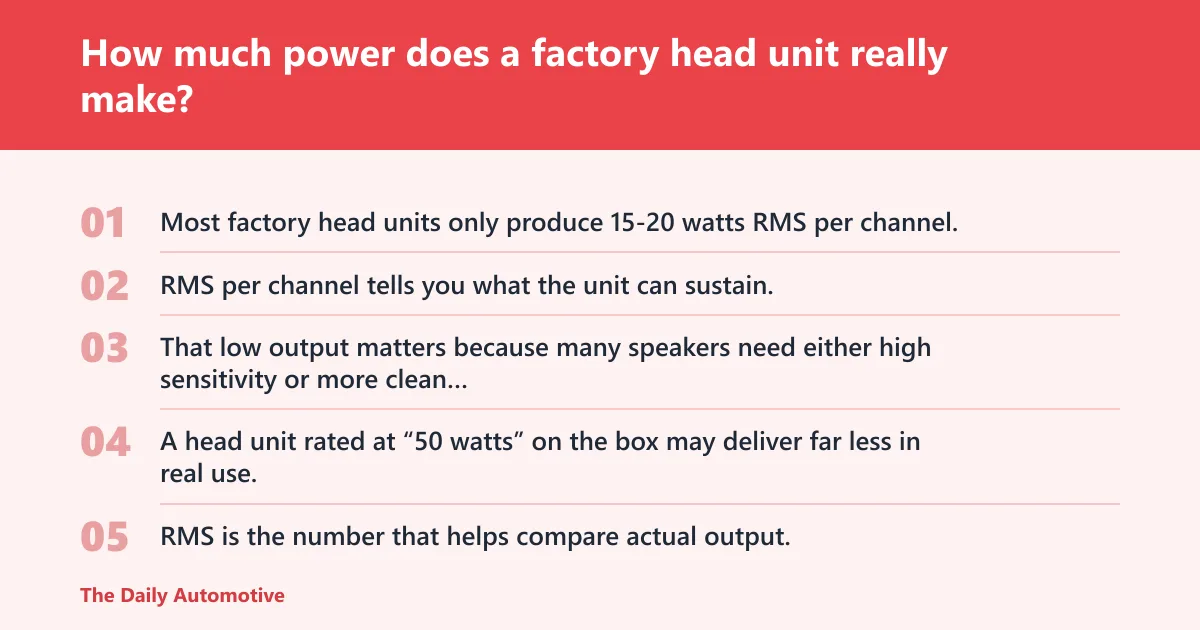
Most factory head units only produce 15-20 watts RMS per channel, which is far less useful than marketing watt claims that quote peak power. RMS per channel tells you what the unit can sustain. That low output matters because many speakers need either high sensitivity or more clean amplifier power to play loudly without strain.
Why RMS per channel matters more than marketing watts
A head unit rated at “50 watts” on the box may deliver far less in real use. RMS is the number that helps compare actual output. With 15-20 watts RMS per channel, a factory source can play cleanly at moderate levels, but it often runs out of headroom before the driver wants more volume.
How speaker sensitivity affects loudness with low-power sources
Speaker sensitivity, shown as a dB rating, tells you how efficiently a speaker converts power into sound. With a low-power factory head unit, higher sensitivity matters because the speaker reaches usable volume with less input. That is why a sensitive speaker often sounds “louder” than a tougher one on the same radio.
A common first-timer mistake is buying low-sensitivity speakers for a weak factory source, then turning the volume up until the signal clips. The result is harsh upper mids, weak bass, and a sense that the new speakers “didn’t help.” The speakers may be fine; the source is the bottleneck.
When the head unit is the wrong place to stop upgrading
If the source cannot provide enough clean power, a better head unit alone may still leave the system short. The real question is whether you need more RMS per channel, cleaner tuning, or better integration. In many cars, the answer is an external amplifier, not a bigger screen.

Which upgrades improve sound the fastest?
The fastest audible gains usually come from a Class D amplifier, a DSP, a dedicated subwoofer, and sound deadening. Those parts address power, tuning, bass extension, and noise before you spend money on cosmetic or convenience items. If the cabin is loud, deadening may beat a speaker upgrade for perceived improvement.
Class D amplifier: efficiency and compact multi-channel power
A Class D amplifier is efficient, compact, and well suited to factory-upgrade systems where space and heat matter. It can deliver multi-channel power without the bulk of older designs. For many daily drivers, that means cleaner output at higher volume and more control over the front stage.
DSP: time alignment, EQ tuning, crossover control, and staging
A DSP, or digital signal processor, is where much of the tuning work happens. It lets you adjust time alignment, EQ, crossover points, and sound staging so the system behaves like a coherent front image instead of separate speakers firing at you from different locations. That is an audible upgrade, not a convenience feature.
Dedicated subwoofer: enclosure type, power handling, and bass extension
A dedicated subwoofer changes the system more than most screen upgrades ever will. Low-frequency reproduction needs cone area, enclosure choice, and enough power handling to stay controlled. A sealed box usually favors tighter response, while a ported enclosure can deliver more output. Either way, bass extension changes perceived quality fast.
Sound deadening: doors, floor, and trunk before expensive speakers
Sound deadening reduces road noise and panel resonance. Treat the doors first for better speaker mounting stability and less metal ringing, then move to the floor and trunk if tire noise or rear boom is still an issue. Better isolation makes bass easier to hear and lets the rest of the system work less hard.
What do DSP, EQ, and speaker choices actually change?
DSP, EQ, and speaker selection shape tonal balance, image placement, and how hard the system has to work. A flat baseline is the right starting point, because heavy bass or treble boosts can hide problems instead of fixing them. Speaker sensitivity and amplifier output should be chosen as a pair.
Balanced EQ as a baseline
Factory-style tuning often uses flat equalization, and that is still the safest starting point in 2026. Some systems expose a handful to about a dozen sliders, which is enough for small corrections. Use those controls to trim rough edges, not to force a dramatic curve into a cabin that is already well behaved.
Flat tuning versus bass and treble boosts
Strong bass boost can mask mids and overwork small speakers. Heavy treble boost can make cymbals and vocals sound sharp without adding detail. A balanced EQ keeps the source neutral and lets you decide whether to add a small lift later. That approach is more repeatable than chasing one song’s sound.
How speaker sensitivity and amplifier power work together
If sensitivity is high, modest amplifier power can still produce useful volume. If sensitivity is low, the same amp may run out of clean output early. The practical rule is simple: low-power sources need efficient speakers, while stronger amplifiers let you choose more demanding drivers without losing loudness.
Are wireless CarPlay, Android Auto, DAB, and Atmos real audio upgrades?
These features range from useful to mostly situational. Wireless Apple CarPlay and Android Auto improve convenience and source delivery, DAB can improve broadcast quality where supported, and Dolby Atmos depends heavily on content and speaker layout. None of them automatically fix weak speakers, poor tuning, or cabin noise.
Wireless Apple CarPlay and Android Auto: convenience and source delivery
Wireless Apple CarPlay and Android Auto make connection easier and keep the infotainment interface cleaner. They help with integration, not with the physics of playback. If the audio path stays the same, sound quality may not change at all. A nicer connection is still useful, just not an upgrade to the speakers themselves.
DAB radio: where it helps and where it does not
DAB radio can improve broadcast quality in regions where it is available, and many aftermarket head units support it. One featured Kenwood unit has Bluetooth, DAB+, WiFi, and wireless CarPlay/Android Auto. That combination is convenient, but the audio benefit depends on local station quality and the rest of the system.
Dolby Atmos and spatial audio: content support, speaker layout, and car limits
Dolby Atmos is an object-based spatial audio format, and the page presents Pioneer Sphera as bringing it to the car. The challenge is implementation: car cabins need the right speaker layout, source support, and processing to make it work as intended. Without compatible content and placement, the effect can be uneven or subtle.
A common expectation gap is assuming “3D sound” automatically means better fidelity. In practice, surround or spatial playback can be impressive, but it is limited by content compatibility and the number and location of speakers. A well-tuned stereo setup often beats a poorly executed immersive system.
2026 upgrade-priority table: what to buy first
Use this as a practical order, not a spec sheet. The best first buy is the part that creates the biggest audible gain for your cabin and budget. Convenience features can wait if the system is still thin, noisy, or hard to tune.
| Innovation | Audible impact | Install complexity | Best-fit vehicle type | Verdict |
|---|---|---|---|---|
| Sound deadening | High in noisy cabins; improves bass perception and reduces panel buzz | Medium | Older cars, trucks, SUVs, loud highway commuters | Buy first |
| DSP | High; fixes staging, timing, crossover balance, and tonal errors | Medium to high | Any car with a poor factory tune or odd speaker placement | Buy first |
| Class D amplifier | High when the factory source is weak; improves headroom and control | Medium | Factory-upgrade systems, limited-space installs | Buy first |
| Dedicated subwoofer | High for bass extension and low-end completeness | Medium to high | Sedans, hatchbacks, anyone missing low bass | Buy first |
| Speaker upgrade | Moderate to high, depending on sensitivity and tuning | Medium | Cars with worn, distorted, or cheap factory speakers | Consider |
| Balanced EQ tuning | High when the baseline is poor; modest when hardware is already good | Low to medium | Every car | Buy first |
| Wireless Apple CarPlay / Android Auto | Low for sound quality; high for convenience | Low to medium | Drivers who want phone integration | Consider |
| DAB radio | Low to moderate, region dependent | Low to medium | Regions with active DAB broadcasts | Consider |
| Dolby Atmos / spatial audio | Variable; depends on content and speaker layout | High | Vehicles with multi-speaker layouts and supported source content | Consider |
| Big touchscreen / interface upgrade | Low for sound quality | High in some vehicles | Drivers prioritizing integration and screen size | Skip for sound |
What can go wrong in a modern car audio install?
The main failures are often impedance mismatch, clipping, bad gain setting, weak factory source output, and unrealistic expectations about wireless features. None of those are exotic problems. They usually come from mixing parts that are not matched to one another or assuming software can replace hardware.
Impedance mismatch and clipping risk
If speaker impedance does not match the amplifier’s safe operating range, output can fall, distortion can rise, or the amp can shut down. Clipping is the bigger everyday danger. It happens when you ask a weak source to play louder than it can do cleanly, and the result is harsh sound and possible speaker damage.
Gain setting mistakes
Gain is not a volume knob. Set it too high and the system clips early; set it too low and you leave usable power on the table. Good gain setting helps a DSP and amplifier work together. Bad gain setting makes expensive hardware sound cheap.
Why premium software features cannot fix weak hardware
Touchscreen integration, voice control, Wi-Fi, and wireless phone mirroring improve use and access. They do not cure a cabinet that rattles, a door speaker with poor sensitivity, or a system starved of power. Premium branded systems such as Bose or Harman can sound good, but brand alone does not guarantee the best result.
Picture a midsize hatchback with a factory radio, wireless phone mirroring, and a premium badge on the grille. If the doors leak noise and the front speakers are low sensitivity, the cabin still sounds compressed. A DSP, modest amplifier, and deadening can beat a fancier label in that case.
Frequently asked questions
What car audio upgrades matter most in 2026?
The most useful upgrades are the ones that change acoustics and headroom: speaker quality, a DSP, a clean amplifier, a subwoofer, and sound deadening. Convenience features like wireless phone integration are valuable, but they do not automatically make the system sound better.
Is Dolby Atmos worth it in a car?
It can be worthwhile only if the vehicle has the right speaker layout, the source content supports it, and the processing is implemented well. In many cars, a strong stereo setup with proper tuning will deliver more consistent results than a weakly executed spatial system.
How many watts does a factory head unit usually produce?
Most factory head units only produce 15-20 watts RMS per channel. That is enough for moderate listening, but not much headroom in a noisy cabin. The RMS figure matters more than peak watt claims because it reflects sustained output rather than marketing language.
What is the difference between DSP and a standard amplifier?
A standard amplifier mainly raises power. A DSP adds time alignment, EQ tuning, crossover control, and staging adjustments. In a car, that extra control often matters as much as power because speaker location and cabin reflections can distort the image long before power runs out.
Do wireless Apple CarPlay and Android Auto improve audio quality?
Usually no. They improve convenience, interface integration, and source access, but they do not by themselves fix poor speakers, weak amplification, or bad tuning. If the audio path stays unchanged, the sound quality may stay the same even though the user experience is better.
What should I upgrade first for better sound in my car?
Start with the weakest audible link. In many vehicles that means sound deadening, then a DSP or amplifier, then a subwoofer, and finally speaker replacement if needed. If the factory head unit is weak and the speakers are inefficient, the right first move is often a power-and-tuning package.
Products related to this article
Sponsored / affiliate links. As an Amazon Associate I earn from qualifying purchases. I may earn additional commission from eligible campaigns.