Best Auto Services Near Me: How to Choose the Right Shop
Score each shop on a few main points, such as diagnostic process, written estimate, warranty terms, and vehicle-specific expertise. Skip that check, and you can pay for the wrong repair, lose time, and end up arguing over coverage later. This guide gives you a shop scorecard and the questions to ask before you book.
Quick picks by need
- Best for a clear written estimate: A shop that separates parts, labor, taxes, and shop fees before work starts.
- Best for complex diagnostics: A shop that explains OBD-II scan results, billable diagnostics, and follow-up testing in writing.
- Best for EV or hybrid work: A shop with documented EV/hybrid training and battery-system capability.
- Best for dealer-only or warranty work: A dealer service center when your warranty requires branded parts, software updates, or campaign work.
- Best for price-sensitive maintenance: A shop that matches the manufacturer schedule and gives a transparent out-the-door total.
How to choose the best auto service near you?
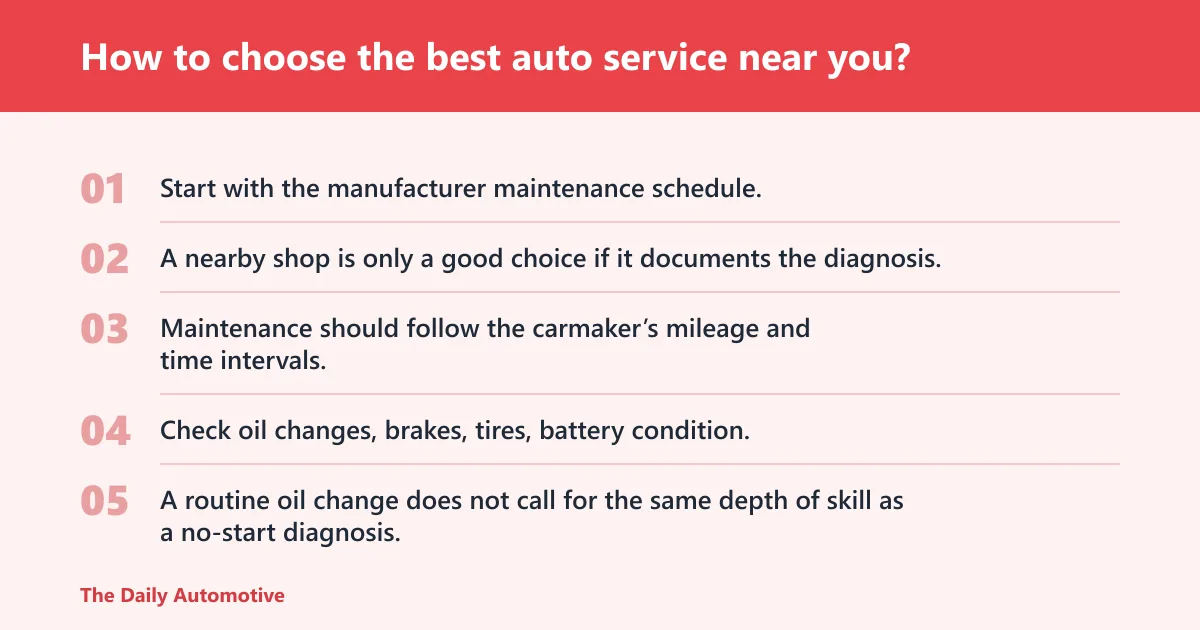
Start with the manufacturer maintenance schedule, then match the shop to the job and compare the real out-the-door total. A nearby shop is only a good choice if it documents the diagnosis, gives a written estimate, and has the credentials for your vehicle’s specific needs.
Start with the manufacturer maintenance schedule
Maintenance should follow the carmaker’s mileage and time intervals, not a generic rule on a wall sign. Check oil changes, brakes, tires, battery condition, and fluids against the schedule in the owner’s manual, then adjust for severe-service use such as short trips, heavy loads, hot climates, or stop-and-go driving.
Match the shop to the job type
A routine oil change does not call for the same depth of skill as a no-start diagnosis, transmission issue, or hybrid battery concern. A good fit for one service can be a poor fit for another, especially when the work involves software, electrical faults, or model-specific procedures.
Separate convenience from true value
Location, hours, and scheduling matter, but they do not tell you whether the repair will be correct the first time. A shop that is five minutes farther away can still cost less overall if it diagnoses accurately, uses the right parts, and avoids rework.
What makes a mechanic trustworthy?
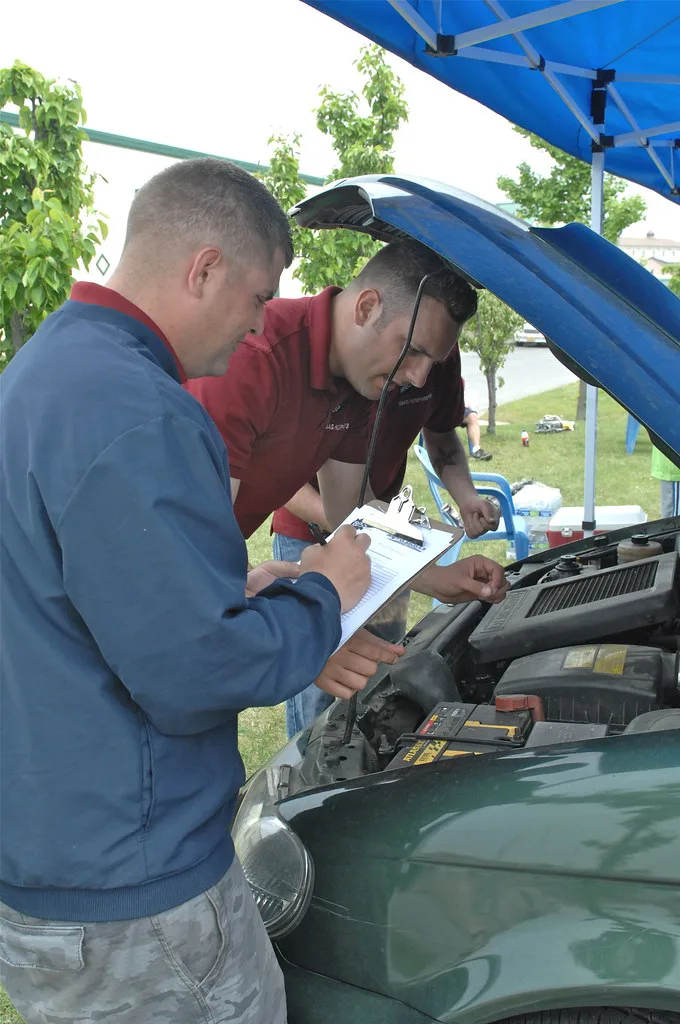
A trustworthy mechanic can show verifiable credentials, explain the diagnosis before extra work begins, and document what was inspected. Look for ASE certification or equivalent training, written estimates, and a clear repair authorization process. Trust grows when the shop explains the evidence, not when it simply sounds confident.
Credentials and training to verify
Ask whether the technician has ASE certification or manufacturer-specific training for your make and model. For EVs, hybrids, transmissions, or advanced driver-assistance systems, general repair experience is not the same as documented technical capability.
Repair authorization before extra work
No additional repair should begin without your approval. A proper shop asks before it goes beyond the original estimate, especially if the diagnostic path points to a more expensive component or if it finds related damage during disassembly.
Inspection checklist and old-part retention
Ask for an inspection checklist and whether the shop retains old parts on request. That paperwork gives you something concrete to compare against the estimate, and it helps if you need to verify that the replaced part actually failed.
How do I compare estimates without missing hidden costs?
Compare estimates line by line, not as one total. The best comparison separates parts and labor, lists diagnostic fees, shop supplies, and taxes, and shows whether the repair is offered as a good-better-best choice. You want the final out-the-door price before you approve anything.
Parts and labor line items
A clean estimate shows the price of parts separately from labor. That lets you see whether one shop is quoting OEM parts, aftermarket parts, or a mix of both, and whether another shop is simply masking a high labor rate with cheap parts.
Diagnostic fee, shop supplies, and taxes
Some shops bill diagnostics separately, especially when the first step is OBD-II code retrieval plus interpretation and follow-up testing. Ask whether the fee is applied to the repair if you approve the work. Also confirm shop supplies, environmental fees, and sales tax so the quote does not grow later.
Good-better-best options and out-the-door total
Good-better-best quoting can be useful if the differences are real and documented. For example, one option might use aftermarket pads, another might use OEM-equivalent pads, and a third might include rotors and a longer warranty. The only number that matters at the end is the out-the-door total for the option you choose.
Use this one-page shop scorecard
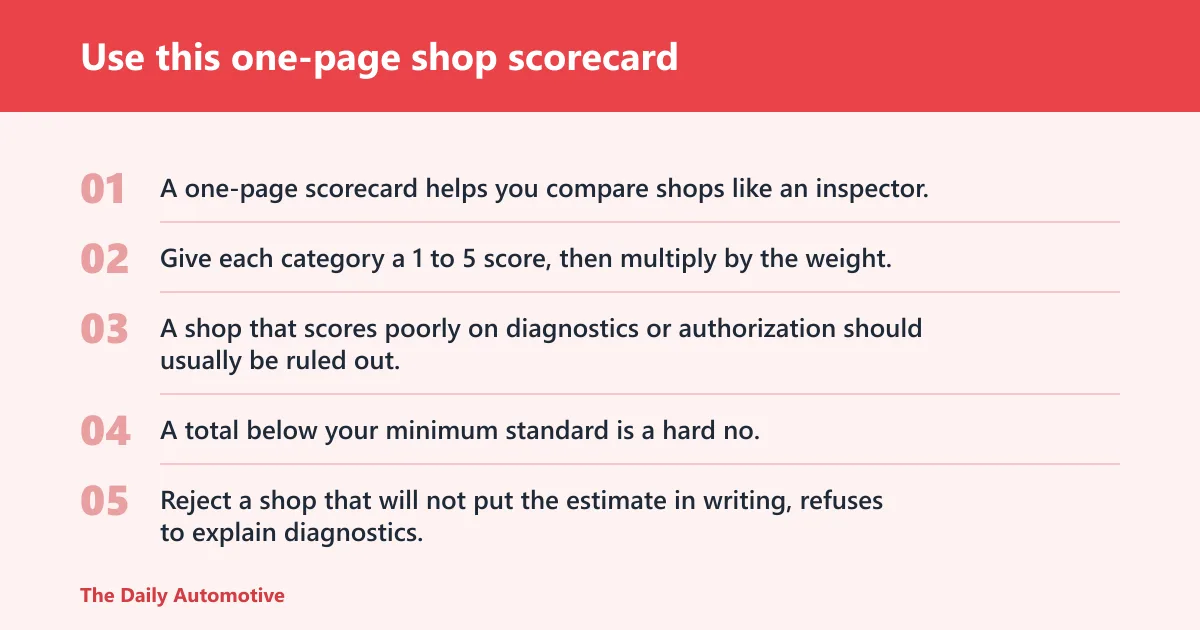
A one-page scorecard helps you compare shops like an inspector, using evidence instead of slogans. Give each category a 1 to 5 score, then multiply by the weight. A shop that scores poorly on diagnostics or authorization should usually be ruled out, even if it has a strong reputation.
| Criterion | Weight | What to look for | Score 1-5 | Weighted points |
|---|---|---|---|---|
| Credentials | 15% | ASE or equivalent training; model-specific capability | ||
| Estimate transparency | 15% | Parts, labor, taxes, fees, and authorization rules in writing | ||
| Diagnostic process | 15% | OBD-II scan, interpretation, follow-up testing, billable terms | ||
| Warranty terms | 15% | Parts and labor coverage, mileage or time limits, validity area | ||
| Review quality | 10% | Recent reviews, volume, complaint patterns, owner responses | ||
| Specialization | 10% | Domestic, import, EV, hybrid, transmission, brake, fleet | ||
| Turnaround time | 10% | Same-day or scheduled, clear expectations, parts availability | ||
| Total out-the-door cost | 10% | Diagnostic fee, labor rate, parts choice, taxes, add-ons |
Scoring rule: add the weighted points. A total below your minimum standard is a hard no, even if the shop is convenient or has flashy reviews.
When a low score is a hard no
Reject a shop that will not put the estimate in writing, refuses to explain diagnostics, or will not state warranty terms clearly. Also walk away if it pressures approval before inspection, hides labor rates, or will not say whether old parts can be returned.
How should you judge reviews and shop reputation?
Reviews help most when you check recency, volume, complaint patterns, and how the shop responds. A high star rating can be misleading if the reviews are old, sparse, repetitive, or padded with generic praise. Look for evidence that matches your vehicle and your problem.
Recency and review volume
Recent reviews matter more than older ones because management, staff, and procedures change. A shop with many current reviews gives you more signal than a shop with a handful of old five-star ratings.
Complaint patterns and photo evidence
Watch for repeated complaints about misdiagnosis, surprise charges, poor communication, or comeback repairs. Photo evidence can be useful when it shows the work area, the damaged part, or before-and-after results rather than generic stock images.
Owner responses and consistency over time
Reasoned replies to complaints matter more than one-off praise. A steady pattern of clear responses suggests the shop has a process. A burst of suspiciously similar compliments, or praise that reads the same from review to review, should make you cautious.
Say your compact sedan needs a brake job and the first shop quotes a low headline price. If the estimate later adds pads, rotors, hardware, brake fluid, shop supplies, and tax, the cheap quote may no longer be the cheap choice. The scorecard catches that before approval.
How do I compare auto repair shops near me?
Compare shops by the evidence they can document: credentials, estimate clarity, diagnostic process, warranty terms, and specialization. Then compare the total cost and turnaround against your vehicle’s needs. A shop that is excellent for commuter maintenance may be the wrong choice for a hybrid, a transmission issue, or fleet work.
Compare the work, not the storefront
A clean waiting room does not prove technical skill. The better comparison is the paperwork you receive, the questions the service advisor answers, and whether the estimate matches the diagnosis.
Compare turnaround and parts sourcing
Same-day service can be valuable for simple maintenance, but a rushed repair is a poor trade if it leads to rework. Ask whether parts are in stock, whether OEM or aftermarket parts are used, and whether the quoted time assumes immediate approval.
What questions should I ask an auto shop before approving repairs?
Ask direct questions before approving anything: What is the diagnosis, how was it confirmed, what is billable, what will the final price include, and what warranty applies? You should also ask whether any extra work requires your written or verbal authorization before the shop proceeds.
- What exactly failed, and how do you know?
- What did the OBD-II scan show, and what follow-up testing supports it?
- Is the diagnostic fee separate, and is it credited if I authorize the repair?
- Can you separate parts, labor, taxes, and shop fees in writing?
- What are the parts and labor warranty terms, and where are they valid?
- Will you ask before any extra work begins?
How do I compare car service prices near me?
Compare car service prices by building the same quote at each shop: diagnostic fee, hourly labor rate, parts choice, taxes, shop supplies, and expected turnaround. A lower labor rate can still cost more if the shop uses pricier parts, bills more diagnostic time, or creates a comeback repair.
True out-the-door cost
The out-the-door price is the only fair comparison. It includes the estimate you approved plus the charges that will actually appear on the invoice, not just the sticker price mentioned over the phone.
Cheap can become expensive
A low price can backfire if the first repair misses the real fault. Then you pay for a second diagnosis, more labor, and sometimes a second set of parts. That failure-case pattern is common enough that it should be on your checklist.
What are warning signs of a bad auto repair shop?
Warning signs include vague estimates, pressure to approve immediately, refusal to explain diagnostic results, and unclear warranty terms. You should also be cautious when a shop will not separate parts and labor, will not document authorization, or has repeated complaints about rework and surprise charges.
Failure-case checklist
- No written estimate before work starts.
- Diagnostic fee not explained in advance.
- Repair authorization requested after the fact.
- Parts and labor lumped into one number.
- No clear warranty on parts and labor.
- Repeated complaints about misdiagnosis or comebacks.
- Refusal to explain what was inspected.
A common first-timer mistake is choosing the lowest headline quote without asking what happens if the first diagnosis is wrong. If the shop misses the cause of a charging-system problem on a 10-year-old SUV, the second repair can cost more than a careful diagnosis would have in the first place.
Is a dealer service center better than an independent shop?
A dealer service center is better for warranty work, model-specific software updates, and brand-trained diagnostics. An independent shop is often the better fit for routine maintenance, brakes, tires, batteries, and many drivability problems if it has the right credentials and clear pricing.
When dealer service makes sense
Choose the dealer when the vehicle is still under warranty, the repair may involve factory campaigns or programming, or the issue is tied to a brand-specific system. Dealer service can also matter when you need original equipment procedures or parts required for coverage.
When an independent shop is the better fit
An independent shop can be a strong choice when you want lower labor rates, faster scheduling, or more flexibility on parts. The best independents still document diagnostics, price the work in writing, and stand behind parts and labor.
What changes for imports, EVs, hybrids, and fleets
Imports may need platform-specific training and scan tools. EVs and hybrids need high-voltage safety competence. Fleet vehicles often benefit from shops that understand uptime and repeat maintenance. Body-work specialization is not the same as mechanical repair, so do not assume one shop can do everything well.
How do I choose the best auto service near me?
Choose the best shop by combining evidence, not by chasing the cheapest ad or the highest star rating. The strongest choice usually has a written estimate, a documented diagnostic process, clear warranty terms, and the right specialization for your vehicle and the job at hand.
What to check before booking a car service near me
Confirm the maintenance interval first, then ask for a written estimate, the labor rate, the diagnostic fee, and the warranty terms. Read reviews for patterns, not just stars, and check whether the shop has the right expertise for your car’s make, age, and technology.
Should you choose the cheapest auto service or the best-reviewed one?
Neither should win by itself. Cheapest can become expensive through misdiagnosis or hidden fees, while the best-reviewed shop may not specialize in your vehicle. Use price and reviews as inputs, then let the scorecard decide.
How do reviews help me choose an auto service near me?
Reviews help most when they confirm recent, repeated strengths or expose recurring problems. Look for volume, recent dates, complaint patterns, photo evidence, and clear owner responses. That is far more useful than a generic five-star average.
What questions should I ask an auto shop before approving repairs?
Ask what failed, how it was confirmed, what the estimate includes, what will trigger additional charges, and what warranty applies. If the answers are vague or defensive, that is a warning sign. Approval should come after clarity, not before it.
How do I compare car service prices near me?
Build a full price comparison from the same components: diagnostic fee, labor rate, parts choice, shop supplies, taxes, and turnaround. Then compare the final out-the-door total, not the first number you hear. That is how you spot false savings.
which car buying service is the best
The best car buying service is the one that gives the clearest pricing, the strongest documentation, and the least pressure to act before you understand the terms. For rental-style buying questions, Booking.com says rental support is available in over 30 languages, most bookings have free cancellation up to 48 hours before pick-up, and it has more than 5 million verified reviews. It also states most companies rent to drivers at least 21 years old, under-25 drivers may have to pay a young driver fee, the price includes mandatory cover such as Theft Protection and Collision Damage Waiver, and some companies do not accept certain credit cards.
Products related to this article
Sponsored / affiliate links. As an Amazon Associate I earn from qualifying purchases. I may earn additional commission from eligible campaigns.