Best Car Wax Applicators for Detailing (2026): We Compared
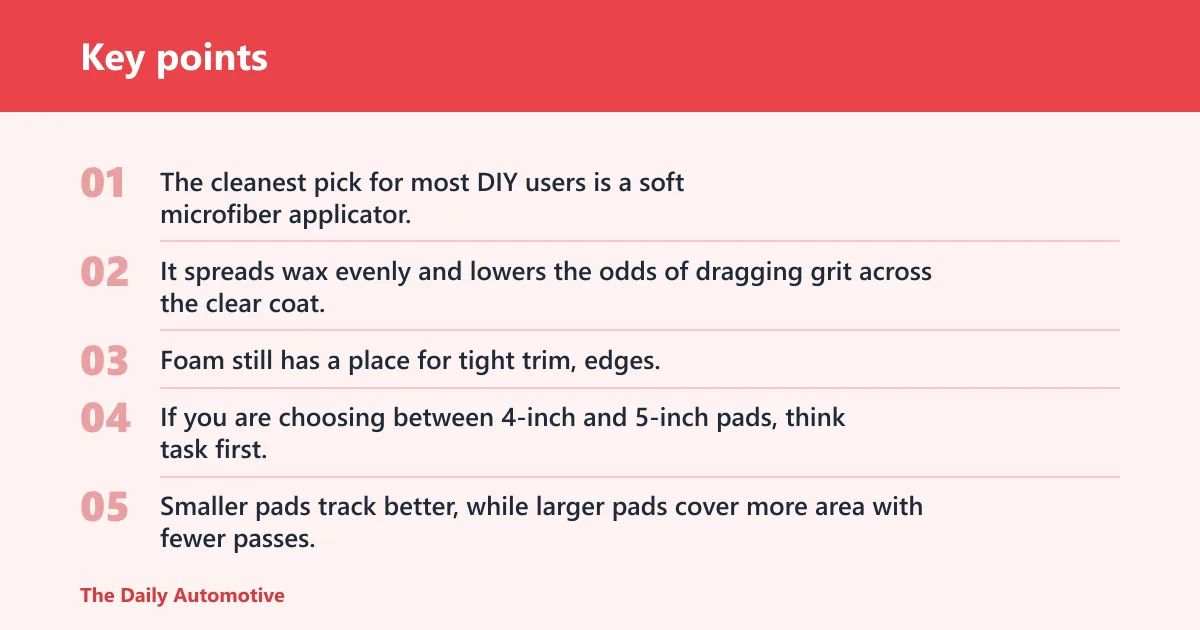
The cleanest pick for most DIY users is a soft microfiber applicator. It spreads wax evenly and lowers the odds of dragging grit across the clear coat. Foam still has a place for tight trim, edges, and small sections where you need sharper control.
Quick comparison
| Product | Badge | Best for | Price | ||
|---|---|---|---|---|---|
 |
SONAX Application Sponge 417300 | Dual-Sided DetailingSONAX | Our pick | Dual-sided foam · Ergonomic grip · 4”x5” | $11.71
Price as of 19 Oct 2026
|
View |
 |
HeatPure 18 Pack Car Wax Applicator Pad 5 Inch, FoamHeatPure | Budget pick | 18-pack microfiber pads · 4.9-inch · Reusable | $9.99
Price as of 19 Oct 2026
|
View |
If you are choosing between 4-inch and 5-inch pads, think task first. Smaller pads track better, while larger pads cover more area with fewer passes. That tradeoff matters more than marketing labels.
How we chose
We compared the listed applicators by paint safety, pad size, grip comfort, product efficiency, and value per pad. We also weighed washability, drying time, shape retention, and how much buildup each design can hold before it starts to waste product.
The selection also reflects the most useful distinction for hand waxing: microfiber for softer contact and broader panel work, foam for tighter control on trim and small sections. A good pad should be reusable, quick to clean, and sized for the job.
One common failure case is product overload. A pad that holds too much wax can smear on vertical panels, then streak as it starts to saturate. Another is moisture retention: a pad that dries slowly can stay gummy and collect residue if you do not clean it promptly.
Wax applicator decision matrix
This matrix ranks the three pads by the buyer needs that matter most during hand application. Scores run from 1 to 5, with 5 being strongest for that need.
| Pick | Delicate paint safety | Tight-area control | Grip comfort | Product efficiency | Value per pad | Best for | Choose this if |
|---|---|---|---|---|---|---|---|
| Chemical Guys Premium Grade Microfiber Applicator Pads | 5 | 3 | 4 | 4 | 4 | Balanced daily use | You want one soft pad type for wax, sealant, and some protectants. |
| Meguiar’s 4″ Foam Applicator Pads | 3 | 5 | 3 | 5 | 4 | Trim and precision work | You care most about tight control, small sections, and lower product waste. |
| Mothers Microfiber Polishing Pad | 5 | 3 | 4 | 4 | 4 | Gentle paint care | You want a soft 5-inch pad for polishing, cleaning, and light wax work. |
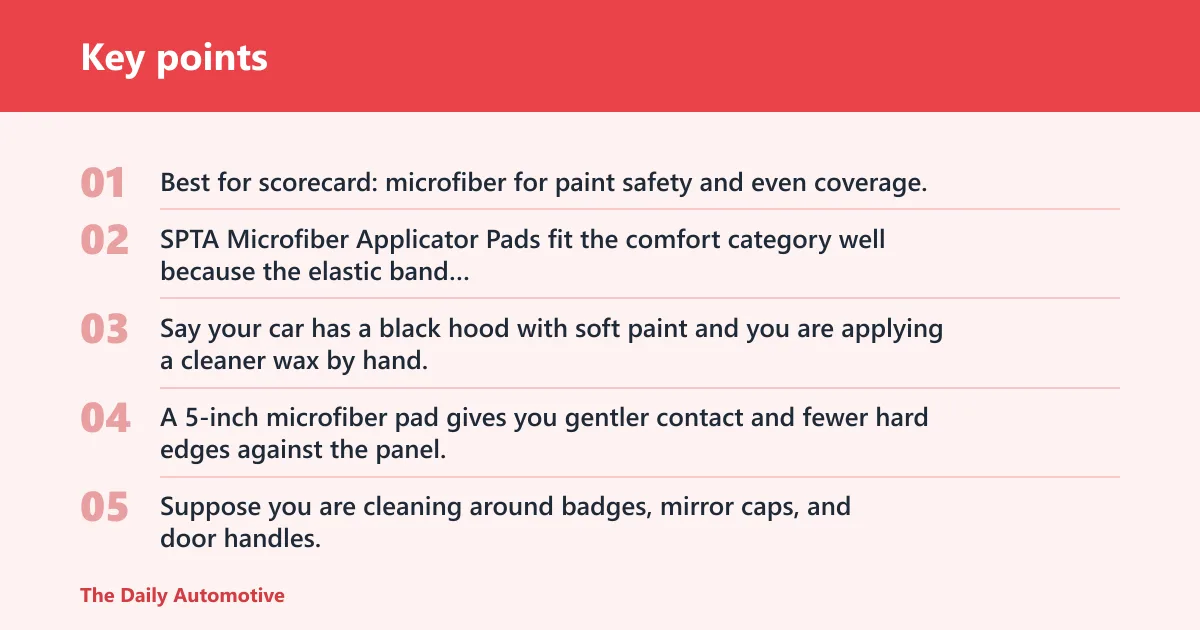
Best for scorecard: microfiber for paint safety and even coverage; foam for small-area control and lower cost per section; larger 5-inch pads for broader hand work where you want fewer overlaps. SPTA Microfiber Applicator Pads fit the comfort category well because the elastic band can help keep the pad anchored, while FONAROLL microfiber wax applicator pads fit the large-pad category with a sponge core and a 6-pack format.
Say your car has a black hood with soft paint and you are applying a cleaner wax by hand. A 5-inch microfiber pad gives you gentler contact and fewer hard edges against the panel, which matters more than raw speed on that kind of finish.
Suppose you are cleaning around badges, mirror caps, and door handles. A 4-inch foam pad is easier to guide into those spaces, and it is less likely to push product onto adjacent trim if you use only a thin amount.
Mothers Microfiber Polishing Pad: best for gentle paint care
The Mothers Microfiber Polishing Pad and Cleaning Pads come as a 6-pack with a 5-inch diameter, which makes them a sensible fit for larger painted areas where you still want a soft, hand-friendly touch. That size works well for polishing and light cleaning, and the microfiber surface is the main reason to choose it over plain foam.
This pad type is aimed at users who want gentle contact for wax, polish, or sealant on broad panels. It is also a practical match for classic-car owners and anyone who wants a scratch-minimizing surface without moving to a machine applicator.
The drawback is control on tight areas. A 5-inch pad is not as nimble as a 4-inch foam applicator for trim edges, and microfiber can hold more product than a dense foam pad if you load it too heavily. That means you still need to use a light hand on vertical panels.
Chemical Guys premium Grade microfiber Applicator pads: best for all-around use
The Chemical Guys Premium Grade Microfiber Applicator Pads are the best all-around pick by material logic: they are described as very soft and scratch-minimizing, and they are presented for waxes, sealants, and some interior protectants. That makes them the most flexible choice for a DIY owner who wants one pad type for several jobs.
Microfiber helps when you want even hand application without a harsh feel against the paint. It also tends to suit buyers who care about product spread more than pinpoint control, because the absorbent surface can carry enough product for a smooth pass without forcing repeated reloads.
The honest drawback is the same thing that makes microfiber useful: absorbency. If you overcharge the pad, it can hold more wax than you meant to apply, especially on vertical panels. It is a better pick for balanced work than for narrow trim or fast edge detailing.
Meguiar’s 4-inch Foam Applicator Pads: best for tight control
Meguiar’s 4-inch Foam Applicator Pads are the clearest choice when precision matters more than broad coverage. The 4-inch size and tight-cell foam construction favor cleaner placement on trim, edges, and other small sections where you want more control than a larger microfiber pad can give you.
That smaller format also helps with product efficiency on limited areas. If you are treating a small scuffed section, a door jamb, or the edge of a bumper, a 4-inch foam pad can keep product where it belongs and reduce waste. For budget control, that matters as much as the sticker price.
The drawback is coverage. A smaller foam pad is slower on full-panel maintenance, and it does not have the softer, slightly more forgiving feel of microfiber on delicate paint. It is the better tool for precision, not the fastest one for a whole car.
Which one should you buy?
Choose microfiber if your first priority is paint safety and even hand application on larger panels. Choose foam if you need tight-area control, lower cost per section, and less product waste. If you detail often, buy enough pads to keep separate ones for wax, polish, and sealant.
For most DIY owners, the practical split is simple: a microfiber pad for paint protection and broad coverage, and a foam pad for trim, corners, and narrow work. If you buy only one type, pick the one that matches the most common job on your car, not the most appealing description on the package.
How many should you buy? Three is the bare minimum for rotating between products and cleaning cycles, but a 6-pack or larger is often better if you do full exterior work regularly. That keeps one pad from carrying too much residue while another is drying.
Quick picks

- Best overall: Chemical Guys Premium Grade Microfiber Applicator Pads for soft, versatile hand application on waxes, sealants, and some protectants.
- Best budget control: Meguiar’s 4-inch Foam Applicator Pads for trim, edges, and small-panel precision.
- Best gentle touch: Mothers Microfiber Polishing Pad for larger painted panels and light cleaning work.
Microfiber or foam wax applicator pads: which is better?
Microfiber is usually better for a scratch-free finish on broader painted panels because the surface is soft and forgiving. Foam is better when you need tighter control, especially on trim, edges, and narrow sections. The better choice depends on the job, not a universal winner.
What size wax applicator pad is best for cars?
A 4-inch pad is better for precision and small areas, while a 5-inch pad gives a better balance of coverage and control for general hand application. The CarResource’s 4-inch to 5-inch guidance is useful here. If you do both trim work and full panels, 5-inch microfiber and 4-inch foam cover the most ground.
How do I clean and reuse a car wax applicator pad?
Rinse the pad promptly after use, work out residue with a cleaner suited to the pad material, and let it dry fully before storage. Cleaning instructions vary by brand and material, so check the label. Better care reduces product buildup, keeps the shape stable, and helps the pad last longer.
Do finger pockets or elastic bands actually help when waxing a car?
Yes, but only for some users and tasks. An elastic band can improve grip when you are working on vertical panels or trying to keep the pad from shifting in your hand. It matters less on large, easy-access panels where a standard flat pad already feels secure.
Which car wax applicator works best for delicate paint?
Soft microfiber is the safest starting point for delicate paint because it reduces the chance of aggressive contact and spreads product more evenly. For very sensitive finishes, choose the softest pad that still gives you control. If the panel is small and detailed, a smaller foam pad may still be the more accurate tool.
Are 4-inch or 5-inch applicator pads better for detailing?
Neither is always better. A 4-inch pad is superior for tight-area control and trim work. A 5-inch pad is better when you want broader coverage with fewer passes. If you want one size for most tasks, 4-inch to 5-inch is the practical range that balances precision and coverage.
How many wax applicator pads should I buy?
Buy enough to separate jobs and keep working while one pad dries. For occasional use, a 4-pack or 6-pack is often enough. If you detail multiple cars or switch between wax, polish, and sealant, a 9-pack or larger makes more sense because it lowers cost per use and reduces product cross-contamination.
What is the best car wax applicator for a scratch-free finish?
For the safest hand application, a soft microfiber applicator is the strongest choice because it minimizes direct abrasion and spreads product evenly. That said, a clean foam pad can also be safe if you are working on trim or tight areas and using a light touch. The finish depends on pad cleanliness as much as pad type.
Products related to this article
Sponsored / affiliate links. As an Amazon Associate I earn from qualifying purchases. I may earn additional commission from eligible campaigns.