Best Battery Chargers for Winter Car Care (2026): we compared
For winter car care, pick a smart charger by the job: low amperage for long storage, higher amperage for recovery, and make sure it matches the battery chemistry, such as AGM, flooded, gel, or lithium. Get the chemistry wrong and I have seen batteries left stranded, weak cells frozen, and batteries cooked when they only needed gentle maintenance. This guide compares the best battery chargers for cold-weather storage, emergency charging, motorcycles, trucks, and seasonal vehicles.
This guide is part of our Car maintenance and repair guide series.
Quick comparison
| Product | Badge | Best for | Price | ||
|---|---|---|---|---|---|
 |
5V 2A AC/DC Adapter Charger for Car Jump Starter 4000A Peakycwwzzh | Budget pick | Universal adapter for 2000A–6000A jump starters | $9.98
Price as of 2 Oct 2026
|
View |
 |
NOCO GENIUS10 10A 6/12V Smart Battery Charger, TrickleNOCO | Our pick | 10A smart charger for 6/12V lead-acid & lithium | $99.95
Price as of 2 Oct 2026
|
View |
 |
12V 6A Smart Battery Charger Maintainer, Fully Automatickalonwell | Also great | 6A smart charger with desulfation for AGM/GEL | $18.95
Price as of 2 Oct 2026
|
View |
 |
S ZEVZO ET03 Car Jump Starter 4000A Jump Starter BatteryS ZEVZO | Upgrade pick | 4000A jump starter for 8.0L gas/7.0L diesel | $53.99
Price as of 2 Oct 2026
|
View |
Use the table below as a winter job map, not a brand ranking. A weekend sit, a month in storage, and a dead battery in an unheated garage need different chargers.
The right call depends on battery chemistry, storage length, and how cold the battery will sit before the next start. I would also factor in whether the vehicle stays outside, in a drafty shop, or in a cold shed.
How we chose
We compared these chargers by four things that matter in winter: charging speed versus maintenance use, battery chemistry support, cold-weather safety and recovery features, and size or setup convenience. The goal was to separate a maintainer for storage from a charger that can do real recovery work.
We also looked for features that matter in unheated garages, including temperature compensation, automatic shutoff, float or pulse maintenance, low-voltage recovery, and clear compatibility checks for 12V and 6V systems. A charger can look capable on paper and still be the wrong tool for a battery that just needs gentle maintenance.
NOCO GENIUS2: best for dead-battery recovery in cold weather
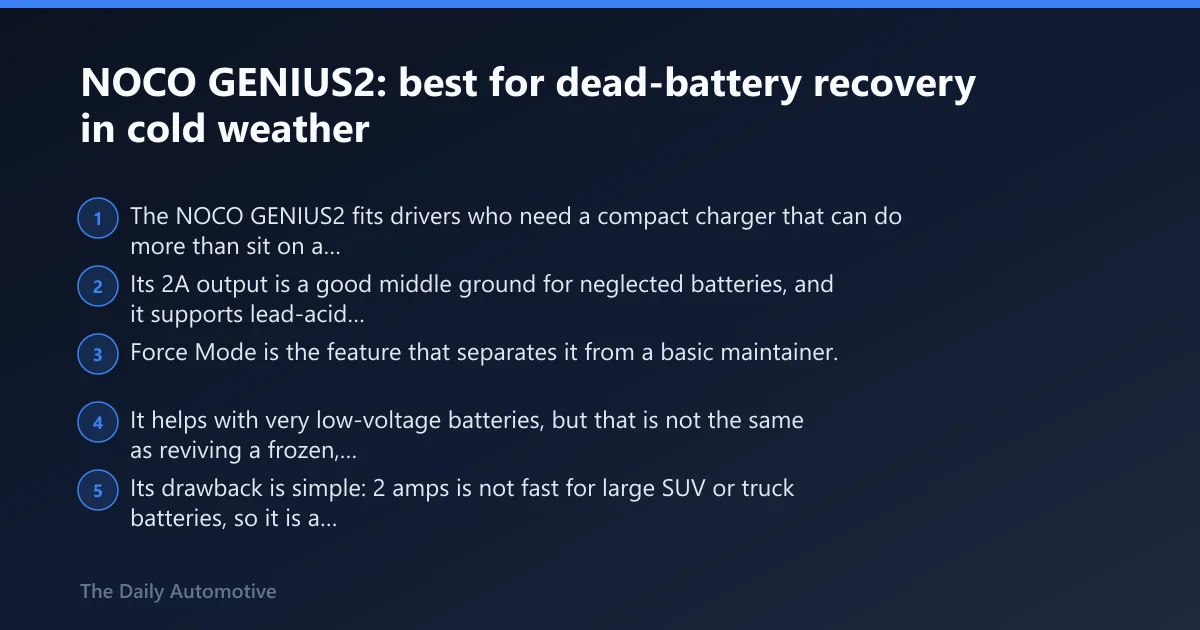
The NOCO GENIUS2 fits drivers who need a compact charger that can do more than sit on a battery. Its 2A output is a good middle ground for neglected batteries, and it supports lead-acid and lithium batteries with temperature compensation for changing conditions.
Force Mode is the feature that separates it from a basic maintainer. It helps with very low-voltage batteries, but that is not the same as reviving a frozen, swollen, or physically damaged battery.
Its drawback is simple: 2 amps is not fast for large SUV or truck batteries, so it is a recovery and maintenance tool rather than a quick turnaround charger.
When 2 amps is enough
Two amps makes sense when a battery has fallen low but is not dead for long, or when a driver wants a slow charge in a cold garage without stressing the battery. It is also a practical choice for smaller batteries that spend winter on a tender rather than in daily use.
Temperature compensation, Force Mode, and low-voltage recovery
Temperature compensation matters because charging behavior changes when the battery is sitting near freezing. A charger that senses ambient conditions is less likely to overdo it in a cold shop or undercharge a battery that is being topped off in winter.
Force Mode is useful when voltage has dropped so low that many smart chargers will not even start. It still has limits, and a battery that is sulfated beyond recovery usually belongs on the replacement shelf.
Lead-acid and lithium compatibility checks
This model works with regular lead-acid and lithium batteries, but the battery label still has the final say. Before connecting anything, confirm battery chemistry, system voltage, and terminal type. That takes less than a minute and avoids expensive mistakes.
Schumacher SC1280: best for bigger batteries and faster recovery
The Schumacher SC1280 is the right fit when a winter battery problem is bigger than a small maintainer can handle. It is a 15A charger and maintainer with 6V and 12V compatibility, which makes it useful in mixed garages where older equipment and modern vehicles live side by side. (caranddriver.com)
It also includes desulfation mode and multi-stage charging algorithms, so it is better suited to recovery work than a simple trickle charger. Alligator clips make it straightforward for quick connection to a battery that is still accessible in a truck, SUV, or project car.
The tradeoff is size and aggressiveness. Fifteen amps can move faster, but that is more charger than a seasonal motorcycle battery needs and more than some storage situations call for.
15A charging for SUVs and trucks
A larger battery benefits from a charger that can push meaningful current without taking all day. That matters after a cold no-start, especially when the vehicle has sat outside and the battery has been dragged down by repeated short trips.
6V/12V compatibility for mixed-garage use
Older tools, tractors, and hobby vehicles often live in the same garage as 12V daily drivers. A charger that handles both voltages keeps one tool from becoming dead weight after the first battery swap.
Desulfation mode, testing, and alligator clips
Desulfation can help with lightly sulfated batteries, but it is not a cure for a battery that has been abused for years. Testing functions are valuable because they help separate a recoverable battery from one that needs replacement before the next freeze.
Battery Tender Junior: best for powersports storage
Battery Tender Junior is the compact maintainer built for powersports and small winter-stored batteries. It is the kind of charger that fits motorcycles, ATVs, and lawn equipment that spend months parked, not a truck battery that needs a hard recovery push.
Because it is a low-amp maintainer, it is a better match for cold storage support than for reviving a neglected car battery. That makes it useful when the goal is to preserve a battery through winter, not rescue one after it has been ignored.
Its weakness is obvious: compact maintenance gear is not the right answer when a battery has already fallen too far.
Compact maintainer design for motorcycles and small batteries
Powersports batteries are usually smaller and more sensitive to overcharging than car batteries. A compact maintainer helps keep them ready without forcing unnecessary current into a battery that will not be used for weeks.
Cold-storage use cases for seasonal equipment
This is the better choice for snowmobiles, motorcycles, and seasonal equipment that may sit in a cold garage all winter. In that role, maintenance matters more than speed.
When a low-amp maintainer is the right call
If the battery is healthy and the vehicle will simply sit, low-amp maintenance is the right answer. If the battery is weak, heavily discharged, or showing signs of age, a maintainer is not a repair tool.
CTEK MXS 5.0: best for AGM winter storage
CTEK MXS 5.0 is a strong fit for 12V lead-acid and AGM batteries that need winter storage care. Its automatic 8-step charging is built for controlled charging and maintenance, which matters when a battery will sit in an unheated garage for weeks or months.
Float and pulse maintenance are useful here because they help keep a battery topped up without constant overcharging. A dust- and moisture-resistant rating also makes it a practical garage or shop choice compared with less rugged gear.
The downside is that it is aimed at careful charging, not fast rescue. If a truck battery is deeply dead, a faster charger is the better first tool.
8-step charging for 12V lead-acid and AGM batteries
AGM batteries are common in winter vehicles because they tolerate vibration and cold-weather use well, but they do not all like the same charging behavior as flooded batteries. A charger with an AGM-specific profile helps avoid charging mistakes.
Float and pulse maintenance for long layups
For a classic car or SUV that will sit all winter, float or pulse maintenance is the point. The charger stays connected and watches state of charge instead of hammering the battery with unnecessary current.
IP65 rating for garage and shop use
In real garages, dust, damp concrete, and snow tracked off tires are part of the job. A charger built for that kind of environment is easier to leave in place and trust through the season.
What is the best battery charger for winter car care?
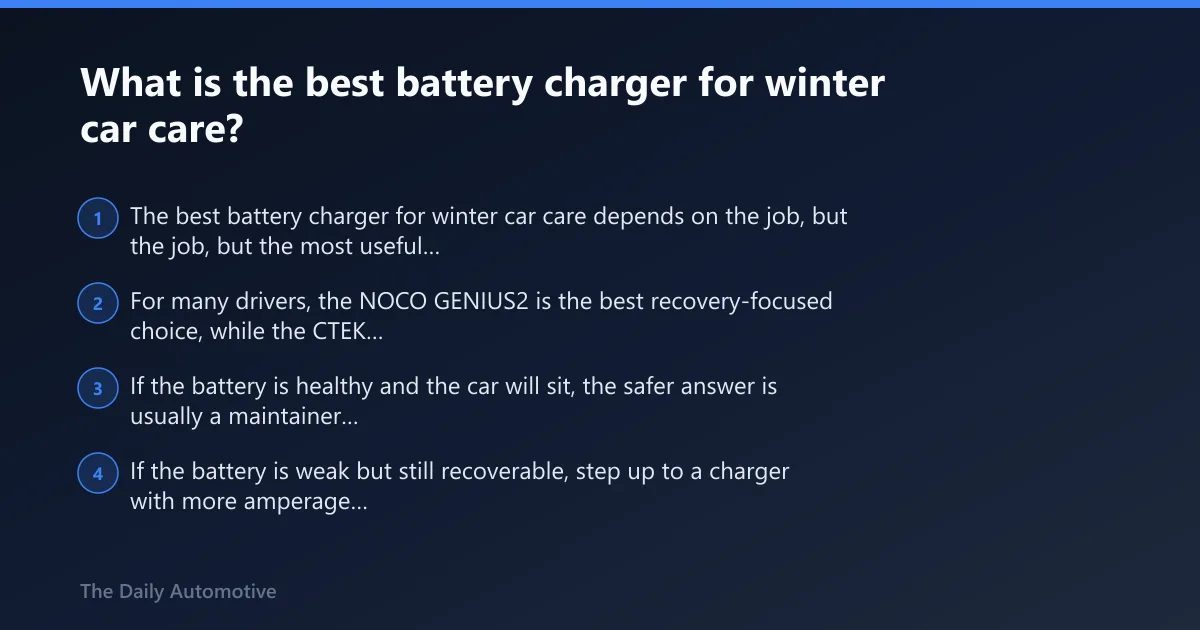
The best battery charger for winter car care depends on the job, but the most useful picks are a smart maintainer for storage and a stronger charger for recovery. For many drivers, the NOCO GENIUS2 is the best recovery-focused choice, while the CTEK MXS 5.0 is the better storage charger for AGM winter use.
If the battery is healthy and the car will sit, the safer answer is usually a maintainer with automatic shutoff or float mode. If the battery is weak but still recoverable, step up to a charger with more amperage and low-voltage recovery features.
Do I need a battery charger or a maintainer for winter storage?
For winter storage, most healthy batteries need a maintainer, not a high-output charger. A maintainer plugs into a wall outlet and monitors battery state of charge, which is exactly what a vehicle needs when it will sit for weeks or months without being driven.
A charger is better when the battery is already low and needs to be brought back to a usable state. Using the wrong tool can waste time or shorten battery life.
Can a battery charger recover a dead car battery in cold weather?
Sometimes, but only if the battery is low and still healthy enough to accept a charge. A smart charger with low-voltage recovery or Force Mode can help, but it will not revive a frozen battery, a swollen battery, or one that has suffered serious sulfation or physical damage.
Cold weather makes the decision harder because weak batteries fail fast below freezing. If the battery case is cracked, bulged, or has been frozen, replace it.
What amperage battery charger should I buy for an SUV or truck?
For an SUV or truck, a charger in the higher recovery range is usually the better fit, especially after a cold no-start or repeated short trips. Low-amp maintainers are fine for storage, but larger batteries benefit from more current when they need real charging work.
The Schumacher SC1280 is the clearest fit here because it is a 15A charger and maintainer. For lighter recovery needs, a 2A or 3A smart charger can work, but it will be slower.
Are smart battery chargers safe for AGM and lithium batteries?
Smart chargers are generally the safer choice when they explicitly support the battery chemistry on the label. AGM batteries need the right charging profile, and lithium batteries often need compatible charging behavior plus low-temperature caution in winter use.
Compatibility is not automatic. Check the battery label, confirm voltage, and verify the charger lists the chemistry before clipping anything on.
How long can a car battery sit in winter without a charger?
There is no single safe storage time, because it depends on battery age, state of charge, temperature, and how much parasitic draw the vehicle has. A healthy battery in a mild garage can sit longer than an older battery parked outdoors in deep cold.
As a rule, the colder and longer the storage, the more a maintainer makes sense. A week is different from a month, and a month is different from all winter.
What features matter most in a winter battery charger?
The most important winter features are automatic shutoff or float mode, chemistry support, temperature compensation, and low-voltage recovery. Desulfation can be helpful, but it is not a miracle fix, and it should never be treated as a substitute for a healthy battery.
Physical setup matters too. Compact size, easy connectors, and clear mode selection reduce mistakes when the garage is cold and the battery is awkwardly placed.
Is temperature compensation worth it on a battery charger?
Yes. Temperature compensation matters in winter because a battery in a cold garage charges differently from one sitting in a warm basement or shop. Without it, charging can be less accurate right when the battery needs the right treatment most.
It does not turn a weak charger into a better one, but it does help a smart charger make the right decision in changing conditions.
Winter charger decision table
| Vehicle type | Battery chemistry | Storage length | Temperature exposure | Right charger type | Amperage range | Must-have features |
|---|---|---|---|---|---|---|
| Daily driver sedan | Flooded lead-acid or AGM | One week | Outdoor parking | Smart maintainer | 1–2 amps | Float mode, overcharge protection, temperature compensation |
| SUV or truck | AGM or flooded lead-acid | One month | Cold garage | Smart charger and maintainer | 4–10 amps | Automatic shutoff, recovery mode, chemistry selection |
| Seasonal classic | AGM or flooded lead-acid | All winter | Unheated garage | Maintainer with float or pulse mode | 1–3 amps | Temperature compensation, long-term maintenance, reverse hookup protection |
| Motorcycle or ATV | AGM or small lead-acid | All winter | Cold storage shed or garage | Compact maintainer | Under 2 amps | Compact size, easy connector setup, maintenance mode |
| Modern powersports with lithium battery | Lithium | Seasonal storage | Cold but dry storage | Smart charger with lithium support | Low amp maintenance | Lithium compatibility, low-temperature caution, automatic control |
| Neglected battery that still tests recoverable | Lead-acid or AGM | After sitting too long | Cold garage | Recovery charger | 4–15 amps | Desulfation, low-voltage recovery, temperature compensation |
Which one should you buy?
Pick the charger by the winter job, not by the badge. If the goal is long storage on a healthy battery, choose Battery Tender Junior for powersports or CTEK MXS 5.0 for AGM and 12V lead-acid storage. If the goal is recovery, NOCO GENIUS2 is a better low-voltage helper, while Schumacher SC1280 is the stronger choice for larger batteries.
For a simple, easy-to-use wall-outlet charger and maintainer, the Battery Tender 3-Amp Battery Charger is a practical middle ground. For a battery that is badly neglected but not ruined, the NOCO Genius 1 offers a slow 1.0-amp charge that suits patient maintenance, while the MOTOPOWER 800mA Desulfator is best reserved for small batteries that need light maintenance and desulfation support.
If you are working with mixed voltages, the 12V/24V automatic battery charger is the utility pick because it covers 10A on 12V and 5A on 24V with temperature compensation and winter mode. The moment a battery is frozen, swollen, or physically damaged, stop charging and replace it.
Failure cases: replace the battery instead of charging it
Use this checklist before clipping on any charger:
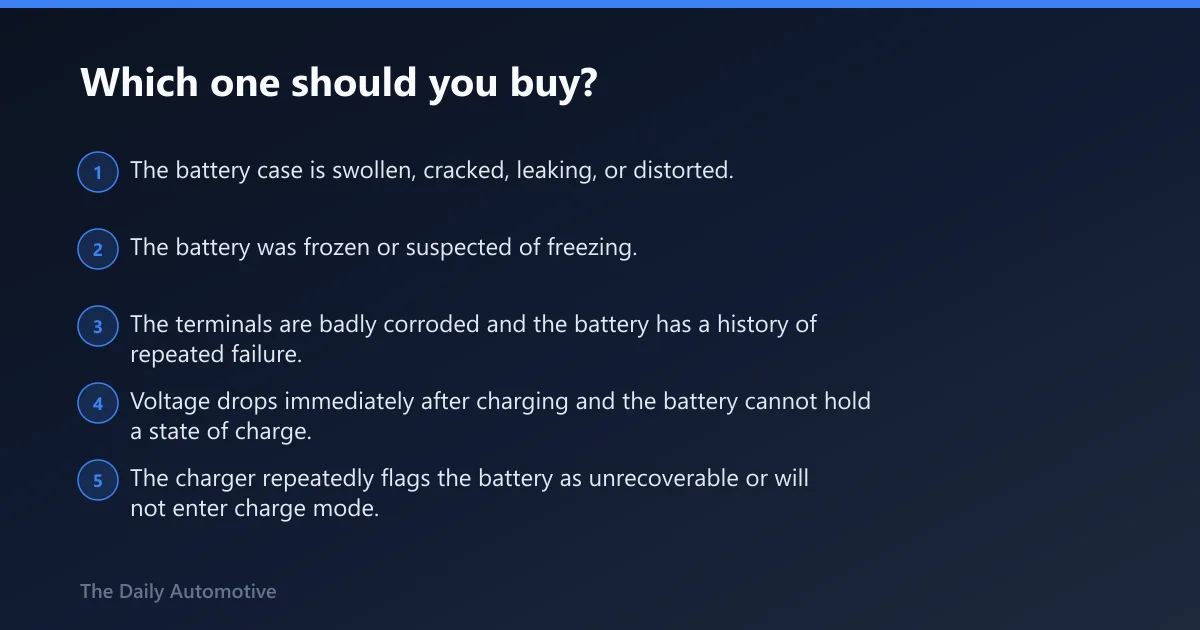
- The battery case is swollen, cracked, leaking, or distorted.
- The battery was frozen or suspected of freezing.
- The terminals are badly corroded and the battery has a history of repeated failure.
- Voltage drops immediately after charging and the battery cannot hold a state of charge.
- The charger repeatedly flags the battery as unrecoverable or will not enter charge mode.
- The battery is old, sulfated, and has already failed more than one winter.
Buying the right charger is cheaper than repeating jump-starts all season. It is also cheaper than replacing a battery that was damaged because it was charged with the wrong tool.
Frequently asked questions
What is the best battery charger for winter car care?
The best choice depends on the job. For storage, a maintainer with float mode is the safest bet. For recovery, the NOCO GENIUS2 or Schumacher SC1280 makes more sense because they can handle low-voltage batteries and more demanding winter starts.
Do I need a battery charger or a maintainer for winter storage?
If the battery is healthy and the car will sit, use a maintainer. If the battery is already low or has trouble starting the vehicle, use a charger first and then switch to maintenance once the battery is stable.
Can a battery charger recover a dead car battery in cold weather?
Sometimes, if the battery is only deeply discharged and still healthy. It will not fix a frozen, swollen, or badly sulfated battery, and cold weather makes those failures more common and more obvious.
What amperage battery charger should I buy for an SUV or truck?
Choose a charger with enough output to handle a larger battery without waiting all day. For SUV and truck recovery, higher amperage is useful; for storage, a lower-amp maintainer is usually the better tool.
Are smart battery chargers safe for AGM and lithium batteries?
Yes, if the charger explicitly supports that chemistry and the battery label matches. AGM and lithium batteries have different charging needs, and some smart chargers are built for only one of those battery types.
Is temperature compensation worth it on a battery charger?
Yes. Winter charging is less forgiving, especially in unheated garages and cold shops. Temperature compensation helps the charger adjust its behavior instead of applying the same charge logic to every environment.
Products related to this article
Sponsored / affiliate links. As an Amazon Associate I earn from qualifying purchases. I may earn additional commission from eligible campaigns.