How Much Does a Car Battery Cost?
Installed car batteries commonly cost roughly $160 to $400. Buy the wrong size or skip proper installation, and you can pay for tow charges, short battery life, or another replacement sooner than expected. This guide breaks down battery-only pricing, labor, and the model-specific factors that move the total.
Typical cost range
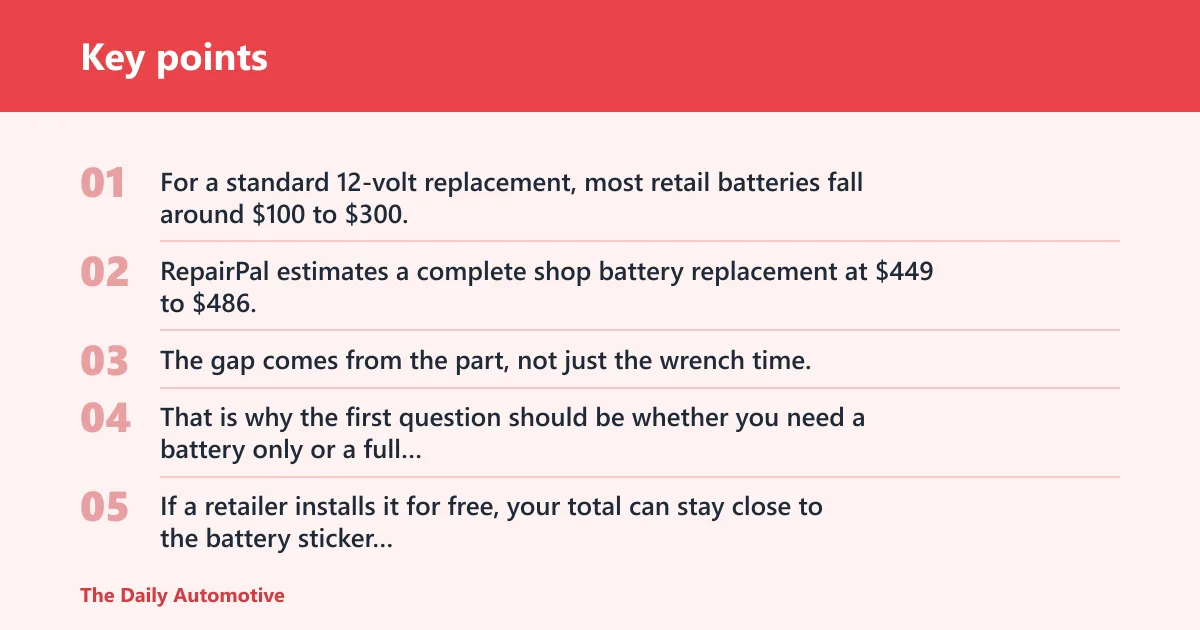

For a standard 12-volt replacement, most retail batteries fall around $100 to $300, with installed shop pricing often landing higher once labor, testing, and a core charge are included. RepairPal estimates a complete shop battery replacement at $449 to $486, while its labor portion is only $60 to $88. The gap comes from the part, not just the wrench time.
That is why the first question should be whether you need a battery only or a full replacement visit. If a retailer installs it for free, your total can stay close to the battery sticker price plus any core charge or recycling fee. If a shop is doing the work, the out-the-door number usually climbs fast.
Battery cost matrix
| Battery tier | Battery-only price | Installed price | Core deposit | Likely add-ons |
|---|---|---|---|---|
| Flooded lead-acid | $100 to $200 | About $160 to $400 installed | Usually modest | Testing, core return, recycling fee where required |
| EFB | Mid-range within the $100 to $300 retail band | Higher than flooded, lower than most AGM installs | Usually modest | Core return, programming on some vehicles, recycling fee where required |
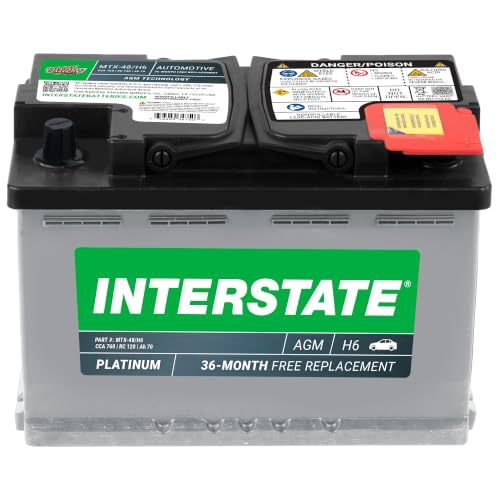
| AGM | $200 to $400 | Often above the standard shop average | Usually modest | Programming, battery registration on some vehicles, recycling fee where required |
| 12-volt EV auxiliary | Varies by vehicle and fitment | Varies by vehicle and service channel | Usually modest | Diagnostic checks, programming, recycling fee where required |
Core charges are refundable deposits. You get them back when you return the old battery. Recycling fees can also appear in some states, and they add to the final total even when the battery price looks low on the shelf.
📊 Car batteries can cost anywhere from $50 to $200. Source: Firestonecompleteautocare.
What makes some batteries more expensive?
Cold-cranking amps, warranty length, and battery chemistry move the price more than most drivers expect. A higher-CCA battery usually costs more because it is built to deliver more starting power, which matters in cold climates or in vehicles with heavy electrical loads. Longer warranties also tend to raise the sticker price.
Cold-cranking amps and climate needs
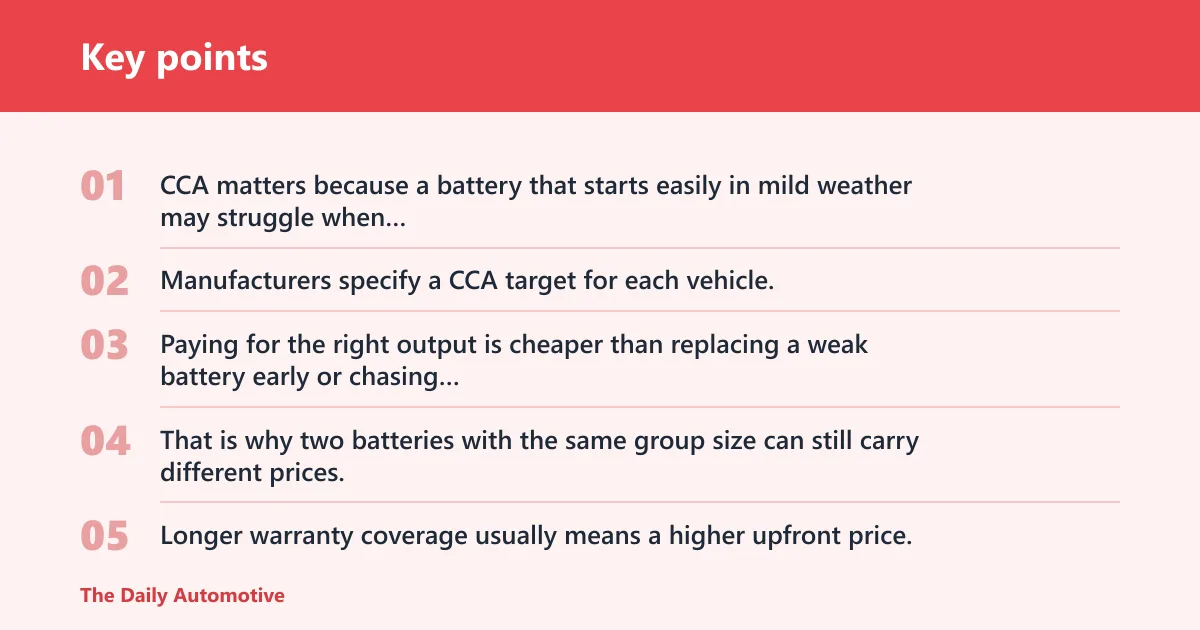
CCA matters because a battery that starts easily in mild weather may struggle when temperatures drop. Manufacturers specify a CCA target for each vehicle, and that spec narrows the price range. Paying for the right output is cheaper than replacing a weak battery early or chasing no-start problems in winter.
Heat pushes battery wear faster. Cold weather demands more starting reserve. That is why two batteries with the same group size can still carry different prices.
Warranty length and price
Longer warranty coverage usually means a higher upfront price. That is normal across flooded, EFB, and AGM batteries. The tradeoff is simple: a longer coverage period can reduce replacement risk, but only if the battery matches the vehicle’s charging system and fitment needs.
Start-stop systems and battery chemistry
Start-stop vehicles often need EFB or AGM batteries because they cycle more often than a basic flooded battery. AGM batteries cost more than flooded batteries, but they also offer better vibration resistance and are often required if the car came factory-equipped with AGM. A cheap flooded swap can be a bad substitution in that setup.
Some specialty 12-volt applications also use lithium-ion, but that is not the standard replacement in most cars. Keep that separate from ordinary starting-battery shopping. It is a different use case and a different bill.
How much does installation add?
Installation can add very little at some retailers or a meaningful amount at a repair shop, depending on vehicle access, battery location, and whether programming is needed. Direct Brakes starts mobile battery replacement at $159 installed, while RepairPal puts labor alone at $60 to $88. That spread shows why service channel matters.
Retailers that may install for free
Some parts stores install certain batteries at no extra charge, but that does not mean every vehicle qualifies. The battery may still carry a core deposit, and a hidden fee can appear if the car needs memory saver work, terminal cleanup, or an unusual fitment. Ask which checks, fees, and return charges are included before you buy.
When extra programming can add cost
Many newer vehicles need battery registration or related programming after replacement. That step helps the charging system recognize the new battery type and capacity. If the store or shop charges separately for it, the bill rises even if the battery itself looks competitive.
Say your sedan uses a trunk-mounted AGM battery and the replacement requires registration. The battery may look like a simple swap on paper, but the final ticket can include labor, a core charge, and a registration fee. That is how a $200-ish part turns into a much larger bill.
Does battery group size change the price?
Yes. Battery group size changes the price because it controls physical fit, terminal layout, and, in some cases, the battery technology you can use. Common sizes such as Group 24, 35, 51R, 65, and 75 do not cost the same across brands, and some vehicles allow only one or two proper matches.
Group size examples by vehicle
A Group 35 battery is common in many compact and midsize cars. Group 51R often appears in some small imports. Group 24 and 65 show up in larger vehicles or trucks, while Group 75 is another fitment seen in certain applications. The exact size depends on the make, model, and model year.
Why fitment narrows your options
If the case is too tall, the hold-down will not secure it. If the terminal layout is wrong, the cables may not reach. If the vehicle is tuned for a specific battery type, the charging system may not be happy with a cheaper substitute. That is where price shopping can go wrong.
A common first-timer mistake is choosing the lowest-priced battery with the right terminal position but the wrong chemistry. A Group 35 flooded battery may fit physically, yet a factory AGM system may call for AGM again. The cheaper part can become the expensive choice if it shortens battery life or causes charging issues.
Standard vs start-stop battery requirements
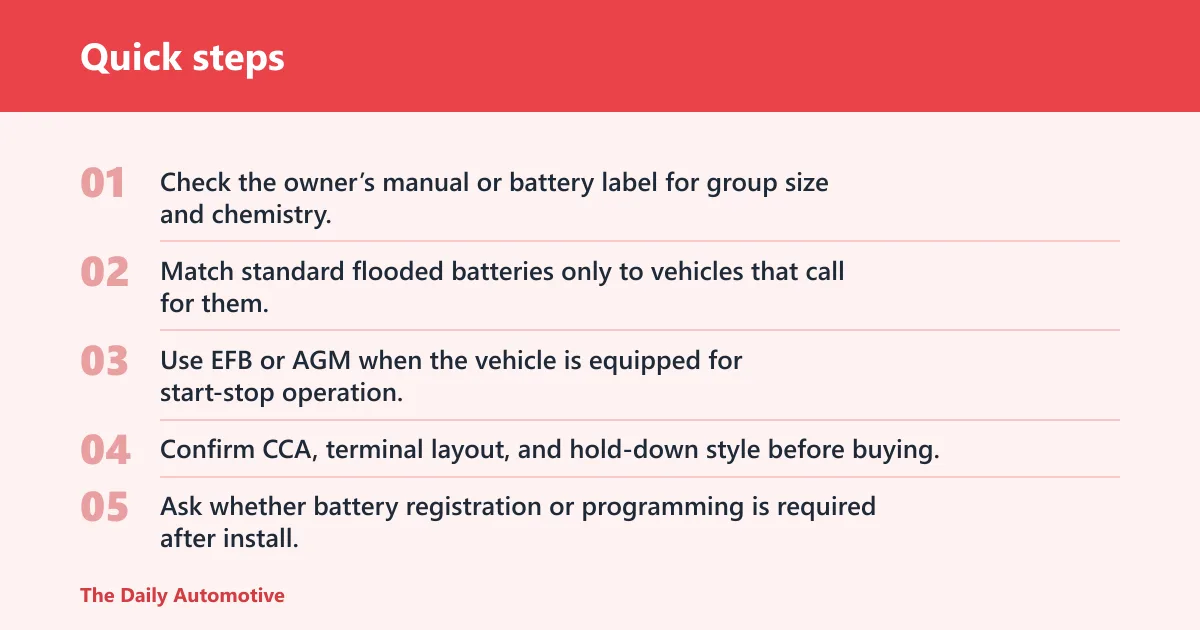
- Check the owner’s manual or battery label for group size and chemistry.
- Match standard flooded batteries only to vehicles that call for them.
- Use EFB or AGM when the vehicle is equipped for start-stop operation.
- Confirm CCA, terminal layout, and hold-down style before buying.
- Ask whether battery registration or programming is required after install.
Where should you buy a car battery?
Walmart, AutoZone, Costco, and dealers can all be reasonable paths, but they do not answer the same need. Walmart is often the low-price reference point for battery-only shopping. AutoZone usually gives you more chemistry choices. Costco may fit drivers who want warehouse pricing on a limited selection. Dealers are the safest match for vehicles with tighter battery requirements.
Walmart
Walmart currently lists a Group 35 EverStart battery at approximately $81.37, a Group 35 EverStart Maxx at $149.84, and a Group 35 EverStart Platinum AGM at about $189. That spread shows the jump from basic flooded pricing to AGM pricing without changing the battery group size.
AutoZone
AutoZone’s current Group 35 Duralast flooded battery costs $184.99, a current Group 35 EFB example costs $179.99, and its Duralast Platinum Group 35 AGM costs $259.99. Some premium Group 35 AGM options at AutoZone reach roughly $362. That range is why chemistry matters more than the store name alone.
Costco
Costco can be worth checking if the battery matches your vehicle and the warehouse carries the right group size. Inventory is limited compared with a dedicated parts chain, so the main value is usually on a narrower set of common applications rather than on the widest selection.
Dealer or independent shop
A dealer or independent shop often makes sense when the vehicle needs battery registration, a difficult battery location, or a factory-spec AGM replacement. That route can cost more up front, but it reduces the chance of fitment mistakes and avoids a second trip if the vehicle complains after installation.
How long does a car battery last?
A 12-volt car battery usually lasts about 3 to 5 years. Heat, short-trip driving, deep discharge, and long idle periods all shorten life. If the battery is within that age range and the car is slow to crank, testing is smarter than replacing it on age alone.
Signs testing is smarter than replacing
Dim lights, slow starts, and repeated jump-starts can point to a weak battery, but they can also point to charging or cable problems. A battery test can separate a bad battery from an alternator issue. That matters because replacing the wrong part wastes money fast.
Picture a compact car with a Group 51R battery that is only two years old. If the engine cranks slowly after a cold night, a load test can tell you whether the battery is actually failing or whether a corroded terminal is causing the symptom. Replacing by guesswork is the expensive move.
Why driving habits and climate matter
Short trips do not give the alternator much time to recharge the battery. Hot weather can dry out or age a conventional battery faster. Cold weather raises starting demand. The same battery can therefore age very differently depending on how and where the car is driven.
How much does a car battery cost for a Honda Civic?
A Honda Civic usually falls into the standard 12-volt replacement bucket, but the exact price depends on the Civic’s model year, engine, and battery group size. Many Civics use a common group size such as Group 35 or 51R, which keeps the battery-only cost in the broad retail range. Confirm fitment before buying.
The total can rise if the car needs a battery with the correct CCA for your climate, or if the replacement requires coding or registration. A basic flooded battery may fit some Civics, but the factory specification should still decide the chemistry, not the lowest shelf price.
How much does a car battery cost for an electric car?
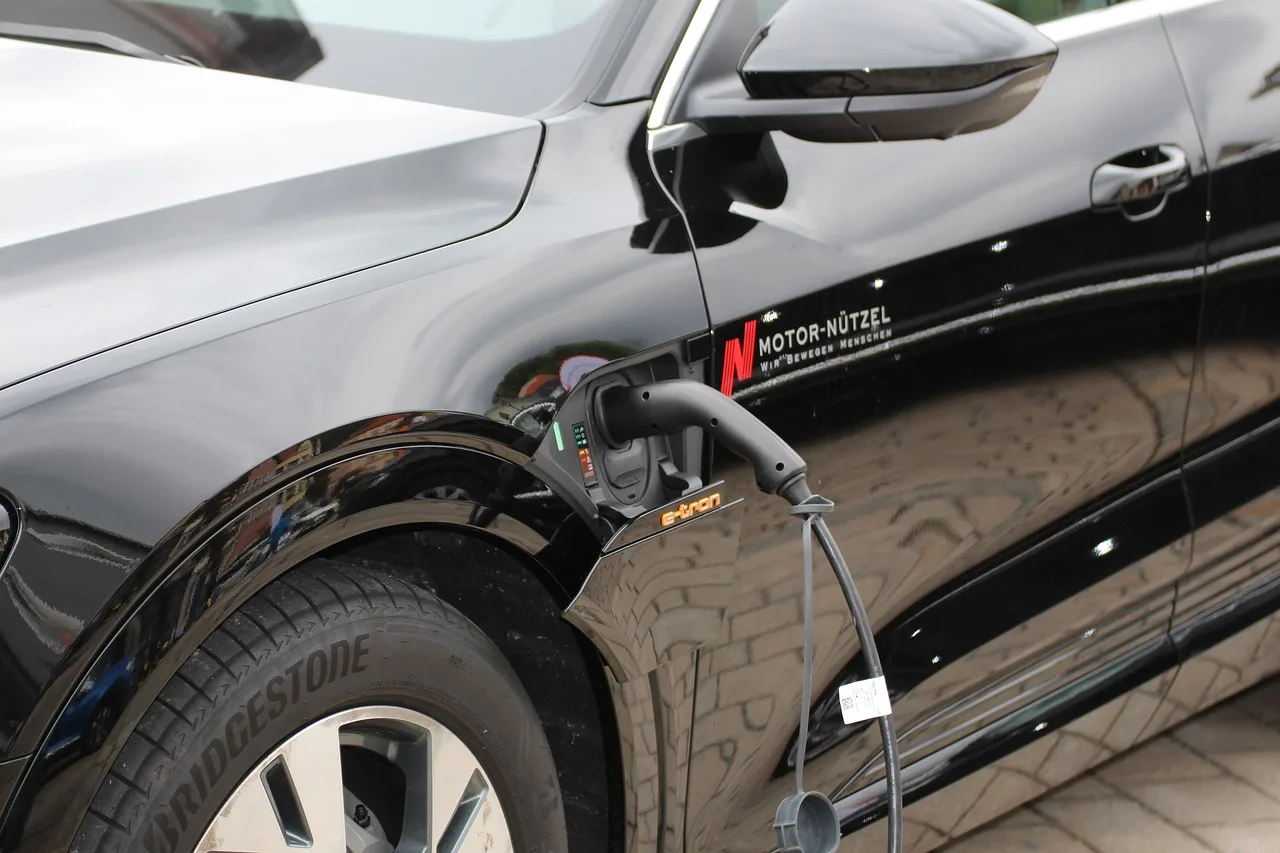
An electric car battery pack is not the same as a 12-volt battery, and the price is not comparable. The 12-volt battery is a small auxiliary unit used for accessories and control systems. The traction battery that moves the vehicle is a separate, far more expensive component.
Do not mix the two when budgeting. A 12-volt replacement can sit in the ordinary retail range. A traction pack is a different repair category entirely and can run into many thousands of dollars depending on the vehicle, warranty, and diagnosis.
Frequently asked questions
How much does a car battery cost to replace?
RepairPal estimates a complete shop battery replacement at $449 to $486, which shows how service charges can change the total.
How much does a car battery and install cost?
Battery and install pricing often starts near the part price plus labor, but the final bill can include a core deposit, recycling fee, testing, and programming. RepairPal puts labor at $60 to $88, and Direct Brakes starts mobile replacement at $159 installed. Vehicle complexity can push it higher.
How much does a car battery cost at Walmart?
The right choice depends on fitment, chemistry, and whether your vehicle needs AGM or standard flooded.
How much does a car battery cost at AutoZone?
Some premium Group 35 AGM options reach roughly $362, so chemistry and warranty tier can move the price a lot.
Are more expensive car batteries worth it?
They can be, if the vehicle calls for AGM or EFB, if you live in a hot or cold climate, or if you need stronger cycling tolerance. A more expensive battery is not automatically better for every car, but the wrong cheaper battery can fail early or create charging problems.
How much does a car battery last?
Most 12-volt car batteries last about 3 to 5 years. Driving pattern, climate, and battery type all affect service life. If the battery is aging but not clearly failed, testing is the better move because it can prevent an unnecessary replacement and identify charging-system issues sooner.
Products related to this article
Sponsored / affiliate links. As an Amazon Associate I earn from qualifying purchases. I may earn additional commission from eligible campaigns.