Car Maintenance and Repair Guide
Use a simple 3-tier maintenance and repair guide: address brake, tire, steering, overheating, oil-pressure, and charging faults first; service fluids, battery, and filters next; leave comfort issues for last, and stop driving for any red warning light or major leak. I have seen people reverse that order and turn a cheap service visit into a tow, brake failure, or engine replacement. This guide ranks inspections by urgency, DIY difficulty, and failure cost, with clear stop-driving lines and shop-only jobs.
Start here: use maintenance triage instead of a flat checklist
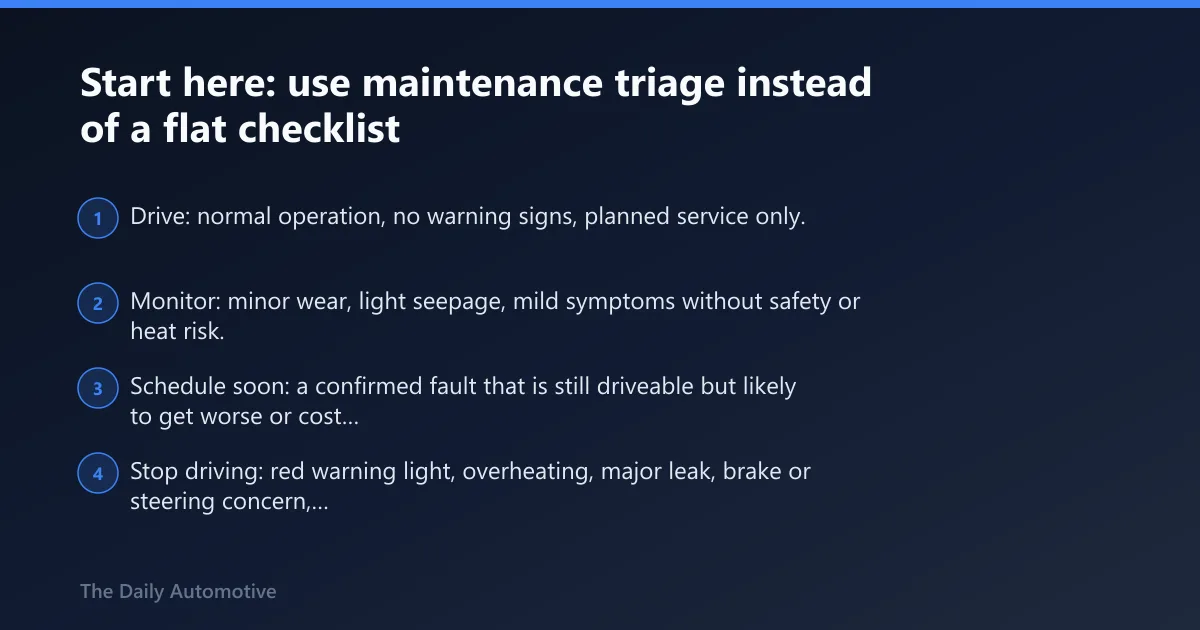


A flat checklist treats a weak cabin filter and a flashing oil warning the same. Real ownership does not work that way. The right first move is to sort every symptom or service into four action levels: drive, monitor, schedule soon, and stop driving.
That order changes with three factors: safety risk, failure cost, and DIY difficulty. A noisy brake jumps ahead of a dirty air filter because stopping distance matters more than airflow through the intake. A charging fault can outrank a small coolant seep because once voltage drops, the car can quit far from home.
The owner’s manual settles fluid type, viscosity, capacities, service indicators, and many normal intervals. It does not settle urgency when a car is already making noise, vibrating, overheating, or leaking. That is where triage matters.
AAA says the guide covers “why preventive maintenance is important,” “what components to check regularly,” and “common auto repair services.” That matters here because the useful part is not naming parts. It is ranking them under time and budget pressure.
The four action levels
- Drive: normal operation, no warning signs, planned service only.
- Monitor: minor wear, light seepage, mild symptoms without safety or heat risk.
- Schedule soon: a confirmed fault that is still driveable but likely to get worse or cost more if delayed.
- Stop driving: red warning light, overheating, major leak, brake or steering concern, severe vibration, exposed tire cords, or a charging problem that is already dropping system function.
How safety risk, failure cost, and DIY difficulty change the order
Safety risk comes first. Brakes, tires, steering, suspension, and overheating faults beat cosmetic and comfort problems every time. Failure cost comes next. I have watched a small oil loss turn into low oil pressure and then bearing noise faster than most owners expect. DIY difficulty matters last, because even an easy job moves up the list if the risk is high.
What regular car maintenance should I do first?
Start with tires, brakes, engine oil level, coolant level in the overflow tank, battery condition, and any warning lights. Then move to oil service, tire rotation, filters, and belt inspection. Comfort items can wait. Use mileage checkpoints as planning markers, but let the owner’s manual settle fluids, viscosity, and exact service timing.
The priority order for most daily drivers
- Tire pressure, tread condition, and sidewall damage.
- Brake feel, brake noise, and visible pad thickness if the wheel design allows a clear look.
- Engine oil level and any fresh leaks under the car.
- Coolant level in the overflow tank when the engine is cold.
- Battery terminals, starting speed, and charging warning lights.
- Oil change and oil filter replacement.
- Tire rotation and uneven-wear inspection.
- Engine air filter and cabin air filter.
- Serpentine belt and hoses.
- Comfort or convenience faults.
Weekly and monthly checks that catch expensive problems early
Weekly works well for tire pressure and a quick walk-around for nails, bulges, fresh fluid spots, and dead lamps. Monthly is a practical rhythm for engine oil level, coolant overflow level, washer fluid, battery terminal corrosion, and a look at the serpentine belt for cracking or glazing.
AAA says maintenance can “extend the life of your vehicle,” improve “better fuel economy,” and that some car warranties can be voided without regular maintenance. I buy that when it ties to a real habit, like using the oil viscosity in the owner’s manual, keeping the tires at the door-jamb pressure, and replacing the oil filter with each oil service.
Mileage-based checkpoints
At 5,000 miles: oil service on vehicles that use that range, tire rotation, brake and tire wear check, fluid level check, and battery terminal inspection.
At 15,000 miles: repeat the 5,000-mile work and inspect engine air and cabin air filters closely, especially if airflow has weakened or the car sees dusty roads.
At 30,000 miles: repeat prior work, inspect belt condition, check brake wear trend, and review the manual for coolant, transmission, and spark plug guidance where applicable.
At 60,000 miles: expect rising odds of tires, brakes, battery, and belt service if they have not already been done; inspect for seepage and age-related rubber wear.
At 100,000 miles: treat cooling system condition, oil leaks, suspension wear, and charging-system health as higher priority, even if the car still drives well.

Wax vs. Sealant: How to Protect Your Paint Long-Term
Not all paint protection is equal—car wax and paint sealant serve different purposes, with trade-offs in durability, shine, and upkeep. Wax offers a glossy finish but requires frequent reapplication (every few months), while sealants last 6–12 months but may lack the deep shine. The right choice depends on your parking habits, climate, and how much effort you’re willing to put into maintenance. This comparison breaks down which option aligns with your routine and how to avoid costly clear-coat damage over time.
For a detailed breakdown of wax vs. sealant—including how they perform against UV rays, water spots, and dirt—check out the wax vs. sealant guide.
Headlight Restoration vs. Replacement
Deciding between a simple lens polish and a full component swap depends entirely on whether the damage is purely cosmetic or structural. Surface oxidation, yellowing, and light pitting can usually be reversed with a proper headlight restoration kit. However, deep internal condensation, cracked mounting tabs, or burned reflectors demand a complete assembly replacement to restore safe nighttime visibility and proper beam pattern alignment.
Understanding the balance between upfront cost, labor time, and long-term durability prevents wasted money on temporary fixes for failing hardware.
The maintenance matrix: 20 common services and symptoms ranked by urgency
The matrix below gives a working triage chart for everyday owners. It combines urgency, DIY difficulty, rough cost range, and a clear action line: drive, monitor, schedule soon, or stop driving. When money only covers one repair this month, choose the row with the highest safety or failure-cost risk.
How to read the matrix
Urgency ranks the issue. DIY difficulty shows whether basic tools and access are enough. Estimated cost is a rough planning range, not a fixed quote. Action tells you whether the car can be driven, watched, booked, or parked.
Prioritized maintenance matrix
| Service or symptom | Urgency | DIY difficulty | Estimated cost range | Action |
|---|---|---|---|---|
| Red oil-pressure warning | Critical | Advanced | Roughly $0 to $300+ diagnosis before major repair | Stop driving |
| Engine overheating or temperature warning | Critical | Intermediate | Roughly $20 top-off to $900+ repair | Stop driving |
| Brake pedal soft, sinking, or poor stopping | Critical | Advanced | Roughly $150 to $900+ | Stop driving |
| Grinding brakes or metal-on-metal noise | Critical | Intermediate | Roughly $250 to $900+ | Stop driving |
| Steering wander, clunk, or severe looseness | Critical | Advanced | Roughly $150 to $1,200+ | Stop driving |
| Tire bulge, exposed cords, or deep sidewall cut | Critical | Basic | Roughly $120 to $400 per tire fitted | Stop driving |
| Charging warning light with dim lights or power loss | High | Intermediate | Roughly $120 to $800+ | Schedule now or stop if symptoms worsen |
| Battery slow crank or repeat no-start | High | Basic | Roughly $0 charge to $300 battery | Schedule soon |
| Major coolant leak under parked car | High | Intermediate | Roughly $30 hose clamp to $700+ repair | Stop driving |
| Low engine oil level without pressure warning | High | Basic | Roughly $10 to $80 top-off and diagnosis | Schedule soon |
| Oil change and oil filter replacement | High | Basic to intermediate | Roughly $40 to $140 | Schedule soon |
| Tire pressure low or uneven | High | Basic | Roughly $0 to $50 unless tire damage exists | Drive after correcting if no damage |
| Uneven tire wear suggesting alignment or suspension issue | High | Intermediate | Roughly $100 to $700+ | Schedule soon |
| Brake pulsation or rotor scoring | High | Intermediate | Roughly $250 to $800+ | Schedule soon |
| Serpentine belt cracked, glazed, or squealing | Medium to high | Intermediate | Roughly $40 to $250 | Schedule soon |
| Check engine light, car drives normally | Medium | Basic with scanner | Roughly $0 scan to $500+ repair | Monitor briefly, then schedule |
| Engine air filter dirty or restricted | Medium | Basic | Roughly $20 to $60 | Schedule soon |
| Cabin air filter causing weak airflow or odor | Low to medium | Basic | Roughly $15 to $50 | Drive or schedule |
| Battery terminal corrosion only | Low to medium | Basic | Roughly $10 to $40 | Schedule soon |
| Minor fluid seepage with stable levels | Low to medium | Intermediate | Roughly $0 monitor to $400+ repair | Monitor and recheck |
How to use the matrix when the budget is tight
First, pay for anything in the stop-driving group. Second, fix the item most likely to turn into a no-start, tow, or expensive engine damage. Third, combine low-risk jobs. A car due for an oil service, engine air filter, and cabin air filter can often have all three done in one visit with less repeat labor.
How often should I check car fluids and wear items?
Check engine oil and tire pressure most often, coolant and washer fluid on a monthly rhythm, and brake fluid by visual inspection rather than casual opening of the reservoir. Use service visits to inspect brakes, belts, battery condition, and filter loading. The owner’s manual remains the final word on fluid type and service intervals.
Engine oil, oil filter, and viscosity
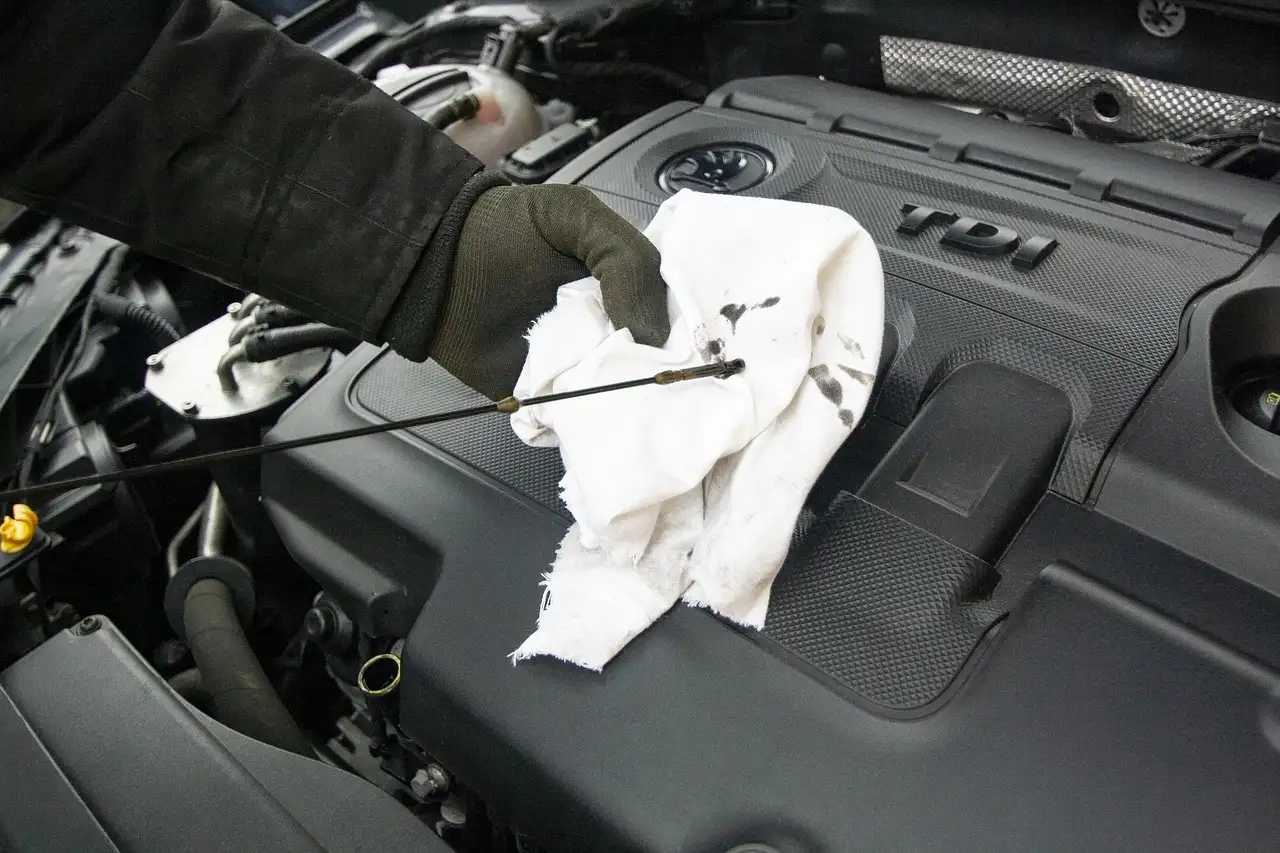
For most owners, checking engine oil every few fuel stops or at least monthly is practical. The oil level should be checked on level ground with the method the manual describes. If the oil is low, top up with the viscosity listed in the owner’s manual, not whatever bottle is closest.
Oil change timing varies by engine design, driving style, climate, and use. Short trips, heat, towing, and long idle time can move oil service earlier. Fresh oil and a clean filter keep hydraulic timing components fed, keep varnish and sludge down, and reduce drag from oil that has sheared out of grade. Replace the oil filter with each oil service. Trust My Mechanic says basic maintenance includes oil changes, filter replacements, spark plugs, tire care, and brake checks.
Coolant, brake fluid, and washer fluid
Check coolant only when the engine is cold, using the overflow tank markings. Do not remove a radiator cap on an overheated engine. If the level keeps dropping, that is a repair issue, not a topping-off routine.
Brake fluid is a visual check item unless brake work is being done. A low reservoir can mean pad wear or a leak; treat a sudden drop as urgent. Washer fluid can be topped off anytime because visibility is a safety item in bad weather.
Tires, brakes, battery, belt, and filters
Check tire pressure weekly and before long trips. Rotate tires around the oil-service rhythm many daily drivers use, unless the manual says otherwise. If wear bars are close to flush, the tires are near the end even if the car still feels fine.
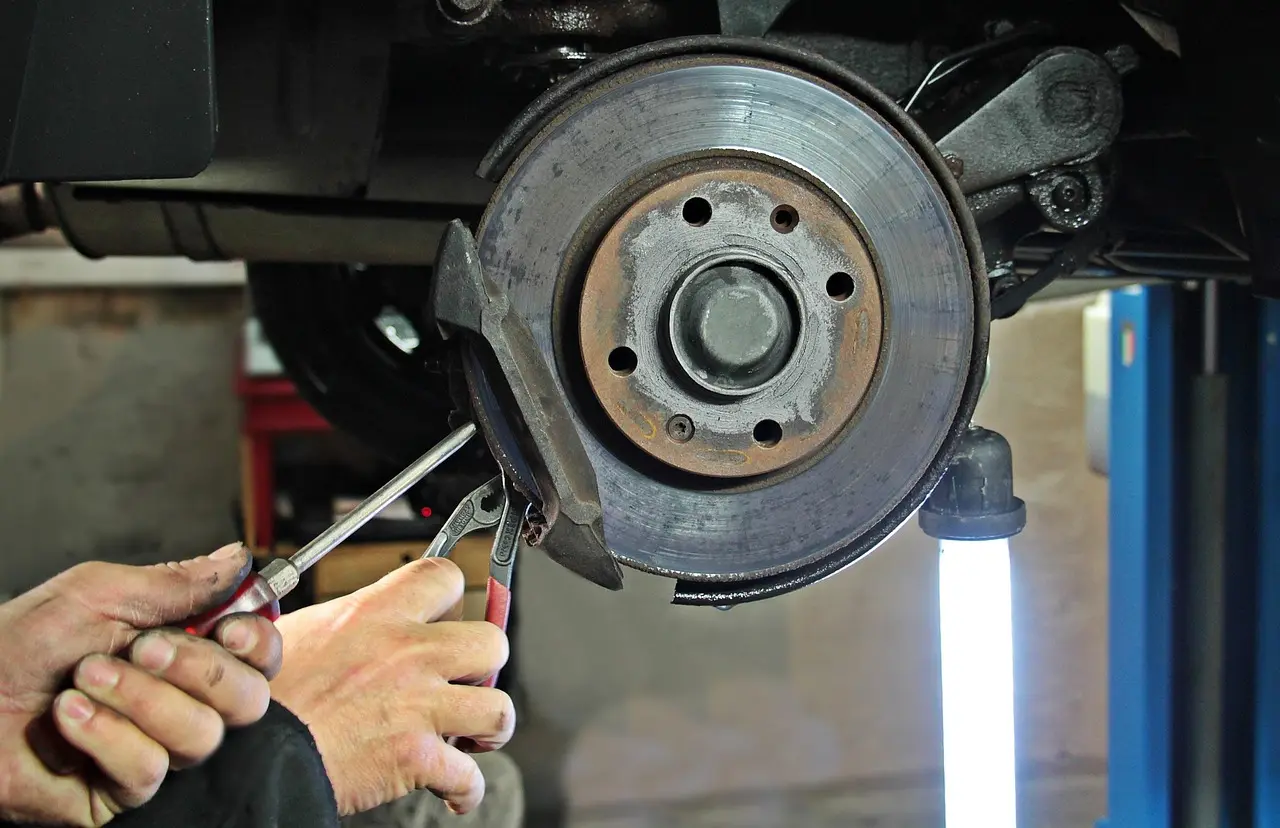
Brake wear needs both sound and sight. Squeal means the wear indicator is likely touching the rotor. Grinding usually means the friction material is gone and the backing plate is cutting the rotor. If pad material looks very thin or the rotor face is deeply scored, book service fast.
Inspect the battery for corrosion and slow cranking before cold weather arrives because low temperatures expose weak batteries. A resting-voltage check can help, but a proper load test tells more. wikiHow features “How to Load Test a Battery,” which is useful context for owners deciding whether the battery itself is weak or the problem sits in the charging system.
Look at the serpentine belt monthly. Replace a belt showing cracking across ribs, shiny glazing, frayed edges, or repeated squeal after tension is verified. If the belt drives the water pump or alternator, waiting carries real risk.
Inspect the engine air filter at regular service visits or sooner in dusty use. Replacement signs are heavy dirt loading, collapsed pleats, or obvious restriction. DIY access ranges from easy clips on top of the airbox to buried housings with screws. Cabin air filters often live behind the glove box or at the cowl. Replace them when HVAC airflow drops, odor builds, or the element looks packed.
What can I safely do myself and what should go to a mechanic?
Good home jobs include tire pressure checks, wiper blades, bulbs, battery terminal cleaning, cabin and many engine air filters, code reading with an OBD2 scanner, and some oil services. Jobs with lifting, torque specs, bleeding, alignment, calibration, or safety-system risk belong to skilled DIYers or a shop.
Good DIY jobs
- Checking and topping washer fluid
- Checking engine oil level and adding the correct oil
- Cabin air filter replacement
- Many engine air filter replacements
- Battery terminal cleaning
- Tire pressure checks and inflating to the door-jamb recommendation
- OBD2 code reading and clearing only after a repair is confirmed
Intermediate jobs
Oil changes, battery replacement, serpentine belt replacement, and brake pad service can be reasonable for owners with tools, access, and the service information to follow torque and routing details. Belt routing matters. Take a photo before removal or use the diagram under the hood when present.
Shop jobs
Alignment, internal engine work, transmission repair, ABS faults, airbag faults, repeated overheating, brake hydraulic issues, and anything requiring programming or calibration should go to a shop. A code is not a permission slip to swap parts. It points to a system that still needs confirmation.
How to decide between DIY repairs and hiring a mechanic
Not every car repair is a safe or cost-effective DIY project. Repairs involving hand tools and ground-level access are generally suitable for home mechanics, while jobs requiring sensor calibration, airbag systems, or high-voltage components should go to professionals. Misjudging this boundary can lead to warning lights, damaged parts, or expensive tow bills.
This framework helps you evaluate each repair by risk level, required tools, hidden electronics, and true cost before starting work. Use the DIY repair decision guide to determine whether a task fits your skill set or requires shop equipment, ensuring safer outcomes and avoiding costly mistakes on modern vehicles.
Core systems every owner should know how to inspect
Tires and brakes
Tires tell the truth about inflation, alignment, and suspension. Wear in the center points toward overinflation. Shoulder wear suggests underinflation or hard cornering. A sawtooth feel or feathering often points toward alignment issues. Brakes should stop straight, stay quiet, and keep a firm pedal. Pulsation usually points toward rotor condition or uneven friction transfer.
Battery, coolant, and serpentine belt
Cold weather exposes weak batteries because cranking demand rises while battery output falls. Corrosion at the terminals adds resistance and can mimic a bad battery. The charging warning light means check both battery and alternator function, not one or the other by guesswork.
Coolant belongs between the marks in the overflow tank when cold. A sweet smell, frequent top-offs, heat spikes in traffic, or no cabin heat on a cold day can all point toward cooling issues. A cracked or glazed serpentine belt can slip before it fails outright, which matters more on cars where that belt runs the water pump.
Engine air and cabin air filters
The engine air filter affects airflow into the engine. The cabin air filter affects airflow into the cabin. Owners often mix them up. Weak defrost performance, musty odor, and blower strain usually point to the cabin filter, while poor throttle response on its own is rarely enough to condemn the engine air filter without a look inside the box.
How do I diagnose a problem before I spend money on parts?
Start with the warning light, the exact symptom, and when it happens: cold start, hot idle, braking, turning, or highway speed. Then check fluid levels, battery terminals, tire condition, and obvious leaks. Use an OBD2 scanner to gather codes and basic live data, but do not treat one code as proof that one part failed.
A simple decision tree
- Warning light: red means stop and assess before driving farther; amber means scan soon.
- Fluid leak: clear water from A/C drain is usually normal; oil, coolant, or brake-fluid leaks are not.
- Overheating: pull over, shut off, let it cool, check the overflow tank later.
- Brake noise: squeal means inspect soon; grinding means stop driving.
- Vibration: if it shows up only while braking, think brakes; at speed without braking, think tires, wheel balance, or suspension.
- No-start: if the engine cranks slowly, think battery or cable issue first; if it cranks normally but will not fire, think fuel, spark, or sensor input.
- Charging problem: battery light plus dim lights or electrical dropouts points toward alternator, belt, wiring, or battery condition.
Using an OBD2 scanner without guessing
A basic OBD2 scanner can read stored and pending codes and show simple live data such as coolant temperature, charging voltage, and fuel-trim movement. That is enough to confirm whether a warning is current or old, and whether the engine has reached normal temperature. It is not enough to skip testing.
wikiHow’s category includes “The Ultimate Guide to Car Maintenance & Upkeep,” and it also features “How to Change an Alternator” and “How to Recharge the Air Conditioner in a Car.” Those are useful examples of why diagnosis comes first. A dead battery, bad belt, weak alternator, or poor connection can all look similar from the driver’s seat.
When diagnosis stops being practical at home
Diagnosis should stop at home when the fault involves brakes, steering, airbags, repeated overheating, internal engine noise, fuel smell, heavy leaks, or any test that requires the car to be safely raised beyond the owner’s skill and equipment. That is the line between useful DIY and expensive guessing.
Selecting an OBD2 Scanner by Budget and Capability
Diagnostic tools vary widely in price and function, directly impacting how much you spend on repairs. To avoid overspending, match the scanner tier to your specific needs: basic units handle simple code retrieval, while mid-range devices offer live data streaming, and professional-grade tools include bi-directional controls. OBD2 scanner costs range from $20 for basic code readers to several hundred dollars for advanced app-based systems.
Understanding these price tiers helps you skip unnecessary features and hidden expenses. A cheaper tool that lacks live data might force you to rely on a mechanic for diagnosis, potentially costing more in labor fees than a better scanner would have saved.
When should I stop driving and call a mechanic?
Stop driving for any red warning light, overheating, low oil pressure, major coolant or brake-fluid loss, severe brake noise, soft pedal, tire bulge, exposed cords, steering looseness, or hard charging failure. If the problem can change control, lubrication, or engine temperature fast, park it and arrange help instead of risking a short drive.
Tow, drive carefully, or use a mobile mechanic?
Tow it: red oil-pressure light, overheating, brake hydraulic fault, steering issue, major coolant leak, tire structural damage, or wheel-bearing noise that is getting loud fast.
Drive carefully to a shop: amber check-engine light with normal operation, mild brake pulsation, slow crank that still starts, minor seepage with stable fluid levels.
Mobile mechanic: dead battery, simple no-start diagnosis, belt inspection, battery replacement, some starter or charging checks, and light service where space allows.
Fluid leaks: what can be monitored and what cannot
A damp oil pan or slight transmission seep can sometimes be monitored if levels stay stable. Brake fluid loss, active coolant dripping, or fresh engine oil loss that lowers the dipstick level quickly should not be monitored. They should be diagnosed.
What tools do I need for basic car maintenance?
Start with a tire gauge, portable inflator, flashlight, gloves, rags, funnel, basic socket set, and an OBD2 scanner. Add a jack, wheel chocks, and jack stands only if the car will be lifted, and only after confirming factory lift points and stand capacity. Tools matter, but safe support matters more.
The short starter kit
- Tire pressure gauge
- Portable inflator
- Flashlight
- Gloves and rags
- Funnel
- Basic socket set
- OBD2 scanner
- Multimeter for battery and charging checks
Jack and jack stands
Use the factory lift points shown in the owner’s manual or service information. Chock the wheels that stay on the ground. Lift on a flat surface. Set jack stands under approved support points, verify the stand weight rating covers the vehicle, lower the car onto the stands, and shake the car lightly before any work underneath. Never rely on a hydraulic jack alone.
Tools worth skipping at first
Special pullers, scan tools with programming functions, brake-pressure tools, and expensive air tools can wait. Buy them only when a specific job justifies them. Most owners get more value from a good light, a dependable tire inflator, and a simple scanner than from a crowded toolbox.
Build a maintenance plan by mileage, climate, and how you drive
Low-mileage cars, short-trip cars, and highway commuters
Low-mileage cars that sit often need battery care, tire-pressure checks, and closer attention to stale fluids, corrosion, and flat-spotting. Short-trip cars build moisture and rarely get fully warm, so oil service and battery health move up the list. Highway commuters wear tires and brakes differently, but often keep batteries charged and engines cleaner internally.
Cold-weather and hot-weather planning
In freezing climates, test the battery before winter, keep washer fluid filled, watch tire pressure after temperature drops, and inspect wiper blades and defrost airflow. In hot climates, give extra attention to coolant level, hose and belt condition, tire pressure growth during long drives, and any sign of weak A/C airflow from a loaded cabin filter.
A yearly budget map by mileage band
| Mileage band | Budget focus | Likely wear items |
|---|---|---|
| Lower-mile daily driver | Oil service, rotations, filters | Cabin filter, engine air filter, wipers |
| Mid-mile driver | Oil, tires, brakes, battery testing | Pads, battery, alignment-related tire wear |
| Higher-mile driver | Cooling system, leaks, suspension checks | Battery, belt, brakes, tires, seepage repairs |
AAA says consistent maintenance records can help at resale. Keep receipts, note mileage at service, and record the oil viscosity used. That makes future diagnosis easier and protects warranty questions where they still apply.
Regular car maintenance saves you time and money in the long run. I have found that only holds if the money goes to the right item first. A cabin filter can wait. A soft brake pedal cannot.
Frequently asked questions
how to maintain a car in good condition
Use a repeatable routine: weekly tire and walk-around checks, monthly oil and coolant checks, oil-service visits that include tire rotation and brake inspection, and yearly battery and belt review before harsh seasons. Follow the owner’s manual for fluids and viscosity, then use triage to sort urgent faults from normal wear.
how to car maintenance
Start simple. Learn to check tire pressure, engine oil level, washer fluid, battery terminals, and warning lights. Then add filters, code reading, and service record keeping. The goal is not to do every repair at home. It is to catch the expensive and unsafe ones early.
what regular car maintenance should I do
Focus first on oil and filter service, tire pressure and rotation, brake inspection, coolant level, battery condition, and air filters. In day-to-day use, these are the basics that most often change how a car stops, starts, cools itself, and uses fuel. Add belt inspection and leak checks as the car ages.
how often should I check car fluids
Check engine oil and tire pressure most often, usually on a weekly or every-few-fuel-stops rhythm. Check coolant in the overflow tank and washer fluid monthly. Look at brake-fluid level visually during monthly checks, but do not open the system casually or remove a cap on a hot cooling system.
when should I take my car to a mechanic
Take it in right away for brake, steering, overheating, charging, oil-pressure, or major leak problems. Book an appointment soon for check-engine lights, uneven tire wear, slow cranking, belt noise, or repeat fluid loss. A mechanic is also the right call when a job needs lifting, alignment, programming, or exact torque and bleeding procedures.
Products related to this article
Sponsored / affiliate links. As an Amazon Associate I earn from qualifying purchases. I may earn additional commission from eligible campaigns.